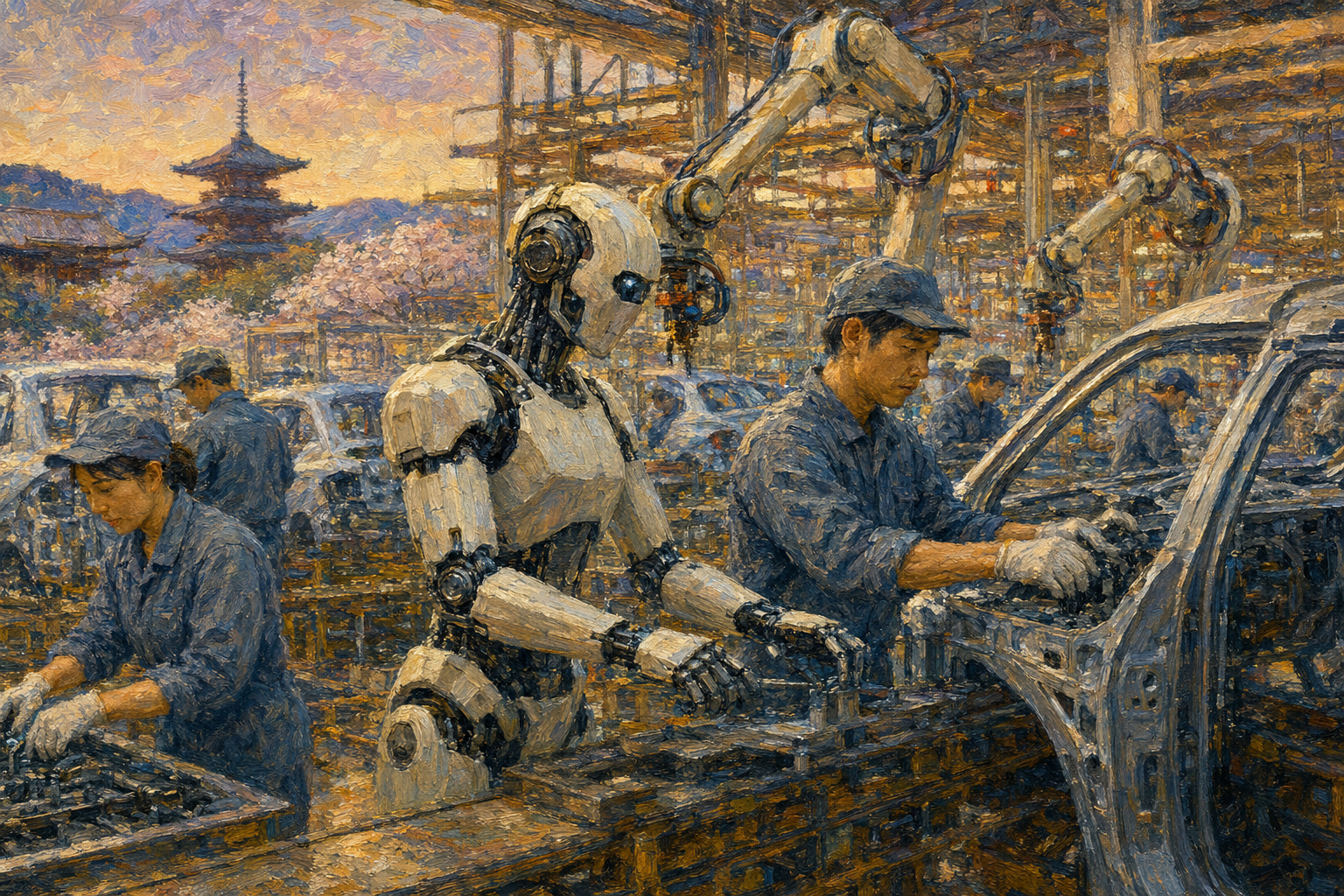
What Was Announced—and What Was Not
Mitsubishi Motors and Highlanders signed a memorandum of understanding on July 9 to pursue what they call a new industrial foundation where people and robots work together. The plan has two connected parts. First, Mitsubishi intends to use Highlanders humanoids in its own manufacturing facilities, collecting operating data and practical knowledge. Second, the automaker will study whether its mass-production engineering, quality assurance, durability and safety design, mechatronics expertise and factory operations can be used to manufacture Highlanders products.
The proposed production site is Mitsubishi's Kyoto Plant in Ukyo Ward. It is an engine factory with casting, machining and assembly experience. Mitsubishi recorded a major milestone there in 2023: 40 million engines produced cumulatively. The new project would use currently idle buildings, with the feasibility of beginning production in early 2027 under examination.
Precision matters. The official release describes a feasibility study, not an unconditional production decision. A target of roughly 1,000 robots per month has appeared in Japanese news reporting, but that number is not stated in Mitsubishi's Japanese or English announcement. The companies have not disclosed a final robot specification, price, initial deployment count, target task, certification schedule or division of future revenue. Between an MOU and a reliable production line lies a great deal of engineering.
Why Give a Factory Robot a Human Shape?
Automotive plants are already filled with robots. Fixed industrial arms are faster, stronger and more repeatable than people at welding, painting, adhesive application, heavy positioning and many handling operations. Why build a comparatively fragile biped that must balance, conserve battery power and coordinate dozens of joints?
Because much of the remaining factory was designed for the human body. Stairs, aisles, doors, shelves, carts, tools, levers and workstations assume human height, reach, hands and stride. Traditional automation often requires fences, dedicated fixtures, new conveyors and a redesigned layout. A humanoid that can travel through the same space, use existing tools and move between processes could fill gaps in automation without rebuilding the entire plant.
Human shape, however, has no value by itself. Wheels are superior on a predictable flat floor. A dedicated arm is usually faster and cheaper for one repeated task. Humanoids become rational when the job requires mobility across multiple work areas, manipulation of varied objects, adaptation to changing conditions and reuse of infrastructure built for people. A factory manager is not buying a futuristic silhouette. The manager is buying safe, useful work per hour.
Physical AI: Moving Intelligence Out of the Screen
Generative AI operates mainly in the realm of words, images and sound. Physical AI connects perception and reasoning to cameras, force sensors, hands, legs and motors. The machine must see its surroundings, feel contact, decide what to do and control its body. A language model can generate a poor sentence without breaking a component. A robot can drop a part, strike equipment or make a person unsafe. The physical world imposes gravity, friction, latency, wear and endless exceptions.
Highlanders describes itself less as a conventional robot manufacturer than as the builder of a “data flywheel for the physical world.” Its public materials call its foundational physical-intelligence system Kepler and its hardware the HLQ series. Each deployed machine, operator intervention and hour in the field is meant to generate data that improves the intelligence, which can then be returned to a fleet through software updates.
On its website, Highlanders reports more than 5,000 contacts and pre-orders across automotive, logistics and manufacturing use cases. That is a company-reported indicator of interest, not the same thing as audited firm backlog. Still, it illustrates the intended model: hardware exists to gather real-world experience as well as to do work.
Mitsubishi's plants would therefore be customer, proving ground and classroom at once. When an operator remotely rescues a failed action, the system gains a valuable example of where human judgment was needed. Successes, failures, emergency stops, grip forces, temperatures, battery behavior and task time can all become training material. Improvement can then be distributed across many machines instead of remaining with one physical installation.
| Traditional Automation | Learning Humanoid |
|---|---|
| Fix the process around the machine. | Try to adapt the machine to an existing and changing process. |
| Repeat a programmed path with high precision. | Combine perception, decision-making and whole-body control. |
| A new task may require fixtures, equipment and reprogramming. | Learn through demonstration, teleoperation, simulation and field data. |
| An improvement mainly benefits that installation. | Aggregate field experience and distribute updates to a fleet. |
Kyoto Is More Than an Ancient Capital
Kyoto evokes temples, gardens and craft traditions, but it is also a city of precision manufacturing and electronics. Nintendo, Kyocera, Omron, Murata Manufacturing and Shimadzu grew in an ecosystem where university research, materials knowledge and industrial production overlap.
Mitsubishi's Kyoto operations include both manufacturing and research-and-development functions. Engine production combines casting, machining and assembly—the transformation of material into precise parts and then into a reliable, traceable system. Humanoid production likewise requires the integration of actuators, joints, reduction gears, sensors, wiring, cooling and batteries. The automotive disciplines of bills of material, process capability, durability testing, supplier quality, service parts and recall management can help turn a laboratory prototype into an industrial product.
There is also symbolism in making robots at an engine site. As vehicle electrification changes the long-term demand for internal-combustion components, manufacturers must decide how to reuse buildings and skills. If idle capacity can be redirected toward another complex machine, Kyoto could become a model for industrial transition rather than a story of managed decline.
Japan's Half-Century Humanoid Journey
| Year | Milestone | What Changed |
|---|---|---|
| 1973 | Waseda University WABOT-1 | Widely regarded as the first full-scale humanoid, integrating bipedal walking, grasping and simple Japanese communication. |
| 1984 | WABOT-2 | Read musical scores and played an electronic organ with both hands and feet. |
| 1996 | Honda P2 | A self-contained biped with onboard power and control; recognized as an IEEE Milestone in 2026. |
| 2000 | Honda ASIMO | Refined, compact walking brought humanoid robotics to a global public. |
| 1998–2002 | National HRP Program | AIST, Kawada and partners developed HRP-2 and OpenHRP as shared research infrastructure. |
| 2018 | AIST HRP-5P | A 182-centimeter, 101-kilogram, 37-degree-of-freedom prototype aimed at autonomous heavy labor. |
| 2026 | Mitsubishi × Highlanders | An effort to connect humanoid research to field data, automotive quality and manufacturing scale. |
WABOT-1 asked whether basic human functions could be integrated into one machine. Honda's P2 and ASIMO advanced the question of stable, self-contained locomotion. Japan's national Humanoid Robotics Project provided common hardware and simulation tools, while later HRP machines moved toward dirty, dangerous and demanding work.
Yet a valley remained between technical achievement and a large market. Walking at an exhibition is not the same as completing two factory shifts every day. Building ten prototypes is not the same as building one thousand consistent products. A real industry also needs spare parts, service networks, charging strategy, remote support, insurance, cybersecurity and clearly assigned responsibility. The Mitsubishi–Highlanders partnership tries to use automotive manufacturing as a bridge across that valley.
Japan Was Early; Commercialization Is Now a Global Race
The International Federation of Robotics counted 542,000 new industrial robot installations worldwide in 2024, with a total operating stock of 4.664 million. Asia accounted for 74% of new deployments. Japan remains a major robot producer and market, but humanoid commercialization has become a fast international contest involving the United States, China, South Korea and Europe.
BMW says Figure AI's Figure 02 supported production of more than 30,000 BMW X3 vehicles during a ten-month 2025 deployment in Spartanburg, working ten-hour weekday shifts on a demanding sheet-metal loading task. Agility Robotics has commercially deployed Digit in logistics and says its Oregon RoboFab can reach peak annual capacity of 10,000 robots. Boston Dynamics has committed its first 2026 production-ready Atlas deployments to Hyundai's robotics application center and other customers. Tesla defines Optimus as a general-purpose biped intended for unsafe, repetitive or boring work.
Japan's advantages lie in motors, sensors, reduction gears, machine tools, field improvement and quality control. Its constraints include access to massive AI computing, risk capital, software talent and the speed of market deployment. Pairing a fast startup with a disciplined manufacturer is an attempt to combine those strengths before the commercial center of humanoid robotics is established elsewhere.
A Response to Labor Scarcity—or a Threat to Work?
Japan's population structure makes the question urgent. In October 2024, 73.728 million people were aged 15 to 64, representing 59.6% of the population. Another 36.243 million people, or 29.3%, were 65 or older. Japan's manufacturing white papers explicitly identify robotics and AI as tools for productivity and competitiveness amid structural labor shortages.
But “use robots because workers are scarce” is not a deployment plan. A factory must decompose jobs into automatable and human elements, retrain workers and preserve production when a robot stops. Automation removes some tasks while creating work in systems integration, maintenance, safety supervision, data operations and teleoperation. If productivity gains accrue only to equipment owners, resistance will follow. Social success depends on sharing gains through wages, shorter hours, improved safety and stronger skills.
The first good applications are likely to be repetitive, physically taxing, difficult to staff and hazardous, but bounded enough to validate: moving bins, feeding materials into machines, simple picking, night inspection and internal logistics. Subtle adjustments performed by experienced workers, or high-speed work in unpredictable crowds, will take longer.
Safety Is the Hardest Product Feature
Conventional robots can be isolated behind fences. A mobile humanoid may share aisles, floors and work zones with people. The 2025 editions of ISO 10218 address industrial robot and system safety, while ISO/TS 15066 covers collaborative applications. But adaptive, general-purpose bipeds raise questions that older assumptions do not fully settle.
| Risk | Required Industrial Answer |
|---|---|
| Falls and contact | Speed and force limits, posture monitoring, safe stopping, controlled fall behavior and access rules. |
| Failed grasp | Weight and geometry awareness, redundant checks, drop prevention and safe placement during an exception. |
| AI uncertainty | Permitted action boundaries, confidence thresholds, human escalation and revalidation after updates. |
| Lost communication | Local control that enters a safe state without a network connection. |
| Cyberattack | Signed updates, access controls, logging, network separation and supply-chain security. |
| Liability | Recorded, contractual roles for manufacturer, AI provider, factory integrator and operator. |
The key is not average performance but safe failure. Even 99.9% success produces an average of ten failures in 10,000 daily actions. Factory quality engineers will look beyond spectacular demonstration videos to exception categories, reproducibility, failure modes, mean time between failures and recovery time.
The Economics of a Humanoid Worker
Purchase price alone does not establish viability. The useful metric is total cost per productive hour: hardware, maintenance, batteries, charging, software subscriptions, remote assistance, insurance, safety integration and downtime, divided by the hours that actually produce good work. A machine that succeeds once in a demonstration and one that operates at 95% availability for thousands of annual hours are different products.
Generality creates a paradox. A machine that can do everything tends to be complex and expensive. For one repeated job, a dedicated device will often win. A humanoid's economic advantage must come from moving among several low-frequency tasks, adapting to new vehicle models and volume changes without major reconstruction, and acquiring new work through software.
Mitsubishi could potentially benefit in three ways: improved productivity and safety in its factories, new manufacturing volume as a robot producer, and the accumulation of operational and control expertise for future businesses. The announcement does not yet provide revenue targets or a final commercial structure, so these remain potential pathways rather than forecasts.
Eight Numbers to Watch Through 2027
| Metric | Why It Matters |
|---|---|
| Autonomous work time | How long the robot creates value without human rescue. |
| Interventions | How often an operator must recover the robot per hour or task. |
| Availability | The share of scheduled time spent working after charging, faults and setup. |
| Mean time between failures | Whether the machine has crossed from prototype into industrial equipment. |
| Cycle time | Whether it is economically competitive with people or dedicated automation. |
| Safety events | Contact, drops, falls, emergency stops and near misses. |
| Total cost per productive hour | Whether the business works without permanent subsidy. |
| Production yield | Whether manufactured robots deliver consistent quality and capability. |
Unit production is not enough. The stronger questions are how many machines perform useful customer work every day, remain deployed months later, renew their service contracts and move successfully into additional tasks. Pre-orders measure expectation. Renewals measure value.
Can a Fifty-Year Dream Be Put on the Shift Schedule?
WABOT-1 showed that a human-like machine could exist. P2 and ASIMO showed that humanoids could enter the world on their own feet. HRP created infrastructure for machines intended to work. The next question is less glamorous and more demanding: Can they deliver the same quality from Monday through Friday?
The Mitsubishi–Highlanders agreement is not a monument to Japan's status as an early humanoid pioneer. It is a present-tense test of whether that technical inheritance can be converted into data, safety, manufacturing yield, service and customer value. If it succeeds, an engine plant in Kyoto could become a place where skills pass from the internal-combustion era to the age of learning machines. If it fails, it may still produce essential evidence about why humanoids could not yet reach factory economics.
The future factory need not be a dark building emptied of people. It could be a place where people handle judgment, improvement and exceptions while machines take weight, repetition and danger. Designing that division of labor as a dependable product is the real task beginning in Kyoto. This is not only a robot story. It is the next chapter of Japanese work and manufacturing.
Sources and Further Reading
- Mitsubishi Motors: MOU with Highlanders — scope, Kyoto site, early-2027 feasibility, investment and company comments.
- Mitsubishi Motors: Domestic and Overseas Facilities — Kyoto manufacturing and R&D locations.
- Mitsubishi Motors: Company History — Kyoto's 40-million-engine milestone.
- Highlanders — Kepler, HLQ hardware, data-flywheel model and company-reported market interest.
- Waseda University: The Robots of Waseda — WABOT-1 and WABOT-2 history.
- Honda: P2, the Origin of ASIMO — humanoid history and the 2026 IEEE Milestone.
- AIST: HRP-5P — a humanoid prototype for autonomous heavy labor.
- Toyota: Humanoid Robots and Reinforcement Learning — general-purpose control research.
- International Federation of Robotics: World Robotics 2025 — installations, operating stock and regional shares.
- BMW Group: Physical AI in Production — Figure's ten-month Spartanburg deployment.
- Agility Robotics — Digit and the stated capacity of RoboFab.
- Boston Dynamics: New Atlas — 2026 industrial deployment.
- Statistics Bureau of Japan: Population Estimates 2024 — working-age and older populations.
- METI: White Paper on Manufacturing Industries 2026 — employment and competitiveness challenges.
- ISO Robotics Standards — ISO 10218 and ISO/TS 15066 safety frameworks.