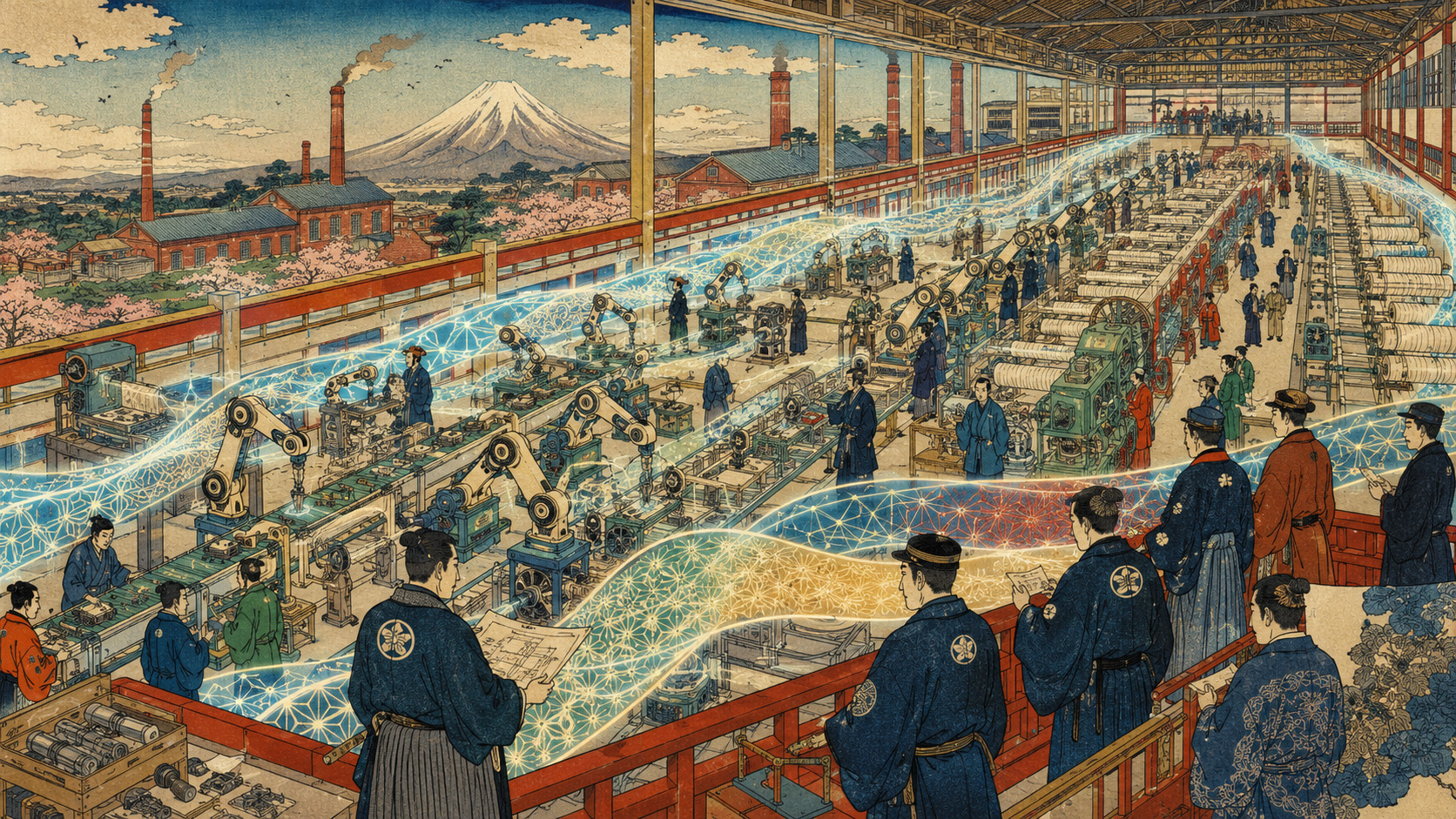
From Chat to Factory: The Difference Between Answering and Acting
When a chatbot gives a wrong answer, a person can close the window and correct it. When an AI tells a robot arm to grasp a part, an automated vehicle to enter an aisle or a furnace to raise temperature, error becomes motion, damage, downtime or injury.
An AI agent receives a goal, gathers information, plans, operates external software or machinery, observes the result and selects the next action. Physical AI senses the real world through cameras, force, sound, temperature and position, then acts through robots and machines. Joined together, they move AI from adviser toward operator.
Not One Universal Robot, but Intelligence Across the Factory
Traditional industrial robots excel at repeating a programmed path with high precision. Behind a safety fence they weld, paint, transfer and assemble millions of times. Product variation or an unexpected obstacle usually required a human programmer.
An agent can reason across scheduling, inventory, quality, maintenance, electricity and delivery. It might read changing orders, resequence a line, reserve material, adjust an inspection threshold and recommend a maintenance window. The value lies not only in a dexterous robot, but in connecting factory information that was previously divided.
| Stage | AI role | Human control |
|---|---|---|
| Observe | Vision inspection, sound anomaly detection, forecasting. | AI reports; human decides. |
| Recommend | Suggest process, maintenance and material changes. | Human approves execution. |
| Limited execution | Change permitted settings or routes. | Constrain speed, zone, value and equipment. |
| Autonomous coordination | Coordinate machines, robots and software. | Maintain monitoring, stop, audit and recovery. |
Why Japan Has an Advantage—and a Problem
Japan has deep capabilities in automobiles, machine tools, sensors, reducers, servo motors and industrial robots. Its factories are strong in kaizen, preventive maintenance and quality control. It therefore possesses both the physical “body” on which AI acts and the manufacturing knowledge from which it can learn.
It also faces severe labor scarcity and skill succession. Veterans detect abnormalities through sound, vibration, color and smell, yet much of that judgment is not written down. Multimodal AI can combine video, audio, time-series data and work records to turn part of that tacit knowledge into repeatable procedure.
Japan's weakness sits in the same place: old equipment, vendor-specific protocols, paper records, isolated data and distance between operations and IT. Physical AI does not appear merely because a company buys an excellent model.
History: From Karakuri to Industrial Robots to the Learning Factory
Japan's automation culture stretches from Edo-period karakuri mechanical dolls through Meiji mechanization and postwar numerical-control machine tools. Industrial robots entered automotive and electronics plants in the 1960s and 1970s, taking dangerous and repetitive work. By the 1980s, factory automation symbolized Japanese quality and export strength.
From the 1990s, sensors, PLCs, manufacturing execution and enterprise systems digitized separate layers. The 2010s brought industrial IoT, predictive maintenance and deep-learning inspection. Generative AI made design documents, maintenance histories and work instructions accessible through language. Agents now attempt to use those tools in sequence.
The critical difference is adaptation. Classical automation executes rules written in advance. Learning systems infer patterns from data and vary output with context. Flexibility rises, but validation becomes harder because the route to an answer may change.
Safety: “Smart” Is Not a Safety Case
ISO 10218-1:2025 addresses inherent robot design and risk reduction; ISO 10218-2:2025 covers integration, commissioning, operation, maintenance and decommissioning of applications and cells. AI does not erase machine-safety fundamentals: identify hazards, eliminate them through design where possible, guard against them and communicate residual risk.
The AI decision layer and safety layer should be separated. Even if AI says “go,” an independent safety PLC, emergency stop, speed-and-force limit and presence monitor must be able to say “stop.” Communication loss, sensor failure, model update and abnormal input must move equipment to a safe state.
| Hazard | Example | Control |
|---|---|---|
| Perception error | Person mistaken for a part. | Sensor diversity, safety monitoring, low speed. |
| Planning error | A shortcut crosses a danger zone. | Forbidden zones, path validation, approval. |
| Wrong objective | Output maximization consumes safety margin. | Make safety a superior constraint. |
| Cyberattack | Instructions or models are altered. | Authentication, segmentation, signing, monitoring. |
| Update drift | Behavior changes after a model release. | Regression testing, staged rollout, rollback. |
Responsibility: Whose Decision Was It?
The agent supply chain includes foundation-model developers, robot makers, systems integrators, factory operators, data providers and maintenance companies. “The AI decided” is not an accountability system.
Factories need an authority matrix: what the agent may read, change, purchase and move; which machines it controls; and when control returns to a person. Inputs, recommendations, approvals, actions, stops and model versions require logs. Responsibility should be assigned during design, not discovered after an accident.
Japan's 2026 AI Guidelines divide responsibilities among developers, providers and users and recommend lifecycle risk management. Although guidance rather than a single binding rulebook, it is likely to shape contracts, audits, insurance and board expectations.
Intellectual Property: Who Owns Learned Skill?
Manufacturing AI consumes drawings, CAD, inspection images, work videos, maintenance records and supplier specifications. Copyright, trade secret, patent, confidentiality and employee know-how overlap. A factory must know whether data sent to a cloud vendor trains a wider model and whether generated process plans might infringe third-party rights.
Recording a veteran's movements also raises dignity, evaluation and compensation. If workers believe the company is extracting their knowledge only to replace them, adoption will fail. Including skill holders in design and benefit sharing improves both trust and data quality.
Where a Small Factory Should Begin
A company does not need to aim immediately for a fully autonomous plant. Start where loss is measurable, danger is bounded and data exists: defect classification, search across stoppage reports, spare-parts recommendations or multilingual work instructions.
| Step | Practice |
|---|---|
| 1. Price the problem | Measure downtime, scrap, overtime and work in progress. |
| 2. Prepare data | Align timestamps, product codes, machine IDs and anomaly records. |
| 3. Begin with advice | AI recommends; people approve. Record accuracy and failure modes. |
| 4. Narrow authority | Limit to one machine, low speed, small value and staffed hours. |
| 5. Test stop and recovery | Drill emergency stop, network loss, misperception and rollback. |
Return on investment should include scrap, avoided stoppage, training, energy, delivery and injury risk—not headcount alone. Operators should participate from the beginning and see the system's reasoning and limits.
Japan's Contest Moves from Building Robots to Operating Intelligence
METI's multimodal foundation-model project aims to create domestic capabilities allowing robots to understand language, images and action. Behind it are concerns about reliance on foreign models, factory data leaving Japan, compute access and the absence of common datasets.
Japan may remain strong in machines yet lose the center of value if models, cloud platforms, chips, software and data standards remain external. But if it combines machine safety and shop-floor quality with AI governance, it could export physical AI that is reliable, recoverable and explainable.
The next factory revolution is not simply a dark building without people. It is a plant where machines understand changing conditions, cooperate inside human purposes and safety boundaries, and return safely when they fail.
Sources and Further Reading
- Mechanical Social Systems Foundation: manufacturing AI-agent findings and July 17 forum.
- METI/MIC: AI Guidelines for Business Ver. 1.2.
- Guidelines Appendix: examples, risks and implementation.
- METI: Multimodal Foundation Model Development for AI Robots and Physical AI.
- ISO 10218-1:2025: industrial robot safety.
- ISO 10218-2:2025: robot applications and cell integration.
- METI: Guidance on Civil Liability and AI.