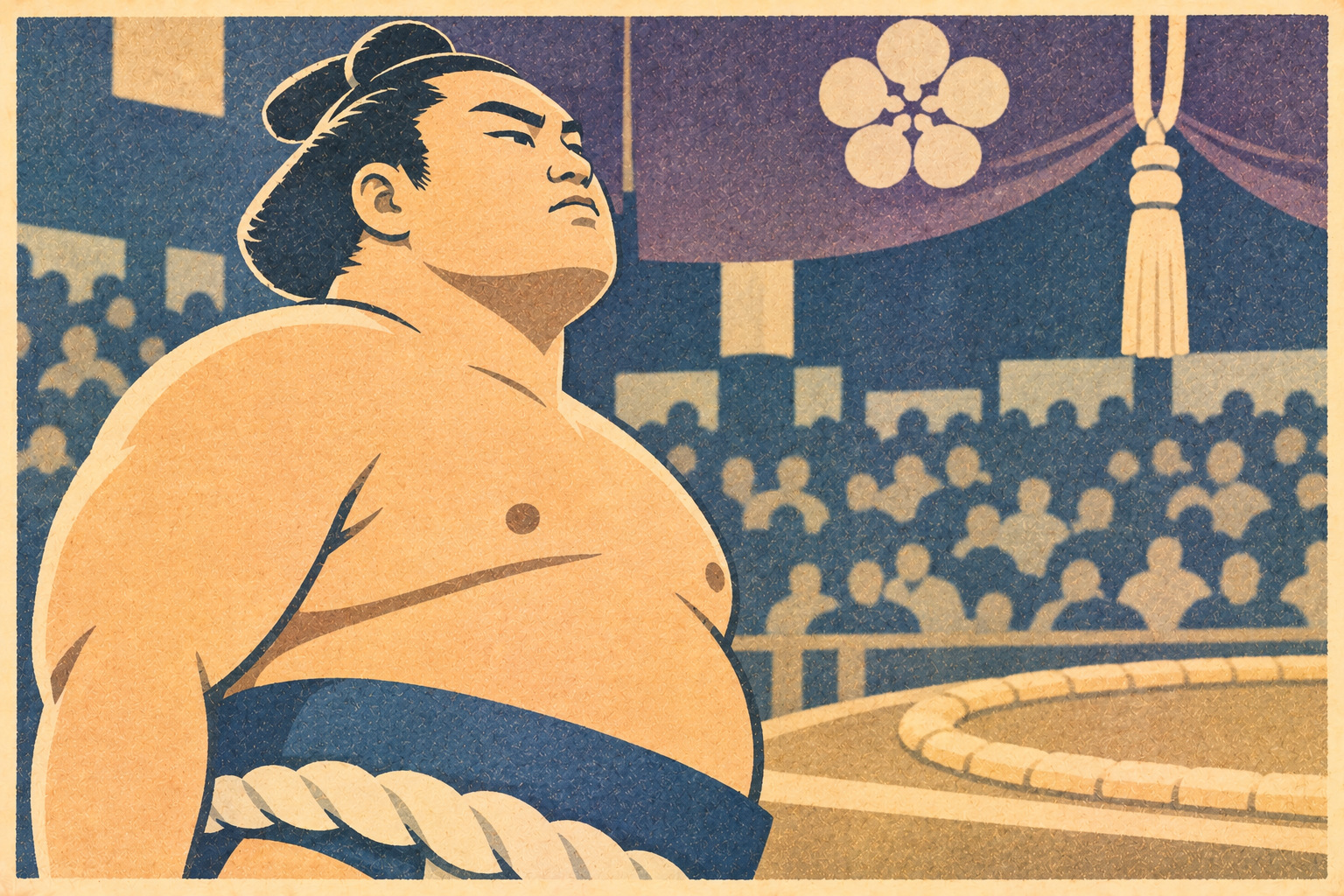
- A first for Okinawa, ten years in the making
- Why a komusubi rank matters
- A childhood in Okinawa, a career on the mainland
- The painful difference between reaching juryo and staying there
- The September tournament that opened the door
- The numbers behind a slow ascent
- A technical wrestler, not merely a late bloomer
- Okinawa had wrestling long before it had a sanyaku wrestler
- A yokozuna on opening day
- The homecoming still ahead
A first for Okinawa, ten years in the making
There is a new place name in the upper ranks of Japanese professional sumo. On the rankings issued October 26, 2026, Churanoumi Yoshihisa of Uruma, Okinawa, was promoted to East Komusubi for the November tournament. According to the Japan Sumo Association and contemporary reporting, he is the first wrestler born in Okinawa Prefecture ever to reach sanyaku, the sport’s elite ranks below yokozuna.
At 33 years and five months, and after 63 tournaments since his professional debut, his achievement resists the familiar story of a teenage prodigy racing to the top. Churanoumi reached the salaried divisions, lost that status, earned it again, and spent years making a place in the top division before the promotion finally arrived.
The tournament runs November 8–22 in Fukuoka. This profile is based on official records and reporting available through November 7; it does not assert results from future bouts.
Why a komusubi rank matters
Grand sumo has a meticulously graded hierarchy. Yokozuna occupies its supreme position; below it come ozeki, sekiwake, komusubi and the numbered maegashira ranks. Ozeki, sekiwake and komusubi are conventionally grouped under the label sanyaku. Reaching komusubi thus means more than moving a few places up a table: it marks entry into a category of rank that has special historical and competitive meaning.
The distinction of East Komusubi is also precise. East is conventionally placed ahead of West within the same rank, though both positions are komusubi. Churanoumi will now meet the highest-ranked opponents, with the burden of retaining his place against competitors who have also risen to the top.
Promotion is no guarantee of permanence. An unsuccessful fifteen-day tournament can send a komusubi straight back to the maegashira ranks. His achievement is a record of arrival, not a prediction of what comes next.
A childhood in Okinawa, a career on the mainland
Churanoumi was born Shinji Kizaki on May 6, 1993, in Uruma, Okinawa Prefecture. The Sumo Association lists him at 176 centimeters and 157 kilograms, affiliated with Kise stable, with left-hand-inside grappling and forward-driving techniques among his strengths. He told the association he first began sumo at age five.
His competitive journey took him from Okinawa through Tottori Johoku High School and Nihon University. After studying and competing in university sumo, he entered the professional ranks in March 2016 under the shikona Kizaki, later adopting Churanoumi—a ring name whose first element echoes the Okinawan word “chura,” often associated with beauty.
Leaving home to train in a regional school, then in Tokyo and in the residential world of a sumo stable, does not by itself explain his success. But it shows the national network of schools and universities through which ambitious wrestlers develop before tackling an unusually unforgiving professional ranking system.
The painful difference between reaching juryo and staying there
His first promotion to the second-highest juryo division came in July 2018. It lasted only one tournament: a five-win, ten-loss result sent him back to makushita, the highest unsalaried division. When he returned to juryo in 2019, another five-win, ten-loss record followed. Progress in sumo is not a smooth climb.
The line between juryo and makushita matters economically and socially. The first two divisions are known as sekitori ranks and bring regular salaries and other privileges that lower-ranked wrestlers do not share. A demotion can therefore be more consequential than the headline ranking suggests.
Churanoumi eventually entered makuuchi, the top division, in November 2023—more than five years after his first juryo promotion. It was only after establishing himself there that an assault on sanyaku became realistic.
The September tournament that opened the door
In September 2026, ranked West Maegashira No. 3, Churanoumi went 10–5 against strong competition. His victories included wins over ozeki Kotozakura and Kirishima. On the final day, he defeated komusubi Daieisho by oshidashi, a frontal push-out, securing his tenth win and a second Fighting Spirit Prize.
That score did not mechanically guarantee promotion. Sumo rankings depend both on individual performance and on how openings emerge elsewhere in the hierarchy. But a ten-win record near the top of maegashira, including notable wins against ozeki, provided compelling grounds for his advancement.
At an October 26 news conference, he described gradually feeling the significance of the achievement as congratulatory messages arrived. His stated goal for the new tournament was matter-of-fact: wrestle as usual, and aim for a winning record.
The numbers behind a slow ascent
Japanese sports reporting describes his 63-tournament journey from professional debut to a first sanyaku promotion as the longest among wrestlers from university sumo. His age—33 years and five months—also makes him the fourth-oldest postwar first-time sanyaku promotion, according to published records.
Such rankings can make persistence sound like a statistical curiosity. They cannot convey the full daily workload, the injuries that athletes face, or the difficulty of rebuilding rank after setbacks. In Churanoumi’s case, the available record establishes repeated returns from relegation and years of performance in makuuchi; it does not justify an invented account of what he thought through every setback.
The Sumo Association’s biographical questionnaire lists the proverb shichiten hakki—fall seven times, rise eight—as a favorite saying. It is an apt detail, although no single phrase should be made to stand in for an entire career.
A technical wrestler, not merely a late bloomer
The association records his preferred styles as hidari-yotsu, a left-arm-inside grip, and yori, forward-moving sumo at close quarters. His own questionnaire names hidari-maemitsu, a forward grip on the opponent’s belt, as a particular strength. Those terms describe a wrestler looking for positional control, not necessarily a spectacular one-move finish.
An October news report highlighted his attention to basics, including varied forms of shiko, the rhythmic stamping exercise central to sumo training. The precise contribution of any technique is difficult to measure without extended match analysis, but the emphasis on fundamental movement helps explain the long craft behind the new rank.
Against yokozuna and ozeki opponents, getting his preferred grip will be much harder. That is why a komusubi debut is not simply a ceremony of recognition; it is a live examination of everything learned on the way up.
Okinawa had wrestling long before it had a sanyaku wrestler
It would be a mistake to conclude that Okinawa lacked a wrestling tradition until Churanoumi arrived. The islands have their own form, Okinawa zumo or Okinawa kakuriki, often called shima in local speech. Its history reaches into the Ryukyu Kingdom era, and the Okinawa General Bureau describes its place in community festivities and local contests.
Traditional Okinawan wrestling differs from modern professional sumo in dress, starting conventions and the methods by which a bout is won. The two forms are related by a vocabulary of grappling but have distinct institutional histories. Meanwhile, Japan’s national professional sumo system developed its own rankings, stables and tournament circuit.
Churanoumi’s first is therefore specifically a first within the Japan Sumo Association’s professional hierarchy, not an assertion that Okinawa had never produced skilled wrestlers. That distinction makes the story richer, not less remarkable.
A yokozuna on opening day
The November 6 tournament draw scheduled Churanoumi to face yokozuna Hoshoryu on opening day, November 8. The November basho is set for Fukuoka International Center, concluding November 22. A first bout against a grand champion would offer an immediate test of his new status.
At the time this reporting was completed, the scheduled matchup was known but the result was not. Draws can change, and a bout should not be reported as having taken place until an official result is available. An editor publishing on November 10 should check the Sumo Association’s official day-by-day results and update this section if appropriate.
Nothing about the opening weekend changes the historical fact of the October promotion. But the first matches matter for evaluating whether he can defend the rank—and that remains an open sporting question.
The homecoming still ahead
Another detail from the promotion news conference makes the achievement more personal. In December, a winter regional tour is expected to reach Okinawa. According to Ryukyu Asahi Broadcasting, Churanoumi spoke of how meaningful it would be to return home as a sekitori and a new sanyaku wrestler.
A touring appearance is subject to participation and scheduling details still to be checked at the time. The significance is not the promise of a grand entrance; it is that the association’s highest ranks can now be represented by a wrestler from Okinawa in a way they have not been before.
For younger Okinawans imagining a route into professional sumo, Churanoumi cannot promise a championship. He can offer something quieter and more durable: a documented path through repeated setbacks into a rank that, before October 2026, no Okinawa-born wrestler had occupied.
Sources and reporting method
This is a documentary report based on the Japan Sumo Association’s official records and Japanese reporting. No original interview was conducted; results from November 8 onward are not included.
- Japan Sumo Association: official wrestler profile
- Japan Sumo Association: 2026 tournament schedule
- Ryukyu Asahi Broadcasting: October 26 promotion interview
- Nikkan Sports: details of the promotion record
- Nikkan Sports: October 26 press conference
- Okinawa General Bureau: traditional Okinawan wrestling
- Japan Sumo Association: November 2026 tournament
- Nikkan Sports: opening-day schedule