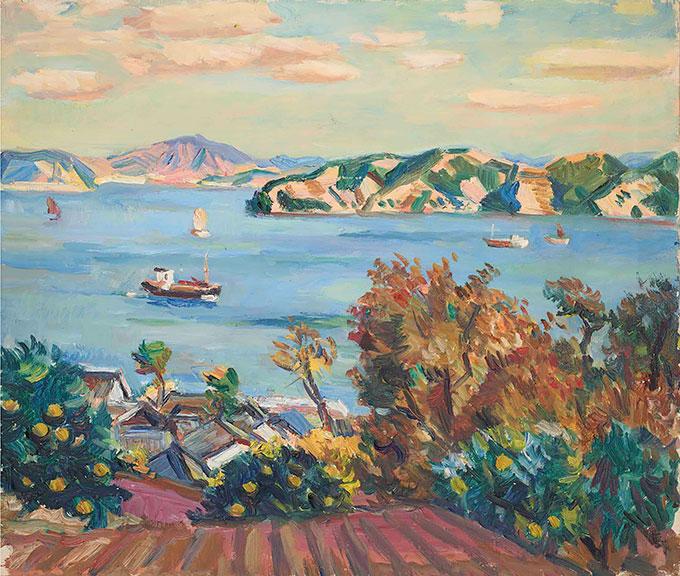
Image 1 — Coastal Landscape
A Seto Inland Sea scene in which boats, islands, fields, and houses occupy a shared world of work and settlement.
File: minami-kunzo-seto-inland-sea-coastal-landscape.jpg
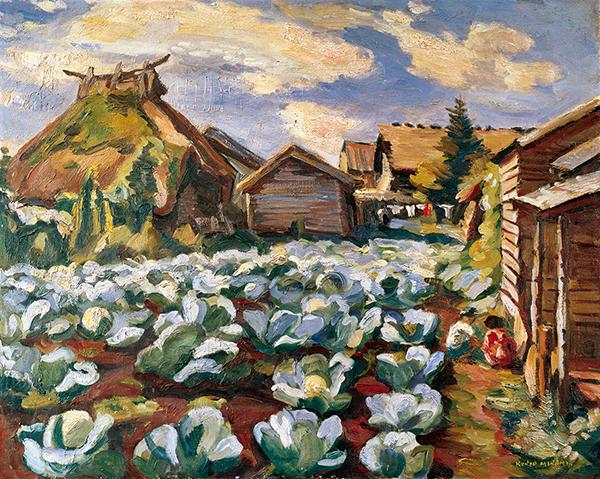
Image 2 — Rural Village
A village scene with thatched buildings and cabbage fields, emphasizing Minami's calm, humane attention to agricultural life.
File: minami-kunzo-japanese-village-cabbage-fields.jpg
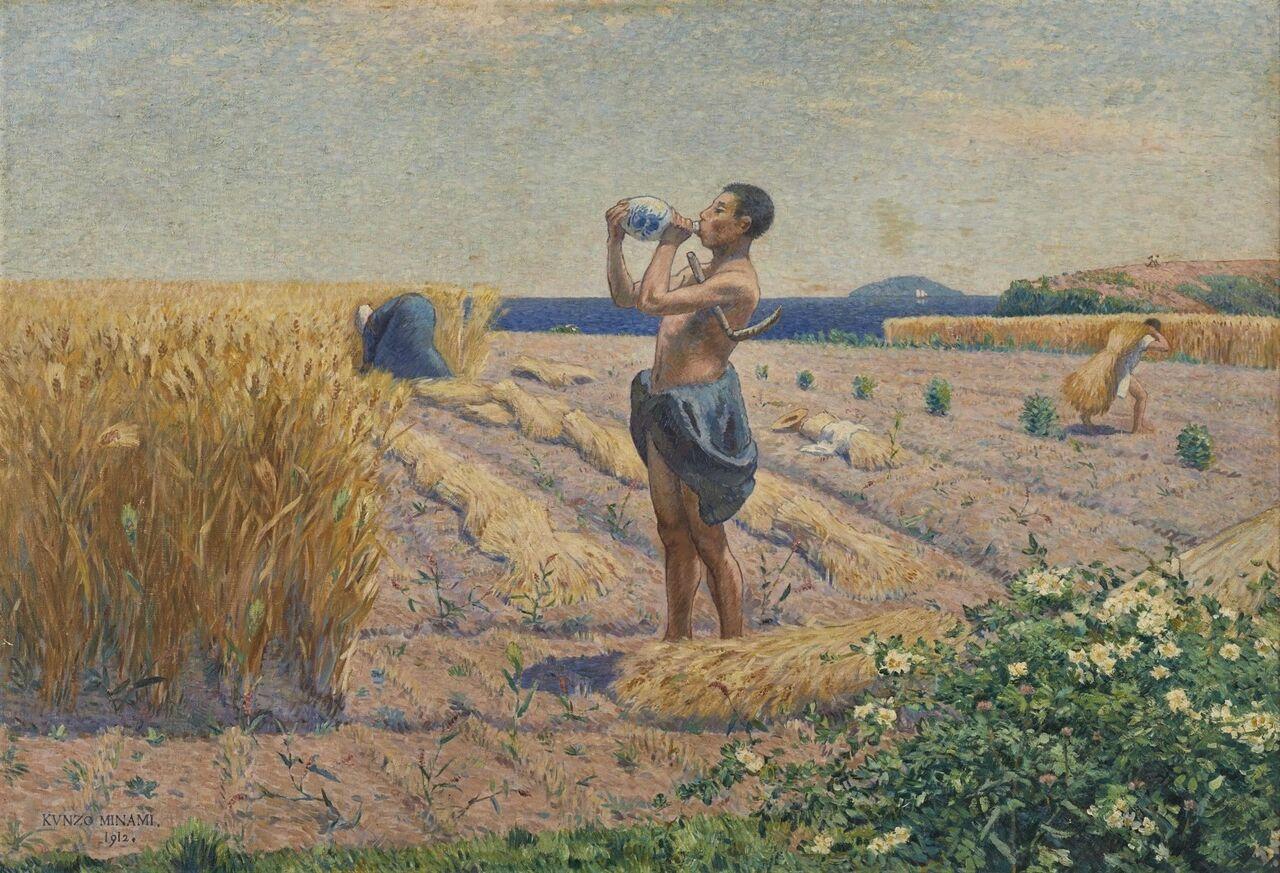
Image 3 — Harvest (1912)
A harvest field centered on a worker stopping to drink, showing Minami's early strength in linking labor, season, and light.
File: minami-kunzo-wheat-harvest-rural-japan-1912.jpg
Why Minami Kunzo belongs in a Hiroshima edition
Minami Kunzo (1883–1950), born in what is now Yasuura in Kure, Hiroshima Prefecture, was one of the key painters in the maturing of modern Japanese yōga, or Western-style painting. The Hiroshima Prefectural Art Museum describes him as a major figure in modern Japanese Western-style art, and its 2021 memorial exhibition placed him firmly in the national canon. That institutional framing matters—but it is only the start of the story.
What makes Minami especially right for a Hiroshima special edition is not simply birthplace. It is the way he made light, weather, coastlines, fields, and ordinary human activity central to his work. He absorbed lessons from Europe, but he used them to describe places that felt lived in rather than exotic. In Minami's hands, Hiroshima's sea and countryside were not backdrops. They were the structure of everyday life.
Training, travel, and a wider artistic horizon
Minami entered the Western Painting Department of Tokyo Fine Arts School in 1902 and studied under Saburōsuke Okada. After graduating in 1907, he traveled to Britain, later moving through France and other parts of Europe before returning to Japan. Museum biographies consistently note that this overseas experience sharpened his sensitivity to color, atmosphere, and the expressive possibilities of watercolor as well as oil painting.
Yet Minami should not be reduced to a simple importer of European Impressionism. His work remained more restrained and structurally grounded than the stereotype suggests. Even when his surfaces became brighter and more luminous, he kept a measured relation between observation and design. That balance—between openness to foreign techniques and fidelity to Japanese experience—helps explain his lasting place in art history.
Success at Bunten and a national career
On returning to Japan, Minami quickly established himself through state-sponsored exhibitions such as Bunten and later Teiten. Works from the early 1910s brought him recognition, and by the interwar years he had become a firmly established presence in the official art world. He later served as a professor at Tokyo Fine Arts School and, in 1929, was chosen as a member of the Imperial Art Academy. In 1944 he was appointed an Imperial Household Artist.
Those achievements matter historically, but they do not fully explain why Minami still feels fresh. Many academically successful painters now seem remote. Minami does not, because his art kept returning to the texture of life—waterfronts, villages, cultivated fields, boats, family spaces, and seasonal change. The Hiroshima Museum notes that he spent his career painting Japan's humid landscapes and calm domestic scenes, and that continuity is one reason his work still speaks clearly.
The Seto Inland Sea as a home vision
A 2020 memorial exhibition organized by Kure City emphasized the artist's deep attachment to the Seto Inland Sea. The city's description highlighted calm blue waters, island silhouettes, sails, fertile land, and the people who worked within that environment. That list could almost serve as a shorthand description of Minami's mature visual world.
For Minami, Setouchi was not merely a scenic subject. It was a home vision—a spatial rhythm of sea, islands, boats, fields, and settlements that he could revisit repeatedly without exhausting it. After wartime dislocation and his eventual return to Hiroshima, that landscape carried even more emotional weight. His coastal paintings are not tourist views. They feel intimate, as if painted by someone who knew how weather moved across those waters and how human life was organized around them.
Curated Image 1: Coastal Landscape
The first curated image on JAPAN.co.jp, filed as 'Coastal Landscape,' shows many of the painter's signature concerns at once: small boats across blue water, layered islands, houses tucked below the hillside, cultivated land in the foreground, and trees animated by wind and light. It is a compact demonstration of how Minami could make a large environment feel inhabited.
The painting's strength lies in its refusal to separate nature from work and settlement. The sea is beautiful, but it is also a working sea. The houses are picturesque, but they are clearly part of a lived community. We were not able to confirm a definitive catalog match for this particular website file from a primary institutional record, so the published feature uses a descriptive label rather than asserting an unverified museum title. Even so, the image is fully legible as part of Minami's Setouchi world.
Curated Image 2: Rural Village
The second image, presented here as 'Rural Village,' brings Minami's rural sensibility into sharper focus. Thatched buildings and a broad cabbage field create a scene that is modest rather than monumental. There is no obvious drama. The subject is simply cultivation, architecture, weather, and the quiet order of village life.
That modesty is part of Minami's achievement. He did not need spectacle to make a painting hold attention. The white heads of cabbage, the ocher and brown structures, and the broken light in the sky create a gentle but persuasive harmony. This is consistent with the museum characterization of his work as warm, stable, and rooted in familiar life. He neither sentimentalizes the countryside beyond recognition nor treats it with detachment. He paints it as a moral and visual fact.
Curated Image 3: Harvest (1912)
The third image, labeled on the site as 'Harvest (1912),' shows a figure pausing to drink in the middle of a harvest field while others continue working nearby. The visible 1912 date makes the picture especially significant, because it belongs to the period in which Minami was consolidating his reputation. In that phase he was proving that agricultural labor, seasonal light, and human physicality could sustain ambitious modern painting.
We did not fully verify a one-to-one match between this website file and a specific museum record, so the publishable article keeps the descriptive site label rather than forcing a catalog title. Still, the historical meaning of the image is clear. This is early Minami at a moment of confidence: attentive to the body's weight, the brightness of open land, and the dignity of ordinary work. It helps explain why his rise in the 1910s mattered.
Watercolor, institutions, and artistic infrastructure
Minami's importance extends beyond his canvases. The Japan Watercolor Association's own history states that he was among the more than 60 painters involved in the organization's founding in 1913. That fact places him not only among notable practitioners but among the people who helped build the infrastructure of modern Japanese art.
As a teacher at Tokyo Fine Arts School, he also shaped later generations. Modern art does not grow through masterpieces alone. It depends on schools, associations, exhibitions, and the daily discipline of craft transmission. Minami was not the loudest avant-garde figure of his era, but he was an essential builder—one of the artists who helped make Japanese Western-style painting durable rather than temporary.
Late work, memory, and Hiroshima's recovery
Educational material published by the Hiroshima Prefectural Art Museum notes that after the war Minami continued painting favorite waterside scenes and family subjects while contributing to Hiroshima's cultural recovery. That point deserves emphasis. His later work is not merely late style; it is part of a damaged society's return to continuity.
He had already achieved prestige before the war, but prestige alone could not shield artists from upheaval. In late Minami, one often senses not triumph but steadiness: the recovery of visual order through attention to sea, village, family, and season. In a Hiroshima context, that steadiness carries historical meaning. It represents a kind of cultural resilience—a refusal to let the ordinary textures of life disappear.
A visual key for seventeen Hiroshima stories
For JAPAN.co.jp's Hiroshima special edition, Minami Kunzo works as more than a biographical feature subject. He also serves as a visual key. His art can support editorial illustrations about coastlines, temples, research, industry, farming communities, and local sport because his central concern was the relation between place and human activity. His paintings offer atmosphere without theatrical excess.
That is why he is such a strong Art Choice. He is authentically of Hiroshima, securely part of the public cultural record, and flexible enough to inspire a suite of original editorial illustrations without overwhelming the journalism itself. If this edition aims to show Hiroshima as lived landscape rather than abstract topic, Minami Kunzo is exactly the artist to lead with.
Primary sources and reporting limits
This report relies on primary and official sources. We did not conduct fresh curator interviews or a site visit. For the three curated images saved on JAPAN.co.jp, we were not able to fully confirm exact institutional catalog matches for Images 1 and 2, or the precise official title corresponding to Image 3, using open primary sources alone; the article therefore uses cautious descriptive labels where necessary.
- Hiroshima Prefectural Art Museum: Minami Kunzo Seventy Years On
- Kure City press release: 70th Memorial Exhibition, The Charm of Setouchi
- Hiroshima Museum of Art artist page: Minami Kunzo
- Kure City: Minami Kunzo Memorial Museum
- Japan Watercolor Association official history
- Art Platform Japan: Landscape of the Seto Inland Sea
- Art Platform Japan: Field
- Art Platform Japan: Seascape
- National Museum of Modern Art, Tokyo: One Day in June
- Hiroshima Prefectural Art Museum annual report