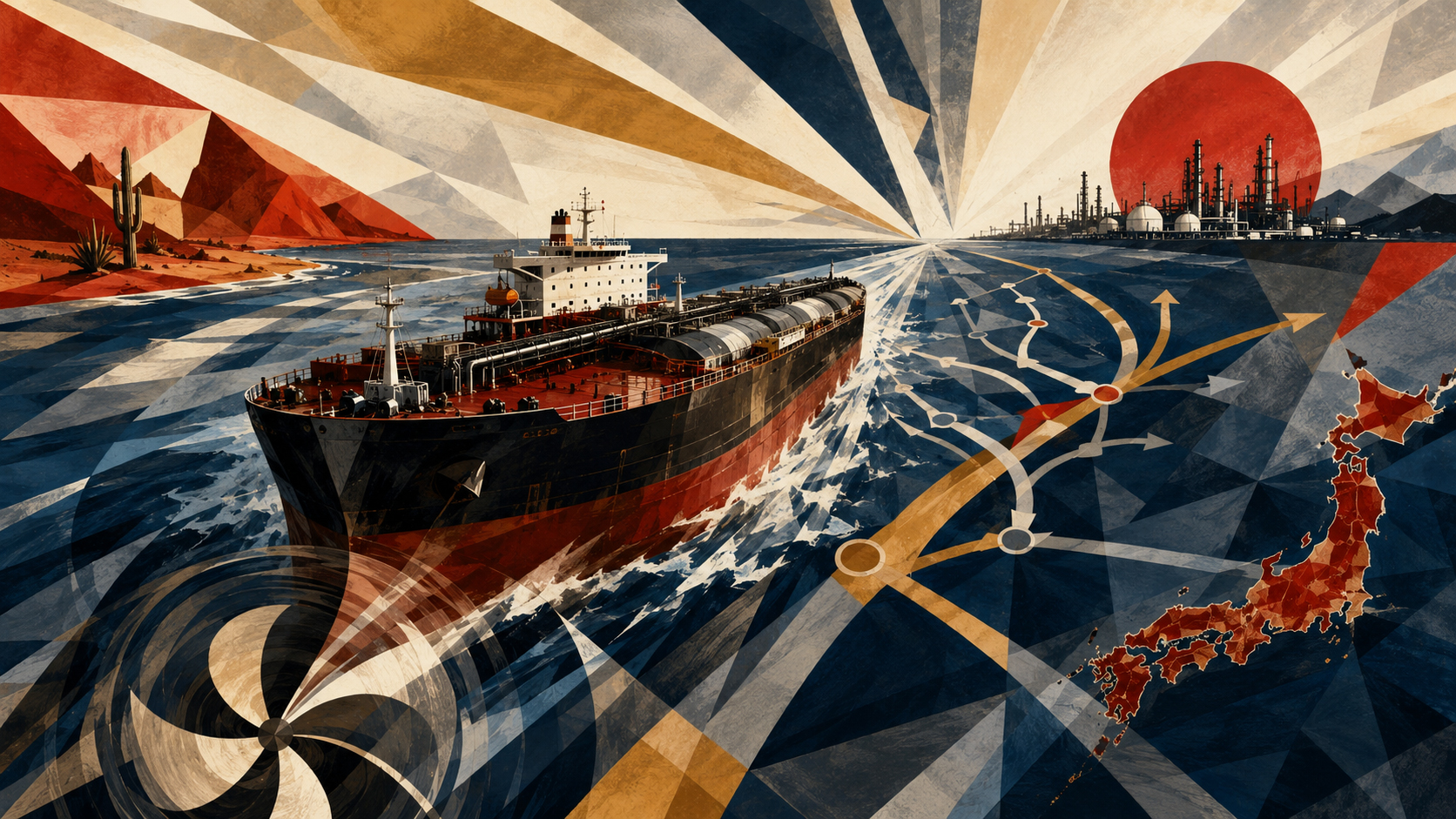
A tanker arrives carrying more than oil
A tanker carrying Mexican crude for Cosmo Oil is expected to call first at the company’s Yokkaichi refinery in Mie Prefecture and then at its Chiba refinery near Tokyo. The voyage began in the Gulf of Mexico and went around southern Africa’s Cape of Good Hope. That geography is the story: the barrel was sourced outside the Middle East and did not need to leave the Persian Gulf through the Strait of Hormuz.
The shipment follows an April telephone call between Prime Minister Sanae Takaichi and Mexican President Claudia Sheinbaum. Mexico agreed to supply one million barrels through state producer Pemex as Japan searched for alternatives after war sharply restricted Gulf shipping. For Mexico, the sale opens an Asian outlet while domestic refining policy and declining mature fields constrain export growth. For Japan, it is a real-world test of procurement, freight, storage, crude blending and refinery operation.
The grade was not identified publicly in the initial announcement. That matters. Mexico’s flagship export stream, Maya, is heavy and sour, but it would be an error to label this cargo Maya without confirmation. Energy reporting must distinguish what is known—the origin, buyer, route and destinations—from what is merely plausible.
First lesson: crude oil is not one uniform product
Oil is often discussed as if one barrel were interchangeable with every other barrel. A refinery knows otherwise. Crudes differ in density, usually expressed through API gravity; in sulfur content; and in acidity, metals, salts and the distribution of hydrocarbon molecules. “Light” crude contains more small molecules that can become naphtha, gasoline and diesel through relatively simple processing. “Heavy” crude leaves more residue. “Sweet” crude contains less sulfur; “sour” crude needs more desulfurization and hydrogen.
A refinery first separates crude in atmospheric and vacuum distillation towers. It then converts less valuable molecules in catalytic crackers, hydrocrackers or cokers and removes sulfur in hydrotreaters. Each plant has a particular balance of units, tanks, catalysts and hydrogen capacity. Change the feedstock and the yields of gasoline, kerosene, diesel, naphtha, fuel oil and asphalt change with it.
| Crude characteristic | What it changes at the refinery |
|---|---|
| Light vs. heavy | The share of naturally valuable light products versus residue requiring conversion. |
| Sweet vs. sour | The burden on sulfur-removal equipment, hydrogen use and emissions controls. |
| Metals and acidity | Corrosion risk, catalyst life, maintenance and blending limits. |
| Assay and boiling curve | How much LPG, naphtha, gasoline, jet/kerosene, diesel and residual material the crude can produce. |
Japanese refiners invested for decades in equipment that can process medium and heavy, sulfur-rich Middle Eastern crudes. That helps explain why a technically complex Japanese plant may accept a heavy Mexican stream more readily than the phrase “distant supplier” suggests. Conversely, very light U.S. crude can produce too much naphtha or light material for a plant’s preferred product slate. The question is not “Can it burn?” but “Can this exact plant process it safely, profitably and in the desired mix?”
Before a new cargo is run, engineers examine its crude assay, plan tank segregation and blending, model unit loads, ensure product specifications can be met and schedule around catalysts and maintenance. Supply diversification therefore depends on laboratories and refinery hardware as much as diplomacy.
Why Japan became so dependent on Middle Eastern oil
After 1945, Japan rebuilt with domestic coal, but rapid growth demanded a fuel that was dense, flexible and then relatively cheap. During the 1950s and 1960s, the “energy revolution” shifted industry from coal to imported petroleum. Tankers supplied coastal refineries; refineries supplied petrochemical complexes, power stations, steel mills, vehicles and households. Oil’s share of primary energy rose dramatically as the high-growth economy expanded.
The Middle East offered giant fields, reliable long-term volumes and grades suited to the increasingly sophisticated refineries built along Japan’s Pacific industrial belt. Geography also favored large tankers moving from the Persian Gulf across the Indian Ocean to East Asia. Long-term contracts created dependable relationships; refinery investments reinforced them. This was economically rational specialization, not simple negligence.
But efficiency produced concentration. Japan has little domestic crude production. In 2025, 94% of its crude imports came from the Middle East, and 93% of those cargoes passed through the Strait of Hormuz. Dependence on several suppliers can still be dependence on one sea gate.
1973: the year energy security entered everyday life
The first oil shock transformed Japan’s understanding of vulnerability. In October 1973, war in the Middle East was followed by an Arab oil embargo and production restraint. Japan’s pro-Israel classification and overwhelming reliance on imported oil exposed foreign policy, factories and household prices to decisions made far away. The government adjusted its Middle East diplomacy while companies faced petroleum and electricity restrictions.
Consumers remember the panic buying of toilet paper, even though paper itself was not chiefly an oil product. The episode is historically important because expectations multiplied the shock. Fear that goods would disappear created shortages before physical supply alone required them. Inflation accelerated, industrial production was squeezed and the era of double-digit high growth ended. The shock did not single-handedly end the postwar boom, but it revealed that the old model—ever more imported oil feeding ever more heavy industry—had reached a political and economic limit.
The response was institutional. Japan built public and mandatory private oil stocks, diversified suppliers, pursued overseas resource diplomacy and invested in efficiency, nuclear energy and alternatives. The 1979 Iranian Revolution and second oil shock reinforced the lesson. The Energy Conservation Act of 1979 pushed factories, buildings and machinery toward lower consumption. Industry moved toward higher-value, less energy-intensive production. Japanese cars became internationally competitive partly because efficiency had become a national economic capability.
| Period | Energy-security meaning |
|---|---|
| 1950s–1960s | Coal gives way to imported oil; coastal refining and petrochemicals power rapid growth. |
| 1973–1974 | The first oil shock reveals the danger of supplier and route concentration; inflation and rationing end the illusion of limitless cheap energy. |
| 1975–1979 | Stockpiling and conservation become permanent institutions; the second oil shock validates them. |
| 1990–1991 | The Gulf crisis again tests sea-lane security and burden-sharing. |
| 2011 | Fukushima closes much nuclear capacity, increasing fossil-fuel imports and weakening energy self-sufficiency. |
| 2022 | Russia’s invasion of Ukraine adds sanctions, LNG competition and producer concentration to the security agenda. |
| 2026 | Hormuz disruption triggers unprecedented reserve use and rapid purchases from the Americas, Caspian region and elsewhere. |
Yokkaichi: the achievement and cost of the oil age
The cargo’s first planned destination gives the story historical depth. Yokkaichi became one of Japan’s great postwar petrochemical centers. Its refineries and factories represented modern abundance: fuels, plastics, chemicals and jobs. But sulfur-oxide pollution from the complex contributed to severe respiratory illness known as Yokkaichi asthma. Litigation in the 1960s and early 1970s helped establish corporate responsibility and strengthened Japanese pollution control.
That history complicates any celebration of a new oil route. Energy security is not merely obtaining enough molecules. It includes the health cost of refining and combustion, climate risk, accident prevention and the fairness of asking industrial communities to carry national burdens. Yokkaichi teaches that a supply can be reliable and still fail society if its external costs are ignored.
The Strait of Hormuz is a concentration point, not just a map label
Hormuz connects the Persian Gulf with the Gulf of Oman and open ocean. Saudi Arabia, the United Arab Emirates, Iraq, Kuwait, Qatar and Iran depend on Gulf export infrastructure to varying degrees. Before the 2026 war, roughly one-fifth of world oil and gas shipments moved through the strait. Asian buyers were the principal destination.
Japan’s immediate problem is therefore not simply “Middle Eastern oil.” Some Saudi and Emirati production can reach terminals outside Hormuz through pipelines. The UAE is expanding the line to Fujairah on the Gulf of Oman; Saudi Arabia has capacity toward the Red Sea and has considered expansion. Petroleum Association of Japan President Shunichi Kito has argued that workable bypass routes may be more important than replacing every Middle Eastern barrel.
This is a crucial distinction. A secure portfolio can retain trusted Gulf producers while changing the route. It can also add Mexico, the United States, Brazil, Guyana, the Caspian region and Southeast Asia while improving refinery flexibility. Country diversification, route diversification and fuel diversification solve different problems.
What 201 days of stocks can—and cannot—do
On June 8, Japan reported oil stocks equivalent to 201 days: 107 days held by the government, 92 by private industry and about three in joint producer reserves, with rounding. The system has several layers because crises differ. Government stocks provide a public emergency buffer. Mandatory commercial stocks are integrated into normal logistics. Joint reserves stored in Japan with producing countries strengthen cooperation and can be released by agreement.
Beginning March 16, Japan released roughly 50 days of consumption from reserves, plus five days of joint stocks, and followed with another 20 days from May 1. By June, Takaichi said alternative purchases and releases had secured supply through March 2028. Refinery utilization, which had fallen below 70% in April, recovered above 70% as substitute cargoes and stocks arrived.
Stocks buy time. They do not manufacture new oil, repair a sea lane or permanently lower import dependence. A long crisis turns the inventory question around: how much can be released without leaving the country exposed to the next earthquake, typhoon, war or refinery accident? The successful use of reserves must be followed by a plan to refill them.
The Mexican route has a price
A Gulf of Mexico cargo sailing around the Cape of Good Hope travels farther than a normal Persian Gulf-to-Japan voyage. More days at sea mean higher charter cost, fuel use, insurance, financing and carbon emissions. A buyer pays for the cargo well before a refinery turns it into saleable products; the longer voyage ties up working capital and tanker capacity.
Mexico is also not an unlimited replacement. Pemex’s mature fields have declined, while the government wants more crude processed in domestic refineries. In early 2026 Mexico was using about 1.4 million barrels per day domestically and exporting roughly 400,000 to 500,000. A million-barrel agreement is meaningful, but Japan cannot build a national strategy on the assumption that Mexico alone can replicate Gulf scale.
At ¥162.03 to the dollar, cost matters acutely. Crude is priced internationally in dollars. Even if the dollar oil price is unchanged, a weaker yen makes it more expensive for Japanese buyers. Freight and war-risk premiums flow into gasoline, diesel, jet fuel, electricity where oil is used, and naphtha for chemicals. The Mexican cargo improves physical optionality; it does not guarantee cheap energy.
One barrel, many parts of daily life
Japan’s oil demand is lower than it was in the 1970s because power generation, vehicles, industry and buildings became more efficient and because natural gas, nuclear energy and renewables took shares of the energy system. Yet oil remains difficult to replace in aviation, shipping, road freight, petrochemicals, construction and emergency response.
| Product | Why supply matters |
|---|---|
| Naphtha | Feedstock for plastics, synthetic fibers, solvents and chemical manufacturing. |
| Gasoline | Passenger transport and regional mobility, though electrification is reducing exposure. |
| Kerosene / jet fuel | Home heating in colder regions and aviation, where substitutes remain limited. |
| Diesel | Trucks, buses, construction, agriculture, fishing and backup generation. |
| Heavy products | Marine fuel, industrial heat, asphalt and specialized uses. |
This is why an oil shock is broader than a filling-station story. It reaches supermarket logistics, airline fares, fishing fleets, plastics, public works and the central bank’s inflation forecast.
Mexico and Japan: two meanings of oil sovereignty
Mexico nationalized its oil industry in 1938, making petroleum a symbol of sovereignty and social ownership. Pemex remains politically central even as it struggles with debt, aging fields and refinery performance. Japan’s oil history is almost the mirror image: with few domestic reserves, sovereignty has meant access—stable contracts, shipping, storage, technology and diplomatic relationships.
The 2026 agreement links those traditions. It also sits within a much wider economic relationship. Japanese automakers and suppliers have built major manufacturing networks in Mexico, while Mexico gives Japan access to North American markets and a Pacific-facing partner. Energy cooperation can deepen a relationship already based on factories, components, skills and trade.
But good diplomacy requires realism. Mexico must balance export revenue against domestic fuel policy. Japan must pay the freight and adapt refineries. A durable partnership is built on transparent commercial terms, not emergency symbolism.
What a resilient Japanese energy system looks like
There is no single replacement for Hormuz. Resilience is layered. Procurement teams need contracts with more producers. Shipping companies need enough suitable tankers and insurance. Ports need storage. Refineries need broader crude acceptance and the ability to change product yields. The state needs reserves and release rules. Diplomats need producer relationships and support for bypass pipelines.
The final layer is demand. The most secure barrel is the barrel Japan does not need to import. Efficient vehicles, electrified transport, heat pumps, better buildings, renewable generation, batteries and transmission reduce exposure to oil and gas shocks. Nuclear restarts, where safety regulators and local communities approve them, can reduce fossil generation but carry a different set of safety, waste and trust questions.
Diversification is therefore not synonymous with adding foreign flags to a tanker schedule. It has at least four dimensions:
| Dimension | The question it answers |
|---|---|
| Supplier | What if one exporting government cuts supply? |
| Route | What if Hormuz, Suez, Panama or another chokepoint becomes unsafe? |
| Technical flexibility | Can refineries and power systems use what alternative suppliers can actually deliver? |
| Demand and fuel | Can the economy provide the same service with less oil—or another energy carrier? |
How to judge whether this shipment changed anything
Do not measure success by the photograph of one tanker. Watch whether Mexican and other non-Gulf purchases become repeatable; whether the landed cost remains competitive after freight; whether Yokkaichi and Chiba can process the crude without sacrificing valuable product output; and whether contracts, tanks and blending systems are revised for the next emergency.
Watch the government’s resilience package expected by the end of August. Useful measures would identify refinery-flexibility investment, tanker and storage capacity, alternative-route infrastructure, naphtha security, rules for replenishing reserves and quantifiable demand reduction. A list of friendly supplier countries without delivery capacity would be diplomacy, not resilience.
The Mexican cargo has historical meaning precisely because it is small beside the system it tests. In 1973, Japan learned that cheap oil could not be separated from geopolitics. In the decades after, it became a world leader in conservation and stockpiling, yet allowed crude supply to reconcentrate in the Middle East because those flows were efficient, compatible and dependable.
In 2026, a tanker approaching Yokkaichi after rounding Africa carries the next lesson. Energy security is not autarky. Japan will continue to trade. Security is the capacity to keep society functioning when the cheapest, shortest and most familiar path is suddenly unavailable. One Mexican cargo cannot provide that capacity. But if it changes contracts, equipment, routes and habits before the next crisis, it can help build it.
Sources and further reading
- Reuters: Mexican crude cargo approaches Japan — buyer, destinations, Cape route and the April leaders’ agreement.
- Reuters: Mexico agrees to send one million barrels — Pemex, domestic refining and export volumes.
- Reuters: Japan’s refiners examine diversification and Hormuz bypasses — refinery compatibility, pipelines and the resilience package.
- Reuters: Japan says supplies are secured through March 2028 — reserve releases, import concentration and 201 days of stocks.
- Reuters: Why Asia relies on Middle Eastern oil — refinery design, sulfur removal, contracts and product yields.
- Reuters: Japanese refinery runs recover — substitute crudes, reserve releases and utilization.
- Reuters: Mexico seeks Asian and European crude buyers — Maya crude, freight and Mexico’s export market.
- Reuters: Mexico’s crude exports decline — mature fields, production and domestic refining constraints.
- Agency for Natural Resources and Energy: Energy White Papers — Japan’s energy balance, self-sufficiency and post-oil-shock policy history.
- U.S. Energy Information Administration: World oil transit chokepoints — the scale and geography of Hormuz traffic and bypass capacity.