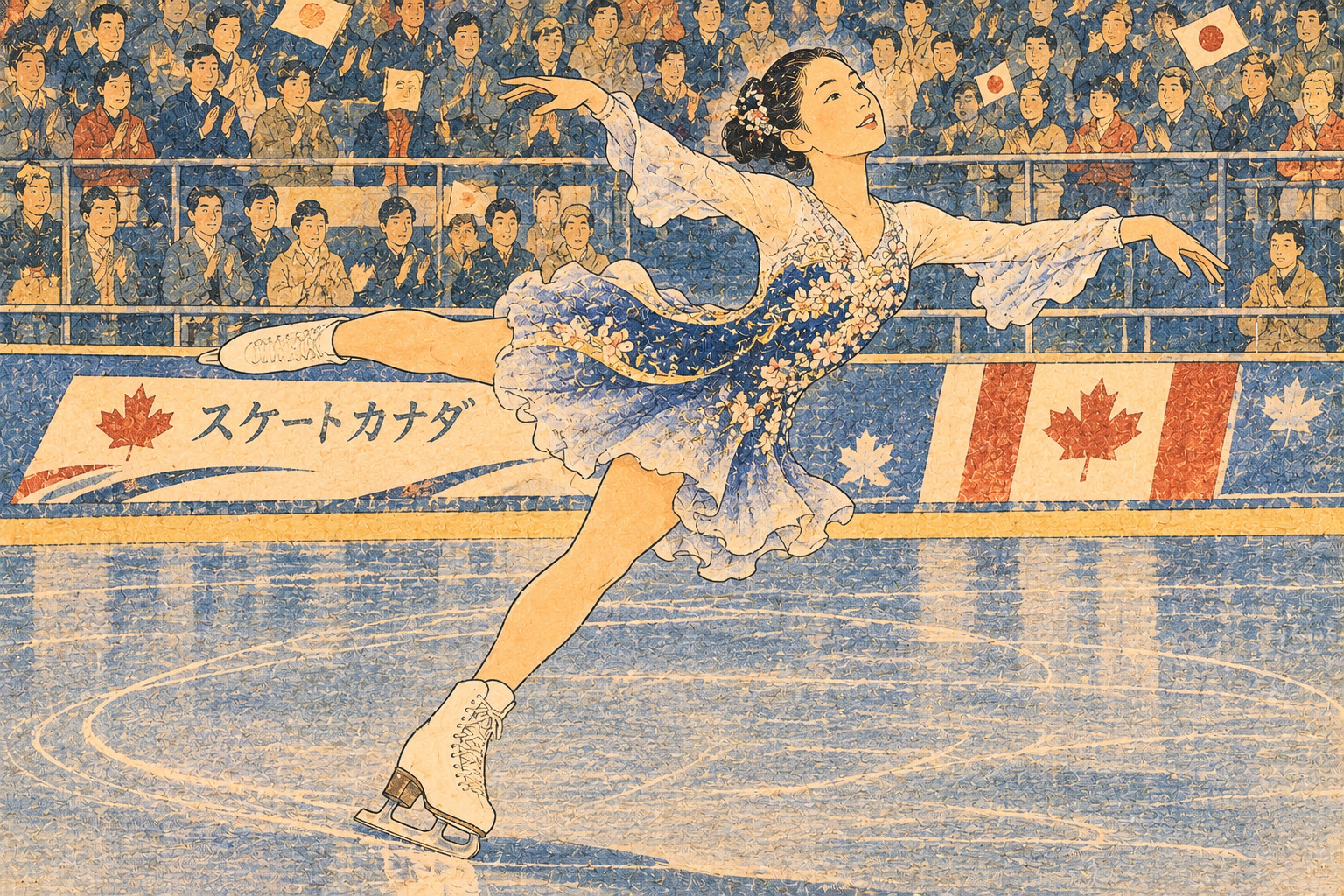
A new stage, and an old habit of winning
At Prospera Place in Kelowna, British Columbia, Mao Shimada took the ice for a senior Grand Prix debut that carried unusual expectations. On November 1, two days after turning 18, she left with the Skate Canada title and 235.44 points—the highest women’s total in the International Skating Union’s 2026–27 season standings as of the event. Her short program earned 82.11 points; her free skate added 153.33. She won both segments and finished 14.37 points clear of Estonia’s Niina Petrokina. These were not the tentative numbers of an athlete merely finding her feet at a new level. But to understand what changed in Canada, one must first understand what did not: Shimada arrived with years of extraordinary junior results and a notably difficult technical repertoire.
The champion who took the long route to senior competition
Shimada entered the junior international circuit in 2022. According to the ISU, she has not lost an international competition since her junior debut. She won four consecutive world junior championships, from 2023 through 2026, an exceptional achievement even in a country with a deep pipeline of elite figure skaters. Yet a senior Grand Prix is different from competing in Japan’s senior national championships, where she had already earned notable finishes. This was her first appearance in the sport’s premier international senior Grand Prix circuit. The distinction matters: describing her as if she had never faced senior competitors would erase important parts of her competitive development.
A short program that set the agenda
In the October 31 short program, Shimada established a lead with 82.11 points. Of that total, 49.23 came from technical elements and 32.88 from program components, with no deduction. Her triple Axel—three and a half rotations—was central to a program that also had to satisfy the discipline’s many demands beyond jumps: turns, spins, transitions and musical interpretation. The score put her ahead of American Isabeau Levito, who earned 78.50, and Petrokina on 77.24. In a two-part competition, a strong first night creates an advantage, but it does not secure the title. The free skate was still to come, and with it the difficult decision of how much technical risk to carry.
The free skate: ambitious, not flawless
The next day, Shimada landed a triple Axel and attempted a quadruple toe loop. The quadruple was called under-rotated, an important qualification when discussing one of the most difficult jumps attempted in women’s skating. Her final free-skate score was 153.33: 85.65 technical points, 67.68 component points and no overall deduction. The distinction between an under-rotation call and a general deduction is worth preserving—judges’ technical calls affect an element’s value without necessarily producing a separate deduction in the final score table. Her personal-best free skate remains 156.16, earned at the 2025 World Junior Championships; Canada gave her a new personal-best combined total rather than a new free-skate personal best.
What the score sheets actually say
Petrokina took silver with 221.07 points and Levito bronze with 212.22. Fellow Japanese skater Saki Miyake finished fourth on 210.09. In the free skate, Petrokina’s 69.90 program-component points exceeded Shimada’s 67.68, while Shimada’s technical score of 85.65 topped Petrokina’s 73.93 by 11.72 points. That gap explains much of the margin. The numbers tell a more useful story than a claim that Shimada was simply perfect in every dimension: she won decisively through technical strength while leaving space to develop the composition, presentation and skating skills that become essential in sustained senior success.
Why four junior titles matter
Elite junior skating is not an extended practice session for seniors. Athletes must compete internationally, adapt to changing bodies and equipment, and repeatedly perform under pressure, often while balancing school and training. Four world junior titles mean Shimada stayed ahead of multiple cohorts of challengers rather than peaking for a single championship. The ISU lists her hometown as Uji, Kyoto, and the Kinoshita Group as her club. Coaches Mie Hamada and Hiroaki Sato are named in her official biography. Those details anchor an international result in the Japanese training environment that helped produce it. Still, winning a string of junior events cannot guarantee senior dominance; stronger competition and a longer calendar create different demands.
An age rule that shaped a career
There is a particular reason Shimada’s arrival in this Grand Prix season feels delayed. The ISU raised the minimum age for senior international events, reaching 17 before July 1 of the relevant season from 2024–25 onward. Born on October 30, 2008, Shimada was 16 on July 1, 2025, leaving her ineligible for the 2026 Olympic Winter Games in Milan and Cortina. The rule was a matter of eligibility, not an assessment of whether she could compete at the required level. It also helped produce a rare sight in modern women’s skating: an athlete arriving at her senior Grand Prix debut already possessing four world junior crowns.
The weight of a famous name
Shimada’s official ISU biography records that she was named after Mao Asada, the three-time world champion who helped make the triple Axel a touchstone of Japanese women’s skating. The connection is evocative, and the jump is part of both athletes’ stories, but it should not be treated as destiny. Shimada competes in a different scoring era, under different age rules and against a changing international field. Her choreography, physical development and choices about risk are her own. Placing her in Japan’s skating lineage can deepen the story without reducing a young athlete to a sequel to an earlier star.
A program with room to grow
For 2026–27, Shimada’s short-program music is “Between Two Worlds” by Mili, Cassie Wei and Yamato Kasai; her free program uses Christopher Tin’s “Waloyo Yamoni.” The ISU credits Shae-Lynn Bourne and Kana Muramoto as choreographers. Those selections invite attention to rhythm, storytelling and how the athlete moves between technically demanding elements. The free-skate component scores also resist easy triumphalism. She was not the highest-scoring competitor in that category in Kelowna, and a season of professional scrutiny will increasingly focus on the craft that connects the jumps, not only on the takeoffs and landings.
The next gate: Grand Prix Final qualification
A Grand Prix victory carries more than a medal. Skaters accumulate ranking points across their assigned events, with the top-ranked qualifiers advancing to the December Grand Prix Final. Winning Skate Canada gave Shimada 15 points and a strong start, but did not automatically secure a Final berth. The next competition and results elsewhere in the series will matter. More broadly, a single November performance cannot tell us who will dominate the next world championship or Olympic cycle. It can, however, make the leading questions sharper: how reliably can she reproduce her highest-value jumps, and how quickly can she refine the whole program?
The athlete’s own measure of success
In its November 2 recap, the ISU quoted Shimada expressing satisfaction at skating with a smile to the end while acknowledging there was still work to do. The comment is revealing precisely because it is less absolute than the headline result. She did not describe a final, perfected version of herself. Instead, her first senior Grand Prix began with both a victory and a set of measurable improvements still to pursue. Treating the person behind the numbers seriously means resisting premature comparisons, predictions and claims of inevitability.
The beginning, not the coronation
The story of Skate Canada 2026 can be captured in a simple row of results: 82.11, 153.33, 235.44 and a gold medal. But the more enduring story lies in the transition between competitive eras. A skater who stayed undefeated across years of junior international competition has now won on a stage that allows a wider field to test her ability. Her under-rotated quadruple, her component-score comparison and her next assignments are not blemishes to hide. They are the things that will make following Shimada’s senior career interesting. Kelowna was a remarkable opening chapter, not the last page.
Sources and reporting method
Documentary reporting from ISU competition protocols, athlete records, organizer releases and contemporaneous Japanese coverage. Japan.co.jp did not attend the event or independently interview the athlete or her coaches.
- ISU: Skate Canada retrospective, Nov. 2
- ISU official women’s short-program results
- ISU official women’s free-skating results
- ISU: Mao Shimada athlete biography
- ISU: 2026–27 season-best standings
- Skate Canada: Official event wrap-up
- TBS NEWS DIG: Japanese results reporting
- Nikkan Sports: Japanese competition coverage
- ISU: 2026 Olympic figure-skating rules