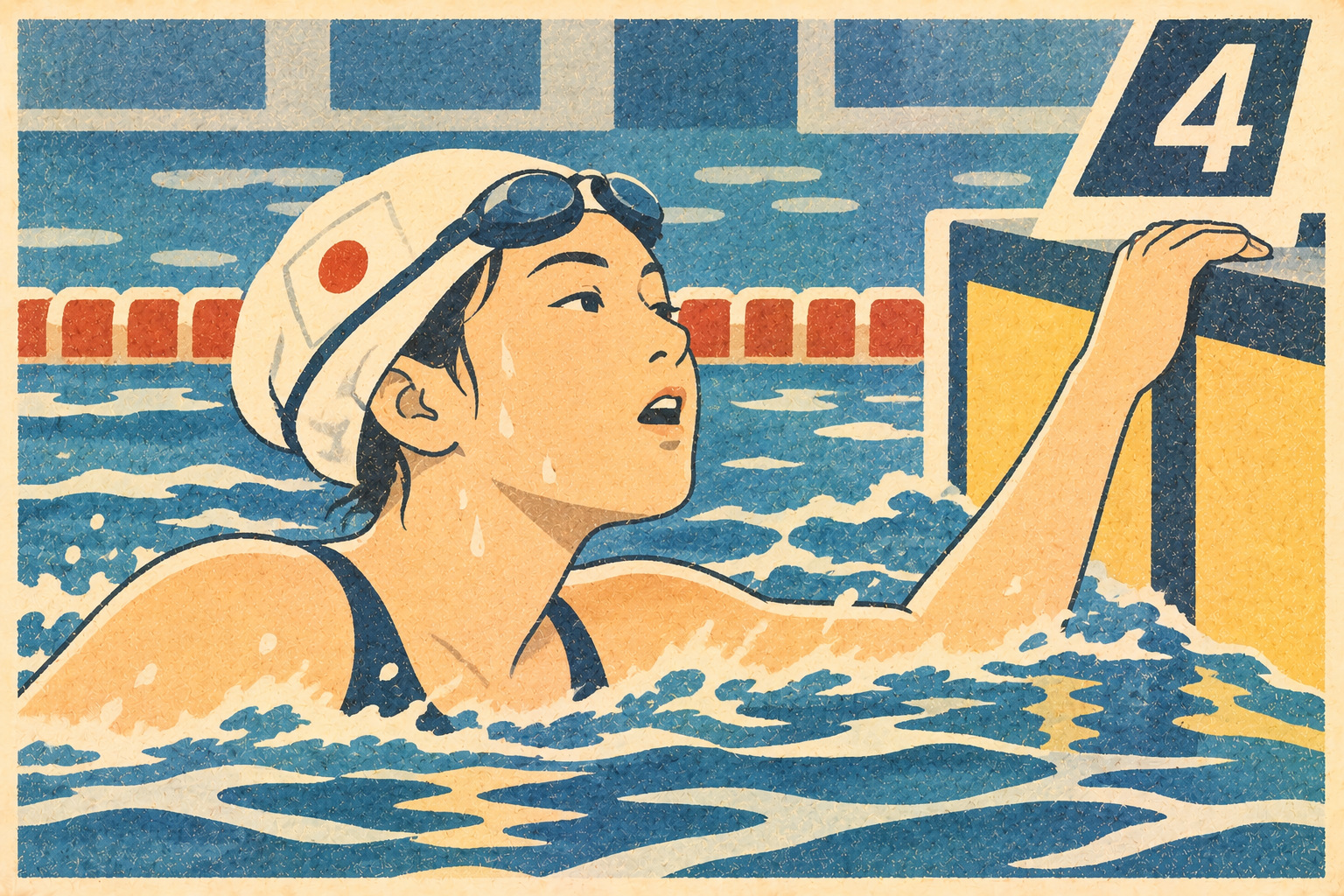
- Four finals, four golds, one unprecedented record
- The first breakthrough was shared
- How the four-gold sequence unfolded
- Miyazaki’s four medals deserve their own account
- Two school students, two Japanese training networks
- A family history stretching back to Atlanta
- Breaststroke and the making of a Japanese sporting memory
- Why Dakar’s location belongs in the story
- What the medals do—and do not—predict
- A completed swimming competition, a much longer journey
Four finals, four golds, one unprecedented record
The most consequential touch of Mana Ishikawa’s week in Dakar came in the shortest breaststroke race. On November 5, the 17-year-old Japanese swimmer finished the women’s 50 metres in 31.76 seconds, completing a sweep that had begun three days earlier with a victory over 200 metres. The fourth gold did not merely make her the leading swimmer of her delegation: according to World Aquatics and the International Olympic Committee, no athlete in the history of the Youth Olympic Games had previously won four individual gold medals at a single edition.
That qualification matters. The distinction covers individual titles at a Youth Olympic Games, across sports. It is not a claim that Ishikawa broke an absolute world record or that she has surpassed every Olympic swimmer in history. Even with those boundaries properly drawn, the achievement is remarkable: four different events, including an individual medley, won on four successive days.
The first breakthrough was shared
Japan’s swimming campaign began its gold-medal run on November 2, when Ishikawa took command of the women’s 200-metre breaststroke. She finished in 2:26.50, beating China’s Chang Mohan, who touched in 2:27.21. The Japanese Olympic Committee identified the performance as the country’s first gold of these Games. In its race account, the committee described Ishikawa setting the pace and then withstanding the challenge of the closing length.
Minutes later, another Japanese teenager won the men’s version of the same event. Iori Miyazaki finished in 2:12.33 after a strong final phase of the race. The contrast between the two wins was instructive: Ishikawa had to defend her position; Miyazaki relied on his finish to take it. Together, the races provided an immediate indication of the depth of Japan’s representation in a stroke closely associated with its swimming tradition.
How the four-gold sequence unfolded
On November 3, Ishikawa added the 100-metre breaststroke in 1:08.81. On November 4, she won the 200-metre individual medley in 2:13.06. The latter victory was especially telling. Unlike a breaststroke race, the medley requires a swimmer to link butterfly, backstroke, breaststroke and freestyle, managing not just speed but the transitions and tactical demands between distinct strokes.
Her final act was the 50-metre breaststroke in 31.76 on November 5, a personal best reported by World Aquatics. The sequence demanded sustained performance across repeated heats and finals, but also adaptability between the precision of a sprint and the pacing of a 200-metre contest. Four days of winning are easy to summarize and far harder to execute.
Miyazaki’s four medals deserve their own account
Miyazaki did not simply accompany a more decorated teammate. His programme produced two gold medals and two silvers. After taking the 200-metre breaststroke on November 2, he finished second in the 100-metre event on November 3, clocking 1:01.30. The following day, he won the 200-metre individual medley in 2:00.71, ahead of New Zealand’s Ariel Muchirahondo. On November 5, he took silver in the 50-metre breaststroke with 28.42, behind China’s Xie Yichen.
That record means that Miyazaki earned a medal in every one of his four scheduled disciplines. His mix of sprint breaststroke, distance breaststroke and medley racing offers evidence of versatility, not just a single exceptional performance. The relevant comparison with Ishikawa is not who was “better,” but how two developing swimmers reached similar breadth of competition through different races and outcomes.
Two school students, two Japanese training networks
The official Japanese Olympic Committee athlete handbook identifies Ishikawa as a third-year student at Nihon University Fujisawa High School in Kanagawa Prefecture, representing Itoman Tokyo. Miyazaki is a second-year student at Shizuoka Prefectural Hamamatsu Commercial High School, affiliated with Hamanako Swimming School. Their names are officially listed as 石川真菜 (Ishikawa Mana) and 宮崎緒里 (Miyazaki Iori), with the latter athlete’s surname also displayed in JOC news coverage using the variant character 﨑.
Their backgrounds highlight a feature of Japanese competitive swimming: the route to international racing is often built through overlapping institutions—schools, private swimming clubs, national junior championships and international age-group meets. Those institutions provide repeated racing opportunities, although access to coaching, facilities and travel funding is not necessarily equal across regions. The Dakar medals tell us that these two pathways produced results; they do not alone prove the entire system is equally accessible or optimal.
A family history stretching back to Atlanta
Miyazaki also carries a personal connection to the senior Olympic Games. Japanese newspaper Nikkan Sports reported in 2024 that his father, Yoshinobu Miyazaki, competed in the men’s 100-metre breaststroke at Atlanta 1996. The report described the younger swimmer’s early immersion in the sport and a national middle-school victory in the 200 metres. World Aquatics likewise notes the Olympic background of his father.
It is a rich human detail, but family history should not stand in for an explanation of performance. Miyazaki’s four medals were earned through training, race decisions and execution against his own generation of international competitors. The more useful story is how an athlete with exposure to elite sport translated that experience into his own competitive identity.
Breaststroke and the making of a Japanese sporting memory
Breaststroke occupies an unusually resonant place in Japan’s Olympic swimming memory. Yoshiyuki Tsuruta retained the men’s 200-metre title at Los Angeles 1932. Kyoko Iwasaki won the women’s 200-metre race at Barcelona 1992 as a 14-year-old. Kosuke Kitajima swept the men’s 100- and 200-metre breaststroke titles at Athens 2004 and Beijing 2008. These performances are milestones in Japanese sport, recalled well beyond swimming circles.
But a lineage is not a mechanism. Techniques change, training science advances and the strength of global fields shifts. Treating a teenager as the automatic successor to an earlier Olympic champion would flatten the individual career into a national myth. Ishikawa and Miyazaki deserve to be understood first as modern competitors with identifiable events, times and development paths.
Why Dakar’s location belongs in the story
The Dakar Games, scheduled from October 31 through November 13, are the fourth Summer Youth Olympic Games. Earlier editions took place in Singapore in 2010, Nanjing in 2014 and Buenos Aires in 2018. Dakar had originally been scheduled for 2022 before the programme was postponed amid the COVID-19 pandemic. The International Olympic Committee describes this edition as the first Olympic sporting event held in Africa.
That setting is more than scenery behind Japan’s medals. The swimming events also brought firsts for countries with smaller histories at this level: World Aquatics reported that Lebanon’s Thea Obeid won her nation’s first Youth Olympic swimming medal in the women’s 50-metre breaststroke, and other delegations celebrated their own breakthroughs. Japan’s results are one part of a wider story about who gets to participate and succeed on an expanding international stage.
What the medals do—and do not—predict
Youth success can reveal elite skills before they are familiar to the wider public. It cannot eliminate uncertainty about the future. The transition to senior international competition involves changing bodies, greater race depth, more demanding schedules, injuries, education decisions and the practical pressures of long-term training. Ishikawa’s four-gold record is already secure as an achievement in its own right, regardless of the senior career that follows.
The same applies to Miyazaki. Two golds and two silvers suggest considerable versatility and composure in this field. They do not establish his future selection for the senior Olympic team, much less guarantee a medal there. The temptation to anoint teenagers as inevitable champions does not make the coverage more accurate; it often obscures the work still ahead of them.
A completed swimming competition, a much longer journey
World Aquatics reported that the swimming programme concluded on November 6. The principal results for Ishikawa and Miyazaki were already final after the November 5 session. Some overview pages maintained by national Olympic bodies may update at different speeds, so event-specific records and World Aquatics’ reporting are the sounder foundation for this account.
When this November 10 edition looks back at Dakar, the central point is not a promise about Los Angeles 2028 or any Games after it. It is what happened in Senegal: Ishikawa became the first Youth Olympian to collect four individual gold medals at one edition; Miyazaki took two golds and two silvers; and two 17-year-old swimmers from Japanese schools and clubs put performances with lasting historical significance into the record books.
Sources and reporting method
Results and names were checked against national and international sporting bodies. The November 5–6 results reflect their published competition records; no athlete interviews are represented as original reporting.
- Japanese Olympic Committee: breaststroke double (November 6)
- JOC: womens and mens 200m individual medley results
- JOC: Ishikawa’s fourth gold, Miyazaki’s sprint silver
- World Aquatics: Ishikawa first to four individual Youth Olympic golds
- World Aquatics: Japan’s double breaststroke gold
- World Aquatics: Dakar swimming concludes November 6
- JOC athlete handbook: Japanese names, readings and affiliations
- International Olympic Committee: history of the Youth Olympic Games
- World Aquatics: Mana Ishikawa athlete records
- World Aquatics: Iori Miyazaki athlete records
- Nikkan Sports: Iori Miyazaki and his Olympic father (2024)