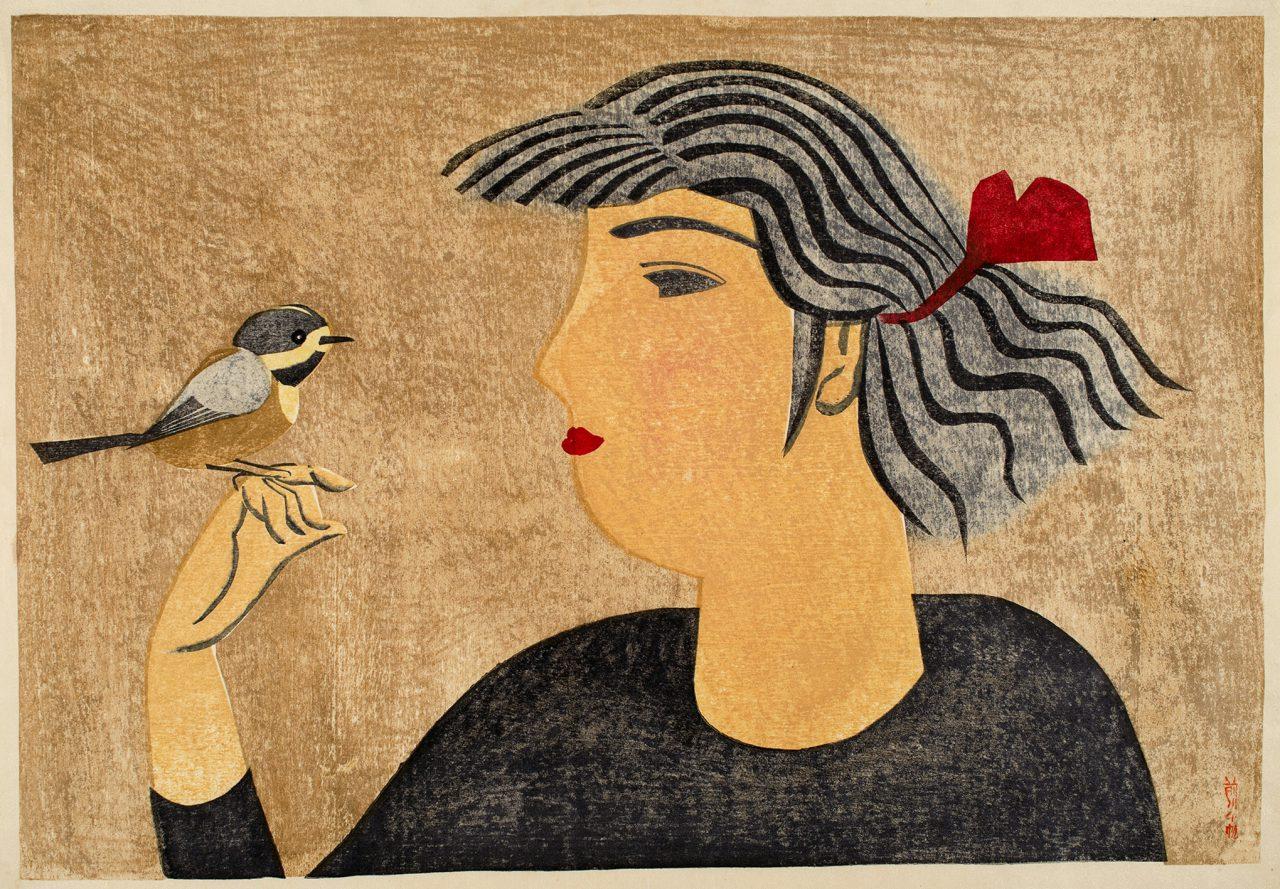
- Why Maekawa Senpan, and why now?
- From Kyoto student to working cartoonist
- Tokyo Puck and the newspaper eye
- Finding a voice in the creative-print movement
- City streets, hillsides and ordinary life
- The underground quality of his modernism
- An Olympian of the arts
- Postwar Tokyo and later reassessment
- Why he fits JAPAN.co.jp’s November 10 edition
- How to look at Senpan today
Why Maekawa Senpan, and why now?
Every JAPAN.co.jp edition needs more than a list of stories. It also needs a visual intelligence that can hold the edition together. For the November 10, 2026 issue, the strongest choice is Maekawa Senpan, a Japanese artist who remains less famous than many canonical printmakers but is arguably more useful to a modern newsroom.
Born in Kyoto in 1888, Maekawa moved through several worlds at once: art school, cartooning, newspapers, and creative woodblock printing. He was not a specialist in a narrow genre. He was an image-maker for modern life. That breadth matters. The November 10 lineup ranges from artificial intelligence and superconductors to youth sports, housing, eel culture, music and cinema. Maekawa’s art can move across all of them because his subject was often not “high drama” but lived reality itself.
His works do not shout. They simplify. They isolate a moment, a silhouette, a street, a roofline, a figure on a stairway. In an age of visual overload, that economy feels newly contemporary. It is also why he makes sense as the featured artist for an edition that wanted one clear focal point in every illustration.
From Kyoto student to working cartoonist
Institutional biographies identify Maekawa as a Kyoto-born artist who studied at the Kansai Bijutsuin under Asai Chū and Kanokogi Takeshirō before moving to Tokyo. That is important background, but it does not fully explain his later visual language. The key to that language lies in his professional life as a cartoonist and illustrator.
By the 1910s he was working in the world around Tokyo Puck, the satirical magazine associated with Kitazawa Rakuten. Later sources also connect him with newspaper work, including the Yomiuri Shimbun. This matters because cartooning and newspaper illustration train an artist to compress meaning quickly. A reader should understand the image at a glance, but the image should still retain character. Maekawa never lost that discipline.
The result is a printmaker whose compositions remain legible even when they are stylized. His figures are simplified without becoming empty. His spaces feel designed, but never cold. He learned how to communicate under pressure, and that skill stayed with him when he turned to printmaking.
Tokyo Puck and the newspaper eye
Tokyo Puck occupies an important place in the history of Japanese caricature and mass visual culture. Working in that orbit meant learning how to observe society through exaggeration, timing and compression. Maekawa carried those lessons forward. He looked at the city not as a grand monument but as a set of relationships: foreground and distance, humor and tension, architecture and motion.
That newspaper-trained eye helps explain why his prints often feel so immediate. He had a reporter’s instinct for choosing the one telling angle. A street does not need every pedestrian. A skyline does not need every building. One figure, one slope, one rail, one lantern, one empty zone of paper can do the work.
For a newsroom, this is especially appealing. Maekawa belongs to the tradition of artists who understood that simplification is not the enemy of truth. It is often what allows truth to be seen at all.
Finding a voice in the creative-print movement
Maekawa is usually placed within the sōsaku-hanga, or “creative print,” movement. In contrast to the collaborative production system associated with earlier ukiyo-e, creative prints emphasized the artist’s own responsibility for drawing, carving and printing. That ideal of self-made image-making gave modern print artists unusual freedom—and also left more of their personal idiosyncrasies visible on the page.
Maekawa exhibited at the first exhibition of the Japanese Creative Print Association in 1919, according to biographical summaries used by institutional collections. From then onward he built a substantial career as a print artist without surrendering the wit and compression he had cultivated as a cartoonist. That combination is one reason he feels difficult to classify. He is serious without becoming solemn.
His woodcuts and prints are not exercises in decorative nostalgia. They are modern works by a modern observer who happened to use the woodblock medium exceptionally well.
City streets, hillsides and ordinary life
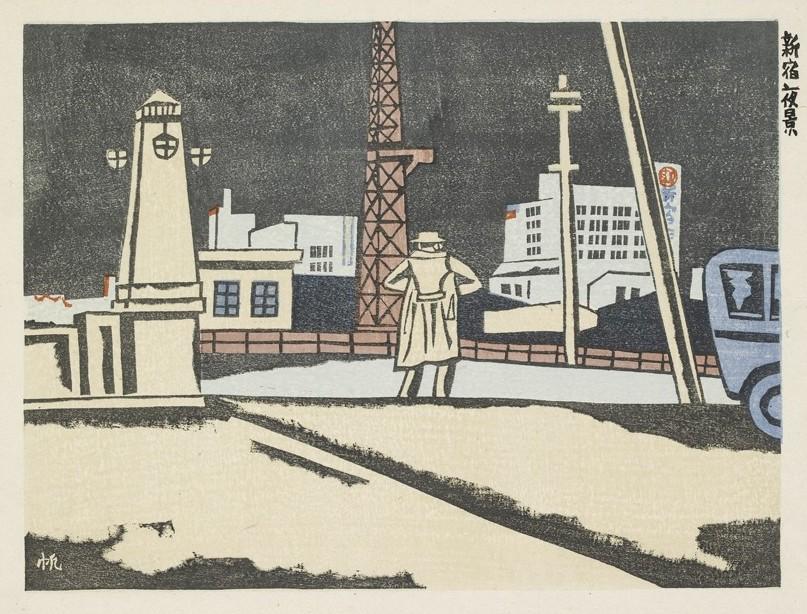
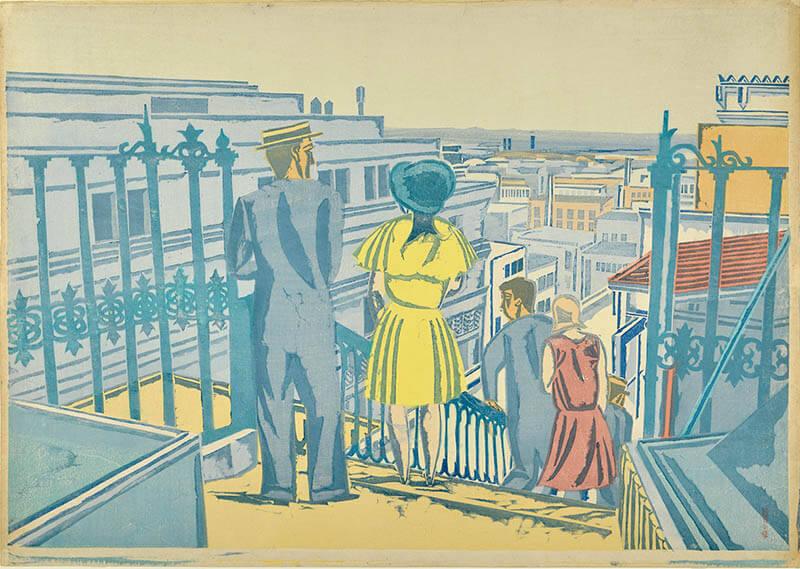
Maekawa’s surviving oeuvre shows remarkable range. University collections list works involving birds and butterflies, roads ascending Mount Akagi, factory districts in Fukagawa, Shinjuku at night, Gion festival scenes, hot-spring travel notes and postwar urban imagery. He was not trapped in a single signature subject.
Yet the variety hides a consistent principle. Whether he was looking at a city quarter, a hill road or a group of people, Maekawa preferred motifs anchored in ordinary experience. He did not need a heroic event to make a compelling image. He could make an image out of a view, a pause, a pattern of roofs, or a small gesture of the body.
That is one reason his work feels unexpectedly compatible with journalism. Much of journalism, at its best, is also an art of attention to what other people overlook.
The underground quality of his modernism
Calling Maekawa “underground” does not mean he was marginal in the sense of being unserious. It means his work often feels slightly off-center from official narratives of Japanese art. He was neither a conventional ukiyo-e revivalist nor a doctrinaire avant-gardist. He occupies a productive in-between space.
His compositions can feel like early independent comics translated into woodblock form: graphic, compressed, dryly humorous and unafraid of emptiness. Even when his subject is a cityscape, his image is never just documentation. It is observation sharpened by design.
This is precisely why he is a useful artist for a twenty-first century edition. The most interesting visual identities are rarely the most overexposed ones. They are the ones that can still surprise a reader.
An Olympian of the arts
The single most startling fact about Maekawa’s career is that he participated in the Olympic art competitions of both 1932 and 1936. Before the modern Olympics abandoned such contests, the Games included architecture, literature, music, painting and sculpture alongside athletic events. Maekawa appears in Olympic-reference records as a Japanese participant in painting at Los Angeles and Berlin.
This does not make him an Olympic celebrity in the modern sense. But it does make him historically unusual. It places him inside a moment when visual art and sport were still imagined as part of one international cultural project.
That fact gives his selection an elegant resonance for JAPAN.co.jp’s November 10 edition, which includes three sports features. Maekawa was not simply a printmaker who can illustrate sports. He was an artist whose own biography already touches Olympic history.
Postwar Tokyo and later reassessment
Works identified as Scenes of Last Tokyo and other postwar city images show how effectively Maekawa handled the modern metropolis. He saw Tokyo not only as a location but as a rhythm of forms—windows, roads, wires, receding blocks, moving people. His urban pictures are pared down, but never dead.
In 2021, Chiba City Museum of Art devoted a major exhibition to him, reaffirming his standing among specialists and museum audiences. That matters. Retrospectives do not automatically create mass fame, but they do signal scholarly and curatorial seriousness.
At the same time, Maekawa remains far from a household name outside print circles. That may be an advantage. He still feels available for rediscovery rather than embalmed by consensus.
Why he fits JAPAN.co.jp’s November 10 edition
Maekawa’s visual language is highly adaptable without being vague. It can translate a bank building into a financial symbol, an abstract scientific concept into a geometric image, or a swimmer, wrestler or table-tennis ball into a concise focal event. His prints are excellent reminders that strong editorial art does not need to be overloaded to be effective.
Just as importantly, his work retains a human scale. Even when architecture dominates the image, the viewer senses the body in relation to space. Even when the composition is graphic, it does not feel mechanical. That balance—between modern design and human presence—is exactly what a broad digital newspaper needs.
For a publication that cares about both discovery and coherence, Maekawa is close to ideal.
How to look at Senpan today
Maekawa Senpan should not be approached only as a footnote to sōsaku-hanga or as a curiosity who once entered Olympic art competitions. He deserves attention as a maker of modern images who crossed professional boundaries with unusual fluency.
He was a serious artist, but also a working media professional. He knew how to reduce, how to stage, how to make a line do more than one job. That combination gives his work a vitality that can still speak powerfully to readers now.
If JAPAN.co.jp’s November 10 edition leaves readers curious enough to seek out more of his prints, that will be one sign the choice succeeded. Maekawa was never the loudest artist in the room. He was one of the most observant.
Sources and reporting method
The feature was written from public source material. Exact dates, titles and object details may vary by institution.
- Chiba City Museum of Art — Maekawa Senpan exhibition
- University of Oregon / Lavenberg Collection — Maekawa Senpan
- Tolman Collection of Tokyo — Senpan Maekawa
- Olympedia — Senpan Maekawa
- Olympedia — Art Competitions at the 1932 Summer Olympics
- Olympedia — Art Competitions at the 1936 Summer Olympics
- National Diet Library Search — bibliography related to Tokyo Puck