- A painter from a mountain crossroads
- Tokyo, a novelist and the apprenticeship
- How modern nihonga found its voice
- A lesson in Europe—and in an ancient Chinese scroll
- Yoritomo in a Cave: a heroic image of defeat
- Why the armor seems almost real
- Cormorants: the painter of movement without noise
- The plum blossoms and the art of restraint
- A lifetime devoted to keeping art alive
- Gifu remembers its artist
- What modern artists can—and cannot—borrow
A painter from a mountain crossroads
In Nakatsugawa, a town on the old Nakasendō highway in eastern Gifu, a marker identifies the birthplace of Maeda Seison. Born on January 27, 1885, as Maeda Renzō, he would become one of the most accomplished painters of twentieth-century Japan. The road around his childhood home once connected merchants and travelers across mountains. It is a useful place to begin his story, because Seison’s art also crosses boundaries: between historical narrative and close observation, between Japanese pictorial tradition and lessons absorbed abroad, and between the creation of new works and the preservation of old ones. He is remembered for dazzling armor, yet there is an equally revealing Seison in the ink-dark plumage of cormorants and the open space surrounding delicate plum blossoms. For Gifu, he is more than a distinguished native son. His career demonstrates how a regional upbringing could lead to a central role in redefining what modern Japanese painting might be.
Tokyo, a novelist and the apprenticeship
Seison showed an early gift for painting and left Nakatsugawa for Tokyo in 1901, aged sixteen. According to Nakatsugawa City’s historical account and the national museum collection database, the novelist Ozaki Kōyō helped introduce him to Kajita Hanko, a painter especially skilled in historical subjects. Under Hanko, the young artist studied both direct observation and older pictorial models. In 1902 a warrior subject, Kaneko Ietada, attracted attention, and Hanko gave him the artistic name Seison. Training in the period demanded more than copying prestigious predecessors. A historical scene had to persuade viewers that its bodies, garments and objects occupied real space. The disciplined handling of a sleeve or an armor plate could carry as much significance as a face. Seison learned to look closely at the world and then reshape that knowledge through the language of Japanese painting.
How modern nihonga found its voice
The word nihonga—Japanese-style painting—does not describe an art form sealed off from change. In the decades after the Meiji Restoration, painters and institutions were asking how familiar materials, formats and motifs could remain vital in a modern art world. Seison participated in the Kōjikai study group from 1907, joining young artists who tested new ways of drawing on the past. When the Japan Art Institute was reconstituted in 1914, he exhibited a hot-spring scene and a painted scroll inspired by the Tale of the Bamboo Cutter. He became an institute member, later emerging alongside Kobayashi Kokei and Yasuda Yukihiko as one of the leading figures of its exhibitions. Their work differed, but each resisted the idea that traditional painting should be merely a museum artifact. Seison’s history paintings were modern not because he discarded old models, but because he chose how to make them speak again.
A lesson in Europe—and in an ancient Chinese scroll
In 1922 and 1923 Seison traveled to Europe with Kobayashi Kokei under the auspices of the Japan Art Institute. At the British Museum they studied and copied the Admonitions Scroll, traditionally associated with the Chinese painter Gu Kaizhi. Seison’s European journey also exposed him to monumental historical and religious painting. The Museum of Fine Arts, Gifu notes the influence of large-scale European composition and technical experimentation in his later painting Roman Mission, which portrays the Tenshō embassy. This was neither a surrender to Western naturalism nor a retreat into a fixed Japanese identity. Seison used the experience to rethink composition, scale and surface. Studying a Chinese scroll in London while exploring European art made his understanding of tradition more international, not less. The results helped turn historical Japanese imagery into something newly commanding.
Yoritomo in a Cave: a heroic image of defeat
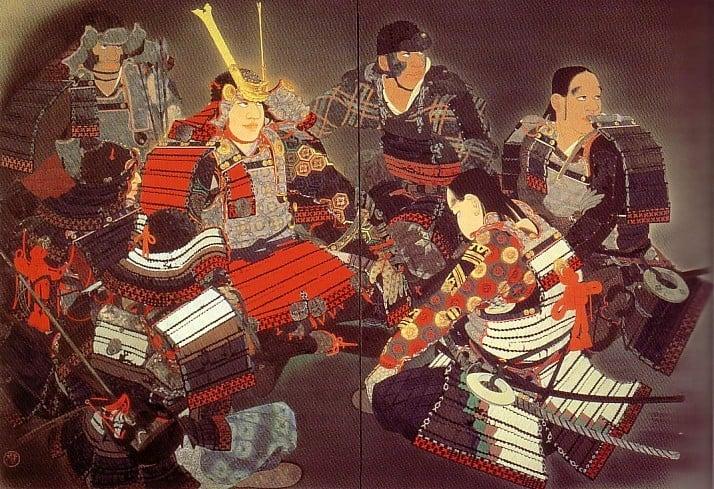
His defining painting arrived in 1929. Yoritomo in a Cave depicts Minamoto no Yoritomo and six retainers hiding in a mountain cave after defeat at the Battle of Ishibashiyama. There is no victorious charge. The moment is quiet and precarious; the warriors’ disciplined stillness suggests that survival and resolve can be as dramatic as battle. Their armor provides a symphony of lacquer red, black, blue and gold, arranged within a close, theatrical space. Crucially, Seison researched the subject. The Okura Museum of Art records his examination of surviving armor, pictorial scrolls and sketches made from a person dressed in a reproduction of historic equipment. The painting belongs to the Okura Cultural Foundation and was designated an Important Cultural Property on June 29, 2010. It is not a generic illustration of a samurai legend. It is an ambitious effort to make historical imagination answer to visual evidence.
Why the armor seems almost real
The extraordinary armor in Yoritomo in a Cave is not simply an exercise in ornament. Interlaced cords, hard plates, metallic fittings and layered textiles form an intricate structure around the warriors. The Gifu museum’s retrospective notes that Seison experimented with pigment and animal-glue concentrations to suggest the sheen of metal. The effect is tactile as well as visual. Each figure carries a distinct mass, and every turn of the head participates in the tension of the group. Negative space is not emptiness but a way to place attention where it belongs. These qualities also explain why contemporary editorial artists may turn to Seison when depicting industrial technology. A mechanical assembly can take on unexpected dignity through precise rendering, a coherent focal point and restraint elsewhere. The point is to learn from his observation and structure, not to paste samurai armor onto a robot and call the result historical art.
Cormorants: the painter of movement without noise
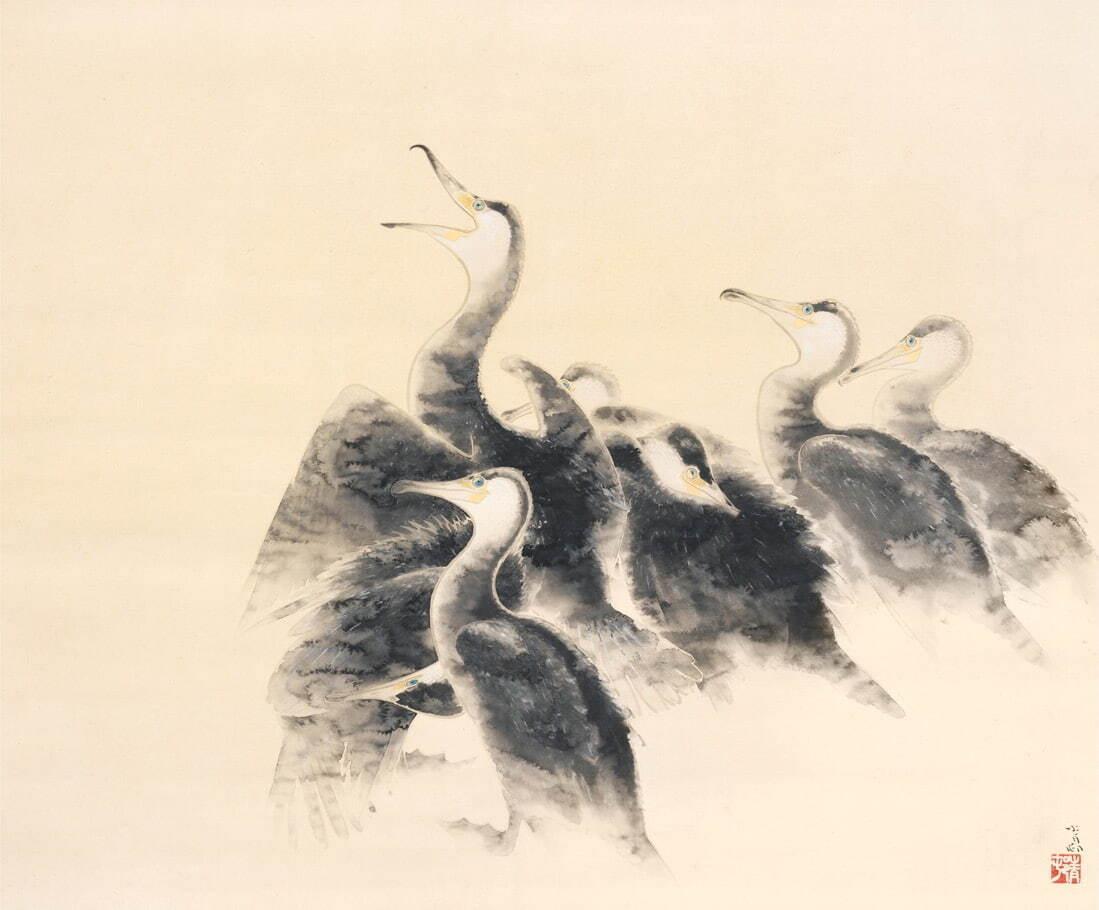
The other Seison may be quieter but is no less sophisticated. The Gifu retrospective describes a work titled Cormorants, completed in 1940 after the artist observed cormorant fishing in 1933. He grouped the birds toward one side of the composition, leaving one bird with lifted neck and open wings to command the scene. Fresh washes of ink distinguish the dark, glossy plumage from the surrounding light. Gifu’s long association with cormorant fishing on the Nagara River adds regional resonance, although the painting stands on its own as a close study of animal movement. Other museum catalogs document distinct works entitled Cormorant Fishing, dated around 1933 and 1956. Those titles should not be conflated. In contrast with the warriors’ layered armor, the birds demonstrate Seison’s ability to construct a memorable scene with relatively few marks and ample unpainted space.
The plum blossoms and the art of restraint
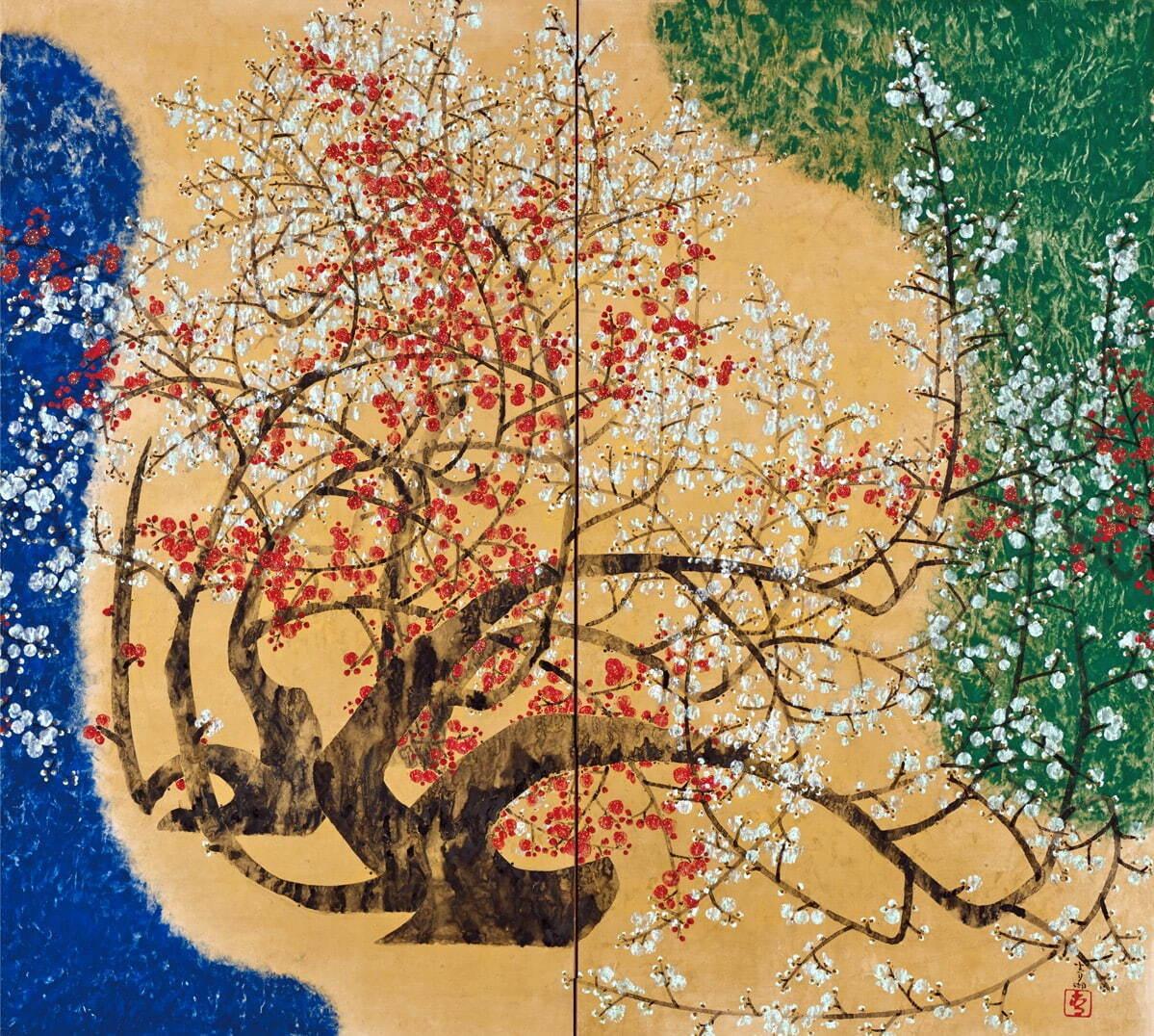
Red-and-white plum blossoms occupied another place in Seison’s visual imagination. The 2022 Gifu exhibition included a Red and White Plum Blossoms work held by the Hiroshima Museum of Art. The national Art Platform Japan database also catalogs works with that title dated 1960 and 1963 in the Tendo City Museum of Art collection. That multiplicity matters when identifying reproductions: a website filename alone does not establish which original version has been reproduced. The formal lesson is clear even without a disputed date. Plum branches bend and spread in expressive rhythms; small concentrations of blossoms bring a surface to life; red and white become part of a larger orchestration of pigment, ground and negative space. These compositions demonstrate the decorative delicacy of a painter who could also work at epic scale. Warrior painting and flower painting are not opposed extremes, but expressions of one extraordinary sensitivity to arrangement.
A lifetime devoted to keeping art alive
After the war, Seison taught at Tokyo University of the Arts, receiving the Order of Culture in 1955. He later took a leading role in the reconstruction or copying of some of Japan’s most significant ancient paintings. The projects included work on the Hōryūji Golden Hall murals in the late 1960s and the Takamatsuzuka tomb murals in the early 1970s. Copying in this context was not a mechanical production task. Understanding how lines, colors and layers had survived—or failed to survive—required an artist’s eye and the judgment of conservation specialists. The painter who had spent decades researching images of the past became a participant in documenting that past for future generations. His public stature can be measured by medals and appointments; his longer influence is also visible in the care with which old visual knowledge was handed forward.
Gifu remembers its artist
Nakatsugawa City identifies Seison’s birthplace in the old post town and honors him as an honorary citizen. A dedicated memorial museum was once established in the area, but it subsequently closed; readers should not assume it is operating today. In 2022 the Museum of Fine Arts, Gifu mounted a major retrospective, The Ultimate White, the Heavenly Blue, presenting more than a hundred works across the artist’s career. The show brought Yoritomo in a Cave back to Gifu after its designation as an Important Cultural Property and placed it beside works that reveal his broader artistic range. That exhibition was held in 2022, not in November 2026. Its online scholarship remains valuable because it explains why Seison’s palette, treatment of surface and understanding of historic forms deserve renewed attention. The town marker and the museum catalog tell different parts of the same story: a local origin and an international artistic legacy.
What modern artists can—and cannot—borrow
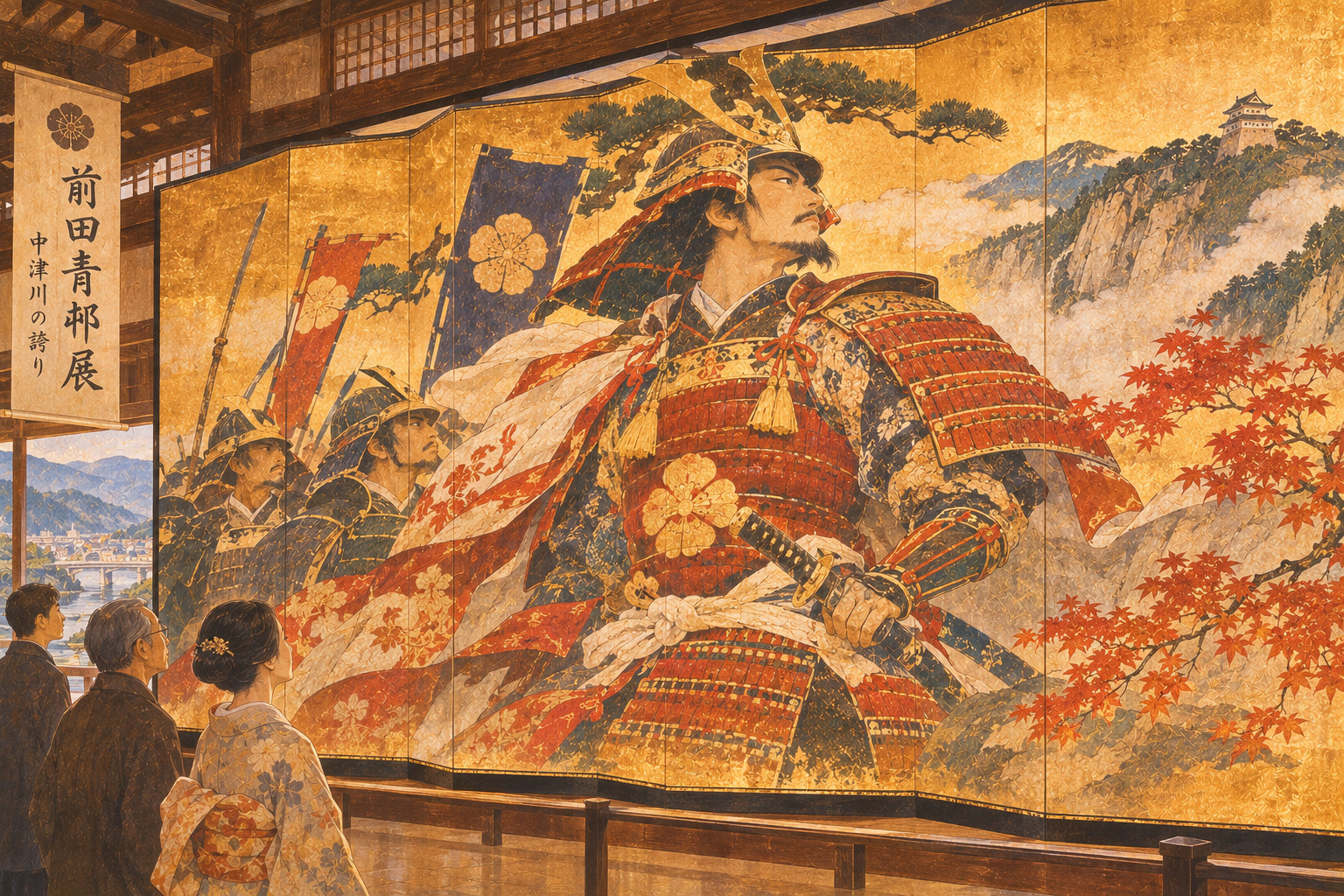
For its November 2026 Gifu special edition, JAPAN.co.jp uses new AI-generated editorial illustrations inspired by Seison across reports on industry, science, communities, sport and culture. These images are contemporary interpretations; they are neither paintings made by Seison nor documentary photographs of the news being reported. The distinction matters especially in an artist profile, where reproductions of actual work appear alongside an imagined hero image. Seison’s deepest influence is not a recipe for gold backgrounds, stylized clothing or dramatic machinery. It is a discipline of looking: observing how an armored figure waits, how a bird folds its wings, how plum blossoms create rhythm against open space. The painter from Nakatsugawa left a legacy richer than a recognizable visual effect. He showed how to make history, nature and material presence newly visible, without allowing spectacle to erase the particular thing being painted.
Sources and reporting method
Japanese museum and cultural-property records take priority. Distinct works sharing a title are not treated as one. The 2022 retrospective is historical context, not a current exhibition.
- Museum of Fine Arts, Gifu: Seison retrospective, works and art history (2022)
- Nakatsugawa City: birthplace, childhood and Nakasendo connections
- Agency for Cultural Affairs: Important Cultural Property, Yoritomo in a Cave
- Okura Museum of Art: Yoritomo in a Cave, subject and source material
- National Museum of Art collection database: Seison biography
- Art Platform Japan: verified 1960 Red and White Plum Blossoms work
- Art Platform Japan: verified 1963 Red and White Plum Blossoms work
- Art Platform Japan: 1956 Cormorant Fishing in the Gifu museum collection
- Shizuoka Prefectural Museum of Art: artist chronology and painting practices
- Kitano Museum: Seison biography and cultural-heritage projects
- Tokyo National Research Institute for Cultural Properties: 2010 designation recommendation
- Museum of Fine Arts, Gifu: retrospective dates and exhibition record