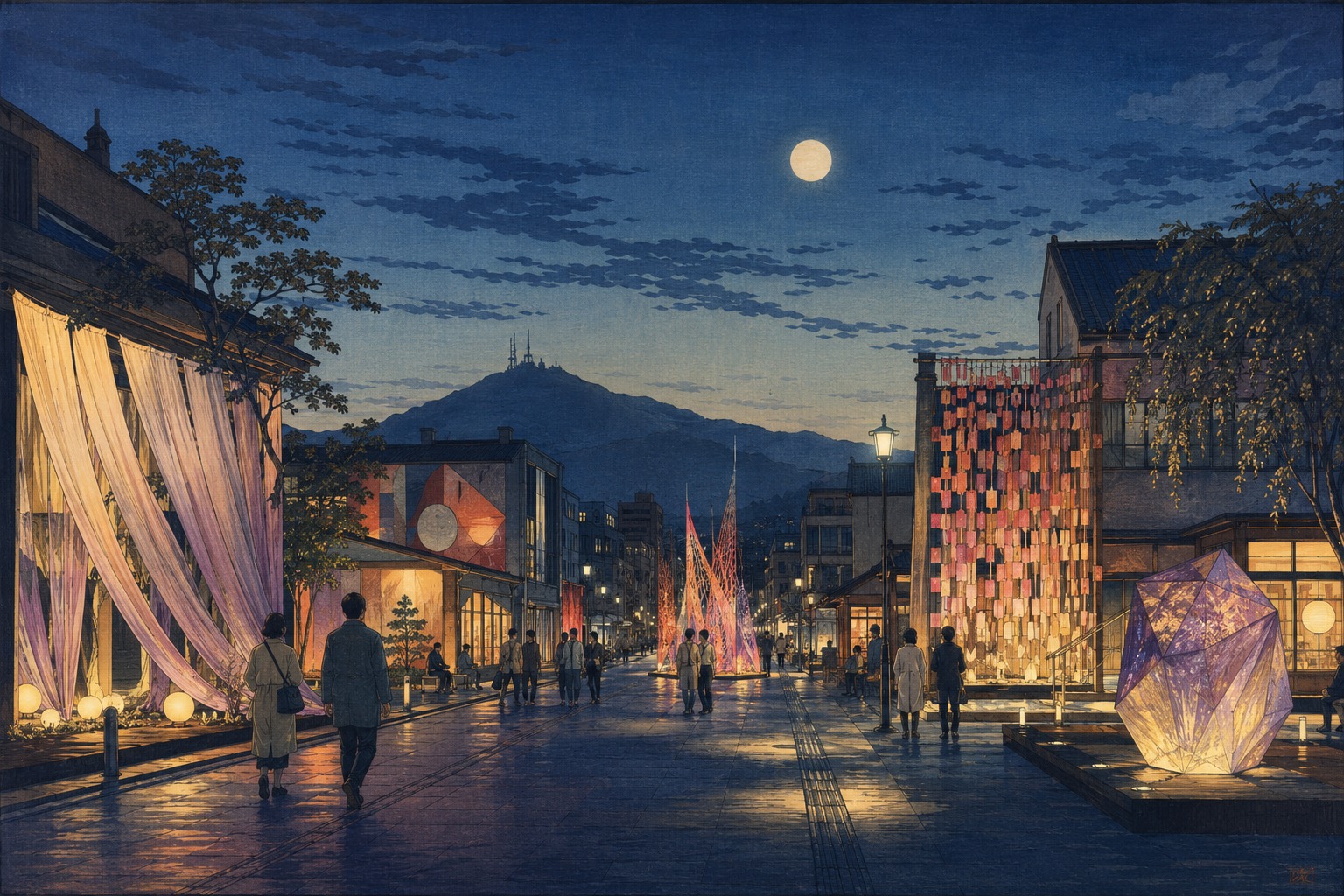
The official website for the Maebashi International Art Festival, also branded Maebashi Biennale 2026, formally opened on July 31, 50 days before the event. The festival itself has not begun. It will run from September 19 through December 20 in central Maebashi. This report examines the announced program, its historical setting and the urban strategy it is designed to test.
The route is the work
When the doors open on September 19, the shortest way to understand Maebashi’s first international art festival may be to ignore the shortest route. Begin at Arts Maebashi, the white aluminum museum made from a former department store. Step outside to a keyaki tree where Tadashi Kawamata plans a wooden “Tree Hut.” Cross toward a bank plaza, an arcade and the half-ruined Hauze Building. Continue to the vegetation-draped Shiroiya Hotel, the Maebashi Galleria and the former Yasuda Bank collateral warehouse. What appears on a map as a handful of blocks becomes a cross-section of 150 years.
The organizers’ phrase is simple: “Walk with art. Walk the city.” Most venues fit within roughly 500 meters square. That compactness is not a convenience added to the exhibition; it is the curatorial proposition. The visitor must repeatedly leave the protected neutrality of a gallery and encounter traffic, shopkeepers, vacant shutters, new condominiums, river air and other people’s routines. Architecture becomes both container and exhibit. The distance between works becomes a place in which Maebashi argues with itself.
More than 70 artist and creator groups are expected to work across contemporary art, architecture, music, poetry, theater, film, fashion and food, with more than 20 collaborations involving local creators. Arts Maebashi, Maebashi Galleria, Shiroiya Hotel and the Maebashi Literature Museum anchor the route, but shops, galleries, empty buildings, shopping streets and public open spaces widen it. A general passport costs ¥3,000, students in higher education ¥2,000, and those of high-school age and younger enter free; several outdoor and associated programs are also free, while limited performances require separate tickets or reservations.
The walk between the works may be the festival’s most important work.
A city that once sold silk to the world
Maebashi’s international history did not begin with a biennale. By the late Edo period, the area was an important market for cocoons and raw silk. In 1870, a mechanized silk-reeling mill began operating in Maebashi before the better-known Tomioka Silk Mill opened nearby. Reeling plants and cocoon-drying exchanges multiplied, and silk shipped through Yokohama helped turn the city into what local history remembers as the “city of raw silk.” The municipal library preserves about 4,500 records from that industry.
This prosperity gave the center its mercantile confidence. Factories stood along the Hirose River; merchants, banks and warehouses organized the movement of fiber, credit and labor. Silk was a material that linked domestic rooms and mountain mulberry fields to global fashion and finance. The festival’s claim to be “international” therefore works best when it is not understood as a parachute drop of famous names. Its deeper task is translation: to make the local layers legible to people who do not already know them.
Alexa Kumiko Hatanaka offers one such bridge. The Japanese-Canadian artist, selected for the 61st Venice Biennale, has been researching papermaking through a Maebashi residency and will exhibit at Arts Maebashi. Paper is not silk, but her attention to fiber, handwork, transmission and place can reopen a city’s manufacturing memory without turning a factory age into nostalgia. The announced artist-in-residence program has, since 2025, placed makers in the shopping streets to live, research and create with residents. That duration matters. A visiting artist can treat a neighborhood as scenery; a resident artist must negotiate with it.
Poetry made by walking
Maebashi calls itself a city of water, greenery and poetry because Sakutaro Hagiwara was born here in 1886. Often described as the father of modern Japanese poetry, Hagiwara helped liberate verse from inherited diction by writing in colloquial, psychologically exposed free verse. He was also a walker. A 2026 Maebashi Literature Museum exhibition cast him as a flâneur, tracing how wandering through Maebashi and Tokyo sharpened his modern urban perception.
That history gives the festival’s walkability an intellectual lineage. Walking is not only transit between objects; it is a method for gathering fragments. Ayaka Wada’s collaboration with the Gunma University–affiliated junior high school music club will collect hidden words and urban sounds and turn them into improvisation. Elsewhere, poetry, performance and music are meant to interrupt the visual-art hierarchy. The city is heard and spoken, not merely viewed.
The theme, Mebuku. Where good things grow., comes from a civic-vision process begun in 2016. A German branding firm, KMS TEAM, analyzed the city; Maebashi-born copywriter Shigesato Itoi rendered the proposition in the concise Japanese verb mebuku—to bud or sprout. It is an unusually patient word for a festival slogan. Budding is not unveiling. It describes a process whose outcome remains uncertain.
The night the center burned
Any account of central Maebashi that speaks only of growth is incomplete. At 10:28 p.m. on August 5, 1945, an American air raid began over the city. By 12:08 a.m., about 180,000 incendiaries had fallen. Municipal history records that roughly 80 percent of the central area burned and about 600 people died. The old mercantile landscape was not slowly replaced; much of it was destroyed in a single night.
The festival’s most ethically demanding works are those that refuse to make this past a picturesque texture. On October 31 and November 1, theater director Takahiro Fujita, musician Ikuko Harada and artist Izumi Aoyagi plan koe oto note in the former Yasuda Bank collateral warehouse, connecting testimony and the memory of the Maebashi air raid through voices, sound and notation. The venue is not a neutral black box. Its survival and damage make the building part of what the performance asks audiences to remember.
This method has already been tested. In 2025, Arts Maebashi presented Mum & Gypsy’s Curtain Call across five urban sites, drawing on testimony from air-raid survivors and research into the silk industry. The city’s own evaluation described the project as a study toward the 2026 festival. Its Arts Maebashi component drew 3,498 visitors and, more importantly for the coming biennale, encouraged movement between art, literature and the city.
If a city is the exhibition, memory cannot be relegated to wall text. It occupies the route.
From department-store decline to a museum without a front door
Postwar rebuilding restored central Maebashi as a place of shopping and administration, but the familiar forces of regional urban decline gathered from the late 1990s: suburban retail, car dependence, demographic contraction and the gravitational pull of larger cities. Footfall thinned. Buildings lost their original uses. “Vacant” became an architectural category.
Arts Maebashi opened in October 2013 inside one of those former commercial structures. Its conversion preserved the memory of the old building while inserting white aluminum surfaces and paths that its architects conceived as an extension of strolling through the city. Its three founding ideas—creative, share and dialogue—were civic rather than monumental. The museum was meant to have a relationship with the center, not behave like an isolated cultural palace.
The 2023 tenth-anniversary exhibition New Horizon expanded through downtown venues. The 2026 festival scales that approach into a recurring biennial. It also gives abandoned or underused buildings temporary assignments. The Hauze Building, for example, will host an opening live program from September 19 to 21 featuring Jim O’Rourke, Carl Stone, Christophe Charles and others. An Algorave will send code-generated electronic music through another semi-ruined space. Mika Ninagawa and the creative team EiM will install a new work in Hauze, following their 2023 use of a closed cabaret and Shiroiya Hotel.
Reactivation is seductive because the before-and-after image is powerful: darkness becomes light; a locked door opens; people queue. Yet temporary use is not the same as repair, and an event crowd is not the same as a functioning neighborhood. The festival will make vacancies visible as possibility. It will also make visible how many remain.
The city’s new architecture is also on trial
Maebashi’s recent regeneration is unusually architectural. Shiroiya Hotel combines a stripped concrete remnant with Sou Fujimoto’s green hill-like addition. Akihisa Hirata designed the Maebashi Galleria as a mixed-use complex with folded, cave-like public space. Babakkawa Square, Maebashi Arcade Terrace, Nakamata and Jasper Morrison’s public toilet form smaller pieces of an emerging pedestrian network. Other projects remain planned, including Maebashi Ridgeline, redevelopment of the Sakuraya site and Babakkawa Garden Park.
A free exhibition at Arts Maebashi, Maebashi Visionary City Guide—Architecture of Maebashi: Walking Through a Dreaming City, will put models and research on this past, present and proposed city in one room. Architectural historian Keitaro Usui’s work gives the display a documentary spine. A related dialogue series will ask what the decade after Mebuku should become.
The sequence is important. These are not festival pavilions that disappear in December. They are real-estate, hospitality and public-space decisions that precede and outlast the art. The biennale provides a narrative connecting them. It can help residents and visitors see scattered developments as a city. It can also make private development appear inevitably public-minded. Critical attention must run in both directions.
| Layer of the city | What history left | How the festival responds |
|---|---|---|
| Silk and exchange | Factories, commercial confidence and an early global connection through raw silk. | Residencies, material research and an international program grounded in local production stories. |
| Poetry and walking | Hagiwara’s urban wandering and Maebashi’s identity as a city of poetry. | A walkable plan, collected street sounds, language, music and performance. |
| Air-raid memory | Destruction of about 80% of the center and roughly 600 deaths in August 1945. | Site-specific performance in a surviving warehouse and earlier testimony-based research. |
| Retail hollowing | Empty shops and structures after the decline of the traditional commercial center. | A former department store as museum; temporary exhibitions and concerts in vacant buildings. |
| Private-led rebuilding | Hotels, housing, plazas and adaptive reuse concentrated in a small downtown. | An architecture exhibition and an art route that links separate investments into a public story. |
A different kind of regional art festival
Japan has spent a quarter-century learning how contemporary art can redirect attention toward places excluded from conventional tourism. The Echigo-Tsumari Art Triennale, begun in 2000 across the mountains and villages of Niigata, became the pioneer. The Setouchi Triennale later made island landscapes, depopulation and the Inland Sea part of an international itinerary. Research on such festivals finds real benefits: visitor spending, reuse of buildings, volunteer networks, cultural confidence and renewed contact between urban audiences and aging communities.
The same research also warns against easy equations. A burst of attendance is not demographic recovery. Outside artists and tourists can displace local voices even when the rhetoric celebrates them. Communities are asked to perform an identity legible to visitors. Benefits depend on sustained resident and entrepreneur involvement, not only curatorial ambition.
Maebashi’s model is different in scale. Echigo-Tsumari requires travel across hundreds of square kilometers; Maebashi compresses its proposition into a central grid that can be crossed in minutes. It is less a journey through remote landscapes than a test of everyday urban circulation. Visitors may pass a performance, buy lunch, enter a shop, see an apartment lobby, encounter schoolchildren making music and return to the station without changing transport. The festival’s strongest economic mechanism may therefore be mundane: walking slowly enough to notice a door.
Who gets to define “good things”?
The regeneration story has a prominent private-sector author. Hitoshi Tanaka, the Maebashi-born founder of eyewear company JINS, helped establish a foundation and, with the city, the civic vision that produced Mebuku. He chairs the festival’s executive committee. The Maebashi Design Commission describes a shift from government-led development toward work led by citizens and private actors. More than 20 companies are supporting or sponsoring the festival, and Tanaka has argued that art is ultimately city-building: a means of bringing new ideas, workers and residents.
This can move faster than conventional municipal redevelopment and can assemble design quality that fragmented public works rarely achieve. It also concentrates agenda-setting power. Who chooses which buildings deserve rescue, which histories appear in the brand, which artists are invited and which future residents are imagined? A premium hotel and destination restaurant can bring attention and employment; they can also create a polished urban narrative priced beyond many residents’ daily life.
The access design contains both impulses. Admission is free for high-school students and younger, and much outdoor work can be seen without a passport. At the other end are separate performances and tourism packages, including premium guided travel. The city’s fiscal 2026 initial budget lists a ¥5 million contribution funded by corporate hometown-tax donations; that line is not the festival’s total budget, which the reviewed public material does not disclose. A privately led event still uses public streets, civic legitimacy and municipal services. Transparent reporting on money, labor and outcomes will be essential.
Then there is the most fashionable danger: art as a soft-focus real-estate rendering. If culture merely makes an investment district more desirable, the people who sustained the center through its least glamorous decades become background characters in somebody else’s revival. Preventing that outcome requires more than community-themed art. It requires paid local work, accessible spaces, durable tenancies, resident authority and the freedom for artists to criticize the regeneration that hosts them.
Look beyond the attendance number
Attendance will be the easiest measure to publish after December 20, and probably the least sufficient. A festival can generate hotel nights, restaurant sales and social-media reach. The harder evidence will emerge during ordinary weeks in 2027: whether people walk the same streets without an event map; whether an activated building gains a safe, permanent use; whether a collaboration continues; whether a student imagines a future in Maebashi; whether local businesses receive more than a three-month spike.
| After the festival, ask | A meaningful sign of success | A warning sign |
|---|---|---|
| Did walking patterns change? | Repeat foot traffic between the station, arcades, river, museum and new developments outside event dates. | Busy ticketed venues surrounded by streets that empty as soon as programs finish. |
| Did vacancy become use? | Buildings move from temporary activation to safe cultural, commercial, residential or civic occupancy. | Photogenic ruins return to darkness on December 21. |
| Did residents become authors? | Paid collaborations, local commissions and decision-making roles continue into the next biennale. | Local people appear mainly as volunteers, audiences or atmosphere. |
| Did the economy spread? | Local procurement, small-business sales, creative employment and affordable spaces are documented. | Value concentrates in a small group of properties, sponsors and tourism businesses. |
| Did memory deepen? | Silk, air-raid and postwar histories remain accessible and open to disagreement. | Complex history is reduced to a pleasing city brand. |
Eighty days, then day 81
Maebashi Biennale 2026 arrives with serious strengths: a legible scale, strong institutions, ambitious architecture, international artists, local collaborations and a theme grown from a decade of civic work. Martin Margiela’s investigation of bodies, traces, time and absence will move between Arts Maebashi and Maebashi Galleria. Kawamata’s tree huts are intended to evolve with redevelopment rather than vanish as temporary decoration. The “Food as Art?” program brings chefs Takafumi Hamada, Rasmus Munk and Yusuke Takada into the question of what a place tastes like. A November art market and live programs widen the routes through which audiences enter.
But cultural policy becomes credible when it survives its own spectacle. The festival cannot reverse national demographic trends, rebuild retail economics or reconcile public and private power in 80 days. It can make those systems visible at walking speed. It can create encounters that no master plan can order. It can demonstrate uses for buildings whose future has seemed closed. It can place a difficult memory in the path of a pleasant afternoon.
A festival can fill an empty building for 80 days. Regeneration begins on day 81.
The best version of Maebashi’s experiment will not make the city look like a museum. It will make a museum unnecessary as the only authorized place to notice value. A warehouse scar, a tree hut, a poem, a hotel wall, a schoolchild’s field recording and a shuttered shop can all enter the same conversation. Visitors will leave with no single image capable of summarizing it.
On December 21, the installations will begin to disappear and the streets will remain. That is not the end of the exhibition. It is the moment its claims can finally be tested: Was the center used, or merely staged? Did art give the city a voice, or a sales pitch? Did people discover a route they will walk again? Maebashi has chosen the city as its medium. The city, in return, will deliver the verdict.
Sources and reporting method
Japan.co.jp used the festival’s official site and its July 30 announcement of the July 31 full launch as the controlling sources for dates, venues, artists, tickets and program status. Historical claims were checked against Maebashi city, library, literature-museum and Arts Maebashi records. The analysis of private-led regeneration uses city budget material, the Maebashi Design Commission’s history and published interviews; the ¥5 million city contribution is explicitly identified as a budget line funded by corporate hometown-tax donations, not as the total event budget. Comparisons with other regional festivals use World Bank and peer-reviewed research. Future scenes are conditional descriptions of announced plans, not eyewitness reporting.
- Maebashi International Art Festival — official site
- Festival executive committee — July 30 program, architecture and ticket announcement
- Maebashi City — public-private roles in the city’s regeneration
- Maebashi City — fiscal 2026 initial budget material
- Maebashi Design Commission — history of the Mebuku vision and urban strategy
- Maebashi City — “Where good things grow” civic vision
- Arts Maebashi — architecture and adaptive-reuse concept
- Arts Maebashi — institutional history
- Maebashi City Library — silk-industry history and archival holdings
- Maebashi City — history of the August 1945 air raid
- Maebashi Literature Museum — Sakutaro Hagiwara
- Maebashi Literature Museum — Hagiwara as an urban walker
- Maebashi City — 2025 Arts Maebashi evaluation and preparation for 2026
- World Bank — community-driven and site-specific lessons from Echigo-Tsumari
- Peer-reviewed study — sustainable-tourism impacts of the Echigo-Tsumari Art Triennale
- Japan Marketing and International Culture — critical study of rural art festivals and local identity
