- A fish from one river gets a second generation
- Why the name Lake Biwa can mislead
- A species recognized by science only recently
- What a single altered waterway can destroy
- The difference between breeding once and breeding again
- An aquarium partnership spreads the risk
- The other fish: four decades of ayumodoki care
- The lost connections between rice paddies and rivers
- A public exhibition of animals and evidence
- A breeding certificate is not the finish line
A fish from one river gets a second generation
One river on the Tango Peninsula in northern Kyoto Prefecture holds the known wild range of a diminutive Japanese loach. For a species whose natural distribution is that narrow, a single environmental disturbance can threaten far more than one local population. The river itself becomes a matter of national biodiversity.
On November 12, 2026, Shiga Prefectural Lake Biwa Museum announced a national first: Tango striped loaches born and raised in captivity had successfully bred with other captive-born fish. The actual breeding took place in 2025. The Japanese Association of Zoos and Aquariums, or JAZA, granted its first-breeding certification on September 27, 2026. Those dates—and the precise achievement—matter.
The museum also announced a separate November 9 commendation from the Environment Ministry’s Kinki regional office for its conservation breeding of another endangered loach, the ayumodoki. Taken together, the developments reveal how keeping rare freshwater species alive can depend on decades of patient work far from public attention.
Why the name Lake Biwa can mislead
The species at the heart of the story does not naturally live in Lake Biwa. Lake Biwa Museum, based in Kusatsu, Shiga Prefecture, is the institution coordinating breeding work outside the animal’s known native habitat. Its wild home is a single river on Kyoto’s Tango Peninsula. Publicizing precise collection locations could also create risks for a fish vulnerable to harvesting.
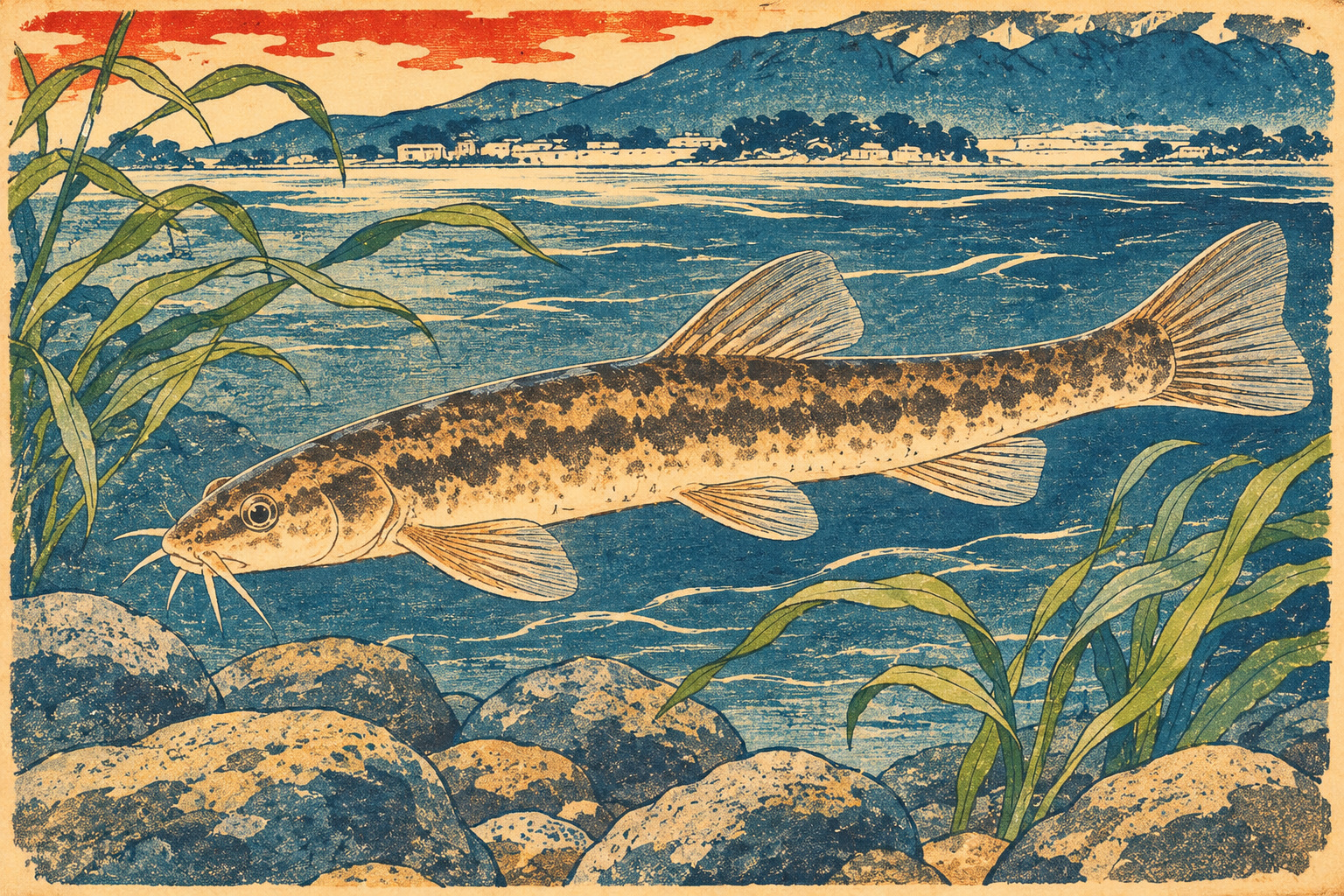
The scientific name is Cobitis takenoi. Kyoto Prefecture’s Red Data Book describes males of roughly 6 centimeters and females of roughly 8 centimeters, living over sandy bottoms in middle and lower river reaches. During the reproductive season, males develop a more continuous stripe along the side of the body, rather than the spotted pattern seen at other times.
Japan classifies it as Critically Endangered, CR, on the national Red List and protects it under the Act on Conservation of Endangered Species of Wild Fauna and Flora. The classification is not an assertion that the fish has already vanished in the wild; it expresses the severity of its extinction risk.
A species recognized by science only recently
The loach was living in Tango long before scientists understood its distinctiveness. Researchers identified an unusual local form in work reported around 2010, and taxonomist Jun Nakajima formally described Cobitis takenoi as a new species in ZooKeys in February 2016. The scientific name honors Makoto Takeno, associated with the fish’s discovery.
Its identification rests on more than a handsome row of dark markings. Nakajima compared such characters as the male pectoral-fin bony plate, mouth barbels, scale-pattern organization and muscle segments. The published description also records a tetraploid chromosome condition, an indication of the complex evolutionary history of Japanese spined loaches.
Names in taxonomy can change the public conversation. A precisely identified endemic species can be evaluated for protection under law. Yet scientific recognition does not itself prevent habitat loss. For a river fish, taxonomy must be followed by careful decisions about the water and land on which it depends.
What a single altered waterway can destroy
Kyoto Prefecture identifies river engineering, concrete channelization and the severing of routes between waterways and surrounding rice fields as threats. A channel may continue to carry water yet lose the gentle flow, sandy substrate and vegetated margins that allow a species to feed, shelter and reproduce.
If a fish occupies many watersheds, a local event may leave other populations untouched. A species confirmed in one river has little such geographical insurance. Drought, flooding, contamination, habitat construction work and collection pressure can become existential concerns rather than merely local ones.
This is why conserving freshwater biodiversity calls for more than a broad promise to keep rivers clean. Seasonal water levels, sediment, bank conditions and connections to agricultural channels can all matter to the life history of small bottom-dwelling fishes.
The difference between breeding once and breeding again
There is an essential distinction between a wild-caught fish spawning in a tank and fish born in a tank growing up to produce their own young. The latter achievement means husbandry has supported an additional life cycle: early feeding, survival, maturation and reproduction under managed conditions.
Lake Biwa Museum obtained animals in fiscal 2023 through cooperation with Kindai University and Tango Uocchikan, the former aquarium. Working under an Environment Ministry–JAZA conservation framework, it developed breeding techniques. In 2025, captive-born Tango loaches bred successfully with one another, leading to the 2026 certification.
This is encouraging evidence that a managed population might be maintained without repeatedly collecting wild animals. It does not demonstrate that the captive population is genetically secure, that breeding will remain successful indefinitely or that fish have been reintroduced successfully to the river.
An aquarium partnership spreads the risk
In March 2025, Lake Biwa Museum transferred approximately 90 Tango striped loaches to Kyoto Aquarium. Kyoto Aquarium reported receiving 91 specimens and participating in an ex-situ breeding program. The slight wording difference reflects the institutions’ own descriptions of the same transfer, not evidence of two separate movements.
Splitting animal populations between institutions can offer protection against a disease outbreak, equipment failure or other disruption in one facility. It also creates opportunities to compare husbandry practices. In this collaboration, national authorities, JAZA, researchers, the museum and the aquarium share parts of a difficult task.
Such transfers themselves require rigorous health and genetic management. The announcement does not provide a complete public account of pedigrees, breeding-group size or long-term genetic-diversity measurements. Those are important subjects for future reporting, not numbers to guess.
The other fish: four decades of ayumodoki care
The second species in the announcement, Parabotia curtus, is called ayumodoki in Japanese. It is an endemic loach with a different biological and conservation history. According to the museum, surviving natural populations are now restricted to parts of Kameoka in Kyoto and areas of Okayama. It is Critically Endangered and has national Natural Monument protection.
Lake Biwa Museum traces stewardship of a lineage originating in the old Yagi area of present-day Nantan back more than 40 years to the former Lake Biwa Culture Museum. Yet no successful breeding occurred after 2017, and the remaining captive group eventually had no females. This illustrates a crucial conservation reality: simply keeping adults alive does not guarantee a population’s continuation.
After consultation with the Environment Ministry and specialists, the museum collected female fish from Kameoka in 2024. Combining them with males in its care produced offspring for the first time in seven years. It also began artificial breeding using both sexes sourced from Kameoka. The November 9 commendation recognizes that work; it is not a claim that wild ayumodoki numbers have recovered.
The lost connections between rice paddies and rivers
Ayumodoki depends strongly on floodplain-like networks of rivers, irrigation channels and rice paddies. The Environment Ministry identifies modification of banks and the disappearance of adjacent habitat as serious pressures. Agricultural landscapes, often imagined as entirely human-made, can also be habitats shaped over generations of interaction between farming and freshwater wildlife.
Kyoto’s conservation account likewise suggests Tango striped loaches may use rice-growing areas during the breeding period. When drainage channels are disconnected or a riverbed is simplified, creatures may lose crucial seasonal pathways even if water still seems present everywhere.
The practical challenge is to accommodate farming and flood safety while protecting ecological connections. It calls for collaboration among local residents, agricultural groups, engineers, municipalities and biologists, rather than a choice between the false extremes of no river management and no wildlife habitat.
A public exhibition of animals and evidence
From November 17 to December 11, Lake Biwa Museum plans to display juveniles of both species, reproductions of its breeding certificate and commendation, research posters and breeding equipment. The special presentation is scheduled for the aquatic exhibition area, at the Conservation and Breeding Center satellite tank in the hands-on experience room.
The museum lists opening hours of 9:30 a.m. to 5 p.m., with last admission at 4 p.m.; its permanent-exhibition admission charge applies. It warns that living-animal displays may be altered or suspended depending on animal condition and museum operations. As of the November 14 publication date, the special exhibition has not yet opened.
A visitor watching a juvenile loach navigate a modest tank is seeing neither a final victory nor merely a curiosity. The animal represents the years of labor that make further generations possible—and the river that still has to be protected.
A breeding certificate is not the finish line
Ex-situ conservation provides a hedge against extinction, not permission to sacrifice habitat. Releasing captive-bred animals without suitable ecological and genetic safeguards can create other problems. The November 12 announcement does not claim successful wild reintroduction, a recovery in river populations or a definitive long-term conservation outcome.
Future reporting should ask how successive captive generations perform, whether genetic diversity can be managed across facilities, and what measurable habitat protection is taking place in the single native river. Population monitoring in the wild and breeding work in tanks are complementary, not interchangeable.
A tiny fish may rarely command the attention given to an iconic mammal or bird. Yet the partnership between scientists, museums, aquariums and public agencies says something substantial about the idea of conservation: safeguarding a species also means preserving the complicated waterways and human commitments that allow it to live.
Sources and reporting method
Reporting method: The November 12 museum announcement was checked against Kyoto Prefecture, Environment Ministry and original taxonomy sources. “First” refers specifically to breeding between captive-born individuals in Japan. The fish does not naturally inhabit Lake Biwa, and no wild reintroduction or population recovery is claimed.
- Shiga Prefecture / Lake Biwa Museum, breeding certification and commendation, November 12, 2026
- Lake Biwa Museum, transfer of rare loaches to Kyoto Aquarium (2025)
- Kyoto Aquarium, 91 specimens and breeding partnership (Japanese)
- Kyoto Prefecture Red Data Book: Tango striped loach
- Nakajima, original species description, ZooKeys 568 (2016)
- Japan Ministry of the Environment: ayumodoki conservation
- Japan Ministry of the Environment: nationally rare species list