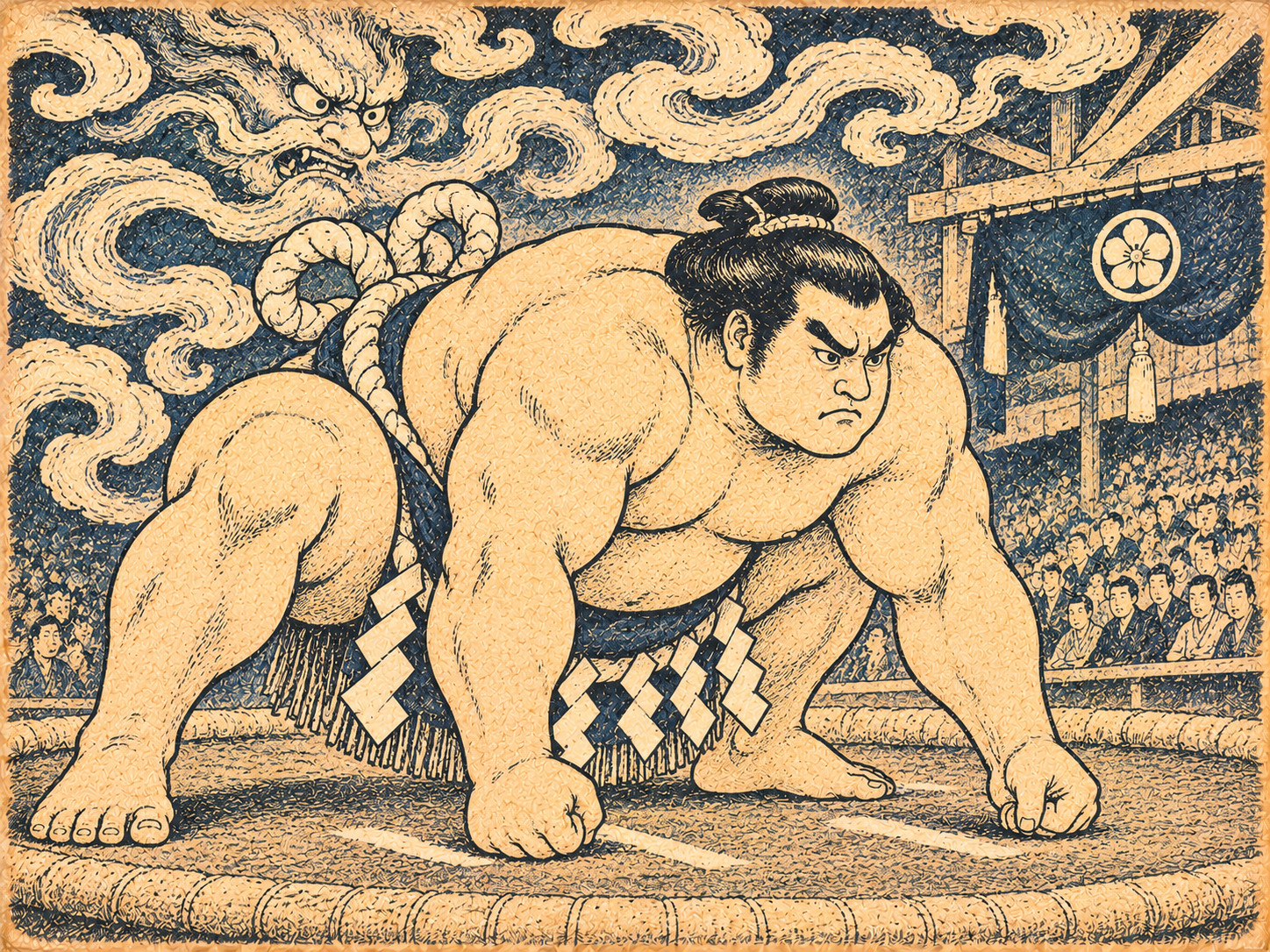
- Four men, four ranks, one lead
- Ōnosato: the yokozuna who recovered from day one
- Kirishima: experience, reinvention and the ōzeki rank
- Atamifuji and the upset that changed the day
- Wakamotoharu: why a maegashira belongs in the conversation
- Hōshōryū and the burden of a difficult comeback
- How a basho is won—and why eight wins are not enough
- Why Fukuoka is the stage for the year's final tournament
- History's central tension: rank and reversal
- The challengers one win behind
- What the late stretch will decide
Four men, four ranks, one lead
At the end of November 16, the ninth day of the Kyushu Grand Sumo Tournament, four men stood at 8–1: yokozuna Ōnosato, ōzeki Kirishima, sekiwake Atamifuji and maegashira Wakamotoharu. Their identical records hid very different routes to the top. One had rebounded from an opening-day defeat; another represented the obligation of an ōzeki; a third had just beaten a yokozuna; the fourth was pushing into the race from the seventh maegashira rank. It was an unusually useful snapshot of what makes sumo more than a numerical leaderboard.
This report is explicitly based on results confirmed through day nine, November 16. Its planned publication edition is November 19, but the bouts of days ten through twelve had not occurred at the research cutoff. No claim is made that the four-way tie will survive through November 19.
Ōnosato: the yokozuna who recovered from day one
Ōnosato lost his opener to Yoshinofuji, then won eight consecutive bouts. On day nine he forced out Takerufuji with yorikiri, taking his record to 8–1 and securing kachi-koshi, the eight-win threshold that is a key measure of a successful tournament. For a yokozuna, however, that threshold is not the finish line. The highest-ranked wrestler is judged not simply on preserving rank but on competing for championships with consistency and authority.
The Japan Sumo Association identifies Ōnosato Daiki as a native of Tsubata, Ishikawa Prefecture, and a member of Nishonoseki stable. He debuted in May 2023, rose to ōzeki by November 2024 and became a yokozuna in July 2025. That rapid career helps explain the attention he receives, but an account of his current form should begin with actual bouts, not an assumption that a fast-rising star must win.
Kirishima: experience, reinvention and the ōzeki rank
Kirishima maintained his one-loss position on November 16 by pushing out Daieishō. The Mongolian-born wrestler belongs to Otowayama stable and is competing at ōzeki, the rank immediately below yokozuna. In March 2026, while ranked sekiwake, he won the top-division championship with a 12–3 record. That documented success helps explain why his current challenge cannot be reduced to one good week.
An ōzeki must negotiate a difficult mixture of authority and vulnerability. Opponents have studied his habits; the schedule brings high-ranking competition; an early mistake can change the character of a tournament. His 8–1 record showed control through nine days, but it gave no guarantee of what the next six would bring. The tension lies precisely in that uncertainty.
Atamifuji and the upset that changed the day
The result with perhaps the greatest symbolic force on day nine belonged to sekiwake Atamifuji, who defeated yokozuna Hōshōryū by oshidashi, a frontal push-out. Contemporary Japanese reporting describes Atamifuji weathering the yokozuna’s initial attack, holding firm near the ring edge and moving decisively forward. It was a victory over the sport's highest rank, not merely another win over a lower-ranked opponent. The result kept Atamifuji at 8–1 while Hōshōryū fell to 4–5.
Born in Atami, Shizuoka Prefecture, Atamifuji Sakutarō joined professional sumo in November 2020 and reached the sanyaku ranks in March 2026, according to the association profile. His reputation grew from earlier championship challenges, including strong runs during 2023 and 2026. A wrestler can repeatedly approach a title before ever winning the Emperor's Cup; the day-nine upset added substance to his newest opportunity without settling its outcome.
Wakamotoharu: why a maegashira belongs in the conversation
Wakamotoharu, the east maegashira number seven, pushed out Ōshōma on November 16 for a seventh successive win, moving to 8–1. The word maegashira sometimes sounds like a description of a novice to international audiences. It is not. These are fully professional top-division wrestlers, many with long careers and previous service in the three special ranks below ōzeki.
Wakamotoharu Minato, from Fukushima City, debuted in November 2011. He has competed as high as sekiwake and is known for left-handed belt positioning and forceful forward sumo. The official association profile records his long career across the divisions. A title challenge from this rank would therefore be a story about accumulated expertise and persistence, not merely an improbable outsider emerging from obscurity.
Hōshōryū and the burden of a difficult comeback
The other side of Atamifuji's victory was the latest defeat for yokozuna Hōshōryū, who stood at 4–5 after nine days. Reporting before the tournament recorded right-knee surgery following the July event and absence from the September basho. Those details offer important context for his return, but they do not authorize speculation about his current medical condition or motivation. A wrestler's physical state is best discussed through official information and attributable statements.
The contrasting records of the two yokozuna—Ōnosato on 8–1, Hōshōryū on 4–5—help explain why a championship is not a ceremonial confirmation of hierarchy. A rank establishes expectations; fifteen days of actual competition reveal what each wrestler can manage at that moment.
How a basho is won—and why eight wins are not enough
The top division, makuuchi, comprises wrestlers who generally contest one bout per day across fifteen days. Eight wins is kachi-koshi, a winning record, and seven or fewer wins is usually make-koshi. These results are important for subsequent rankings. Yet the championship, or yūshō, goes to the wrestler with the best top-division record; a tie after the scheduled bouts is settled by a playoff. Neither a winning record nor an advantage in rank automatically creates a title.
Bouts have no fixed clock like football or basketball. A contest can end swiftly by a push-out, a force-out while gripping the mawashi, a throw or another recognized technique. The terminology is worth translating carefully: oshidashi is a push-out, yorikiri a force-out, and a tachiai is the opening charge. Understanding them turns a list of results into a sequence of tactical decisions.
Why Fukuoka is the stage for the year's final tournament
The Japan Sumo Association schedules the 2026 November tournament at Fukuoka Kokusai Center from November 8 through November 22. It is the sixth and final major tournament of the year, after events in Tokyo, Osaka, Nagoya and Tokyo again. The event sits within a nationwide professional circuit whose cities and rituals help define its public identity.
Sumo also retains formal ceremonial elements. The association's fiscal 2026 business plan describes the dohyō-matsuri conducted before each honbasho: officials ceremonially welcome deities to the newly prepared ring and pray for safety, public wellbeing and an orderly tournament. That tradition is not the same thing as a sporting result, but its coexistence with the daily competition gives professional sumo a cultural character distinct from most global leagues.
History's central tension: rank and reversal
Professional sumo grew from centuries of organized bouts, temple and shrine associations, and public performance, eventually developing a detailed ranking system. The modern banzuke places yokozuna at the top, followed by ōzeki, sekiwake, komusubi and maegashira. These terms convey history as well as competitive expectations; the hierarchy is visible before the first bout begins. What makes the tournament dramatic is that performance can still cut across the hierarchy.
A sekiwake beating a yokozuna, or a maegashira joining a leading group, is not an error in the system. It is the system being tested. The ranks make the stakes intelligible, while the results prevent the hierarchy from becoming a foregone conclusion. The November 16 table tells that story in miniature.
The challengers one win behind
The day-nine chase extended beyond the four men sharing first place. Kinbōzan, Asahakuryū and Dewanoryū were at 7–2 and only one victory behind. In the second-tier jūryō division, Wakatakakage and Tamashōhō were both undefeated after nine days. Those other contests matter because a leader who loses could instantly alter the title calculations. The tournament is a moving field of opponents, records and scheduling choices, not a four-person exhibition.
It would be premature to name the eventual finalist or imply a particular pairing has been confirmed for the decisive days. For the planned November 19 edition, a proper update must compare the association's day-twelve leaderboard with the day-nine picture here. Until then, the accurate formulation is 'four leaders after nine days,' not 'four leaders on November 19.'
What the late stretch will decide
Ōnosato's recovery, Kirishima's high-rank steadiness, Atamifuji's defeat of a yokozuna and Wakamotoharu's sustained winning run each provide a credible contender's narrative. But sport is compelling only when the result is left to the athletes. A six-day runway remains from the day-nine checkpoint to the November 22 conclusion. Ranking implications, prize awards and the ultimate champion are all contingent on bouts not yet completed.
The most useful way for an international reader to follow the remaining days is to watch each wrestler's record, the ranks of his opponents and the winning technique in decisive bouts. For Japanese readers, the same details reveal a deeper familiar drama: whether the hierarchy of the banzuke will hold, or whether a challenger will transform the final tournament of the year.
Sources and reporting limitations
This independently written analysis relies on the Japan Sumo Association’s official day-nine leaderboard, wrestler profiles and tournament calendar, cross-checked with contemporary Japanese match reports. JAPAN.co.jp did not attend the event or interview wrestlers. Day-twelve results and the eventual champion are not known at this research cutoff.
- 日本相撲協会:令和8年十一月場所・各段の成績優秀力士(九日目) / Official leaders
- 日本相撲協会:2026年十一月場所・本場所日程 / Official schedule
- 日本相撲協会:大の里 泰輝・公式力士プロフィール / Ōnosato
- 日本相撲協会:霧島 鐵力・公式力士プロフィール / Kirishima
- 日本相撲協会:熱海富士 朔太郎・公式力士プロフィール / Atamifuji
- 日本相撲協会:若元春 港・公式力士プロフィール / Wakamotoharu
- 共同通信:九州場所九日目の主要取組と優勝争い / Kyodo match report
- 日刊スポーツ:熱海富士が豊昇龍に勝利 / Atamifuji match account
- 日本相撲協会:九州場所・福岡国際センター観戦案内 / Fukuoka venue
- 日本相撲協会:令和8年度事業計画書 / Association operations and ceremonial background