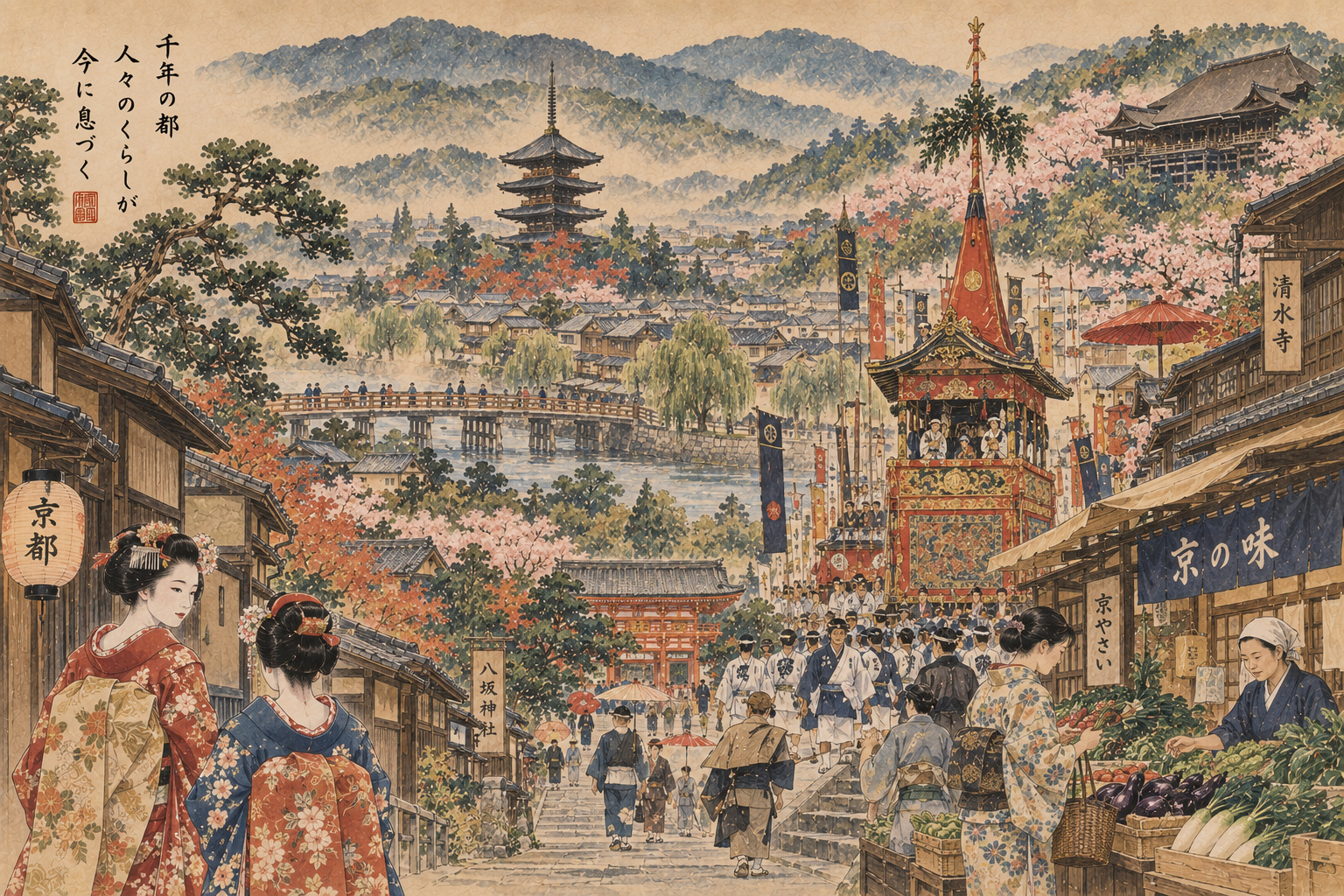
Kyoto is a physical city, but it is also an image produced over centuries. Gold clouds reveal temples and townhouses. Festival floats fill the streets. Maiko become shorthand for neighborhoods. Purple eggplants and green onions stand for local cuisine. Long before modern destination marketing, paintings, festivals, confectionery design and performance were already telling people what “Kyoto” was supposed to look like.
On October 3, the Saga Arashiyama Museum of Arts & Culture opens Discover And Enjoy Kyoto Even More Through Pictures, running through February 28, 2027. The exhibition uses Japanese painting from the early-modern through modern periods to connect famous places, festivals, entertainment districts, food and commercial design. The first period runs October 3–December 14; the second, December 16–February 28.[1]
The first Kyoto in the show is a city seen all at once
First-period works include an anonymous Scenes in and Around Central Kyoto screen, Uemura Shōen’s Niken-chaya, Kishi Chikudō’s Ōfune-hoko and Kawamura Manshū’s Mt. Inari. Hara Zaichū’s Aoi Festival and Ikeda Yōson’s Balmy Breeze in Arashiyama remain on view throughout the exhibition. The second period brings in works including Itō Shōha’s Mibu Kyōgen, Takeuchi Seihō’s A Dish of Fish and Vegetables and Kurihara Gyokuyō’s Evening.[1]
The choice to begin with a rakuchū-rakugai-zu—a screen depicting Kyoto and its outskirts—is revealing. A conventional city history might start with founding dates or architecture. A city screen begins instead by asking what deserves to be seen.
Kyoto National Museum examples from the seventeenth century gather castles, shrines, temples, the Kamo River, neighborhoods and crowds into a single bird’s-eye composition. They are records of urban life, but they are also acts of selection: a painted ranking of the places, events and institutions that made Kyoto recognizable.[2]
A city screen is also a recommendation engine
It is misleading to read a rakuchū-rakugai-zu as if it were a modern map. Distances compress. Gold clouds divide space. Important institutions become disproportionately visible. The viewer is being told where attention should go.
One Kyoto National Museum screen from around the mid-seventeenth century concentrates famous places and religious sites around Kitano. Another, probably made around 1606–09, gives Nijō Castle a commanding place in the left screen, reflecting the political order of the early Tokugawa period.[2][3]
When political centers changed, the painted image of Kyoto changed with them. The city’s visual identity was never neutral.
The Aoi Festival is an example of tradition being performed back into existence
Hara Zaichū’s Aoi Festival, displayed throughout the show, makes one of the exhibition’s strongest historical arguments.
The Aoi Festival is the annual festival of Shimogamo and Kamigamo shrines. Kyoto’s official tourism history traces its legendary origins to the reign of Emperor Kinmei roughly 1,500 years ago and notes that by 819 it had the status of a major court observance. In the mid-Heian period, “the festival” could simply mean the Kamo Festival; it appears in both The Tale of Genji and The Pillow Book.[4]
But continuity was not uninterrupted. The procession disappeared for roughly two centuries after the Ōnin War and was suspended again in the Meiji and wartime periods. The name “Aoi Festival” itself became established after the early-modern restoration of the event, when hollyhock leaves were used to decorate carts, costumes and horses. The modern Saiō-dai women’s procession was revived in 1956.[4]
That history matters. The festival is traditional not because every detail remained frozen for fifteen centuries, but because Kyoto repeatedly chose to restore, adapt and perform it.
Gion floats turn the street itself into art
Kishi Chikudō’s Ōfune-hoko, shown in the first period, brings another civic system into view: the Gion Festival.
Kyoto’s official guide treats Gion Matsuri as one of the city’s major annual events, running through July with the great float processions on July 17 and 24. Thirty-four floats now form the processional landscape.[5]
The floats are not simply festival vehicles. Neighborhood organizations preserve and assemble them; textiles, carving, metalwork, painting and music travel together through the city. A street becomes a stage, and a neighborhood becomes curator, performer and conservator.
The painting of a float records the festival. The annual festival then recreates something like the painting in actual urban space. In Kyoto, visual representation and city life continually feed each other.
Uemura Shōen and the construction of the Kyoto woman
Uemura Shōen, one of modern Japan’s most celebrated women painters, is represented in the first period by Niken-chaya. Her presence makes it possible to ask how female figures came to embody the city itself.[1]
Geiko and maiko are among the most recognizable images of Kyoto tourism today. Yet they are not timeless symbols handed down unchanged from ancient Kyoto. The entertainment districts and their public performance culture were shaped through early-modern and modern institutions.
One key example is the Miyako Odori. Kyoto’s official tourism history notes that in 1872, during the first Kyoto Exposition, geiko and maiko performed dances as entertainment for visitors. The success of those performances led to the establishment of a Gion kaburenjō theater the following year, while other districts developed their own venues and dance traditions.[6]
A symbol that now looks “traditionally Kyoto” is therefore linked to the city’s Meiji-era effort to reinvent itself after the imperial capital moved to Tokyo.
Geiko and maiko are performers before they are tourist imagery
Because kimono-clad maiko appear so often in posters and social media, it is easy to reduce them to costume. The actual district culture is built on training.
Kyoto’s official guide describes annual dance seasons across Gion Kōbu, Miyagawachō, Pontochō, Kamishichiken and Gion Higashi, where geiko and maiko present dance, shamisen, song, flute and percussion in dedicated theaters.[6]
Paintings of these performers therefore belong not only to the history of beauty imagery but to a history of skilled urban entertainment labor.
Kyoto vegetables are not “nature.” They are urban agriculture
The exhibition places Kyoto vegetables alongside festivals and performers. That decision helps dismantle another myth: that local food simply grows out of timeless local soil.
Kyoto Prefecture explains that, over more than a millennium as a capital, superior produce and seeds arrived from across Japan as offerings to the court and temples. Farmers adapted them to fertile soil, abundant water and local cultivation practices. The official definition of “traditional Kyoto vegetables” generally requires a history of introduction and cultivation dating to before the Meiji era.[7]
Kyoto’s inland location also mattered. Fresh marine products were historically harder to obtain than in coastal cities, increasing the importance of vegetables in court and elite cuisine. Kujo green onions, Kamo eggplants, Shogoin vegetables and other varieties became foods of place because they met the needs of a dense urban market.[8]
Painting food is also painting logistics and season
Takeuchi Seihō’s A Dish of Fish and Vegetables, shown in the second period, turns ingredients into pictorial subject matter. But food in Kyoto is never merely still life.
Traditional vegetables are seasonal. Their names carry districts and villages. Their use depends on cooking technique and preservation. To paint them is to paint a network connecting fields, markets, kitchens, restaurants and ceremonial food.
By presenting produce beside festivals and geiko, the museum makes a useful argument: urban culture is produced by what people eat and buy as much as by what they worship or visit.
Why wrapping paper belongs in an art museum
One of the exhibition’s most revealing choices is the inclusion of confectionery wrapping designed by artists including Tomioka Tessai and Ikeda Yōson.[1]
That may seem peripheral until one considers Kyoto’s confectionery culture. Long-established sweet shops do not sell only taste. Box, wrapper, seasonal motif, poetic name and gift etiquette convert food into a total aesthetic object.
Kyoto’s official tourism site traces Kyoto sweets through court culture, tea, high-quality water and ingredients gathered around the capital. Seasonal confectionery is designed to evoke scenery and the calendar through color, form and naming, engaging sight and language alongside taste.[9]
When painters design wrapping paper, art leaves the museum and enters an object meant to be carried home, opened and eventually discarded. Commercial design becomes part of the city’s visual memory.
Ikeda Yōson’s Arashiyama connects the gallery to the view outside
The Saga Arashiyama Museum sits beside the landscape it presents. Its upper floor looks toward Arashiyama and the Ōi River. Ikeda Yōson’s Balmy Breeze in Arashiyama, on view throughout the exhibition, therefore exists in dialogue with the actual district outside.[1]
Arashiyama has been a poetic and pictorial destination for centuries, but a famous place is never one fixed image. Cherry blossom, autumn leaves, riverboats, bridge, mountain and crowds become dominant at different times.
The title’s “balmy breeze” is especially telling. The artist defines Arashiyama not only through landforms but through seasonal atmosphere. Painting helps turn climate and feeling into destination identity.
Kyoto history is real precisely because it contains interruption
Tourism language often describes Kyoto as unchanged for a thousand years. The history is more interesting than that.
The Aoi Festival disappeared and returned. The Miyako Odori began in the Meiji era. The Jidai Festival began in 1895 in connection with the 1,100th anniversary of the founding of Heian-kyō and later expanded its historical processions.[10]
None of this makes Kyoto tradition false. It reveals how tradition works: institutions revive practices, communities add elements, performers learn roles, governments and associations formalize preservation, and audiences accept the renewed form as meaningful.
By putting early-modern and modern paintings in one exhibition, the museum makes those layers visible. Hara Zaichū’s festival Kyoto, Shōen’s human Kyoto and Yōson’s landscape Kyoto are all recognizable, but they do not describe the same historical city.
Who decides what counts as “Kyoto”?
Every city image is selective. Which temples enter a city screen? Which festival becomes iconic? Which form of womanhood is idealized in painting? Which vegetables receive official “traditional” status? Which season appears on a sweet-shop wrapper?
Artists do not make those choices alone. Shrines, neighborhoods, shopkeepers, farmers, theater schools, collectors, governments, tourism organizations and visitors all participate.
Kyoto had a visual brand long before the phrase “city branding” existed. The media have changed—from painted screens and hanging scrolls to photography, posters, film and social media—but the process of selecting recognizable motifs remains remarkably similar.
This is also an exhibition about being a tourist city
The museum itself describes Kyoto as a tourist city with more than a thousand years of history.[1]
That label is not merely modern. Kyoto has been viewed from outside for centuries—through pilgrimage, sightseeing, guidebooks, expositions, school trips and international tourism. Every new audience creates pressure to package the city into legible experiences.
A rakuchū-rakugai screen visualized the whole city. The Meiji dance festivals staged local culture for exposition visitors. Today the museum packages those earlier acts of representation into an exhibition about Kyoto identity itself.
The first and second periods change what “Kyoto life” means
The first period foregrounds cityscape, procession, religious space and public identity through works such as Scenes in and Around Central Kyoto, Niken-chaya, Ōfune-hoko and Mt. Inari. The second shifts toward performance, food and more intimate life through works including Mibu Kyōgen, A Dish of Fish and Vegetables and Evening.[1]
The change is not merely conservation rotation. Seen across both periods, the exhibition expands the definition of a city from its skyline into bodies, ingredients and performance.
Aoi Festival and Balmy Breeze in Arashiyama remain throughout, giving the show two stable anchors: ritual and place.
Looking at paintings can change what a visitor sees outside
The title Discover And Enjoy Kyoto Even More Through Pictures suggests that the paintings are not substitutes for the city. They are training in how to see it.
After viewing an Aoi Festival painting, the May procession becomes more than a costume spectacle. After seeing Kyoto vegetables treated as pictorial subjects, produce in a market can register as agricultural history. Once a wrapper designed by a major painter enters the gallery, souvenir packaging may look less disposable.
To describe Kyoto simply as a place where “old things survived” is to miss why those old things remain culturally active.
Kyoto renews itself by repeating. Festivals are performed again. Painters reinterpret familiar views. Sweet shops wrap seasonal products differently. Artists turn vegetables and performers into motifs. That repetition does not freeze the city. It is how the city keeps producing a recognizable Kyoto for each generation.
Sources
- Saga Arashiyama Museum of Arts & Culture, Discover And Enjoy Kyoto Even More Through Pictures
- Kyoto National Museum, Scenes in and Around Kyoto collection entry
- Kyoto National Museum, Scenes in and Around Kyoto (Nijō Castle)
- Kyoto City Official Travel Guide, Aoi Festival history
- Kyoto City Official Travel Guide, major festivals
- Kyoto City Official Travel Guide, spring geiko and maiko dance traditions
- Kyoto Prefecture, traditional Kyoto vegetables
- Kyoto Prefecture, court cuisine and Kyoto vegetables
- Kyoto Official Travel Guide, Kyoto confectionery culture
- Kyoto City Official Travel Guide, Jidai Festival history