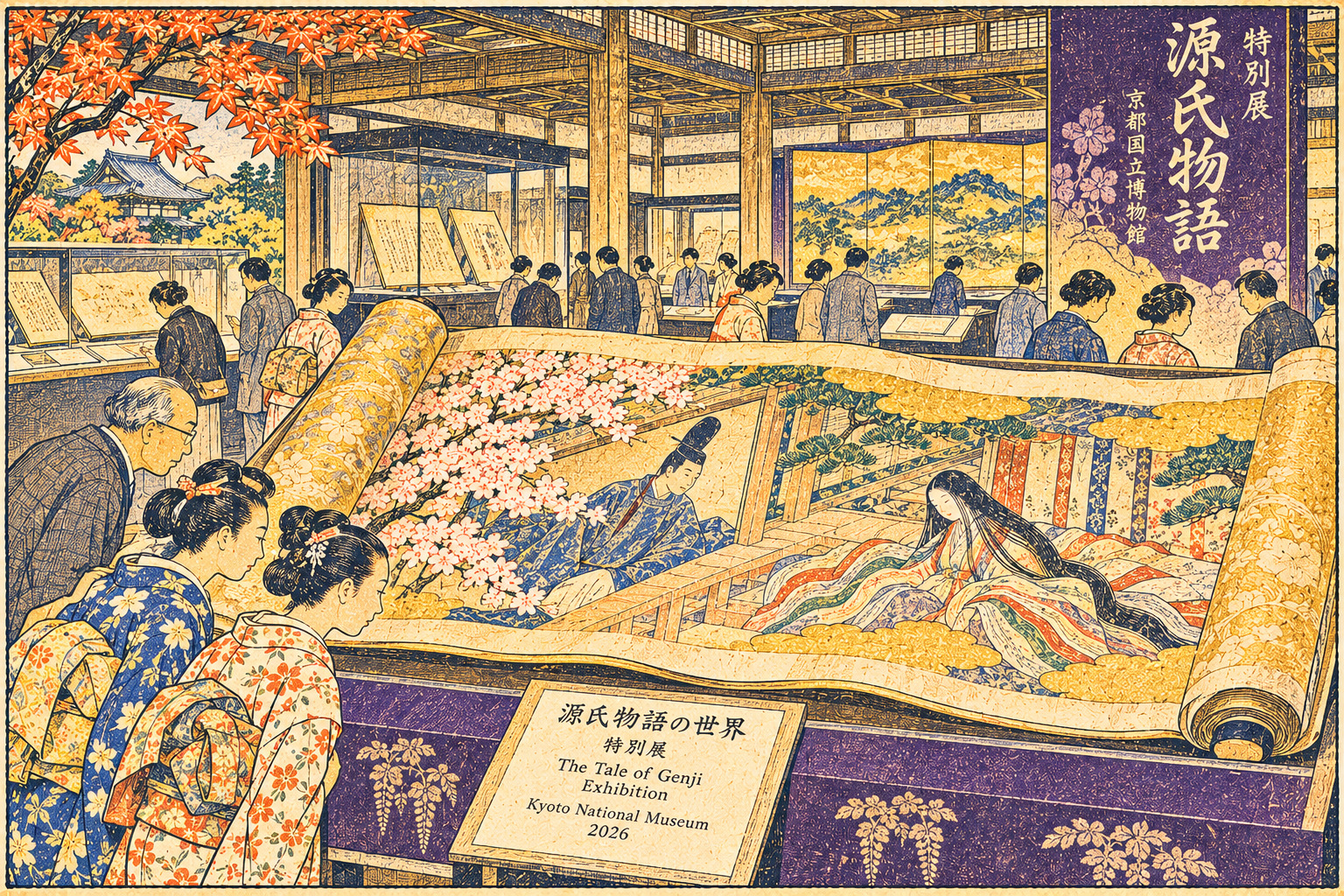
- A two-week window into a thousand-year-old masterpiece
- The rare assembly of five Teika manuscripts
- Murasaki Shikibu wrote for a complicated court
- Why a small handscroll painting matters so much
- From copying a book to making a classical authority
- The Tale of Genji enters the architecture of daily life
- When Genji walks onto the Noh stage
- Edo readers turned a courtly classic into popular entertainment
- The twentieth century did not stop drawing Genji
- What to see now—and what remains for later
A two-week window into a thousand-year-old masterpiece
The most arresting object in Kyoto this November is modest in physical scale. A painted scene from the National Treasure Genji monogatari emaki, the surviving illustrated handscrolls of The Tale of Genji, is on view at Kyoto National Museum only from November 3 through November 15. The scene is Hashihime, or “The Divine Princess at Uji Bridge,” lent by the Tokugawa Art Museum in Aichi. An image barely more than twenty centimeters high can contain an entire world of architecture, intimacy and restrained emotion.
The painting is part of The Tale of Genji: Radiant Culture of the Japanese Imperial Court, a major exhibition at the museum’s Heisei Chishinkan Wing from October 6 through November 29. Its second installation began November 3, making November 7 an unusually timely moment to visit. The changing display is not merely a curatorial refresh: these fragile treasures are shown for restricted periods, and individual scenes carry different narratives.
This is the story of a book becoming an image, an image becoming a cultural language, and that language surviving a thousand years of changing readers. The exhibition spans manuscripts, courtly art, scrolls, lacquerwork, textiles, Noh theater and popular print culture. It also challenges the habit of seeing Genji as a single frozen symbol of a glamorous past.
The rare assembly of five Teika manuscripts
A second reason to pay attention to the November 3–15 window lies in the written text itself. Kyoto National Museum says all five surviving fascicles of a manuscript lineage associated with Fujiwara no Teika are assembled together for the first time, for just these two weeks at the Kyoto venue. This is separate from the rotating painted National Treasure handscroll scenes; the two should not be confused.
The earliest form of Murasaki Shikibu’s manuscript has not survived. Copyists carried the narrative forward, introducing omissions, variants, mistakes and deliberate alterations. To read Genji today is therefore to encounter centuries of decisions about which words to preserve. The museum’s first chapter foregrounds that physical process rather than offering the romanticized notion of an unchanged book passed straight from its author.
Teika, a poet and textual authority of the late Heian and early Kamakura eras, became central to the text’s later transmission. Seeing multiple witnesses together is consequential because variants can be compared as actual historical objects, not simply as modern edited passages. The display offers no license to claim that scholars have recovered an original autograph; it helps visitors appreciate why no such straightforward original is available.
Murasaki Shikibu wrote for a complicated court
The Tale of Genji emerged around the turn of the eleventh century, in the environment of aristocratic Heian Kyoto. Its author Murasaki Shikibu served Empress Shōshi, daughter of the powerful Fujiwara no Michinaga. Dates and details of the author’s life remain uncertain; the surviving diary and later portraits show how subsequent generations imagined her as well as what can be documented about her.
The work’s central figure, Hikaru Genji, is not simply a romantic hero. His relationships take place in a hierarchy shaped by rank, family alliances, gendered power and the fear that reputation can alter a life. The Uji chapters, including Hashihime, move toward other characters and tonalities, making the story far richer than the familiar image of a shining prince at court.
Calling the work “the world’s first novel” may serve as a convenient introduction, and the museum notes that it is sometimes described that way. It is not a settled historical classification: the definition of a novel and the comparison with earlier long-form traditions are debated. The more substantial achievement is how Genji developed sustained interior lives, memory, social observation and emotional consequence across an extensive narrative.
Why a small handscroll painting matters so much
The National Treasure Genji monogatari emaki is among the oldest extant visual interpretations of the tale. Its compositional economy is striking. Architectural forms divide space; areas of subdued pigment manage emotional distance; writing, decorative paper and image collaborate as the scroll gradually unfolds. The museum describes scenes of little more than twenty centimeters in height, a reminder that monumentality need not be measured in centimeters.
The Hashihime scene on display from November 3 to 15 draws the visitor toward the later Uji world of the novel. On November 17, a different scene, Yadorigi III, is scheduled to replace it through November 29. These dates matter: a visitor arriving in the final week will not see precisely the same selection as someone attending on November 7.
It would be misleading to suggest that all surviving Genji scroll scenes are displayed simultaneously, or that the editorial illustration accompanying this article reproduces the Tokugawa museum’s National Treasure. The image is a modern imaginative tribute inspired by Hasegawa Settan; the original artworks can only be understood on their own terms and under their own rights.
From copying a book to making a classical authority
After Murasaki Shikibu’s lifetime, medieval scholars and courtiers added commentaries, collected textual variants and made Genji a subject of learned interpretation. The museum’s chapter on the deepening of the tale traces how scholarship helped elevate a popular narrative into a canonical work associated with the court’s cultural self-understanding.
This transformation had visual consequences. Literary references could become emblems of cultivated status; painted episodes could stand for the possession of knowledge. A patron did not need to commission a full illustrated narrative. A selected passage, a scene on a fan or a decorative allusion could announce familiarity with a recognized cultural inheritance.
Here lies a contradiction worth studying. The story was transmitted precisely because people revered it, but it survived as a changing artifact because each generation interpreted and rearranged it. Respect for a classic did not mean passive reproduction. The many forms now gathered in Kyoto are evidence of continual reinvention.
The Tale of Genji enters the architecture of daily life
In the Momoyama and Edo periods, painted Genji episodes expanded from manuscripts and small formats into large folding screens, sliding-door panels and elegant furnishings. The museum shows that Genji imagery could ornament interiors, accompany marriages and express aspirations for longevity and household prosperity.
Objects may refer to a chapter through a motif rather than a figure. This indirect mode, known as rusumoyō, or absent-figure patterns, rewards viewers who recognize the source without being shown its protagonists. A lacquer box or patterned garment becomes a compact literary riddle. The National Treasure Hatsune bridal furnishings include an Uji incense box, which the museum lists as on view throughout the exhibition.
The latter installation also includes a light-blue crepe-silk kosode with court-carriage, palace-building and hawk motifs, according to the museum’s published schedule. These works remind us that Genji is not only a story about court dress. It became a vocabulary used to make and understand material culture centuries after the setting of the narrative itself.
When Genji walks onto the Noh stage
The exhibition’s theater section explores “Genji Noh,” plays inspired by the novel, including Aoi no Ue, Nonomiya, Yūgao and Genji Kuyō. The shift from page to stage changes the way a character’s longing or regret reaches an audience: controlled movement, chant, masks and the presence of an actor carry emotions differently from painted pigment and written prose.
Kyoto National Museum has arranged a reconstructed Noh-stage display using restored costumes. The museum lists Aoi no Ue-related material in the first installation and Tamakazura in the second. An Important Cultural Property Noh mask, Deigan, associated with the Konparu family, is listed for the full period. These are examples of the repertoire’s continued cultural life, not claims that the exact Heian characters once wore such stage costumes.
The scheduled November 14 lecture by museum researcher Maiko Yamauchi will examine The Tale of Genji and Noh. The public booking may already be full; prospective visitors should verify current availability directly with the museum. The broader point is that the tale has remained productive because different arts can take its characters into spaces prose alone cannot occupy.
Edo readers turned a courtly classic into popular entertainment
Genji’s career did not stop at aristocratic refinement. In the Edo period, incense identification games developed Genji-derived patterns, artists made ukiyo-e that translated its figures into contemporary fashions, and publishers discovered an enormous popular appetite for adaptation.
The museum highlights Ryūtei Tanehiko’s Nise Murasaki Inaka Genji, illustrated by Utagawa Kunisada, a bestseller that helped turn the old story into a popular publishing phenomenon. A copy of its first volume is listed as on view throughout. The distance between Murasaki’s aristocratic milieu and nineteenth-century readers was bridged by commerce, pictorial invention and play.
This popular history matters to the contemporary exhibition. If Genji was ever a restricted court text, it did not remain confined there. It could be made playful, reimagined as contemporary fashion, or translated into the visual conventions of another age. That flexibility helps explain why the work’s cultural reach is still so broad.
The twentieth century did not stop drawing Genji
In the modern era, painters continued to study earlier Genji imagery while developing their own interpretations. The exhibition concludes with Matsuoka Eikyū’s The Princesses of the Uji Court, lent by the Himeji City Museum of Art and scheduled to remain on view throughout the Kyoto presentation. Its large format offers a different answer to the ancient narrative than the intimate medieval handscroll.
This contrast is the exhibition’s quiet argument: there is no single definitive image of Genji. A manuscript page protects words; a handscroll organizes time through sequential looking; a screen transforms a room; a modern painting revisits the story from a new historical standpoint. The work endures through relationships between these media.
For visitors accustomed to screen adaptations and contemporary illustrated storytelling, that is a useful historical perspective. Visual adaptation did not begin with cinema or anime. Japan’s artists have spent centuries finding new ways to make audiences see a literary world.
What to see now—and what remains for later
Kyoto National Museum lists the exhibition through November 29, 2026, in the Heisei Chishinkan Wing, 527 Chayachō, Higashiyama Ward, Kyoto. The main hours are 9 a.m. to 5:30 p.m., last admission 5 p.m.; on Fridays hours extend to 8 p.m., last admission 7:30 p.m. General admission is ¥2,200, with reduced rates for students and free admission for younger visitors under the stated rules. Mondays are generally closed, with specified holiday exceptions.
The practical distinction for the November 7 edition is simple: Hashihime and the five extant Teika manuscript fascicles are announced for November 3–15; Yadorigi III is announced for November 17–29. The schedule can include additional rotations, so check the museum’s complete works list before travel. Visitors should not assume an item reproduced in promotional materials is on view every day.
A Tokyo presentation is planned for January 19 to March 14, 2027, but the museum explicitly identifies some works as Kyoto-only; one should not assume that the same precious objects will travel. What Kyoto offers in November is a rare meeting of textual and visual histories. The greatest revelation may be that a thousand-year-old narrative is not preserved by remaining still: it survives because successive readers keep seeing it anew.
Sources and reporting method
Based on official museum exhibition catalogues, installation notes and visitor information. Images of exhibited artworks are subject to separate rights held by their owners.