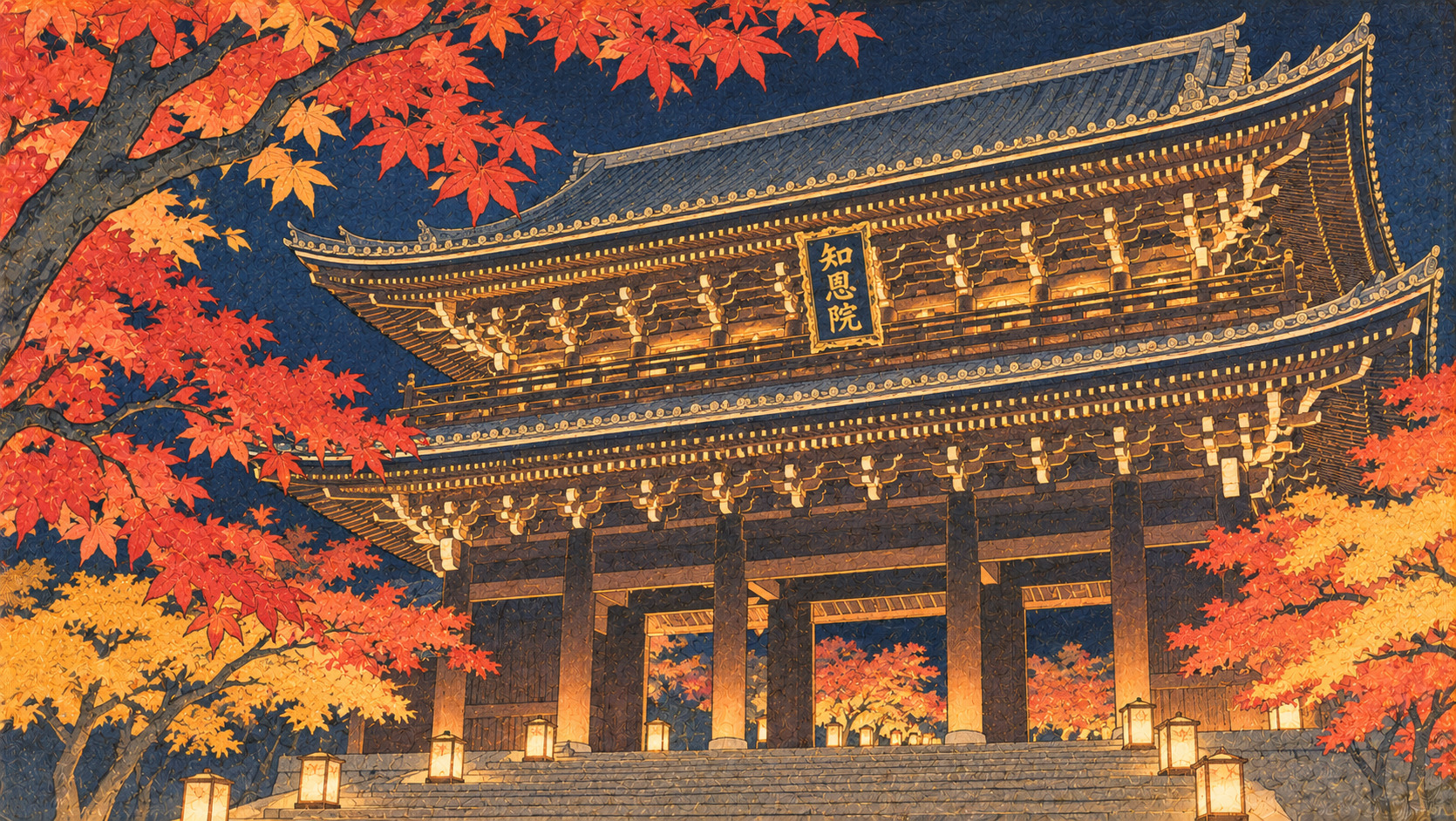
- A Kyoto landmark opens a different view of the night
- Honen and the origins of a place of worship
- Two Tokugawa shoguns and two great National Treasures
- Why shoguns invested in this Buddhist landscape
- What the upper corridor tour actually includes
- A garden linking Buddhist Kyoto with the art of dyeing
- Meet a monk: the temple’s invitation beyond sightseeing
- Chant, Buddhist hymn and gagaku in late November
- Planning a visit: tickets, cash and timing
- More than a night photograph
A Kyoto landmark opens a different view of the night
The massive Sanmon gate at Chion-in has looked across Kyoto for more than four centuries. Beginning November 17, 2026, the Pure Land Buddhist temple plans to illuminate the gate, its main worship hall and gardens through December 6. But this edition of the annual autumn event offers something more unusual: a reservable guided experience that includes a walk along the upper-level corridor of the National Treasure gate.
For a visitor who knows Kyoto primarily through photographs of autumn leaves, the invitation is a chance to understand how the city’s sacred buildings relate to faith, political power, craftsmanship and conservation. Chion-in is not a scenic set dressed up for the season. It is the head temple of the Jodo-shu school, a place of continuing worship whose modern visitor program is built around an eight-century history.
Honen and the origins of a place of worship
The story begins long before the buildings now visible at the temple. Honen (1133–1212), founder of the Jodo-shu or Pure Land school, established a retreat in the Yoshimizu area of eastern Kyoto in 1175. His teaching emphasized nembutsu, the recitation of the name of Amida Buddha, as a path open to people seeking rebirth in the Pure Land. The phrase Namu Amida Butsu continues to give the temple its spiritual identity.
Honen endured exile in 1207, returned to Kyoto, and died in the Otani area in 1212. His disciples cultivated the site as a memorial and place of practice. In 1234, the disciple Genchi established or restored religious buildings there, helping form the institution that became Chion-in. Those beginnings explain an apparent paradox: visitors encounter grand seventeenth-century architecture, yet the place commemorates a religious movement that emerged centuries earlier.
Two Tokugawa shoguns and two great National Treasures
Chion-in’s Sanmon was built in 1621 under the second Tokugawa shogun, Hidetada. According to the temple, it measures roughly 24 meters high and 50 meters wide, making it one of Japan’s largest surviving wooden two-storey gates. Its name refers to the Buddhist “three gates of liberation”—emptiness, signlessness and wishlessness—rather than simply being a poetic term for a mountain entrance.
The other major illuminated building, Miei-do, was rebuilt in 1639 under the third shogun, Iemitsu. The hall houses the revered image of Honen and remains the center of worship. The temple gives its dimensions as approximately 45 by 35 meters. Both structures were designated National Treasures in 2002. After a major restoration project lasting roughly nine years, the main hall was reopened in 2020, reminding visitors that monumental architecture survives through painstaking contemporary labor.
Why shoguns invested in this Buddhist landscape
Tokugawa Ieyasu, the founder of the shogunate, supported Jodo-shu and designated Chion-in an important family memorial temple in Kyoto. Chion-in’s chronology records a grant of temple lands in 1603. His successors expanded the complex through major construction. The resulting architecture cannot be separated from the Edo government’s relationship with Kyoto’s religious institutions.
That does not make the buildings reducible to a statement of political authority. They also served communities of monks and worshippers who inherited Honen’s teaching. This dual history—religious devotion and state patronage—helps explain why the Sanmon feels so imposing, and why it remains more than a monument to the Tokugawa family.
What the upper corridor tour actually includes
The temple’s 2026 program marks the 60th anniversary of the Ote-tsugi movement, which helps transmit its religious tradition. The special guided Moonlight Premium Tour, called Tsukikage Premium Tour in Japanese, promises access to the Sanmon’s upper corridor and normally restricted parts of the inner sanctuary of Miei-do, alongside the illuminated grounds. This is not blanket permission to wander every chamber of the gate or temple.
The temple lists guided tours on Wednesdays, Saturdays, Sundays and holidays, beginning at 6 p.m. and lasting about 90 minutes. Places are limited to 30 per tour. Prices are ¥3,000 for adults and ¥1,500 for elementary and junior-high students, including standard evening admission. Advance booking is required, with a stated cutoff of 4 p.m. on the chosen date. The ordinary evening ticket alone should not be assumed to include the same restricted access.
A garden linking Buddhist Kyoto with the art of dyeing
Yuuzen-en, another illuminated part of the grounds, commemorates the dyeing innovator Miyazaki Yuzensai, long associated with the development of yuzen textile designs. The temple explains that the garden was arranged to mark the 300th anniversary of his birth. Its composition brings together a pond-centered garden and a dry landscape, combining flowing water, stones and cultivated vegetation.
The pond features a standing figure of Sho Kannon attributed by the temple to sculptor Takamura Koun. Looking at this carefully arranged landscape after dark offers another perspective on the event: it connects Buddhist practice with Kyoto’s long history of textile artistry. The lighting is modern, but the design traditions it reveals belong to different historical periods.
Meet a monk: the temple’s invitation beyond sightseeing
Each evening, the temple plans a recurring program called “Let’s Hear a Monk’s Talk” in Miei-do, followed by a chance to try wooden-fish percussion while reciting the nembutsu. Four daily start times are advertised—6 p.m., 6:45 p.m., 7:30 p.m. and 8:15 p.m.—with talks of approximately 15–20 minutes and a further 5–10 minutes for the participatory experience.
The anniversary theme, onko chishin, invokes learning from the past to understand the present. For visitors unfamiliar with Japanese Buddhism, this matters more than any decorative display: the event is intended to introduce living voices and practices. Participation does not require prior familiarity with ritual etiquette, though attendees should follow instructions and respect those attending for religious reasons.
Chant, Buddhist hymn and gagaku in late November
The illumination season also includes special cultural performances. On November 26, the program advertises shomyo, the ritual chanting tradition of Buddhist clergy; on November 27 it schedules a Buddhist hymn service; and on November 28 it presents gagaku, Japan’s long-preserved court-music tradition with important connections to Buddhist ceremony.
The gagaku program includes Etenraku and Gojouraku-kyuu, as well as Karyoubin, a dance representing a mythical bird associated with the Buddhist Pure Land. The temple points to depictions of the creature in the upper part of the Sanmon. These events should be understood as proposed performances, not performances this publication witnessed; times and arrangements can change.
Planning a visit: tickets, cash and timing
General evening admission runs November 17–December 6, 2026, from 5:30 p.m. until 9:30 p.m., with final admission at 9 p.m. Standard tickets cost ¥800 for adults and ¥400 for elementary and junior-high students. The temple’s FAQ says that ordinary evening entry requires no advance reservation, but payment is cash only. Daytime entry does not carry over; the grounds close at 4 p.m. before reopening for the evening. Re-entry after leaving is not permitted.
Chion-in is at 400 Rinkacho, Higashiyama Ward, Kyoto. Kyoto’s tourism federation lists a walk of about five minutes from the Chion-in-mae bus stop and eight minutes from Higashiyama Station on the Tozai subway line. Slopes and steps are part of the grounds, so visitors with mobility requirements should consult current accessibility guidance. The advertised viewing area includes the surroundings of Sanmon, Yuuzen-en, Onna-zaka, Miei-do and the exterior of Amida-do. Autumn foliage color depends on weather and cannot be guaranteed on opening night.
More than a night photograph
Chion-in’s illumination is easy to understand as a tourism event. The more interesting story, however, lies in what the light reveals: a Buddhist movement reaching back to Honen, major Tokugawa-era construction, the preservation work of subsequent generations, and a living temple trying to speak to visitors from beyond its congregation.
The upper corridor offers a striking physical viewpoint, but the story’s deeper perspective may come from hearing a monk explain a practice sustained for centuries. When the lights are switched off, the gate and hall remain. So do the reasons they were built and the communities that continue to care for them.
2026 visiting information at a glance
| Item | Ordinary evening admission | Tsukikage Premium Tour |
|---|---|---|
| Dates | Nov. 17–Dec. 6 | Wednesdays, weekends and holidays |
| Time | 5:30–9:30 PM (last entry 9 PM) | Starts 6 PM; approximately 90 minutes |
| Price | Adults ¥800; schoolchildren ¥400 | Adults ¥3,000; schoolchildren ¥1,500, incl. entry |
| Booking | Not required | Required; 30 maximum; deadline 4 PM on tour day |
Primary sources and reporting limitations
Based on Chion-in’s official 2026 event pages, history and visitor FAQ, plus Kyoto government tourism information. No on-site reporting or interviews were conducted. Verify any access changes directly with the temple.
- Chion-in: official 2026 autumn illumination guide
- Chion-in: 2026 special evening admission announcement
- Chion-in: official 2026 visitor FAQ (PDF)
- Chion-in: historical chronology and highlights
- Chion-in: the history of Miei-do
- Kyoto official tourism guide: Chion-in Autumn Light-up
- Kyoto Prefecture tourism federation: 2026 event and transport
- Chion-in: annual event calendar
- Chion-in: restoration of the National Treasure Miei-do
- Chion-in: Ote-tsugi movement and its purpose