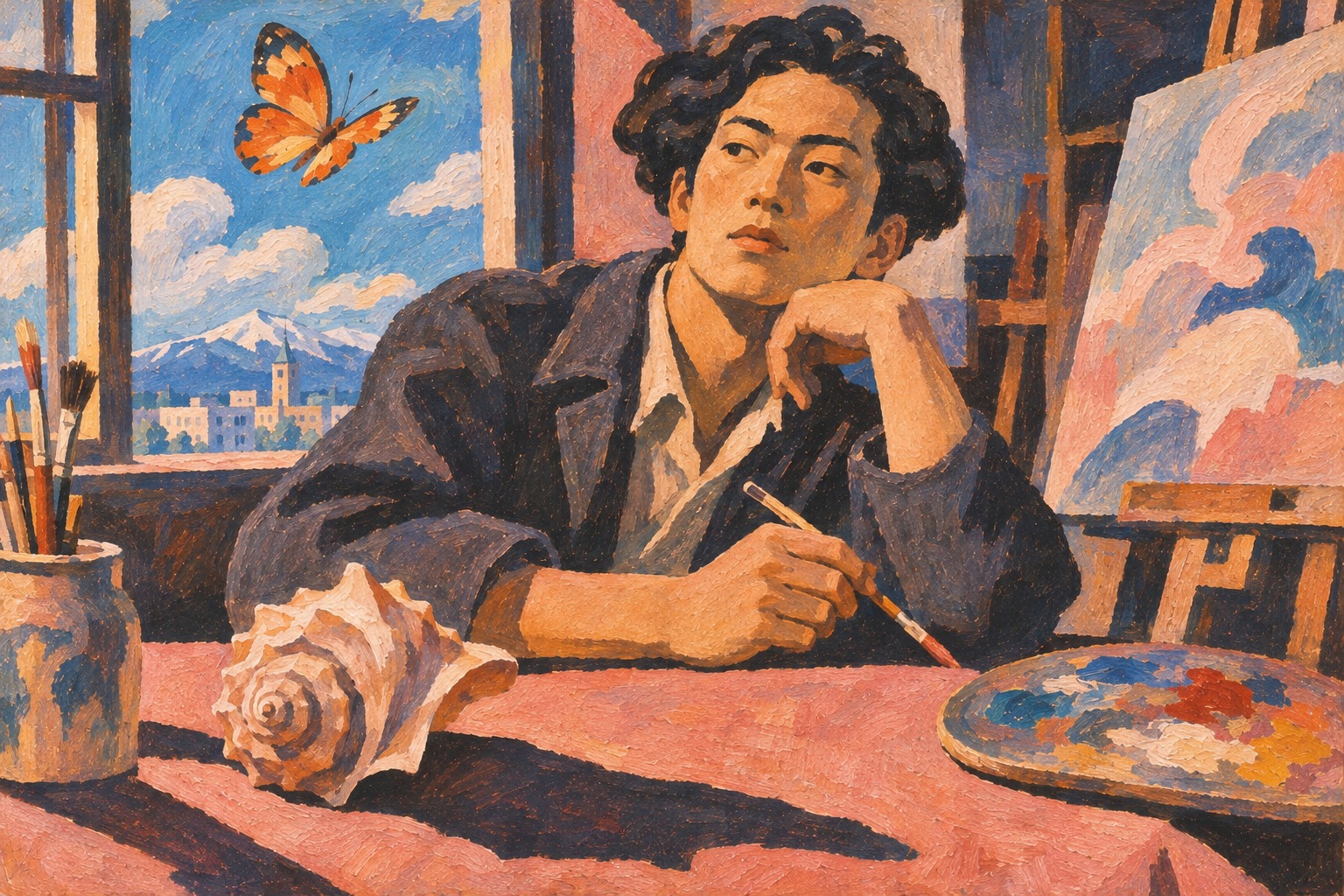
A prodigy from Sapporo
Kotaro Migishi was born in Sapporo in 1903 and left for Tokyo after graduating from Sapporo Daiichi Junior High School, now Sapporo Minami High School. Official biographies from the Migishi Kotaro Museum of Art in Hokkaido and the Sapporo International Art Festival describe a young painter who educated himself under difficult conditions, absorbing the possibilities of yōga—Japan’s modern tradition of Western-style painting—while developing a deeply personal sense of poetry and form.
What makes Migishi extraordinary is not merely that he died young, but that his art changed so quickly. Within little more than a decade he moved from early portraits and figure painting to clown motifs, avant-garde experiments, scratch-like linear compositions, and finally the dreamlike butterfly-and-shell paintings that define his late reputation.
That pace of transformation is central to his legacy. The Migishi museum in Sapporo presents him as a comet-like figure in modern Japanese art: brief, brilliant, and still difficult to classify neatly within a single school.
The breakthrough at the Shunyo exhibitions
Migishi’s public emergence came early. In 1923, his Girl Holding a Lemon was accepted to the first Shunyo Art Exhibition, and in the following year he received the top Shunyo Prize for a group of works that included Older Brother and His Eldest Daughter. The achievement brought him rapid attention in Tokyo’s art world.
These early paintings already show a refusal to settle for straightforward realism. Figures are organized through blocks of tone and color, and emotional atmosphere matters as much as likeness. Even before his explicitly avant-garde period, Migishi was using structure and simplification to make painting feel inward and atmospheric.
Success did not make him conservative. If anything, the recognition gave him room to take risks, and his subsequent career is best understood as a sequence of experiments rather than a steady refinement of one marketable style.
China, clowns and the Independent Art Association
A trip to China in 1926 helped open Migishi to new visual and emotional possibilities. According to the Sapporo International Art Festival biography, the journey energized the romantic impulse already present in his art. Soon afterwards he developed a series of clown and marionette images—figures at once theatrical, melancholy and psychologically charged.
In 1930 he became the youngest founding member of the Independent Art Association. That move mattered. It aligned him with a new artistic platform more open to experimentation than the established exhibition world and helps explain the restless boldness of his work in the early 1930s.
The clown pictures are not a side note. They introduced a way of converting observed reality into symbolic performance, an approach that would later reappear in the music-themed works and in the surreal transformations of butterflies, shells, light and shadow.
Why Orchestra matters
From late 1932 into 1933, Migishi made one of the sharpest stylistic turns of his career. The Migishi museum describes works such as Orchestra as part of his move toward avant-garde expression, including the use of scratch-like lines, abstracted form and daring compositional rhythms.
Cultural Heritage Online identifies the orchestra as the New Symphony Orchestra under Hidemaro Konoye, the ensemble that later became today’s NHK Symphony Orchestra. Rather than documenting a concert in a literal sense, Migishi seems to have been trying to paint sonic motion itself—the sweep of conducting, the pulse of performance, the compressed intensity of collective sound.
That is one reason Migishi feels newly relevant today. The visual vocabulary of rhythm, repeated human forms, spatial distortion and forceful line makes his work unexpectedly adaptable as inspiration for editorial illustration, including sports scenes and other stories built on movement.
Butterflies and shells at the end of his life
In 1934 his art changed again. The Migishi museum notes that this was the year of butterflies, shells, the hand-colored drawing collection Butterflies and Shells, and the visual poem “Butterflies and Shells.” These were not decorative motifs picked at random. They became vehicles for a fragile, hallucinatory world all his own.
In Flying Butterfly, several butterflies appear pinned against a pale wall, while one breaks free and lifts away. The museum explicitly notes that these are not depictions of actual species but inventions of the painter. The result is a remarkable mixture of specimen case, dream image and allegory of release.
Carefree Shellfish turns to another motif from the same final year. Cultural Heritage Online describes the huge shell, its long shadow and the peculiar mood that combines humor with a sense of emptiness. Here Migishi’s late Surrealism becomes quieter and more existential: a still life that feels suspended between sunlit play and mortality.
His artistic partnership with Setsuko
No serious account of Migishi is complete without Migishi Setsuko, the major painter who married him in 1924 and continued her own career after his death. The Tokyo National Research Institute for Cultural Properties records the marriage and the independent course of her later work, while the Migishi museum has also explored their relationship through exhibitions such as The Seashell Trip.
One of the poignant episodes in Migishi’s final year is the journey he took with Setsuko after works such as Carefree Shellfish were sold. On that trip, in Nagoya, he died suddenly at the age of 31. The loss hardened his posthumous legend, but it also shaped Setsuko’s life and art in lasting ways.
Seen together, the Migishi story is not only that of a male genius cut short. It is also the story of a couple within modern Japanese yōga, of shared struggle, ambition, love, friction and endurance across generations of painting.
A curated guide to four key works
For this Hokkaido edition, JAPAN.co.jp selected four Migishi images that together illuminate the decisive late arc of his career. They also help explain why he is such a fitting “Artist of the Day” for a special edition that ranges from rail infrastructure and fisheries to science, sports and Indigenous culture.
Butterflies Flying above Clouds
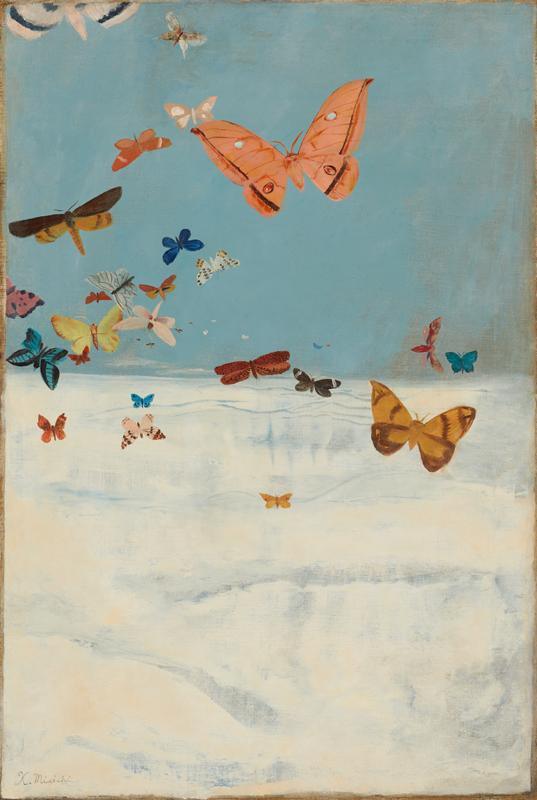
The painting removes the ground beneath the butterflies. Against a broad blue field, their orange, ochre and dark-blue wings become independent patches of color; the soft cloud bank makes their scale impossible to judge. The vertical canvas encourages the eye to travel upward. Recorded in the posthumous exhibition at Migishi’s Tokyo studio on November 1–10, 1934, the painting entered the National Museum of Modern Art, Tokyo, by purchase in 1997. Its imagined space is a useful starting point for understanding how Migishi turned ordinary natural forms into extraordinary pictorial experiences.
Flying Butterfly
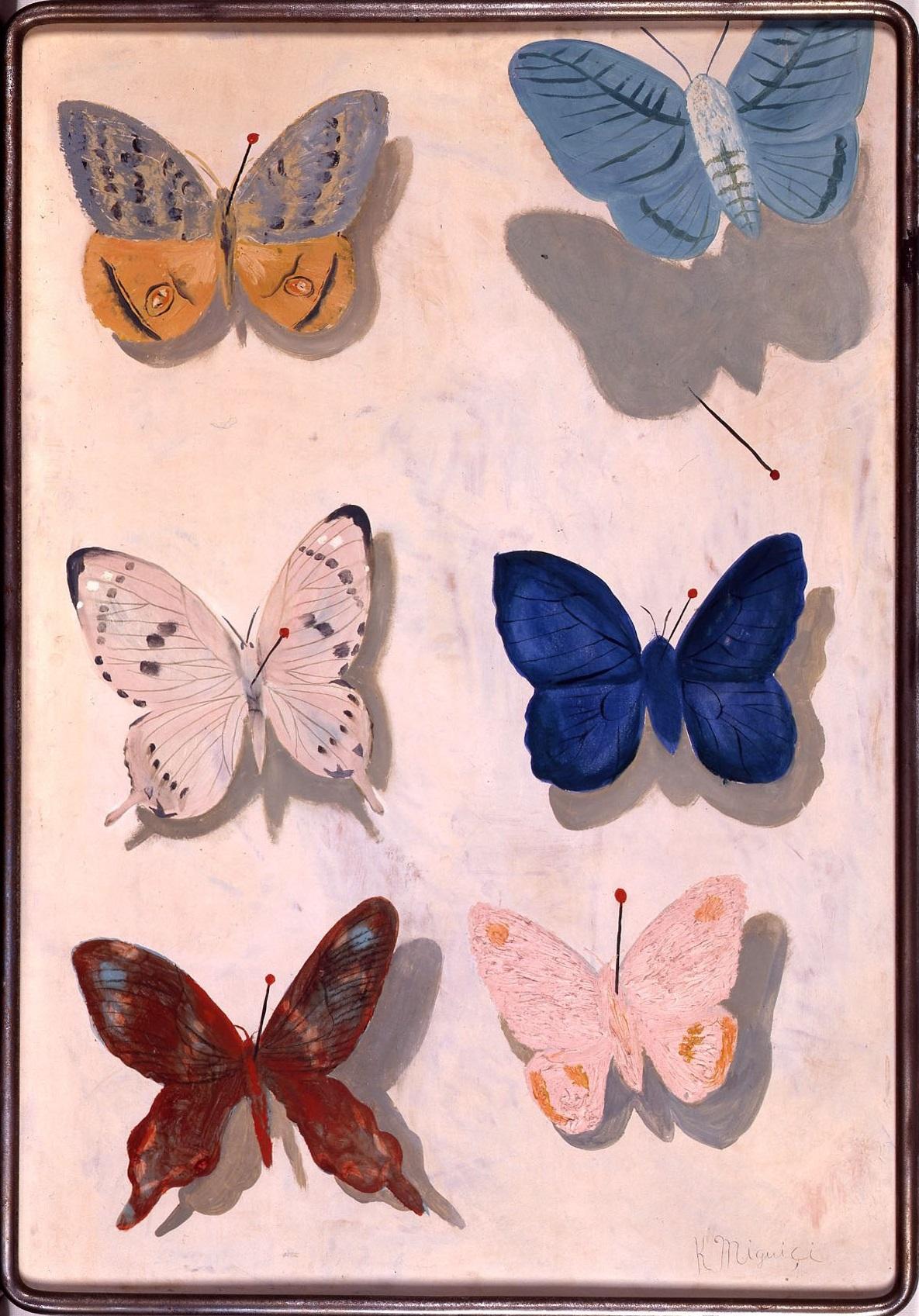
Six invented butterflies confront the viewer like specimens in a display case, each with its own color and shadow. At upper right the blue butterfly has escaped its pin. The dislodged pin is a small but decisive detail: a static arrangement suddenly becomes an event. Migishi designed the tubular metal frame himself. Exhibited at the Fourth Independent Art Association Exhibition in 1934, the painting has a close relationship to his visual poem about butterflies and shells. It invites a reading about freedom, without requiring the viewer to accept a single symbolic interpretation.
Carefree Shellfish
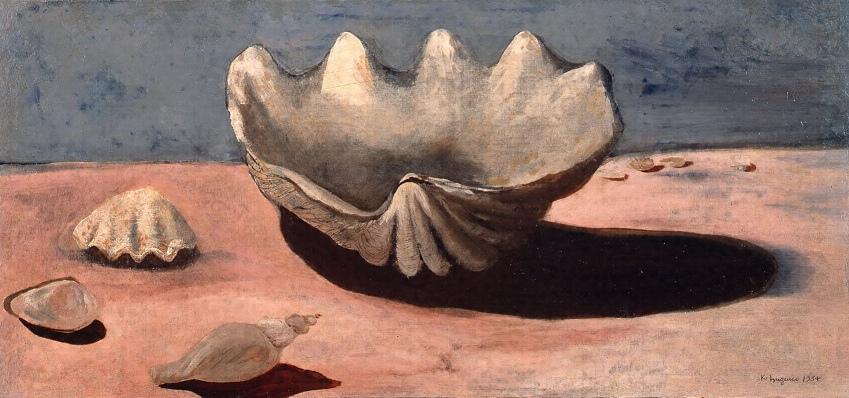
A giant clam shell occupies an unusually wide composition, surrounded by smaller shells. Its dark shadow extends across the pinkish ground, while the blue-gray background offers almost no indication of place. The title is playful, but the hollow shell and heavy shadow give the still life a more ambiguous mood. Shown at the Fourth Independent Art Association Exhibition in 1934, the work also has a documented biographical connection: its sale helped finance the couple’s final journey to Kansai. Migishi died in Nagoya on the return journey. That history adds poignancy, but the picture need not be interpreted as a prediction of his death.
Orchestra (Preparatory Study)
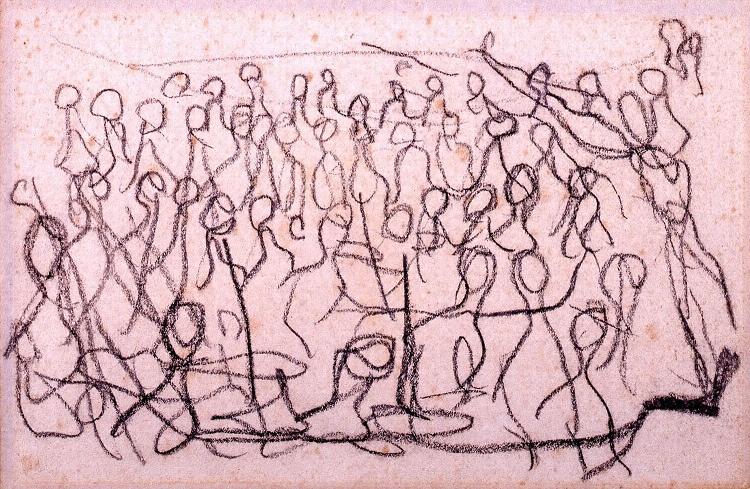
This particular image is a conté drawing, not either of the surviving oil paintings titled Orchestra. The museum identifies it as D-20 and suggests that its apparent choral scene may relate to the lost large painting of the New Symphony Orchestra. Repeated contours and interwoven figures reveal an artist testing the organization of an ensemble rather than making a literal portrait of every performer. Migishi’s 1933 orchestral studies investigated gestures, instruments and the trajectories of movement. The apparent spontaneity of the finished works emerged from careful preparation. This drawing makes that working process visible and offers a particularly apt reference for the rhythmic human movement in our sports and dance illustrations.
The jump from Orchestra in 1933 to the butterfly-and-shell paintings of 1934 is often described as dramatic, but the four images reveal a continuity as well. The dynamic line that once rendered sound becomes the floating and suspended spatial logic of his final imagery.
Why Migishi belongs in Hokkaido’s story
The Migishi Kotaro Museum of Art in Hokkaido traces its roots to a 1967 donation of 220 works by the artist’s family, and the current building opened in Sapporo in 1983. The museum notes that elements of Migishi’s own unrealized studio concept were incorporated into the present structure. In other words, his presence remains physically embedded in the city where he was born.
That legacy is larger than biography. Migishi’s art links painting with music, architecture, shadow, motion and imaginative scale. He belongs to Hokkaido not simply because he came from Sapporo, but because he represents a distinctly modern, outward-looking northern imagination—one that could absorb cosmopolitan influences yet remain unmistakably personal.
For our Hokkaido portfolio, Migishi is therefore an ideal touchstone. His butterflies echo the fruit-fly genetics story, his rhythmic figures suit the sports features, his marine and shell imagery resonates with fisheries and coastal towns, and his atmospheric color logic lends itself to winter harbors and wide northern skies. Few artists fit the full emotional range of this edition so naturally.
Primary sources and references
- Migishi Kotaro Museum of Art, Hokkaido: About Kotaro Migishi
- Migishi Kotaro Museum of Art, Hokkaido: Museum history
- Migishi Kotaro Museum of Art, Hokkaido: Gallery
- Sapporo International Art Festival: Migishi Kotaro
- Cultural Heritage Online: Orchestra
- Cultural Heritage Online: Flying Butterfly
- Art Platform Japan / The National Museum of Modern Art, Tokyo: Butterflies Flying above Clouds
- Cultural Heritage Online: Carefree Shellfish
- Tokyo National Research Institute for Cultural Properties: Migishi Setsuko
- Migishi Kotaro Museum of Art, Hokkaido overview (English)
- Orchestra preparatory study (D-20)
- National Museum of Modern Art, Tokyo — collection record