- A portraitist in irons
- The uncertain beginnings of a famous name
- The publisher who recognized a new kind of star
- Three Beauties: an Edo celebrity portrait
- An ordinary gesture made extraordinary
- Why publishing mattered to the shogunate
- The cherry-blossom gathering that crossed a line
- Fifty days in restraints—and a complicated record
- Did censorship end his career?
- What endures beyond the scandal
A portraitist in irons
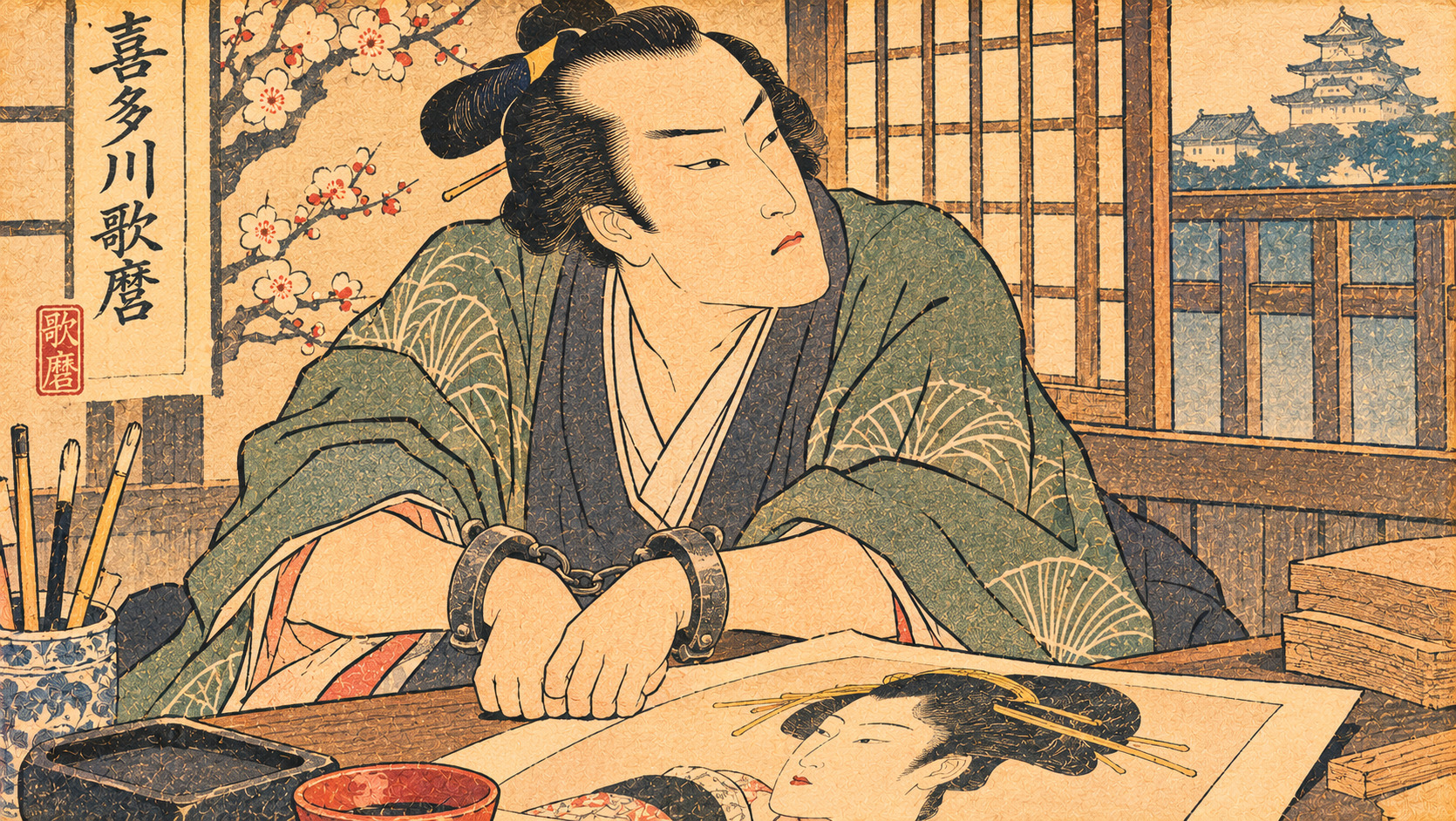
In 1804, one of Edo’s most sought-after designers of woodblock prints was punished for depicting a scene that had taken place more than two centuries earlier. Kitagawa Utamaro, celebrated for making the smallest gesture of a woman’s hand feel intensely alive, had pictured Toyotomi Hideyoshi at a cherry-blossom gathering with women from his household. The Tokugawa authorities treated the publication as a breach of restrictions on historical imagery.
The often-repeated punishment—three days in jail followed by fifty days under hand restraints—makes a dramatic beginning. But it is also a doorway into a more surprising history: Edo’s commercial publishing industry was sophisticated enough to create celebrities, and tightly regulated enough to turn a popular print into a punishable offense.
The uncertain beginnings of a famous name
Utamaro’s birth is commonly placed around 1753. His birthplace, family history and some biographical details are disputed. Japanese cultural reference sources identify the painter Toriyama Sekien as his teacher and record early work under the name Kitagawa Toyoaki. Utamaro entered a world of illustrated books, poetry, actors, popular entertainments and collaborative printmaking.
Unlike an oil painting produced by one artist at an easel, a typical commercial ukiyo-e print depended on a designer, publisher, block carvers and printers. Publishers financed and distributed editions, while artisans translated delicate lines into cut wood and carefully registered layers of color. The story of Utamaro is therefore also the story of a mass medium in a thriving city.
The publisher who recognized a new kind of star
Tsutaya Jūzaburō, a publisher with deep connections to Edo’s pleasure-quarter print culture, helped bring Utamaro to prominence. Illustrated poetry and natural-history books offered the artist room to sharpen an exceptional eye for texture, line and observation. His insect illustrations, as well as portraits, belong to the foundations of his reputation.
By the early 1790s, Utamaro was exploring bijin ōkubi-e—large-format close views of women’s heads and upper bodies. He made the picture less dependent on a crowded setting and more attentive to the angle of an eyebrow, the tension of a sleeve or the poise of fingers. The result was simultaneously a powerful artistic language and a highly marketable one.
Three Beauties: an Edo celebrity portrait
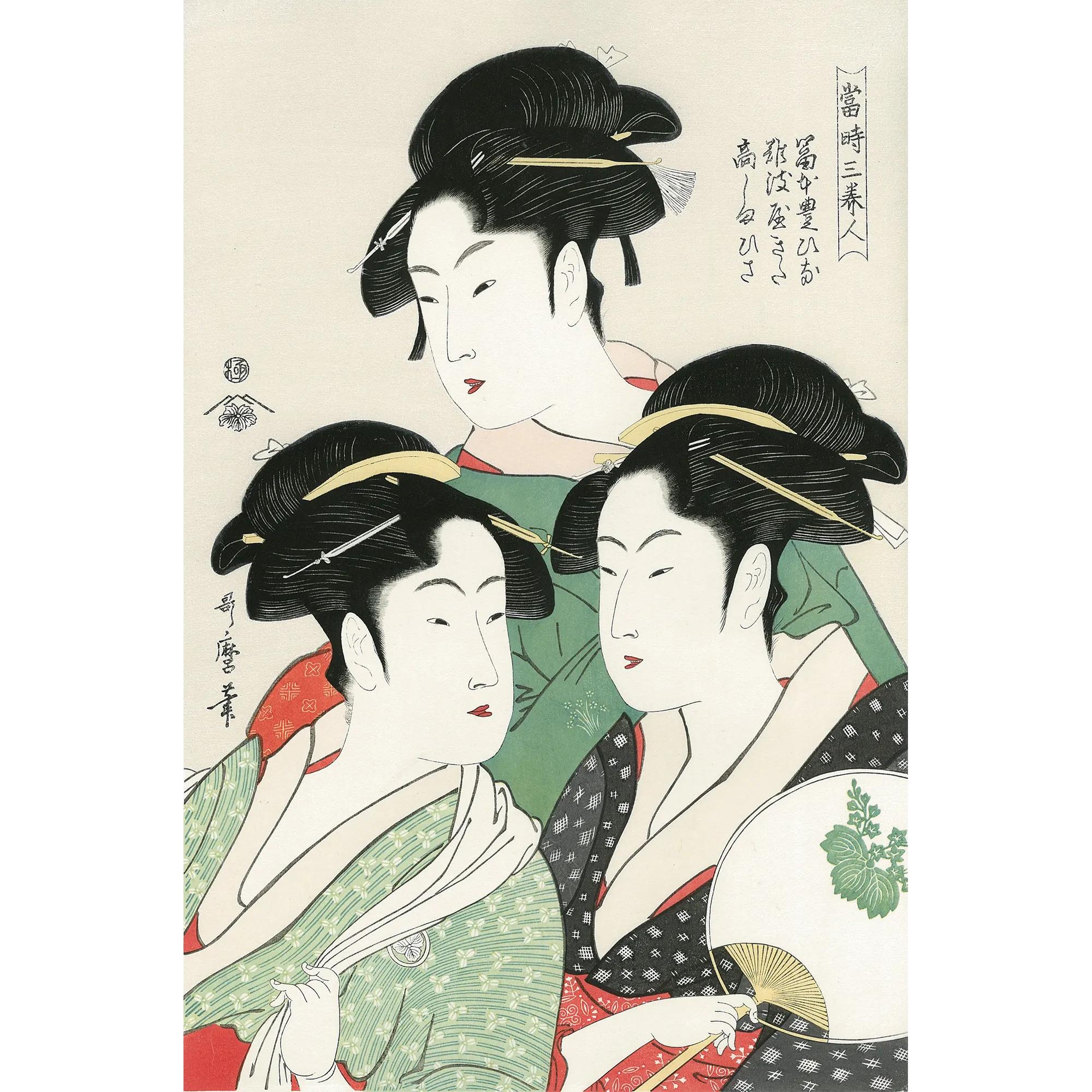
His 1793 Three Beauties of the Present Day presents Tomimoto Toyohina, Naniwaya Okita and Takashima Ohisa. Chiba City Museum of Art identifies the sitter at the upper center as Toyohina, Okita at lower right and Ohisa at lower left. The arrangement recalls devotional triads, yet the subjects are women celebrated within the social world of Edo rather than religious icons.
The print belongs to a culture in which names, establishments and personal reputations mattered. It should not be treated as photographic evidence of how three women looked: Utamaro stylized them according to contemporary ideals and the commercial demands of his medium. That tension between individuality and convention is part of the work’s appeal.
An ordinary gesture made extraordinary
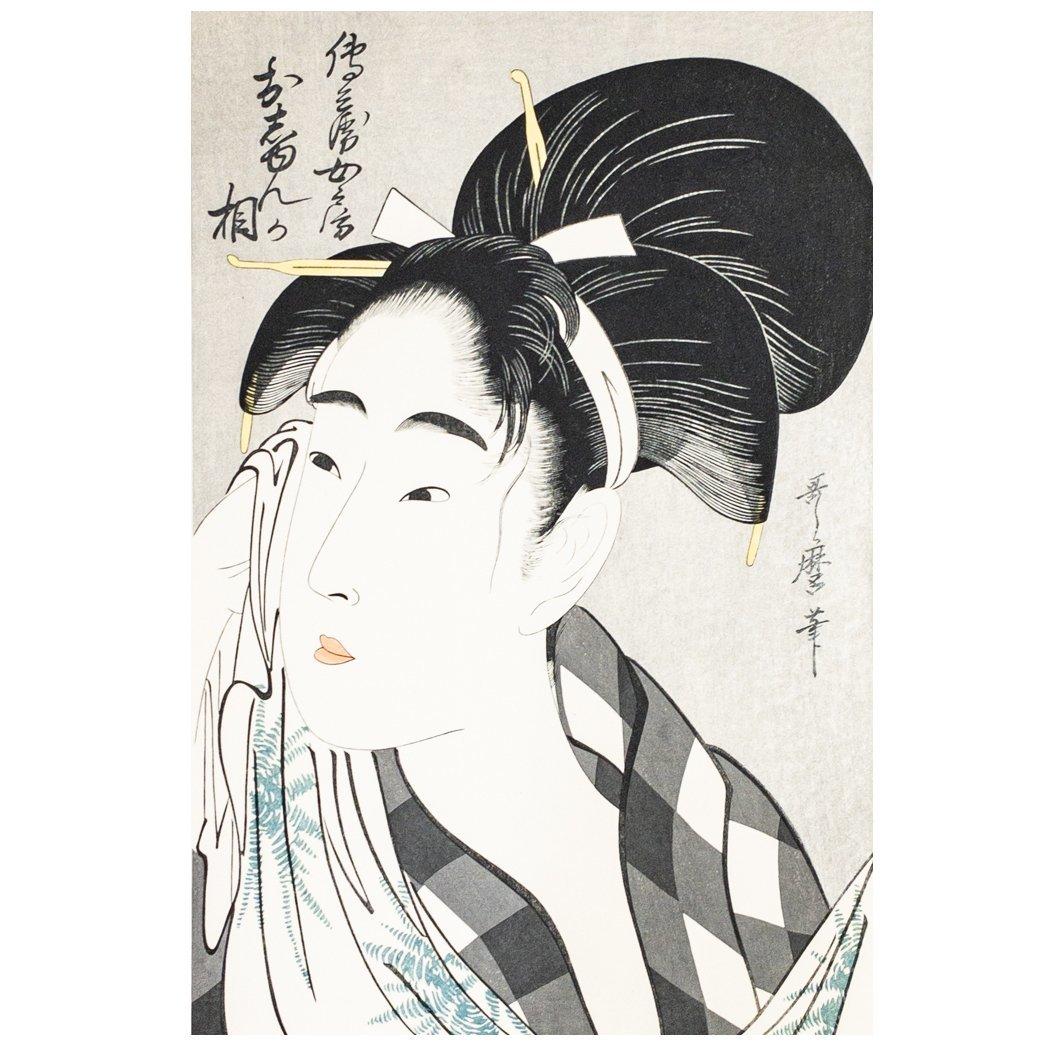
Woman Wiping Sweat, designed around 1798, turns a fleeting act into an entire composition. There is no palace, battle or procession. The drama is the placement of a hand and cloth beside a face. Utamaro’s skill lay partly in making a moment feel observed while remaining beautifully orchestrated.
The Library of Congress record provides a caution for modern readers: the impression in its collection is a twentieth-century reprint of an earlier design. Its catalog distinguishes the design date, 1798, from an impression printed between 1918 and 1923. A historical image may be public domain while an individual catalog photograph or print impression has its own provenance and reproduction terms.
Why publishing mattered to the shogunate
During the Kansei Reforms associated with senior councillor Matsudaira Sadanobu, regulation reached into publishing, social behavior and representations of politically sensitive history. The enormously popular Ehon Taikōki, a narrative of Hideyoshi’s career, inspired prints and other adaptations. Historical entertainment was not separate from present-day authority: it could invoke names and symbols whose political resonance remained alive.
Ritsumeikan University’s research collection traces the suppression of works drawing on Ehon Taikōki and notes that Utamaro was not the only artist disciplined. Utagawa Toyokuni and others were also involved, while publishers faced sanctions and associated publications were prohibited. Reducing the case to a lone artist bravely defying the rulers would erase the larger system being policed.
The cherry-blossom gathering that crossed a line
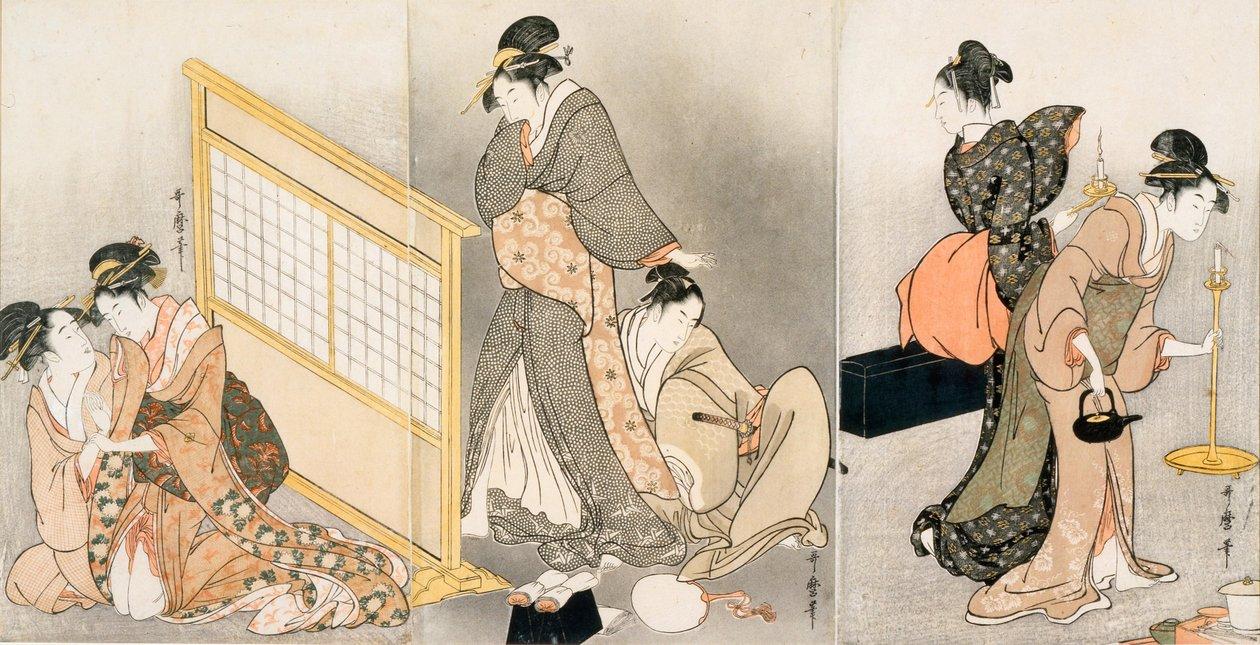
The Metropolitan Museum of Art dates A View of the Pleasures of the Taiko and His Five Wives at Rakutō to 1804. It depicts the 1598 flower-viewing festivities associated with Hideyoshi at Daigo, east of Kyoto. In the triptych, historical rank and social intimacy appear together. Its apparent frivolity was part of what made the subject combustible.
Ota Memorial Museum has examined how the names of historical warriors appeared in prints despite restrictions, and how the shogunate subsequently insisted that names and crests of prominent commanders from the late sixteenth century be kept out of commercial images. Historians debate the exact sequence of restrictions and what most angered officials. The safe conclusion is not that a single joke inevitably produced a sentence, but that a widely circulated historical image was caught in a wider regime of publication control.
Fifty days in restraints—and a complicated record
Official Japanese cultural summaries and major museums agree that Utamaro received a hand-restraint punishment. Many modern accounts describe three days in jail and fifty days confined in restraints. Historical sources are not entirely uniform on sentencing details, however, and some records suggest different durations. The widely cited fifty-day version is therefore presented here as the prevailing account, not as a unanimous transcript of every surviving document.
Hand restraints, or tejō, were a material restriction on the ability to work and move through daily life. The punishment reached beyond the artist’s pride; Edo’s prints were produced for a market, and other artists and publishers could be exposed to similar official scrutiny. That is why this story concerns the economics of expression as much as its symbolism.
Did censorship end his career?
Utamaro died in 1806. A familiar telling says that humiliation and physical hardship destroyed his health or inspiration. It is possible that the punishment had an impact, but the causal story is difficult to prove. Publishers had died, tastes and patrons changed, and surviving work complicates any claim that he abruptly stopped producing art.
A responsible biography can describe the documented sanction without presenting a diagnosis or a story of artistic decline as an established medical fact. It can also acknowledge that his last years remain less well documented than the prints that made him famous. The certainty lies in the punishment and his death date; the personal aftermath is harder to recover.
What endures beyond the scandal
Utamaro’s prints later reached European audiences and helped shape a wider fascination with Japanese art. He is regularly discussed alongside Hokusai and Hiroshige in histories of the nineteenth-century encounter between Japan and European artists. Yet reducing his significance to a Western influence risks overlooking the audience he first served and the complex lives his compositions represented.
A hand turning toward a face; three celebrated women sharing one picture; quiet scenes populated by figures engaged in everyday work. These are the works that explain why his name survived. His punishment reveals something equally important: when images can circulate widely, authorities may treat them as acts with political consequences. Utamaro’s art offers a record of the pleasures—and constraints—of Edo’s visual world.
Sources and image provenance
This independently written historical feature draws on publicly available museum catalogues and research collections; no unpublished archival documents or original interviews were obtained.