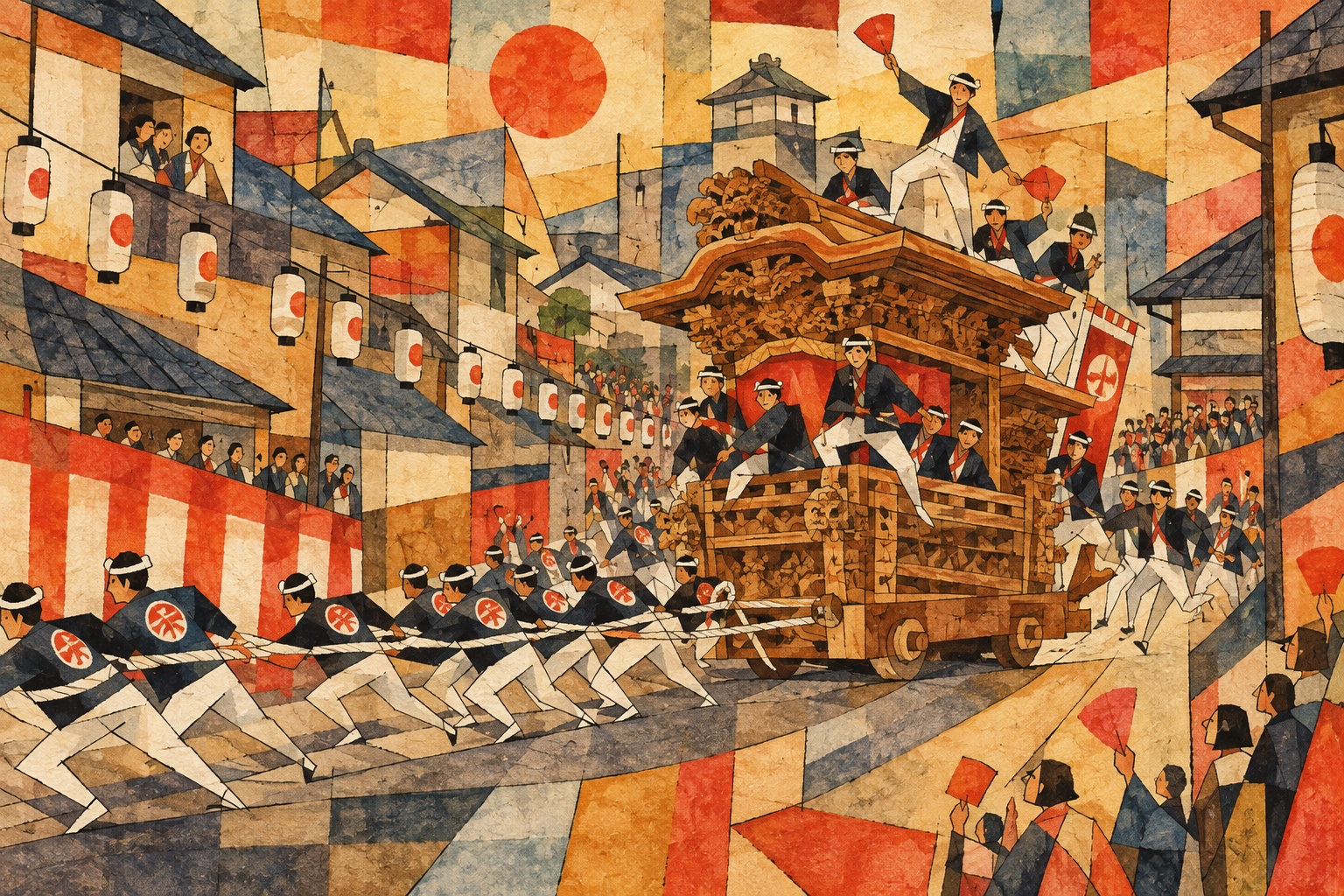
The most dramatic image of Kishiwada’s danjiri festival lasts only a few seconds: a carved wooden float turns a street corner at speed, its pulling team and steering crews moving together. Understanding those seconds takes longer. The spectacle depends on people in different positions receiving signals, applying force and trusting one another’s timing. [3]
Kishiwada’s September festival is scheduled for September 19–20, 2026. Beyond its celebrated turns, the event offers a way to see neighborhood organization, woodcarving and musical knowledge at work—and to watch the atmosphere change when lanterns illuminate the evening procession. [1]
The September weekend, correctly located
| Date | Published procession window |
|---|---|
| Friday, September 18 | Trial pull / 14:00–16:00 |
| Saturday, September 19 | Yoimiya / 06:00–22:00 |
| Sunday, September 20 | Honmiya / 09:00–22:00 |
These are the city’s general procession windows, not a promise that every float moves continuously throughout them. Individual neighborhood and shrine schedules matter. The September festival covers the Kishiwada and Haruki districts; other districts hold their festivals in October. This year’s October main festival dates are October 10–11. [1][5]
For the Kishiwada district, the published Saturday parade order starts at 13:00 in front of Kishiwada Station. Sunday’s Kishiki Shrine schedule begins at 09:30. The city specifically identifies that second time as departure from the foot of Konakara slope, rather than arrival at the shrine. Reading the location attached to a time is as important as reading the time itself. [9]
A harvest tradition, not a frozen performance
The city presents the festival’s origin as a tradition reaching back to 1703. Its historical account describes Kishiwada lord Okabe Nagayasu bringing the worship of Kyoto’s Fushimi Inari to the castle’s Sannomaru precinct and holding an Inari festival to pray for abundant crops. Early celebrations, it says, included theatrical entertainments and shrine visits. [2]
That account should not be read as proof that every feature visible today existed in its present form in 1703. An origin story establishes a relationship with the past; the subsequent history explains how people have continued to make that relationship meaningful. The carved vehicle, the neighborhood team and the visitor’s experience belong to a tradition developed over time.
Look below the rooftop performance
The roof-top performer, the daikugata, naturally draws the eye. The city’s explanation of procession roles also gives that figure a practical responsibility: signaling direction to the rear steering crew, whose view ahead is obstructed. At ground level, the nearest rope pullers transmit force to the float, the front levers help initiate a turn and the rear lever changes its direction. [4]
Kishiwada calls the fast cornering maneuver yarimawashi. The city describes floats weighing more than four tonnes and emphasizes the difficulty of coordinating their movement. This is a collective achievement, even when a photograph isolates one person above the roof. [3]
A rewarding viewing approach is to widen the frame. Follow the line of the rope, then the people working near the vehicle, then the signal from above. The question becomes not simply how fast the float travels, but how many separate actions must agree for it to turn. Space to see the whole team can reveal more than proximity to a single dramatic detail.
The organization behind the moment
The municipality’s guide describes neighborhood responsibilities spanning generations and a coordinating system known as nenban. Its work includes settling procession times and routes and liaising with the city and police. Neighborhood associations also prepare throughout the year and organize service and social activities. These are the city’s descriptions of the organizational framework, not a verified roster for every neighborhood in 2026. [5]
The distinction matters. A festival can appear spontaneous to someone encountering it for a few hours, while depending on decisions made well before the first rope is pulled. Negotiating a shared route, distributing responsibility and teaching a role are less visible than cornering a float. They are nonetheless part of the cultural work that makes the public performance possible.
Carving stories into wood
Seen at rest, a danjiri offers another kind of movement: figures, animals and scenes worked into wood. Kishiwada’s carving guide describes finishes that reveal the grain of keyaki, or Japanese zelkova, and subjects drawn from war tales, mythology and popular theatrical storytelling. The images can mix historical material with fiction; they are not simply illustrated chronicles. [6]
The same guide explains that Edo-period controls limited acceptable subjects, while the Meiji period brought a broader choice. A carved panel can therefore prompt two questions: what story does it depict, and why might that story have appealed to the people who commissioned it? Craft becomes a route into the history of taste and public expression. [6]
Visitors need not press toward a moving float to appreciate this detail. The city’s neighborhood guide provides an introduction to individual danjiri. Learning about one before the procession gives the eye something specific to recognize. What first looked like one spectacular cart among many becomes a vehicle belonging to a particular community. [14]
Music that does a job
The festival’s narimono ensemble combines large and small drums, flutes and a gong. In the city’s account, rhythmic patterns change with the procession’s movement and help coordinate the pullers’ steps. Listening is therefore another way to follow what the team is doing. The sound is connected to the work. [7]
At night, the city’s terminology guide describes lantern processions between 19:00 and 22:00, with roughly 200 lanterns decorating a float. This is the general practice described by the municipality; individual movements remain subject to local arrangements. The change in light invites a different pace of attention, from a sudden turn to the outline and presence of the whole vehicle. [8]
The municipal music guide describes children boarding floats and playing drums during the evening procession. That shift in participation is as revealing as the lanterns. A child can encounter the festival as something to watch and something to help make. From an editorial perspective, this is one reason the evening belongs at the center of the story rather than being treated merely as a photogenic ending. [7]
A neighborhood is more than its procession route
Kishiwada’s festival customs also extend into homes. The city mentions swimming crab, kantodaki—oden—and kurumi mochi among foods prepared to welcome guests. This is a description of local hospitality, not a claim that every household serves the same menu. It opens a view of the festival beyond the street stalls and the passing floats. [13]
For visitors, recognizing that domestic setting has practical consequences. These streets remain places where people live. In a notice dated September 1, 2026, the city asks spectators not to mark roads or attach tape to reserve viewing positions, and not to place stepladders or chairs on the roadway. [11]
Traffic restrictions apply on the trial-pull and main festival dates. Consult the current city map before traveling and follow stewards and police on site. The city’s spectator guidance stresses that the rear steering lever requires room beyond the width of the float itself. Leaving that space clear is part of enabling the performance, not merely an inconvenience imposed on spectators. [10][12]
The turn, the carving and the lantern procession reward different kinds of attention. One reveals coordination in motion; another preserves stories in a worked surface; the third makes room to notice younger participants. Together they offer a fuller understanding of Kishiwada: a festival whose great wooden floats become public expressions of the neighborhoods that move them.
- Kishiwada City: 2026 festival schedule
- City: festival history
- City: yarimawashi
- City: procession roles
- City: neighborhood organization
- City: float carvings
- City: festival music
- City: festival terminology
- City: 2026 Kishiwada district parade and shrine-entry order
- City: 2026 traffic restrictions
- City: September 1, 2026 notice on reserving viewing space
- City: guidance for spectators
- City: festival customs
- City: neighborhood float guide
Based on schedules and city materials checked through September 17. Origin traditions are attributed to the city. Interpretation of community significance is Japan.co.jp analysis.