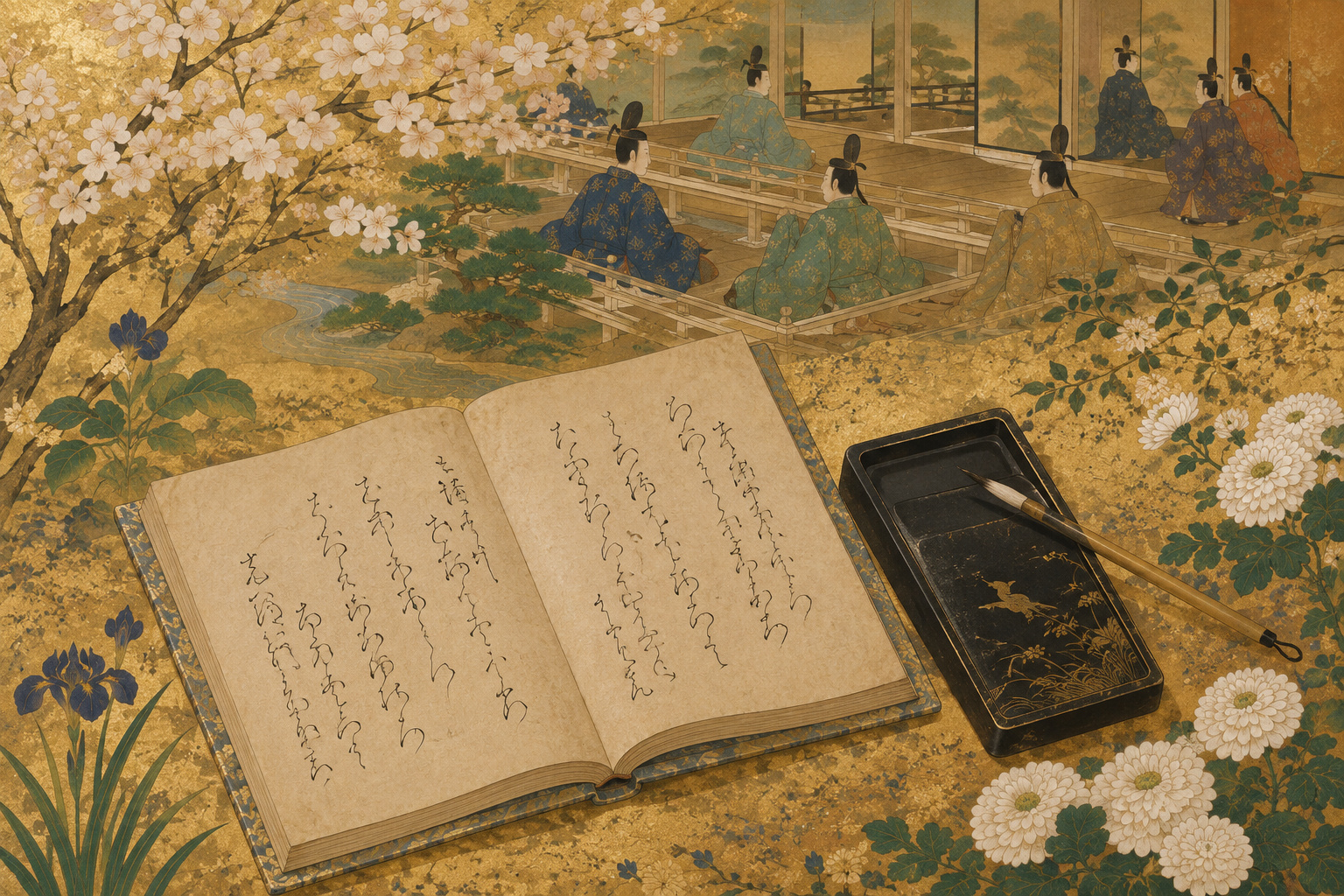
Six hundred years ago, a court noble in Kyoto wrote down what he had seen and heard, pasted original documents directly into his diary, and reused discarded letters and debt papers as writing material. Much of that paper still survives. The special exhibition that opened September 2 at the Kyoto University Museum is therefore not simply a display of an old historical text. It is an encounter with the working archive of Made-no-koji Tokifusa (1394–1457), a court official who stood on the communications line between the imperial court and the Ashikaga shogunate.
Tokifusa was not merely watching politics—he was carrying messages through it
Tokifusa belonged to the Made-no-koji family, part of the Kanjūji branch of the northern Fujiwara lineage. Kyoto University historian Susumu Uejima explains that the Kanjūji line produced practical court officials who served as chamberlains and senior administrative officers before rising into the ranks of court nobility.
Tokifusa followed that path. He served emperors Go-Komatsu and Shōkō, rose through the court hierarchy and for many years worked as buke densō—an intermediary responsible for communication and negotiation between the imperial court, including the emperor and retired emperor, and the military government headed by the shogun.
That position makes Kennaiki unusually valuable. Tokifusa was not a distant scholar writing political commentary. He received documents, handled ceremonial and personnel questions, transmitted positions and had access to current information that moved between the two governing worlds of Muromachi Kyoto.
The Agency for Cultural Affairs specifically cites the abundance of material on both court and shogunate affairs as a reason the autograph diary is an important record of early-to-mid Muromachi politics, economics and society.
In 1428, the next shogun was chosen by lot
The Kyoto autograph holdings begin close to one of the most unusual succession episodes in Japanese political history. In 1428, fourth shogun Ashikaga Yoshimochi died without an adult son ready to inherit the office. Several potential successors were Yoshimochi’s brothers who had entered religious life.
The Cultural Affairs designation dossier highlights Kennaiki’s account of the process in which the successor was selected by drawing lots. The winner was Gien, head of Shōren-in, who returned to secular life and became Ashikaga Yoshinori, the sixth shogun.
Kennaiki preserves more than the famous “lottery shogun” anecdote. Tokifusa recorded negotiations over Yoshinori’s new name, court rank and appointment. The episode shows that shogunal succession was not only an internal military-house matter: the new ruler had to be fitted into the imperial court’s order of names, ranks and ceremony.
The same year brought the Shōchō uprising
1428 was also the year of the Shōchō uprising, a wave of collective action demanding debt relief. Kyoto University identifies the diary as a key source not only for court–shogunate politics but also for the appearance of tsuchi ikki, rural and urban popular movements that could place direct pressure on creditors and authorities.
That breadth matters. A diary written by a high court noble records institutions from above, but the institutions were being pushed from below by debt, land disputes, temple networks, merchants and local communities.
The University of Tokyo Historiographical Institute’s critical-edition commentaries show how widely Kennaiki ranges: court ceremony, shogunal politics, estate administration, lenders, breweries and moneylenders, religious ritual, scholarship, rumor and street incidents all enter Tokifusa’s pages.
It is therefore a political diary and a social-history source at the same time.
In 1441, news of a shogun’s assassination entered the diary tradition
Yoshinori’s increasingly coercive rule ended in June 1441, when Akamatsu Mitsusuke had the shogun killed at his residence, beginning what is known as the Kakitsu Incident. An autograph Kennaiki volume now held by the Imperial Household Agency preserves Tokifusa’s report based on information reaching him on June 24.
That example also makes a crucial archival point: Kyoto University does not hold every surviving autograph section of Kennaiki. Original leaves and scrolls became dispersed among Kyoto University, the Imperial Household Agency and other collections, while later copies preserve still other material.
Modern researchers read “Kennaiki” as one diary because generations of textual scholarship reconstructed it from those dispersed originals, copies and excerpts.
Tokifusa sometimes pasted the medieval equivalent of an email attachment into the diary
The physical object can preserve information that disappears in a transcription. Uejima’s Kyoto University commentary uses entries from January 1447 as a clear example.
Tokifusa received a formal report from Kanjūji temple describing prayers performed for his health, longevity and fulfillment of wishes, together with a covering letter. Instead of simply summarizing the documents, he attached the originals to the diary.
For a historian, that means the evidence survives twice: Tokifusa’s account and the incoming document itself. Handwriting, paper, format, sender and documentary form can all be examined.
The diary is therefore not only narrative. In places it is a working file.
The back of the paper became a second archive
Paper was valuable. Tokifusa reused discarded letters, debt documents and his own draft correspondence as writing material. The Agency for Cultural Affairs specifically emphasizes these reverse-side documents as part of the manuscript’s importance.
One Kyoto University Museum autograph—the October 1428 diary—is a scroll made from 35 sheets and stretches roughly 14.3 meters. Its catalogue lists court-lady correspondence, draft letters, estate-document inventories, a borrowing memorandum and other older records on or behind the sheets.
To Tokifusa, some of that material had become scrap paper. To modern historians, it preserves household finance, landholding, communication networks and administrative practice.
Kennaiki is therefore best imagined not as one clean book but as a layered micro-archive assembled through daily work.
Three documentary layers inside Kennaiki
| Layer | What survives | What it can reveal |
|---|---|---|
| Diary text | Tokifusa’s own daily writing | Court and shogunate politics, ceremony, social life, culture, estates and rumor |
| Inserted documents | Original incoming letters and formal reports | Provenance of information, senders, documentary forms and administrative workflow |
| Reverse-side documents | Reused letters, debt papers and drafts | Household finance, land, personal networks and paper-use practice |
“Kennaiki” was not a modern author’s title
Kyoto University gives the standard reading as Kennaiki and notes that Kendaiki is also used. The name is an abbreviation of Kenshō-in Naifu-ki, combining Tokifusa’s Buddhist posthumous name Kenshō-in with his highest court office, naidaijin.
That is typical of the way many premodern court diaries came to be known. They were not finished books issued with a title page by their authors. Daily records were written in separate chronological units, transmitted within families, copied, reorganized and eventually referred to by titles derived from the writer’s office, residence or religious name.
“Seventeen surviving years” therefore does not mean an unbroken diary from 1414 to 1455. The gaps are substantial. The Historiographical Institute has argued that many sections were already lost relatively early in the manuscript tradition.
A copy can preserve something the autograph no longer does
Autographs are uniquely valuable because they preserve the writer’s own hand. But later copies cannot simply be dismissed as inferior. When an original section disappears, a copy may contain the only surviving wording.
The critical edition of Kennaiki has relied on originals and copies held by multiple institutions, including the Kikutei materials at Kyoto, Imperial Household Agency manuscripts, Kanjūji-line copies and other collections.
The related work designated as an attached item, Kenna Gyoki Nukigaki, was compiled by Tokifusa’s descendant Made-no-koji Korefusa (1513–1573). The Agency for Cultural Affairs notes that some passages survive only there, which is why it is preserved together with the autograph group.
Historical authenticity is therefore not a simple ladder where “original equals useful, copy equals disposable.” The copyist can become the sole bridge to a lost original.
Kyoto University’s holdings came together by two different routes
The university’s autograph material has two provenances. The Main Library group belonged to the Kikutei (Imadegawa) family, a branch of the Saionji lineage. The Kikutei Collection entered Kyoto University on permanent deposit in two stages, in 1921 and 1923, from the late Marquis Kikutei; the collection was formally donated to the university in 2021 together with related family documents and artworks.
The museum’s two autograph items arrived separately. Kyoto University purchased them in 1915, and they were kept for decades in the Department of Japanese History as teaching and research materials.
After the 2021 donation, a broad survey of the Kikutei Collection was organized around Kyoto University professors Susumu Uejima and Makoto Ōtsuki, with researchers, graduate students and library staff working across institutional boundaries. Kyoto University explicitly connects that survey to the new Important Cultural Property designation.
The cultural-property story is therefore not one of discovering in 2026 that a famous diary is old. It is a story of provenance, deposit, acquisition, donation, cataloguing and collaborative study making the collection legible as a whole.
From the university vault to a global screen
Kyoto University has also put the newly evaluated materials into its Rare Materials Digital Archive. Two museum-held Kennaiki items were released online in March 2026, joining the library material.
Digitization changes the preservation equation. Frequent opening and handling of fragile scrolls stresses paper, ink, joins and mountings. High-resolution images allow many research questions to be answered remotely and reserve direct examination for cases in which the object itself must be studied.
It also changes public access. A non-specialist can see uneven handwriting, attached documents, reused paper and the structure of a scroll rather than encountering Kennaiki only as a footnote in a history book.
Why is a diary designated in the “Ancient Documents” category?
In the March 2026 Cultural Affairs Council recommendation, Kennaiki appears in the Ancient Documents category of Important Cultural Properties (Fine Arts). At first that can seem surprising: a diary sounds like a manuscript or literary text.
The category fits the object’s function. The Cultural Affairs assessment emphasizes its value as a first-order record of politics, economy and society and its preservation of original administrative documents and reverse-side papers.
What is protected is not merely the information Tokifusa wrote down. The paper, joins, corrections, inserted documents and reuse patterns are themselves evidence.
An autograph preserves thinking in progress
Autographs preserve traces that a clean copy can normalize away. The Historiographical Institute has highlighted an entry from June 1444 in which Tokifusa first crossed out wording and later marked it to be restored. The published critical edition could not fully express the visual process and therefore reproduced the passage as an image.
Such corrections reveal a diary being made rather than a finished chronicle. Tokifusa selected, revised and sometimes reconsidered what should remain in the record.
An autograph is not automatically “truer” because it is in the author’s hand. Tokifusa could repeat rumor or misunderstand information. Its special value is that researchers can study how information became a written historical record: what was added, removed, attached and physically preserved.
A court diary became an external log of the Muromachi shogunate
Researching the Ashikaga shogunate requires more than documents produced inside the military government. Shoguns sought court rank, appointments and ceremonial recognition; temples and aristocratic estates interacted with military authorities; era names, ritual and land disputes crossed institutional lines.
Tokifusa lived at that junction. Kennaiki is in one sense an outsider’s record of the shogunate, yet his buke densō role gave him unusually direct access to the information moving between institutions.
The diary also captures material far outside high politics. Historiographical Institute summaries note thieves entering the palace, rumors of poisonous rain, strange public performances, women’s hair being cut at the shogunal residence, moneylenders, estate disputes, religious ceremonies and scholarship.
Muromachi Kyoto emerges not as a diagram of institutions but as a noisy city around them.
1394: Made-no-koji Tokifusa is born.
1414–1455: Surviving Kennaiki material spans portions of 17 years, with major gaps.
1428: Yoshimochi dies; shogunal succession by lot; Shōchō uprising.
1441: Ashikaga Yoshinori is assassinated in the Kakitsu Incident.
1457: Tokifusa dies at 64.
1915: Kyoto University purchases the two autograph items now held by the museum.
1921: Kikutei Kin'osa permanently deposits the Kikutei Collection at Kyoto University.
2021: The Kikutei Collection is donated to the university; comprehensive survey expands.
March 2026: Cultural Affairs Council recommends the Kyoto Kennaiki autograph group for Important Cultural Property designation; digital access expands.
September 2, 2026: Kyoto University Museum opens the designation exhibition.
Seeing the original turns history from outcomes back into process
The exhibition runs through October 4 in the west gallery on the second floor of the Kyoto University Museum’s North Building. A related symposium on September 30 is scheduled to include Cultural Affairs Agency specialist Kenji Satō, historian Keiko Hongō, Kyoto University’s Susumu Uejima and Takafumi Aoki of the Kyoto Institute, Library and Archives.
Kennaiki can be mined for facts: a shogunal succession, a debt-relief uprising, the assassination of Yoshinori. Those facts alone make it a major historical source.
The autograph manuscripts add something different. A rushed hand. A document pasted in place. A letter recycled as backing paper. A phrase crossed out and revived. They preserve the moment a working official turned incoming information into memory.
Modern histories compress Ashikaga Yoshinori into “the shogun chosen by lot” and 1428 into “the Shōchō uprising.” Tokifusa’s paper shows the administrative world between those labels—messages, rituals, rumors, prayers, loans, estates and people.
That is ultimately why the newly designated manuscripts matter. They do not merely tell us what happened six centuries ago. They preserve how one participant tried to make sense of what was happening while it was still happening.
Sources & Reporting Notes
- Kyoto University Museum, 2026 special exhibition “Kennaiki — The World Conveyed by the Autograph Manuscripts” — Primary exhibition information, Tokifusa’s role, provenance of the university holdings and related symposium.
- Kyoto University, “Kennaiki to be designated an Important Cultural Property” — Primary university account of the designation, name readings, surviving chronology and collection history.
- Kyoto University Rare Materials Digital Archive, Kennaiki commentary — Detailed explanation by Professor Susumu Uejima of Tokifusa, buke densō duties, inserted original documents and paper reuse.
- Agency for Cultural Affairs, 2026 Important Cultural Property recommendation dossier — Official assessment of the autograph materials, 1428–1447 contents, shogunal succession, estate records and documentary layers.
- Agency for Cultural Affairs, March 26, 2026 Cultural Affairs Council recommendation — Lists Kennaiki in the Ancient Documents category among newly recommended Important Cultural Properties.
- Kyoto University Rare Materials Digital Archive, Kennaiki: October 1428 — Physical description of an autograph scroll and its attached/or reverse-side documents.
- Imperial Household Agency Shoryobu, Kennaiki vol. 5 — An autograph Kennaiki manuscript outside Kyoto University, with commentary on Tokifusa’s June 24, 1441 account of the Kakitsu Incident.
- Historiographical Institute, University of Tokyo, Dai Nihon Kokiroku: Kennaiki II — History of the critical edition and the dispersed autograph/copy tradition.
- Historiographical Institute, University of Tokyo, Dai Nihon Kokiroku: Kennaiki III — Examples of the diary’s coverage of court, shogunate, social rumor, economics, religion and scholarship.
- Historiographical Institute, University of Tokyo, Dai Nihon Kokiroku: Kennaiki X — Discussion of gaps, lost sections, excerpts and the importance of copies for reconstructing the diary.
- National Diet Library Search, Kennaiki: Made-no-koji Tokifusa ga mita Muromachi Bakufu — Authority-form reading for Made-no-koji Tokifusa and recent research publication context.
This article was checked against public material available by 2:24 AM JST on September 3, 2026. The Japanese reading Kennaiki (also Kendaiki) and the official reading of 万里小路時房 as Made-no-koji Tokifusa were verified against Kyoto University and National Diet Library authority information. The Agency for Cultural Affairs describes the designated Kyoto autograph core as principally covering 1428–1447 and counts 18 scrolls plus one document with an attached excerpt volume; Kyoto University describes its institutional holdings as 17 autograph items in the Main Library, two museum items and one attached item. The article explains rather than conflates those cataloguing systems. Surviving Kennaiki material as a whole spans portions of 17 years between 1414 and 1455 and is not continuous. The 1441 Kakitsu Incident example cited here comes from an autograph volume now held by the Imperial Household Agency, demonstrating the dispersed manuscript tradition; it is not presented as part of the Kyoto designation. Exact page-by-page exhibition rotation was not assumed.
Image rights: © 2026 Japan.co.jp. AI-assisted historical editorial illustration. Reproduction or reuse without permission is prohibited. For licensing, see the contact page.