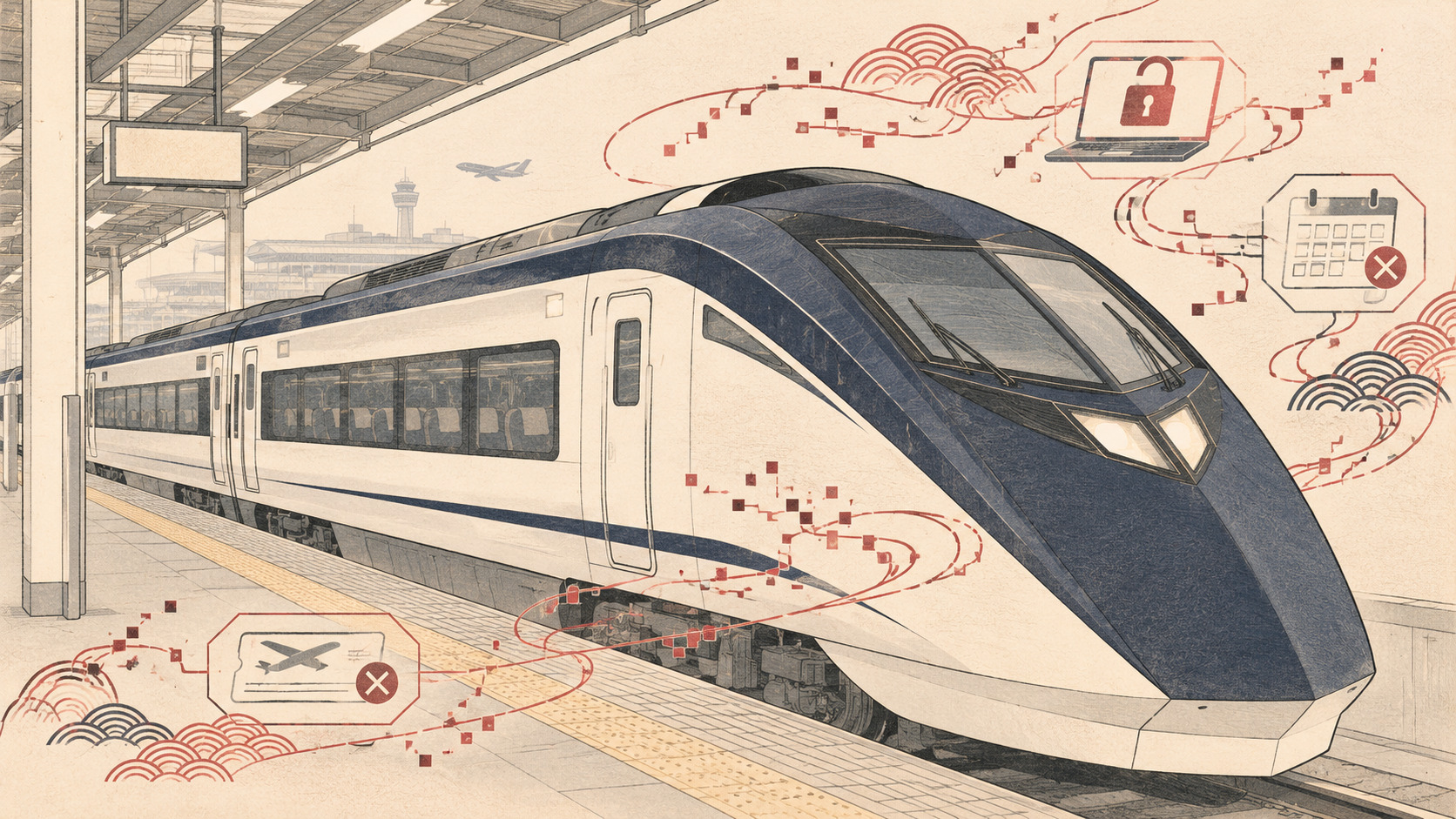
- A breach of trust at the beginning of a journey
- What Keisei actually disclosed
- Four booking channels interrupted—not the train service
- Already purchased a ticket? The refund complication
- From a 1973 express to a 36-minute airport link
- Why travel technology increases the perimeter of responsibility
- What Japan's privacy rules require—and what remains unknown here
- How travelers can guard against a second wave of harm
- Restoring confidence requires answers beyond a restart notice
A breach of trust at the beginning of a journey
For a traveler landing at Narita, the journey to Tokyo often begins long before the airport doors open. A reserved seat, a confirmation email and a ticket stored on a phone promise an efficient connection to the city. Keisei Electric Railway's November 13 disclosure exposed a vulnerability in that promise: a third party had gained unauthorized access to the Skyliner seat-reservation system late on November 11.
The company said information associated with its ticketless service may have been obtained, affecting up to approximately 3.37 million records. Keisei did not say that 3.37 million people were definitely exposed, nor did it establish that every listed type of data was stolen for every customer. The distinction is central. A maximum potential count is an investigative boundary, not a confirmed victim tally.
Keisei responded by suspending the reservation system and related purchase channels while strengthening security. That protected one part of the operation at the expense of another: passengers lost convenient digital booking routes just as the railway sought to contain the incident. It is a case study in the growing overlap between travel infrastructure and information security.
What Keisei actually disclosed
The November 13 announcement identifies five categories of potentially affected information: user IDs, passwords, names written in katakana, telephone numbers and email addresses. The railway says passwords were encrypted and could not be restored by a third party. The notice does not identify the cryptographic method, any independent verification of that assertion or the period covered by the database.
The statement does not confirm exposure of card numbers, passport information, biometric templates or travel itineraries. Equally, silence about those categories is not proof that a complete forensic review has excluded every possibility. Reporting should distinguish what Keisei lists from what it has not yet addressed.
Even the unit matters: the Japanese release says up to 3.37 million ken (records/cases), not a separately verified number of unique passengers. A customer might have used a system more than once, and the scope of the count remains unexplained in the document. A more precise final tally would require a subsequent update from the company.
Four booking channels interrupted—not the train service
Keisei's November 12 emergency-maintenance notice names four suspended services: its Skyliner Ticketless Service, Skyliner e-ticket, Skyliner e-ticket's facial-recognition system and purchases of Skyliner tickets through travel agencies. The breadth of those channels matters for foreign visitors as well as domestic passengers, including people who arrange airport transport before arriving in Japan.
But there is an equally important boundary to the news: the official notices did not announce that Skyliner trains had stopped running, that operational train-control equipment was compromised, or that passenger rail safety systems were affected. Seat reservations and train operations are different systems. Headlines suggesting that a cyberattack shut down the railway would overstate the evidence.
Keisei explicitly said tickets would continue to be sold through station windows and ticket vending machines. Maintaining an offline purchasing route is a practical form of resilience, although a person traveling with luggage or a tight airport connection may have less flexibility than someone buying a ticket in advance.
Already purchased a ticket? The refund complication
Passengers who had already bought through the affected ticketless and facial-recognition channels were told to buy a separate Skyliner ticket at a station counter or machine and advise station personnel of the original purchase. Keisei said refunds would follow. It warned that credit-card cancellation processing might take time to appear.
This instruction is specific to the affected services and should not be casually extended to every third-party travel package. Customers who booked through agencies may need to check both the seller's terms and Keisei's latest official notice. Keeping the original receipt, booking email and transaction details is sensible when seeking assistance.
Readers planning travel should verify the available channels again before departure. These details describe what Keisei communicated on November 12–13, not a guarantee that the identical arrangements remain in force on November 17. As of the source cutoff used for this article, a confirmed restoration announcement had not been identified.
From a 1973 express to a 36-minute airport link
The Skyliner's story began before Narita Airport itself opened. According to Keisei's corporate chronology, the first-generation service launched between Keisei Ueno and Keisei Narita on December 30, 1973. It reached the original airport station, now Higashi-Narita, in 1978 and gained direct access beneath the airport terminals in 1991.
A defining transformation came on July 17, 2010, when the Narita Sky Access route and new AE-series trains entered service. The train, designed by Kansai Yamamoto, could operate at up to 160 km/h. Keisei advertises the fastest Nippori-to-Airport Terminal 2 journey at 36 minutes. Those figures describe a specific route segment and fastest scheduled service, not every passenger's door-to-door travel time.
Half a century of investment made rail access faster, more direct and more appealing to international arrivals. In September 2026 Keisei celebrated the 70 millionth passenger milestone for its third-generation Skyliner. That historical ridership figure should never be confused with the reservation database's potentially affected record count.
Why travel technology increases the perimeter of responsibility
The railway's own business materials describe a push to sell Skyliner tickets through overseas online travel agencies and to introduce facial-recognition check-in products. Such features have genuine convenience benefits: travelers can cross languages and payment systems before touching down in Tokyo.
Every additional sales interface also raises questions about data handling, authentication, third-party dependencies and failure recovery. That does not mean a partner caused this intrusion; Keisei has not identified the route into its systems. Nor does the inclusion of a facial-recognition ticketing product on the suspension list establish that photographs or biometric data were stolen. They were not among the categories specified in the November 13 release.
The broader lesson is institutional rather than speculative: travel companies must design customer-service continuity alongside cyber controls. A service can be efficient under normal conditions yet difficult for travelers to navigate when the system is disconnected.
What Japan's privacy rules require—and what remains unknown here
Japan's amended Act on the Protection of Personal Information introduced mandatory reporting and notification for certain serious personal-data incidents from April 2022. The Personal Information Protection Commission identifies cases involving suspected malicious access or information concerning more than 1,000 people among circumstances that can trigger reporting duties. Its general guidance calls for an initial report promptly, typically within three to five days of discovery.
Those rules provide context, not a finding about Keisei's compliance. Its November 13 notice said that potentially affected customers would be contacted individually at registered email addresses. It did not, in the document examined for this report, specify whether a regulator filing had already been completed or the final result of any investigation.
Effective notification is more than sending an apology. It should explain what data is involved, what remains uncertain, the steps customers can take and when further information will become available. The company's updates will be as consequential for public confidence as the technical restoration itself.
How travelers can guard against a second wave of harm
Contact details and a recognizable company name can help criminals craft convincing phishing messages. That does not establish that such a campaign has occurred in this case. It is a foreseeable risk worth addressing without making unsupported claims about confirmed fraud.
Passengers should navigate to Keisei's official website directly rather than using unfamiliar links in emails or text messages asking them to log in, verify a payment or request a refund. Where a password has been reused elsewhere, changing it on other services may be prudent. Any request for additional card details, one-time authentication codes or sensitive identification should be treated cautiously and checked through a separately obtained official contact route.
Keisei published an incident enquiry contact and limited weekend hours in the November 13 notice. Rather than reproducing a number that might later change, this article links to the original document, allowing travelers to check the latest details through the railway's own channels.
Restoring confidence requires answers beyond a restart notice
The outstanding questions are substantive. How did the intruder gain access? Which database fields were actually obtained? Over what period? How many distinct people were affected? Were any records misused? How are travel-agent channels being reviewed? When will customers receive notices, and how will refunds and service restoration be handled?
Keisei's initial disclosures did not answer all of them. That is not grounds to invent an attacker, assert a ransomware campaign or claim a wider rail-system compromise. It is grounds for follow-up reporting focused on evidence and on passengers' practical experience.
Japan's airport railways have spent decades compressing the time between aircraft and city center. The Skyliner episode demonstrates a different measure of performance: whether a railway can protect a passenger's information and preserve a usable route to travel when the digital booking layer fails. The new frontline of transport reliability begins before anyone steps onto the platform.
Sources and reporting limitations
Primary documents: Keisei notices dated November 12 and 13, corporate histories and official privacy-regulator guidance. Intrusion method, confirmed exfiltration, final affected-user count and restoration date are unresolved. No on-site or victim interviews were conducted.
- 京成電鉄・2026年11月13日「スカイライナー座席予約システムへの不正アクセスについて」 / Keisei, Nov. 13 incident disclosure
- 京成電鉄・2026年11月12日「スカイライナーチケットレスサービス一時停止について」 / Keisei, Nov. 12 service advisory
- 京成電鉄・お知らせ一覧 / Keisei official service notices
- 京成電鉄・スカイライナーのご案内 / Keisei Skyliner passenger information
- 京成電鉄・沿革 / Keisei corporate history
- 京成電鉄・路線延伸の歴史 / Keisei railway museum timeline
- 京成電鉄・2010年成田スカイアクセス開業 / Keisei 2010 launch
- 個人情報保護委員会・漏えい等報告・本人への通知 / Japan Personal Information Protection Commission
- 個人情報保護委員会・漏えい時の対応 / PPC guidance