- Why Keisai Eisen now?
- From samurai background to ukiyo-e artist
- Why Eisen’s women feel different
- Roads, waterfalls and the theatre of travel
- Bird-and-flower prints and the discipline of brevity
- Eisen as writer and historian of ukiyo-e
- Curated images for this Art Choice
- What Eisen reveals about late Edo culture
- Why he still matters
Why Keisai Eisen now?
There are artists whose reputations are so monumental that they flatten an entire period around them. Edo ukiyo-e can sometimes feel like that when viewed only through Hokusai, Hiroshige or Utamaro. Keisai Eisen belongs to the same world, but occupies a more revealing position: close enough to the center of the tradition to define it, and just far enough from the canon’s most famous names to show how much more varied the tradition really was.
That is why Eisen makes such a strong Art Choice. He is usually remembered as a master of bijin-ga, pictures of beautiful women, yet museum records and historical references point to a much wider career. He designed landscapes, bird-and-flower compositions, warrior subjects and illustrated books. He also wrote about ukiyo-e itself. If many artists help us see a period, Eisen helps us see a period thinking about itself.
From samurai background to ukiyo-e artist
Authority records and museum biographies identify Eisen as an ukiyo-e artist who came from a samurai background, studied first in a more formal painting lineage, and later entered the orbit of Kikukawa Eizan. That combination matters. It suggests that his work did not emerge simply from commercial opportunism, but from a solid grounding in drawing combined with an acute awareness of the urban print market.
Late Edo Japan was a world of circulating images, printed texts, pleasure-quarter culture, fashion, poetry and travel. Eisen moved through those currents with striking flexibility. He could make images that were commercial and seductive, but also intellectually alert. That ability to operate across categories helps explain why he seems at once familiar and elusive: he belongs fully to ukiyo-e, yet refuses to fit into only one compartment of it.
Why Eisen’s women feel different
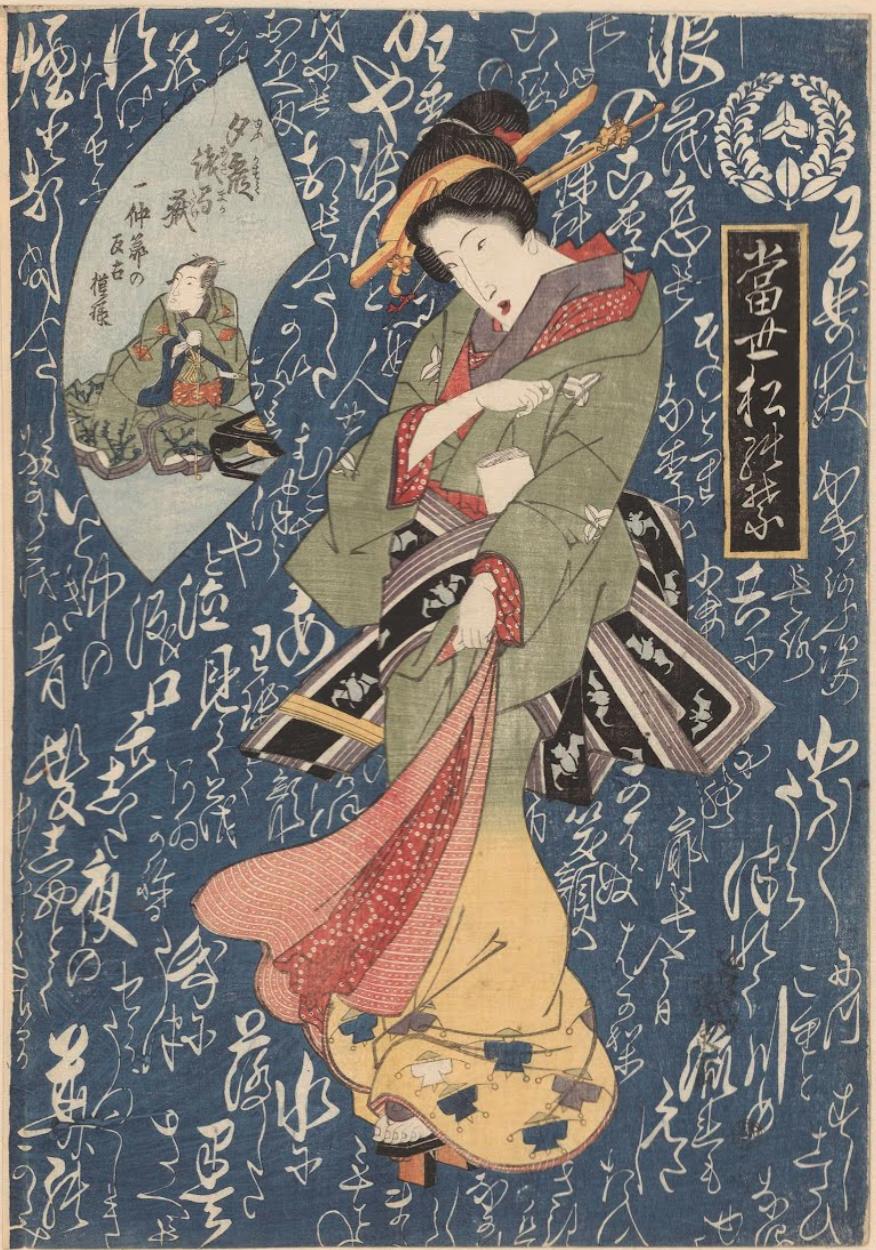
Museum descriptions repeatedly note the distinctive character of Eisen’s women. Their faces are often sharper than those of earlier idealized beauties. The eyes can appear elongated and tense, the mouth slightly protruding, the pose poised between display and reserve. Rather than serene perfection, Eisen often offers a more unstable mood—one that can feel glamorous, self-aware and faintly dangerous at the same time.
That emotional ambiguity is part of what keeps the work alive. The curated beauty image on this page, with its dense field of calligraphic forms behind the figure, turns the whole print into an atmosphere of information, fashion and performance. The kimono pattern, the hair ornaments and the body’s turn all matter, but so does the pressure of the surrounding surface. In Eisen, beauty is rarely isolated. It sits inside a larger designed world.
Roads, waterfalls and the theatre of travel
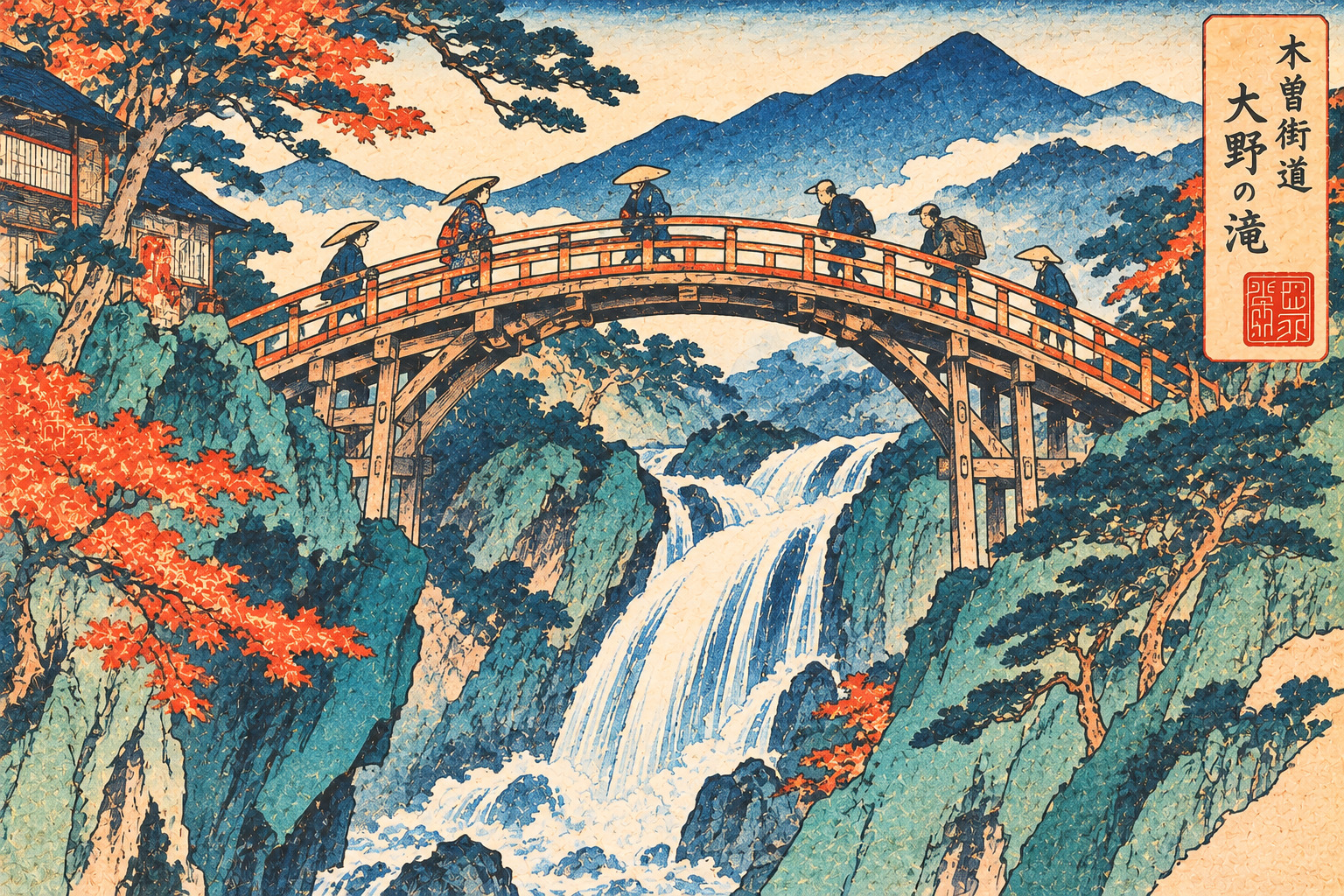
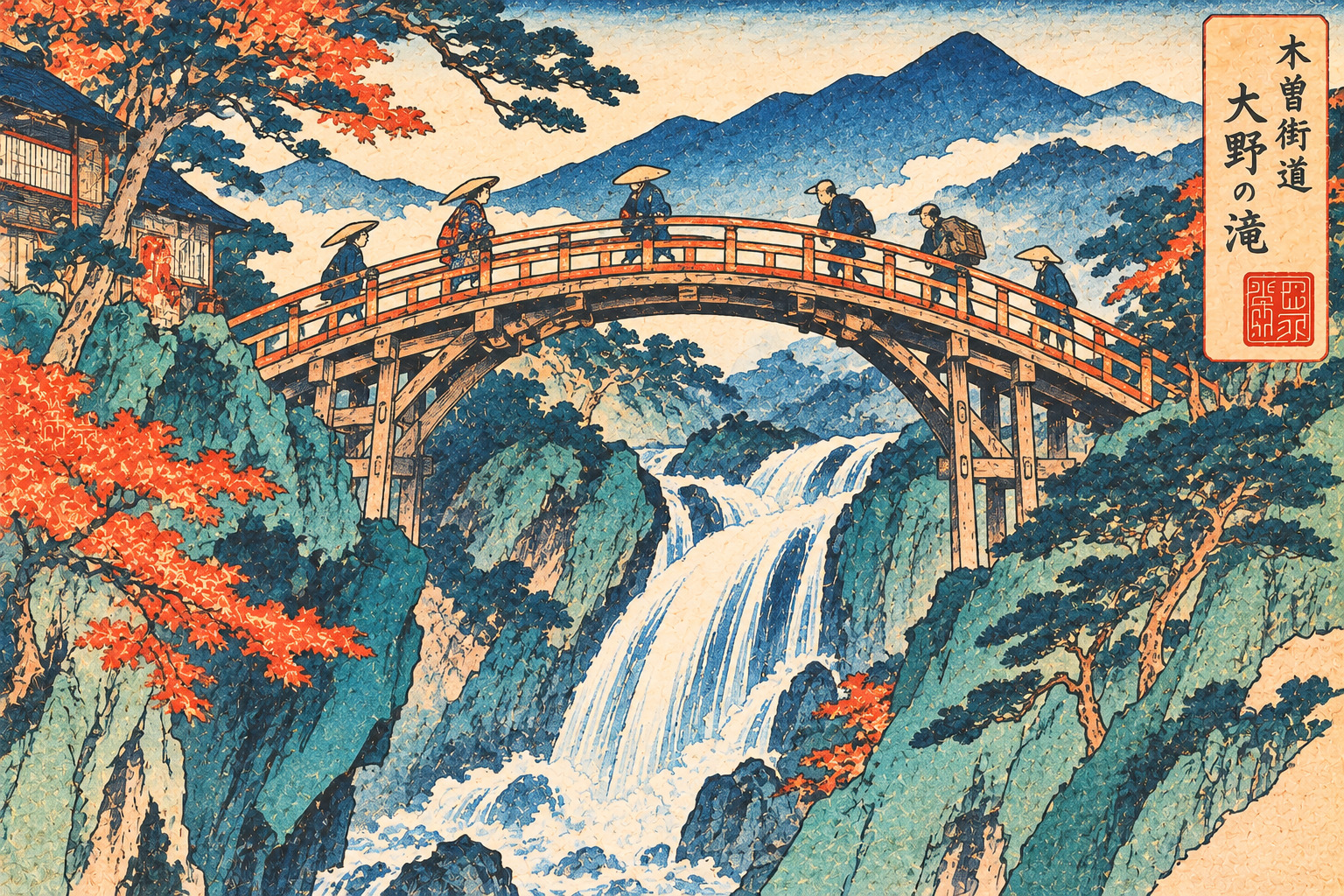
Eisen’s reputation expands immediately once one looks at his landscapes. The National Diet Library authority record links him to Kiso Kaidō Rokujūkyū-tsugi, the celebrated series on the sixty-nine stations of the Kiso Road. In popular art history the route often becomes a story about Hiroshige, but Eisen’s presence is fundamental to understanding how the series connects travel imagery with dramatic design.
The curated image of Ono Waterfall on the Kiso Road captures this well. A great arched bridge spans the torrent; travelers cross above a burst of white water; mountains and autumn foliage frame the scene. It is landscape, but also staging. Eisen composes the view almost as if arranging a performance in which nature, architecture and human passage each take a role. The result is neither pure topographical record nor pure fantasy. It is a persuasive image of travel as experience.
He also made other waterfall prints, including works identified in major museum collections as depictions of Kegon Waterfall. Such works show how comfortable Eisen was with subjects that required strong contrasts between open water, rock surfaces and vertical movement. His landscapes remind us that ukiyo-e’s visual language was not limited to urban beauty culture.
Bird-and-flower prints and the discipline of brevity
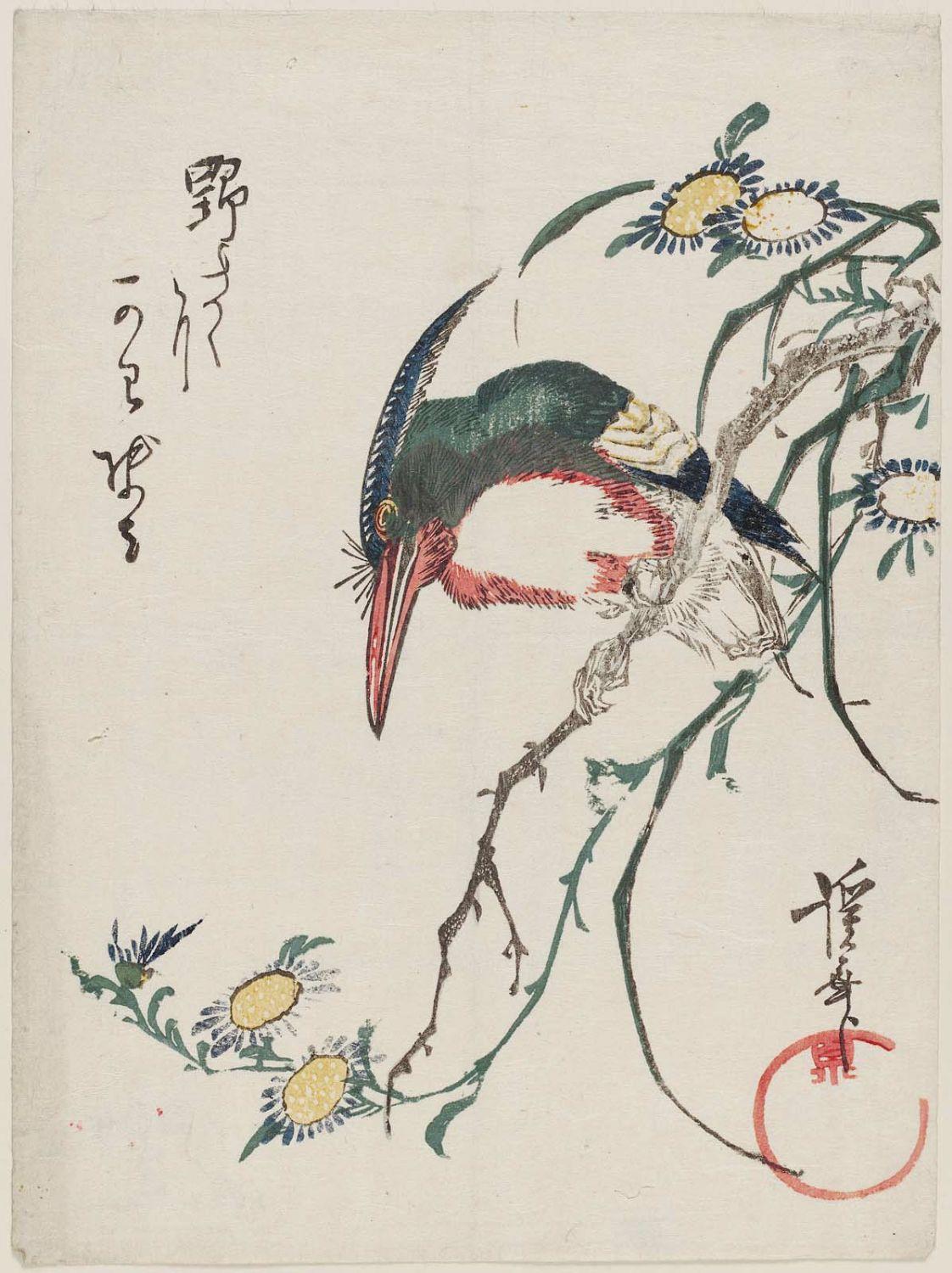
The kingfisher and chrysanthemums image on this page reveals another Eisen entirely. Here the scale shrinks, the atmosphere calms, and the white of the paper becomes an active participant in the composition. The bird bends downward on a delicate branch; the flowers hover in a sparse arrangement. There is almost no narrative, and that is precisely the point.
Bird-and-flower prints in ukiyo-e often test an artist’s discipline. Without the direct appeal of a famous beauty or a dramatic road scene, the image must survive on line, rhythm and proportion. Eisen succeeds by making every element count. The beak’s red, the breast’s pale white and the cool green-blue of the bird’s back are enough to energize the sheet. The empty paper is not absence but breathing room. In this quieter register, Eisen’s control becomes especially clear.
Eisen as writer and historian of ukiyo-e
Eisen’s importance is not only visual. Japanese museum sources note that he later devoted substantial energy to writing, including the antiquarian and historical work known as Mumeiō zuihitsu, also referred to as Zoku ukiyo-e ruikō. That makes him unusually valuable for modern readers. He was not simply producing prints inside the ukiyo-e world; he was also helping to narrate and organize that world.
Any such source must be handled critically. Memoirs and historical notes can preserve hearsay alongside firsthand knowledge. But the fact that Eisen wrote at all changes how we see him. He becomes not only a maker of images for a market, but a witness to a culture with enough self-consciousness to record its own lineage. That dual role gives his career an additional depth missing from narrower accounts of ukiyo-e production.
Curated images for this Art Choice
To show Eisen’s breadth, JAPAN.co.jp curated three historical images alongside the new editorial illustration. Taken together, they make a concise argument: Eisen should not be reduced to a single subject or mood.
What Eisen reveals about late Edo culture
Eisen’s range helps explain why late Edo visual culture was so rich. The same artist could address pleasure-quarter fashion, road travel, birds and flowers, and art-historical writing without seeming fragmented. That is because the culture itself was interconnected. Publishing, commerce, tourism, taste, poetry and celebrity all fed one another. Eisen’s career becomes legible when we stop asking what his one “true” subject was and instead ask what kind of world made all these subjects feel related.
His women are glamorous, yet often edged with unease. His landscapes are scenic, yet carefully staged. His smaller prints are restrained, but never empty. This mixture of polish and restlessness may be one of the clearest windows onto late Edo sensibility: a culture of refinement that also understood transience, fashion, appetite and self-display.
Why he still matters
Keisai Eisen matters because he resists simplification. He reminds us that ukiyo-e was never one thing. It was not only a record of famous places, not only an archive of pleasure-quarter beauty, and not only a decorative export image of “Japan.” It was a living system of image-making that could absorb commerce, scholarship, observation and fantasy all at once.
That is what makes him an apt Art Choice for November 18, 2026. Through Eisen, readers can move from an iconic feminine figure to a waterfall on a travel road, then to the poised stillness of a kingfisher on a branch, and finally to the realization that the artist also helped write the history of the very tradition he belonged to. Few choices offer a better invitation into the complexity of Edo Japan.
Primary sources and institutional references
This article was built primarily from authority records, museum biographies and public collection pages. Title translations and artist dates can vary across institutions.
- National Diet Library authority record: Keisai Eisen
- Kitakyushu Municipal Museum of Art: artist data for Keisai Eisen
- Hokkaido Museum collection database: Keisai Eisen
- The Metropolitan Museum of Art: Books and a Bookcase (Public Domain)
- The Metropolitan Museum of Art: Kegon Waterfall (Public Domain)
- Tokyo National Museum: Edo ukiyo-e exhibition work list