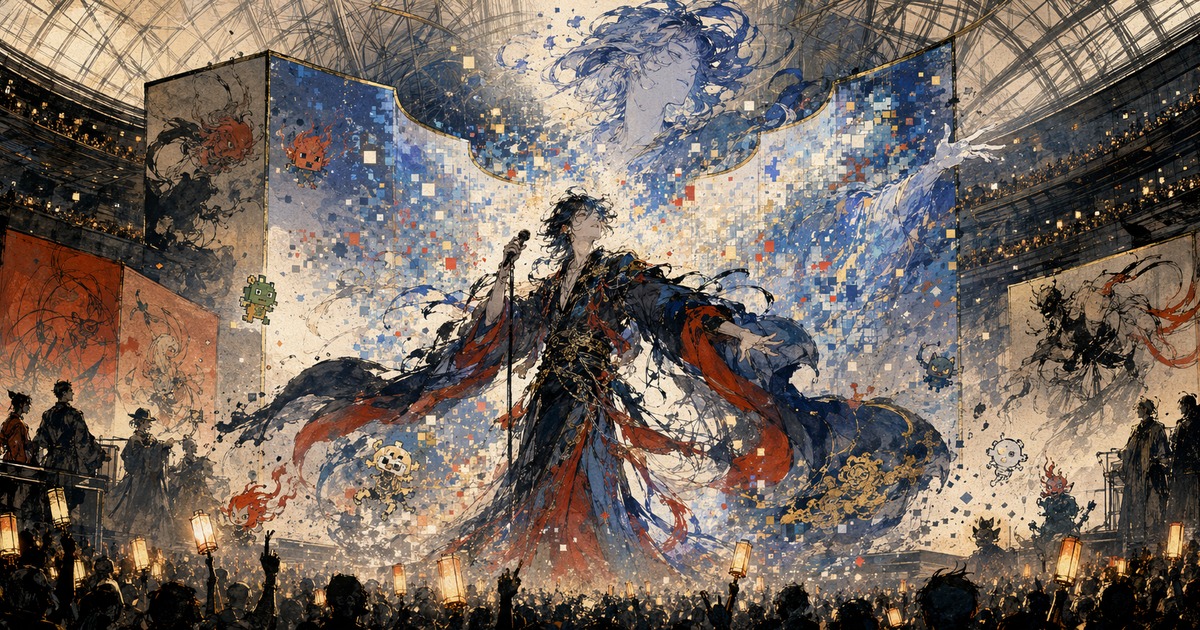
On Friday evening, people leaving Yurakucho Station will look up at the ship-like glass atrium of Tokyo International Forum and turn toward the halls that appear to hover across its plaza. Doors open at 5:30 p.m.; the show begins at 6:30. The figure who appears onstage will not be a fictional recording sealed inside a screen. Somewhere, at the same moment, a performer will sing, move and respond, while Kanae—the virtual body through which that performance is known—meets the audience.
The concert is called “Kanae 2nd LIVE Kodoku -solitude-.” Its title suggests a closed room and a person alone. Its machinery describes nearly the opposite. Tokyo International Forum’s Hall A publishes 5,012 seats. The live-viewing network reaches 39 cinemas from Hokkaido to Kumamoto. The main online program runs through Nico Nico Live and YouTube, and purchasers can add a camera that follows a selected performer or a fixed camera that shows the complete stage.
The venue ticket page marks the planned allotments for general admission, restricted-view seats and the front-center upgrade as finished. That is firm evidence of demand, but it is not an independently audited attendance total and does not prove that every one of Hall A’s 5,012 seats will be occupied. Staging, equipment, accessibility zones and production choices can reduce the sellable inventory. In this report, “fill” means that the offered allocations are exhausted and that several kinds of audience space are waiting for the same performance.
That precision matters because the most interesting story is larger than a sellout badge. In eight years, Kanae has moved from long game streams in an emerging agency project to a major-label catalog, a million-subscriber milestone, an Osaka solo concert, an arena show as half of ChroNoiR and now one of central Tokyo’s grandest public halls. The path did not abandon livestreaming for “real” entertainment. It carried the habits of livestreaming—duration, intimacy, responsiveness and selectable attention—into concert architecture.
“Planned Allotment Finished” Is Not the Same as 5,012 Attendees
Concert promotion treats “sold out” as a medal, but reporting must ask what, exactly, was sold. Hall A has 5,012 installed seats. A production does not necessarily release all of them. Seats beside or behind a stage, positions occupied by cameras and control equipment, and places from which the visual show cannot be seen may be withheld. For this concert, even a later allocation of restricted-view seats—created after equipment positions were adjusted—has reached its planned limit. That shows demand extending to seats with acknowledged compromises.
The standard reserved ticket is ¥11,000, limited to two per person. A ¥5,500 upgrade moves an eligible ticket holder into the front-center zone, making the total ¥16,500. At the displayed rate of ¥163.74 to one U.S. dollar, those face values are about $67.18 and $100.77. Preschool children are not admitted. The ticket is displayed on a smartphone, with SMS authentication, registered companion information and possible identity checks narrowing the distance between the purchased name and the person at the door.
There was no single route into the room. The first lottery was attached to a serial code inside Kanae’s February album “Ai.” It was followed by general and individual fan-club lotteries, a Stagecrowd Ticket lottery, first-come general sales, restricted-view sales, an upgrade and an official resale lottery. Listening to the record, maintaining a membership and entering a drawing became stages on the way to a seat. In contemporary Japanese fan culture, a concert ticket often functions not merely as permission to enter but as the last verification in a long relationship.
A Virtual Liver Enters Tokyo’s Great Civic Vessel
Tokyo International Forum opened in January 1997 on the former site of the metropolitan government complex after city hall moved west to Shinjuku. The design was selected through a 1989 international competition won by U.S.-based architect Rafael Viñoly. Its great Glass Hall is suspended beneath a roof often compared to a ship or whale skeleton. The atrium, plaza, theaters and conference rooms were conceived as public infrastructure for culture, information and international exchange.
In 2024, the American Institute of Architects gave the complex its Twenty-five Year Award. The recognition was not just for spectacle. Viñoly’s scheme placed halls away from railway vibration, lined conference rooms along the tracks and built a sheltered civic plaza between opaque theater volumes and the transparent atrium. Tokyo Station and Yurakucho Station feed the site with constant pedestrian movement. A building made to connect different urban systems now hosts an artist whose career connects different forms of presence.
Hall A is the complex’s grand performance and conference room: 3,025 seats on the first level and 1,987 on the second. A finely carved wood-ribbed proscenium frames the stage, illuminated audience walls rise at its sides, and technical systems include advanced audio, stage machinery and simultaneous interpretation in 16 languages. A VTuber solo concert nearly three decades after opening is not an invasion by some alien digital culture. It is an update to the Forum’s original assignment: create a public vessel in which culture and information can be exchanged.
The scale change from Kanae’s first solo concert is substantial. The Main Hall at Grand Cube Osaka, where “Beyond Midnight” was held in March 2023, has 2,754 seats. Hall A’s published count is about 1.82 times larger. Yet the conceptual change is equally important. The first show placed several versions of Kanae inside one tightly controlled narrative. The second invites seven guests. The room is larger, and the network of relationships onstage is wider. “Solitude” is not another word for performing alone; it becomes a subject examined in the presence of others.
One Concert, Four Different Audience Rooms
The physical hall, the cinemas, the main stream and the optional cameras offer at least four ways to inhabit the same night. Hall A holds air moved by speakers, the pressure of thousands of cheers and the peripheral choreography of light sticks. The 39 Aeon Cinema venues allow people unable to reach Tokyo to gather locally before a large screen and theatrical sound system. Each live-viewing attendee receives a postcard bearing the event’s key visual.
The main online ticket costs ¥6,500 and remains on sale through August 17, with timeshift viewing until 11:59 p.m. on August 18. The opening portion is free on YouTube. A ¥2,500 “Liver camera” follows a selected performer and returns to the main program when that person is not onstage. A ¥2,000 fixed venue camera shows the overall stage rather than submitting to close-ups chosen by the program director. Those options can only be bought after the main stream, making the totals ¥9,000 and ¥8,500.
| View | Face value | At ¥163.74/$1 | What changes |
|---|---|---|---|
| Hall A reserved seat | ¥11,000 | $67.18 | Shared room, cheers and three-dimensional stage |
| Front-center upgrade | ¥16,500 total | $100.77 | Eligible ticket moves to front-center zone |
| Cinema live viewing | ¥6,500 | $39.70 | Simultaneous communal viewing at 39 cinemas |
| Main online stream | ¥6,500 | $39.70 | Home viewing and archive through August 18 |
| Main + Liver camera | ¥9,000 total | $54.96 | Camera follows a designated performer |
| Main + fixed camera | ¥8,500 total | $51.91 | Unbroken view of the complete stage |
This is more than an expanded product menu. The director’s official edit, a fan’s performer-centered edit and an architectural view of the whole stage can coexist. In the television era, camera selection belonged almost entirely to the producer. In the livestream era that formed VTuber culture, the audience purchases a degree of agency over whom to watch, at what distance and how often. The live event is no longer one definitive moving image. It is a bodily and digital system with several doors.
Trust Accumulated One Long Stream at a Time
Kanae debuted on May 2, 2018, as one of the earliest members of what was then NIJISANJI Gamers. Even the name VTuber was young. Kizuna AI had opened A.I.Channel in December 2016 and called herself a “Virtual YouTuber.” By the end of 2018, she had staged the two-day solo concert “hello, world,” demonstrating that a character born on a video platform could become a physical-venue music artist.
NIJISANJI’s decisive contribution was to center ordinary live broadcasting rather than only highly edited videos. Kanae played many games for long periods, building an identity not simply through wins or technical skill but through conversation, pauses, mistakes and changing relationships with other streamers. The audience came to know a person inferred from thousands of hours of choices and reactions, not merely a character described in a profile sheet.
That history contains what can look like a long detour from music. In fact, it builds the element a concert needs beyond competent singing: a desire to witness what this particular person feels and does next. For viewers who shared late-night sessions, collaborative jokes and hours when little happened, a major concert does not begin a separate celebrity career. It is a turn in a serial narrative whose quiet chapters mattered.
It also changes the meaning of liveness. A conventional pop artist may be introduced through a finished recording and later reveal personality through interviews. A game streamer begins with duration. The imperfections, recurring habits and spontaneous judgments are already part of the work. When that person enters a rehearsed concert, the dramatic question is whether careful production can preserve the responsiveness that made the relationship feel alive.
ChroNoiR Made Individuality Relational
On July 17, 2018, Kanae and Kuzuha chose the unit name ChroNoiR during a collaborative stream. The pair expanded from games and conversation into songs, merchandise and a regular program. In February 2022, they streamed a 3D music live free on their YouTube channel. In April 2024, their first one-man concert reached Osaka-jō Hall. A relationship that began inside personal streaming channels had become an arena-scale music unit.
Kanae passed one million YouTube subscribers on May 14, 2022, four years after debut. He was the second NIJISANJI Liver to reach the mark, after Kuzuha. The ranking is less important than the cultural structure it reveals. Within a few years, a male VTuber could sustain overlapping identities as game commentator, singer, radio personality, advertising figure and arena performer without treating one as the authentic career and the others as distractions.
Beside Kuzuha, Kanae’s soft voice and measured manner gain definition through contrast. Personality is not a sealed list of traits; it appears differently according to who stands nearby. The seven guests at “Solitude” can perform the same function across a broader history. Kaede Higuchi and Toya Kenmochi connect to NIJISANJI’s 2018 beginning. Yuika Shiina shares the Gamers-era history. Akina Saegusa, Hayato Kagami, Sara Hoshikawa and Rou Koyanagi extend the network through later cohorts.
The guest list can therefore act as a living timeline rather than a parade of cameos. Changes in Kanae’s speech, vocal blend, competitive energy, humor and silence with each person can show dimensions that a solo statement cannot. A concert about solitude may need other people precisely because no self is visible from only one angle.
From “Flores” to a Double Album About the Public and Private Self
Kanae’s major music debut came through Lantis in 2022. The five-track mini-album “flores” was released July 27, led by “Broadcast Parade.” At the time of the announcement, his official artist site counted 987,000 subscribers and more than 300 million YouTube views. He began as a recording artist while already commanding an audience many musicians spend a career seeking. That asymmetry is characteristic of VTuber music: famous in one medium, a beginner in another.
His first full album, “Ai,” released February 25, 2026, turns that divided career into a two-disc structure. Disc 1, the “A” side, observes Kanae objectively as a public-facing person or someone standing onstage. Disc 2, the “I” side, looks from Kanae’s first-person point of view. One body of songs presents the figure seen; the other gives space to the self speaking.
The first disc contains 16 tracks including instrumentals, opening with “Ai,” written, composed and arranged by Saeki youthK. The second contains nine, led by “Refrain,” made by Kana Yaginuma and Kanae’s music director Yuki Waga. The limited edition extends the idea into an object: transparent removable pieces shaped around masks and earrings can reveal or obscure Kanae’s expression. The jacket’s theme invokes the three wise monkeys—see no evil, hear no evil, speak no evil.
The Japanese title “藍” denotes indigo, yet its sound opens further readings: “ai” as love, the song title “アイ,” and in English, “I.” The official description does not dictate every interpretation, but the ambiguity suits an album moving between the public figure and the first-person self. Its enclosed concert lottery code then converted private listening into a route toward Hall A. The product did not sit before the live event as mere promotion; it built the conceptual and commercial bridge into the room.
The First Concert Broke the Glass Between Selves
On March 16, 2023, Kanae staged his first solo concert, “Beyond Midnight,” at Grand Cube Osaka. It was not structured as a conventional sequence of songs interrupted by casual talk. Several versions of Kanae moved through a story of mirrors, dreams, an aquarium-like world and a clock approaching midnight. According to SPICE’s detailed performance review, the main program withheld a normal MC section until the encore, allowing theater and music to continue without breaking the spell.
A white Kanae and a black Kanae addressed one another across glass. When each acknowledged that the other’s voice had been heard, the barrier shattered. The clock finally moved beyond midnight, and the story was handed to the crowd with the suggestion that although this was Kanae’s story, it might also belong to the listener. The point was not to rule which side—virtual or physical, bright or dark, performed or private—was the real one. It was to accept that several possibilities can inhabit one person.
Three years later, time returns in the second concert’s key visual. Kanae stands with a sparkling hourglass and Diphylleia grayi, the “skeleton flower” known in Japan as sankayou, whose white petals become glasslike and transparent when wet. The first concert broke glass; the second holds a flower whose transparency appears under rain. The connection is an interpretation, not a plot officially confirmed by the organizer, but both images ask the same difficult question: under what conditions does an inner self become visible?
A VTuber Concert Is Not a Screening of a Cartoon
A newcomer looking at a character on a stage display may mistake a VTuber concert for the exhibition of a finished animation. But liveness is not determined by the material of the visible body. A performer’s voice and movement are captured, mapped onto a three-dimensional model and rendered into the stage image. The crowd’s cheers, applause and light reach the performer in real time, changing breath, timing and speech. Technology does not remove the person; it constructs a new performing body between person and audience.
Not everything is improvised. Set list, visual worlds, lighting, camera cues, digital effects and guest entrances require rigorous preparation, just as they do in a human pop arena show. The distinction lies in what the avatar can extend: instant costume changes, altered gravity, multiplication, impossible scenery and meetings between several versions of one self. Kanae’s recurring concern with divided identities is especially compatible with a medium capable of placing those identities visibly beside one another.
In the early history of VTuber music, Kizuna AI’s 2018 concert made the crossing from platform to physical venue itself feel extraordinary. By 2026, the artistic questions are more mature. Which building serves the story? What viewpoints should the audience control? How should theater and song connect? How can a continuing character identity coexist with an artist’s change? The form is moving beyond novelty and into a period when concert aesthetics can be compared.
That development is visible in the fixed-camera ticket. A viewer who wants to study choreography and spatial composition can refuse the intimacy of the close-up. Another who cares most about one guest can purchase a tracking feed. Hall A spectators may watch the screen and the apparent stage body at once. Each audience receives a different balance of mediation and presence, yet all are attached to the same irreversible performance time.
Why “Solitude” Needs Seven Guests
A large guest list appears to contradict the concert title. Yet people are not lonely only when physically alone. Loneliness can sharpen while a person is exposed to many eyes and everyone seems to know them. Streamers live this paradox intensely: they may speak to tens of thousands at once while physically sitting before a camera. The more intimacy they accumulate, the more consequential the distance can become between the self that is visible and the self known from within.
The guests are therefore not decoration added to soften solitude. They can become mirrors for different periods and voices in Kanae’s life. The vocabulary, vocal color, competitive tension, joke and silence that each relationship produces make one person into a many-sided figure. If “Ai” divided the objective and first-person views across two discs, the concert can add a third dimension: the self reflected through other people.
The public entry into the evening begins before the doors. At 5:15 p.m., a free pre-show program will feature Ibrahim as host and Hyakka Ryoran as reporter. People outside the building can enter the waiting time together. There will be no official fastest-reaction broadcast after the performance. That absence may leave useful space: instead of immediately receiving an authorized interpretation, viewers must find their own language for what they saw.
Even the merchandise operation maps the event into separate physical zones. Advance and event sales run in Hall D7, with the official page warning visitors that it is in a different block from Hall A. The concert is not one door but a temporary district of queues, screens, fan-club benefits, objects and movement across the Forum. The avatar may be virtual; the day requires bodies to navigate architecture.
What Will Decide Success on July 31
The immediate tests are concrete. Does the voice carry? Do captured movement and music feel joined? Can a 5,012-seat room be made intimate? Do seven guests enlarge Kanae’s outline without blurring it? Can the transmission remain stable through cinemas and homes? Live production offers no automatic victory. A convincing concept still depends on audio engineering, timing, performance stamina and hundreds of people whose labor remains outside the frame.
The longer test lies elsewhere. Will someone who has watched Kanae since 2018 encounter more than a polished repetition of the person already known? Will a newcomer opening the free segment look beyond the labels—game streamer, half of ChroNoiR, soft-voiced virtual character—and want to continue with a musician? Can a private word like “solitude” travel out of the hall and attach itself to the audience’s own experience?
Outside Hall A, the Glass Hall will reflect Tokyo at night. The sand in the key visual’s hourglass will fall; the concert will end. Even the archive closes August 18. Digital culture often appears to preserve everything, yet the value of live performance comes from a deadline. Some responses can only be returned in the same moment, and what remains is the knowledge that people separated by distance chose that time together.
For Kanae to fill Hall A is not a story about a screen character conquering reality. It is a story about trust accumulated in livestreams taking form in architecture, cinemas, network routes, cameras and cheers. What enters Tokyo International Forum on Friday is not the old contest between virtual and real. It is a more human tension: the self that can be seen from outside, and the self heard only from within, placed in the same public hour.
Reporting Notes and Sources
This pre-event report reflects information published by 10:29 a.m. Japan time on July 28, 2026. The standard, restricted-view and upgrade allocations are marked finished, but the organizer has not published final attendance or the number of seats configured for sale; neither is estimated. Japan.co.jp counted 39 locations in the official live-viewing list.
- NIJISANJI: official Kanae 2nd LIVE “Kodoku -solitude-” site
- Stagecrowd Ticket: venue availability and admission rules
- ANYCOLOR: key visual, hourglass, sankayou flower and guest announcement
- ANYCOLOR: “Ai” double-album concept and second-live announcement
- Tokyo International Forum: Hall A’s 5,012 seats and technical features
- Tokyo International Forum: 1989 competition and architectural concept
- American Institute of Architects: 2024 Twenty-five Year Award
- ANYCOLOR: Kanae’s 2018 debut and one-million-subscriber milestone
- Lantis: 2022 major debut and “flores”
- NIJISANJI: first concert “Beyond Midnight”
- SPICE: detailed review of the 2023 first solo concert
- ANYCOLOR: ChroNoiR’s formation date and 2022 3D live
- ANYCOLOR: ChroNoiR’s 2024 Osaka-jō Hall concert
- Kizuna AI official biography: 2016 launch and 2018 solo concert