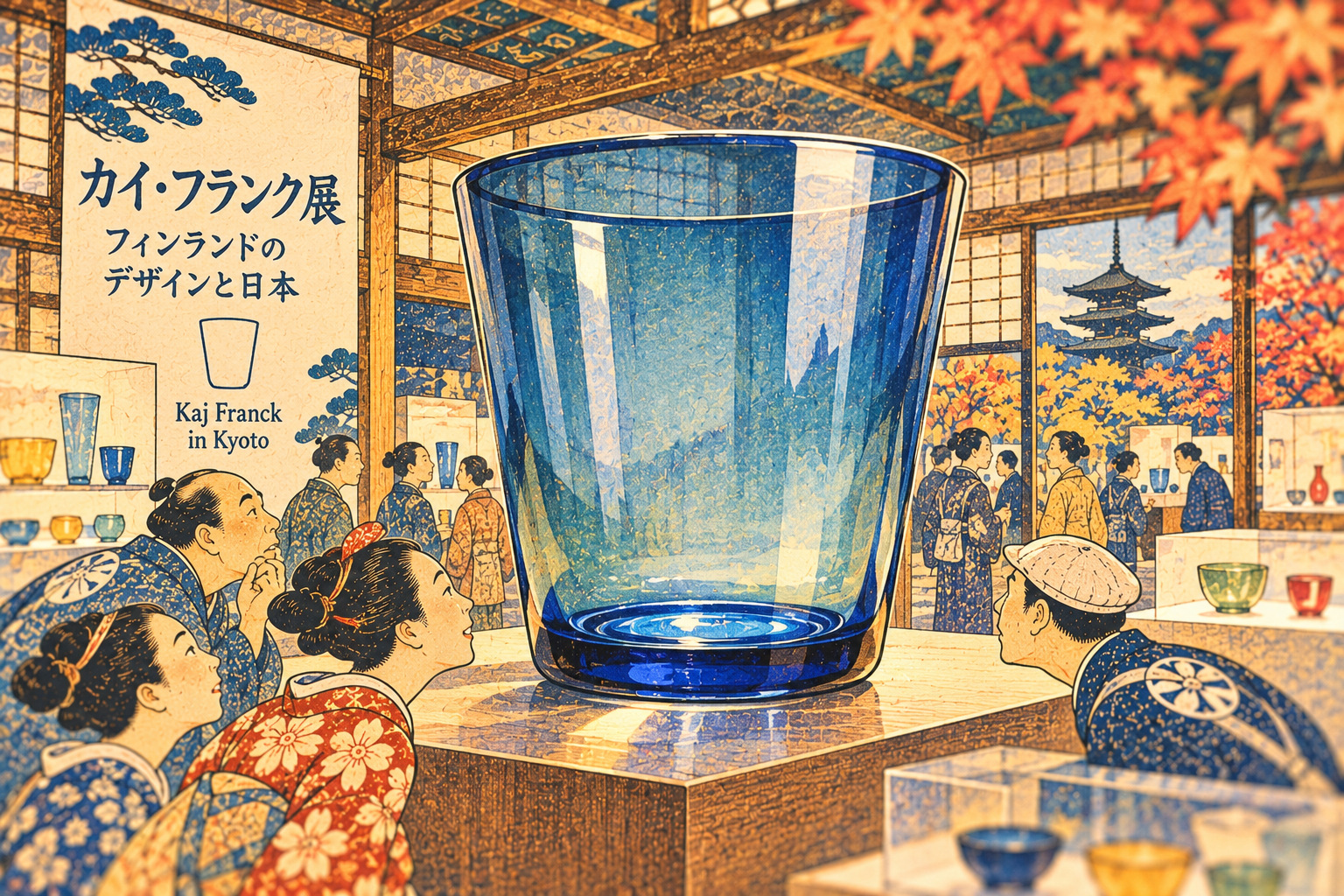
A glass, a plate and the life lived around them
At first glance, a Kaj Franck glass offers almost nothing to decode. There is no emblem, no spectacular ornament, no declaration that its owner possesses an exceptional object. What remains is a disciplined negotiation among material, proportion, balance and use. That modest ambition made the Finnish designer consequential. A retrospective that opened at Museum EKI Kyoto on November 3, 2026, asks what happens when objects ordinarily relegated to the kitchen are approached as social ideas. Running through December 20, the exhibition traces Franck’s work in ceramics, glass, textiles, toys and art glass, drawing on the collection of Helsinki’s Architecture & Design Museum. It also revisits a less familiar chapter: his extended attention to Japan, including three visits and records newly presented in the touring exhibition.
A social argument disguised as tableware
The shorthand for Nordic design—clean, timeless and minimal—can conceal more than it reveals. Franck pursued designs that could be used by households rather than admired only in affluent interiors. In postwar Finland, material shortages, changing domestic routines and expanding industrial production made the inherited ideal of a matched, lavishly decorated dinner service increasingly questionable. An adaptable system of pieces could meet multiple needs without requiring a complete set. It could also be manufactured, replaced and combined across time. Those were design and economic choices, not merely stylistic preferences. Franck’s reputation as the “conscience of Finnish design,” a phrase employed by the exhibition organizers, rests on this ambition to make useful quality accessible.
A career that did not start with minimalism
Born on November 9, 1911, in Viipuri, then part of the Grand Duchy of Finland and now within Russia, Franck trained in interior architecture in Helsinki. He moved through textile, furnishing and other assignments before becoming associated with Finland’s major ceramics and glass producers. The Kyoto exhibition challenges the idea that his visual language arrived fully formed. Early wooden figures from 1945 depict storybook characters, while a printed textile designed in 1948 has a decidedly pictorial sensibility. Those works matter because Franck’s eventual reliance on circles, cylinders and restrained surfaces was a development, not a biography in which experimentation somehow disappeared. His career crossed both functional production and expressive one-off work.
Kilta, the practical revolution of 1952
Franck’s Kilta tableware appeared in 1952 through Arabia. The innovation was not that plates had become suddenly plain. It was that related, multifunctional pieces could be selected and combined without the ceremonial rigidity of a traditional matching service. Iittala, which now documents the line’s history, states that Franck revisited and renewed Kilta in 1981, producing the successor collection known as Teema. That distinction matters: it would be misleading to describe today’s Teema as an unchanged 1952 product. What persisted was a design method—simple geometry, useful proportions and a flexible relationship among pieces. A soup bowl need not announce its membership in a complete set before it can do its job.
Kartio: the deceptively difficult drinking glass
The Kartio glass, introduced in 1958, is another example. Iittala describes it as an attempt to remove excess while preserving durability and suitability for everyday use. The object seems nearly self-evident, yet small differences in its profile change how it feels in the hand, how confidently it sits on a table and how it can be cleaned and stored. Franck also worked with Nuutajärvi craftspeople on expressive art glass, including experiments far removed from the appearance of plain tumblers. The retrospective places such work alongside pieces like the 1953 Prisma vase and a 1968 goblet designated KF486. The contrast does not expose a contradiction. It shows that disciplined restraint in mass-market objects and exploratory form in glass art could coexist in one designer’s practice.
What the journey to Japan actually looked like
Japan did not enter Franck’s story as a late marketing slogan. The exhibition’s historical material and earlier work by the Museum of Modern Art, Kamakura & Hayama document three visits, beginning in 1956. A museum research report reconstructs his arrival in Yokohama on September 4 of that year and a journey lasting roughly six weeks. Traveling through Tokyo, Kyoto and other regions, he encountered museums, craft traditions, homes and working communities. The earlier Kanagawa exhibition describes his meetings with figures including the ceramic artists and cultural leaders Rosanjin Kitaōji and Shōji Hamada. Such encounters offer firmer evidence than the fashionable assertion that every plain Scandinavian object must have been inspired by a Japanese tea room.
Letters and photographs complicate the legend
One particularly valuable source is a research paper by Yuichiro Takashima published in the Kanagawa museum’s research materials. Drawing on letters, photography and period accounts, it reconstructs Franck’s 1956 and 1958 journeys, including his response to a modest Japanese room at Tokyo’s International House of Japan. The museum notes that portions of the archive remained incompletely catalogued when research was undertaken. The 2026 exhibition says it is presenting newly disclosed materials from his trips, an opportunity to advance the story beyond attractive design analogies. Evidence about where a designer traveled and what he photographed is not yet proof that a particular product was caused by a particular encounter. But it is an essential place to begin.
Japan’s Mingei movement: common questions, different answers
Japanese folk-craft thinking offers an illuminating comparison. In the 1920s, the Mingei movement, associated with Sōetsu Yanagi, Kanjirō Kawai and Shōji Hamada, argued for the value of the useful work of ordinary makers. The Japan Folk Crafts Museum traces the formulation of the term mingei to 1925. One can recognize an affinity with Franck’s conviction that everyday utensils deserve serious aesthetic attention. Yet a craft tradition concerned with local making and the anonymous artisan is not identical to a modern industrial designer’s challenge of producing affordable tableware at scale. The more interesting question is where these intellectual projects intersect—and where their priorities remain distinct. Cultural exchange does not require two histories to become one.
A 1957 plate, and the limits of influence
The official retrospective highlights an Arabia serving plate designated KF1, dated 1957, in the section devoted to Japan. That placement invites comparisons among Zen-associated ideas, Japanese craft and Franck’s later designs. Its date—just after his first visit—is suggestive but not conclusive. The chronology alone cannot establish that a specific Japanese potter, temple or vessel directly inspired the piece. A responsible account of influence should be able to distinguish an exhibition’s interpretive claim from an archival demonstration of a line of transmission. The exhibition’s value lies partly in bringing examples into the same space so viewers can test affinities rather than accept them as established genealogy.
The hands behind a universal object
Even a perfectly repeatable product depends on people and techniques. Franck’s work at Arabia and Nuutajärvi involved industrial systems, factory processes, materials knowledge and individual skilled makers. Archival photographs show him collaborating with glassworkers. That is an instructive counterweight to the designer-as-solitary-genius narrative. The celebrated silhouette of a tumbler may have begun with one person’s judgment, but making thousands of usable glasses requires a broader chain of expertise. The same distinction is familiar to students of Japanese ceramics, where the physical process—clay, kiln, glaze and the maker’s hand—can be as revealing as the finished outline. Following production makes the Finnish–Japanese comparison more concrete.
Does timeless design automatically mean sustainable design?
There is a credible environmental intuition behind objects designed to remain usable over decades: households may replace them less often, and compatible pieces can extend a set’s useful life. Iittala explicitly links Franck’s design philosophy to moderation and sustainability. Yet a claim about durability cannot substitute for a life-cycle assessment. Glass and ceramics require energy-intensive heat, packaging and transport; their actual environmental footprint depends on production, lifespan and disposal or reuse. The exhibition provides a chance to examine a long-lived design idea. It does not provide independent proof that every product bearing the designer’s name has lower emissions than its alternatives. That restraint matters at a time when sustainability is itself a selling point.
A retrospective with a new reason to visit
The 2026 tour previously visited Oita and Iwami before arriving in Kyoto. Its official website describes more than 250 items across the wider retrospective, while also warning that the number of objects differs by venue; Kyoto’s precise count should not be inferred from the tour-wide headline. The exhibition includes sketches, photographs and works by designers influenced by Franck, in addition to the best-known glassware and ceramics. It is organized with Helsinki’s Architecture & Design Museum and Japanese media partners. After Kyoto the announced tour continues to Tokyo Opera City Art Gallery, January 16–March 22, 2027. The newly presented Japan-trip materials, rather than the mere presence of familiar tabletop classics, provide an especially compelling reason to take this iteration seriously.
Practical details—and the question visitors can take home
Museum EKI Kyoto is beside JR Kyoto Isetan on the seventh floor of Kyoto Station’s building. The exhibition is scheduled daily from November 3 to December 20, opening 10 a.m.–7:30 p.m., with last entry at 7 p.m. Regular same-day admission is ¥1,300 for adults, ¥1,100 for high-school and university students, and ¥500 for elementary and junior-high students; the organizers list concessions and disability-related discounts. These details should be checked immediately before traveling. Franck’s most challenging idea is also the simplest to take home: look closely at a plate already in your cupboard. Does it help you live, or merely ask you to admire it? That is a question that survives long after a museum label is removed.
Sources and reporting method
Priority was given to exhibition documents, Japanese museum research and manufacturer records. A documented journey is not treated as proof of influence on any particular object without additional evidence.
- Official exhibition website: history, objects, Japanese visits, 2026 itinerary
- Museum EKI Kyoto: venue, admission and opening times
- Kanagawa Museum of Modern Art, 2020 research report: Franck and Japan
- Kanagawa Museum of Modern Art, 2019 Kaj Franck exhibition
- Iittala: the origins of Kilta (1952) and Teema (1981)
- Iittala: Kartio glass introduced in 1958
- Kyoto City official tourism listing for the retrospective
- Japan Folk Crafts Museum: Kawai Kanjirō, Hamada Shōji, Mingei history
- Oita Prefectural Art Museum: exhibition research and Japanese connection
- Kyoto Shimbun: exhibition works and organizers