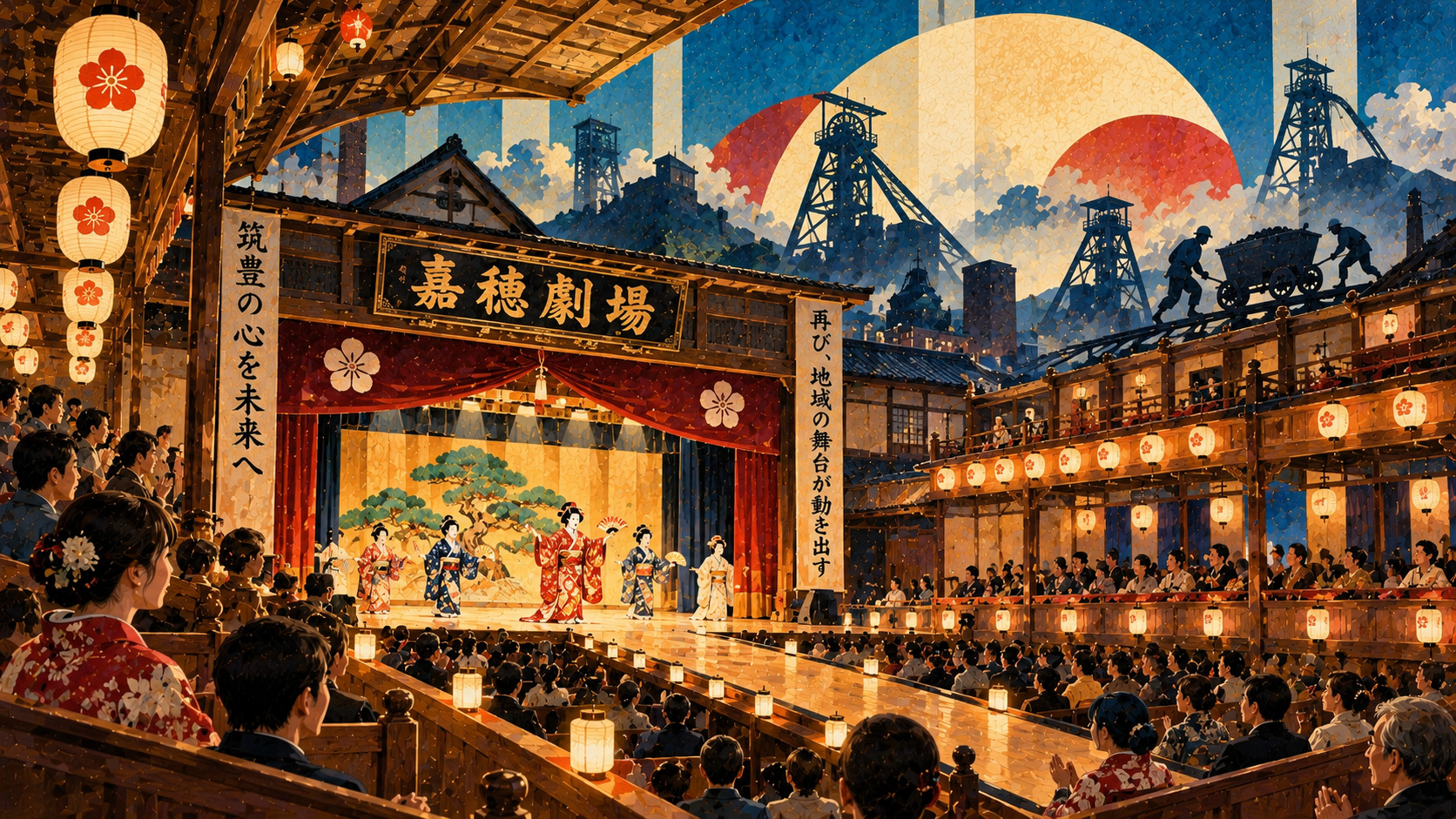
Opening the doors is an achievement. Making the theater live again is the harder second act.
A coal town gets its stage back—partly
In Iizuka, a city built into the history of Japan’s Chikuho coalfield, a wooden theater is preparing to welcome the public again on October 24, 2026, after more than five years behind closed doors. Kaho Theater is not reopening as the full-scale commercial performance house it once was. Iizuka City explicitly describes its initial role as a visitor facility, with restricted event uses. That distinction is the real beginning of the story: a remarkable building has survived, but the question of how to make it a living institution remains open.
What the reopening weekend will bring
Iizuka City schedules an invitation-only ceremony on October 24 at 11:30 a.m., followed by public entry from 12:30 p.m. Admission will be free October 24–26. Two special programs called “Kaho Theater Centennial Picture Scroll” are scheduled for Saturday at 1:30 and 3:30 p.m.; Sunday has three performances, at 10:30 a.m., 2 p.m. and 4 p.m. Capacity is 100 for each performance, with same-day numbered tickets. General sightseeing is suspended during performances. Tea gatherings and a Sunday sweets event are also advertised, though weather or capacity could change arrangements. These are the published plans, not eyewitness confirmation that each activity occurred.
Where industry and popular theater met
Chikuho coal helped fuel Japan’s industrialization, supplying energy for railways, factories and heavy industry. Mining settlements also supported a rich everyday culture. Workers and their families wanted laughter, music, drama and somewhere to gather. Iizuka City says 48 playhouses once stood along the Onga River basin. Kaho is the sole survivor of that tradition. Its history reminds us that an industrial landscape is made not only of mines and machinery but also of the places people built to recover from work.
Before Kaho came Nakaza
The theater’s first chapter began on January 3, 1922, when a three-story wooden playhouse called Nakaza opened. Fire destroyed it in 1928; a replacement opened in 1929, only to fall in a typhoon in 1930. Financed by Takashi Ito, a new, smaller two-story building opened on February 6, 1931, under the Kaho Theater name. The repeated cycle of loss and rebuilding helps explain why survival has become central to the theater’s identity. The building visitors see today dates to that 1931 rebuilding, not to the original 1922 structure.
Architecture that puts an audience into the drama
The theater preserves a form inherited from Edo-period kabuki playhouses. Its tatami-floored masu-seki are divided into box seating, with elevated sajiki seating and two permanent hanamichi runways connecting performers with the audience. Traditional stage machinery includes a manually operated revolving stage and lift, or seri. The national cultural-property register identifies it as a two-story timber building with 1,117 square meters of building area, constructed in 1931 and repaired in 2004. Its value lies in the surviving whole: entrances, audience arrangement, stage and mechanical systems as one theatrical machine.
A theater outlives the coal economy
As the coal industry declined amid Japan’s postwar energy transition, the town’s economic geography changed. Venues that depended on mining communities lost their audiences. Regional tourism records credit Eiko Ito with helping preserve Kaho through changing conditions. This was not preservation by architecture alone; it involved years of ticket selling, production work, maintenance and persuading people that live entertainment still belonged in the old hall. Coal could vanish from the local economy faster than an institution could find a new purpose.
The flood that almost ended the story
Heavy rain in July 2003 severely flooded the auditorium and stage. Performers, public figures and local supporters helped raise money for repairs, and a substantial restoration followed in 2004. In 2006 the theater was registered as a national Tangible Cultural Property, and in 2007 it received recognition as a heritage site associated with industrial modernization. “Registered Tangible Cultural Property” is a specific Japanese legal status; it should not be confused with designation as a National Treasure or Important Cultural Property. Its survival was extraordinary without embellishment.
Pandemic closure and a change of ownership
COVID-19 devastated the economics of gathering for live shows. The nonprofit that operated Kaho dissolved in May 2021, and the theater closed. Ownership passed to Iizuka City through a donation that September. Public ownership created a different set of obligations: preserve an irreplaceable building, make it safe, decide what kinds of use to permit, and explain to taxpayers how those choices would be funded. The October 2026 opening is the result of that transition, not the end of it.
What ¥320 million actually bought
At an August 2026 briefing, the mayor described about ¥320 million spent on reopening work, including seismic assessment, renovation, management planning, demolition of auxiliary facilities and new outdoor toilets. The city separately reported about ¥528 million received through crowdfunding, but said only approximately ¥182 million remained to apply to the work after necessary expenses; about ¥138 million came from city funds. The headline crowdfunding sum is therefore not the same as the renovation budget. The city also said additional investment would be needed, without a firm timetable for the next improvements.
A 1,200-seat memory, a 100-person present
Tourism literature describes the historical theater as holding approximately 1,200 spectators. The newly published venue-use rules tell a different operational story. For events with patrons seated in the traditional boxes, capacity is generally around 100, sitting must last less than an hour and building use is limited to three hours. Nonprofit usage costs ¥17,000 for up to three hours; commercial use is ¥29,000. Some exhibition uses allow circulation rather than prolonged sitting. These limits make it inaccurate to imply that the historic 1,200-seat performance capacity has simply returned.
How a building becomes useful again
Iizuka is opening the theater first for looking, learning and limited gatherings, not promising a packed nightly performance calendar. One path could connect visits with school arts, local festivals and exhibitions; another is gradual expansion of theatrical programming when works and operating capacity permit. Neither path can be declared successful in advance. Visitor numbers, maintenance bills, accessibility, preservation quality and demand for events will determine whether reopening becomes a sustainable civic institution.
The last playhouse, and a larger question
Forty-eight playhouses no longer line Chikuho’s river towns. Coal is no longer the region’s economic foundation. Kaho’s wooden auditorium cannot bring either past back. What it can provide is an unusually direct encounter with the people and culture that inhabited an industrial Japan too often remembered only through mines and machines. The doors scheduled to reopen this weekend offer a beginning. The next challenge is to keep them meaningfully open.
Sources and reporting notes
This advance feature relies on published public records available through October 23, 2026. The October 24 ceremony, performance completion and actual attendance have not been independently observed. Plans may change.
- Iizuka City: official reopening events
- Iizuka City: August mayoral briefing and restoration spending
- Iizuka City: history and overview
- Agency for Cultural Affairs: registered cultural property record
- Iizuka City: current rules and rental charges
- Fukuoka tourism authority: building and historic mechanisms
- Iizuka City: historical chronology
- Iizuka City: calendar after reopening