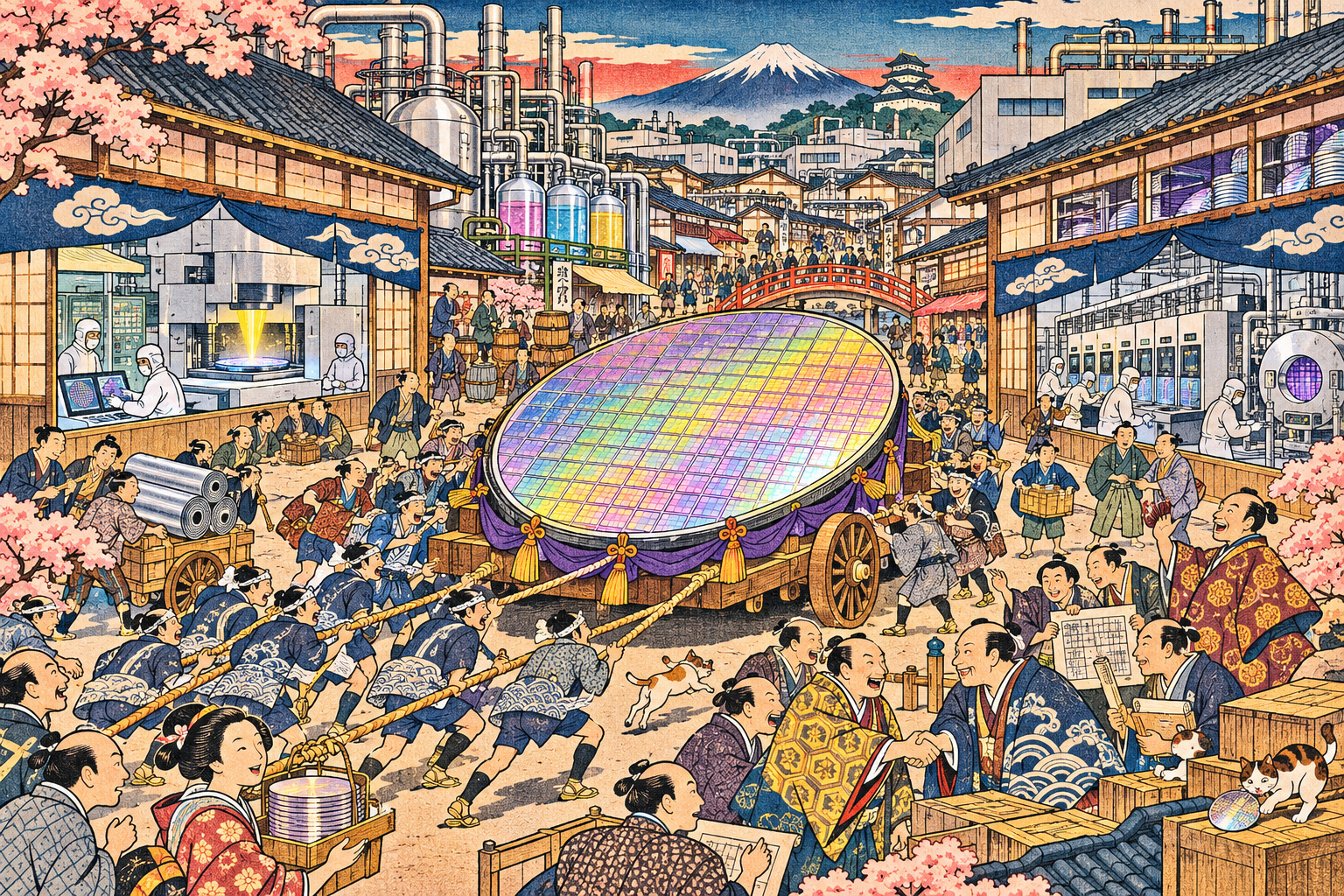
A headline large enough to move a market
The reported price is striking: more than ¥1.3 trillion for JSR, the Japanese chemical specialist whose products help manufacturers draw microscopic circuits on silicon. But the larger question is what such a transaction would mean for the way Japan organizes, finances and protects its semiconductor materials industry. On November 4 Reuters reported, citing two people familiar with the matter, that state-backed Japan Investment Corporation was planning to sell JSR to Mitsui Chemicals. One source said a decision might be made during November.
The operative word is reported. Reuters said JIC, JSR and Mitsui Chemicals had not responded to requests for comment when the story was published. No signed purchase agreement, confirmed transaction price, financing package or regulatory clearance was established by that report. The distinction matters all the more when a transaction of this size can move the buyer's share price before investors know its terms.
The materials behind the chip
A modern chip is built through repeated cycles of deposition, patterning, etching and cleaning. Photoresist, a light-sensitive coating, is essential to defining features on a wafer. Its chemistry must work with expensive lithography equipment and meet requirements for defects, resolution and repeatability. As manufacturers pursue advanced nodes, extreme ultraviolet, or EUV, lithography intensifies those demands. A photoresist does not operate in isolation: the process also depends on masks, protective pellicles, polishing, cleaning and many other materials.
JSR has become one of the significant suppliers in that ecosystem, with expertise in photoresists and chemical mechanical planarization materials. These products can be difficult to replace abruptly because customers qualify them through long, exacting manufacturing tests. That is the structural reason a materials company, relatively obscure outside engineering circles, can become the focus of a transaction worth billions of dollars.
A company born to make synthetic rubber
JSR's origin story begins in 1957, when Japan Synthetic Rubber Co. was established to help establish a domestic synthetic-rubber industry. Its Yokkaichi operations began producing rubber materials in 1960. The company's polymer expertise subsequently carried it into electronics, including commercial photoresists in 1979. It adopted the name JSR Corporation in 1997, acknowledging a much broader industrial identity.
The transformation did not stop there. JSR sold its original elastomers business to ENEOS in 2022 and had already acquired Inpria, a specialist in metal-based EUV resists, in 2021. The group has also reshaped its life-sciences portfolio, including a divestiture of bioprocess materials to Merck completed in March 2026. These are not incidental changes: they show how an enterprise built around the raw materials of Japan's postwar growth increasingly came to depend on the manufacturing processes of the digital economy.
Why the state-backed fund took JSR private
In June 2023, JSR's board endorsed a tender offer by JICC-02, a vehicle owned by JIC Capital. The stated offer price was ¥4,350 per common share. The underlying industrial argument was that patient ownership outside public equity markets could give JSR more freedom to invest, restructure and potentially help consolidate a fragmented but globally competitive domestic materials industry.
The offer succeeded in 2024, and JSR was delisted on June 25 that year. In December the acquisition vehicle and the original operating company merged, with the surviving entity taking the JSR name and business. The proposed sale now being discussed is therefore not an ordinary stock-market exit from a listed company. It would transfer control of a group deliberately taken private to pursue a longer-term industrial project.
An investment fund is not the same as an industrial owner
Established in 2018 under Japan's industrial competitiveness framework, JIC describes its mission as supplying risk capital to policy-relevant businesses, strengthening industrial competitiveness and helping mobilize private investment. The idea behind the JSR investment was not simply to buy an asset and hope its price rose. It involved a broader ambition for the nation's materials sector.
Reuters put the earlier JSR acquisition at roughly ¥900 billion and the potential new sale at more than ¥1.3 trillion. The difference is at least ¥400 billion on a simple subtraction, but it would be misleading to call that JIC's profit. A credible calculation requires clarity about equity versus enterprise value, subsequent borrowing and investments, fees, ownership structure and the final consideration. A genuinely useful assessment must also measure what happened to research capability, capital spending and the industry's competitive position under JIC's stewardship.
Why Mitsui Chemicals would be a consequential buyer
Mitsui's chemical heritage reaches back to coal chemistry in Omuta in 1912. The present Mitsui Chemicals was formed in 1997 from the merger of Mitsui Petrochemical Industries and Mitsui Toatsu Chemicals. Its history stretches through dyes, basic chemicals, petrochemicals and advanced functional materials, a different but equally revealing account of Japan's industrial evolution.
One particularly interesting point of technical proximity is lithography. In April 2026, Mitsui Chemicals said it had been selected for a NEDO-backed research project developing pellicles for high-output EUV exposure equipment. A pellicle helps protect a lithography mask from contamination; it is not a photoresist. JSR's resists and Mitsui's pellicle research occupy neighboring parts of the same demanding process. That suggests an area of possible strategic interest, but neither an operating synergy nor a financial return should be presumed without a concrete integration plan.
The balance-sheet test
Reuters reported that Mitsui Chemicals held approximately ¥217.8 billion in cash and equivalents and ¥876.4 billion in interest-bearing debt at the end of June 2026, with a debt-to-equity ratio of 0.75. The reported potential purchase price also exceeded Mitsui's approximate ¥800 billion equity market capitalization. The size of the transaction is therefore as much a financing story as an industrial one.
How might it be paid for? Bank lending, bonds, new equity, co-investors or asset disposals are all conceivable. None has been confirmed as the structure of this particular proposal. More debt would affect leverage and interest costs; new shares could dilute existing investors; disposals could weaken the rest of the portfolio. The initial market response underlined the issue: Japanese market coverage on November 4 reported that Mitsui Chemicals shares dropped more than 13% intraday following the Reuters report. That is evidence of investor concern, not evidence that a purchase has been approved or rejected.
Industrial logic is not automatic synergy
The attractions are easy to sketch: larger research budgets, a wider collection of materials, opportunities to share customers and potentially stronger negotiating capacity. The difficulties are less photogenic. Chipmakers may insist on independent qualification of every input; process know-how may be protected by confidentiality agreements; products developed for adjacent stages of lithography are not interchangeable; and the capital required to keep pace with a new technology generation may be enormous.
A change in ownership can also prompt questions from customers and competition authorities. Japan-based suppliers serve international manufacturers, so overseas commercial and legal conditions may matter alongside domestic ones. Whether notification or approval would be required in any particular jurisdiction cannot be determined without the transaction structure and relevant turnover figures. A plausible strategic narrative is not a substitute for a documented operating plan.
AI optimism meets the long clock of materials research
Investment in AI computing has helped lift expectations for semiconductor equipment and materials companies. Reuters identified rising chip-related valuations as one reason a sale might be attractive to JIC. Yet semiconductor manufacturing cycles do not follow the daily movement of the stock market. It can take substantial time to develop a material, establish its reliability and qualify it for production in a customer's factory.
A deal reached during an investment boom would need to make sense under less accommodating conditions as well. A successful owner would have to protect engineers' ability to experiment, fund manufacturing capacity, preserve supply continuity and keep customers confident. Those hard-to-measure capabilities often explain why Japan's material suppliers matter more to global technology than their public profiles suggest.
What an official announcement must answer
The first question is the price and what exactly it includes. Does a quoted headline refer to the equity bought or an enterprise value that incorporates debt? Second is the financing mix and any outside capital. Third are JSR's current earnings, cash generation and expected investment needs. Fourth are the timetable, integration costs, antitrust procedures and safeguards for sensitive customer relationships. Fifth is what JIC would retain or reinvest, if anything, and how it would assess the success of its original industrial-policy mandate.
Until those answers emerge, investors and readers should resist treating the rumored valuation as an agreed purchase, or the difference from the 2024 take-private valuation as a realized public return. The reported transaction may change, be delayed or never happen. Its ultimate meaning cannot be known from anonymous sourcing alone.
Japan’s next industrial chapter will not be written at signing
The story joins several eras of Japanese development: postwar synthetic-rubber production, the global expansion of precision chemicals, the 1990s reshaping of chemical conglomerates, and today's strategic race to manufacture advanced chips. What appears to be one extraordinary corporate transaction is also a test of whether public risk capital can help build a stronger industrial base before handing it to a private company.
If Mitsui Chemicals eventually acquires JSR, the decisive evidence will come afterward: new materials that work, factories that produce them reliably, engineers who can keep innovating and customers who choose to buy them. A trillion-yen price tag can announce ambition. It cannot, by itself, prove industrial success.
Sources and reporting method
Desk research based on corporate disclosures and published journalism available through November 4, 2026 (Japan time). Japan.co.jp did not independently interview the transaction parties or review a purchase agreement.
- Reuters, 4 November 2026: reported JSR sale to Mitsui Chemicals
- Reuters, 28 May 2026: earlier consideration of JSR sale
- JSR: corporate history
- JSR: governance and 2024 take-private sequence
- JSR: merger notice, 2024
- JSR: tender-offer materials, 2023
- JSR: bioprocess materials divestiture, 2026
- Mitsui Chemicals: company history
- Mitsui Chemicals: 2026 NEDO EUV pellicle program
- JIC: official company profile and mandate
- Mitsui Chemicals: 2026 investor relations releases
- Reuters Japanese-language market reaction, Nov. 4