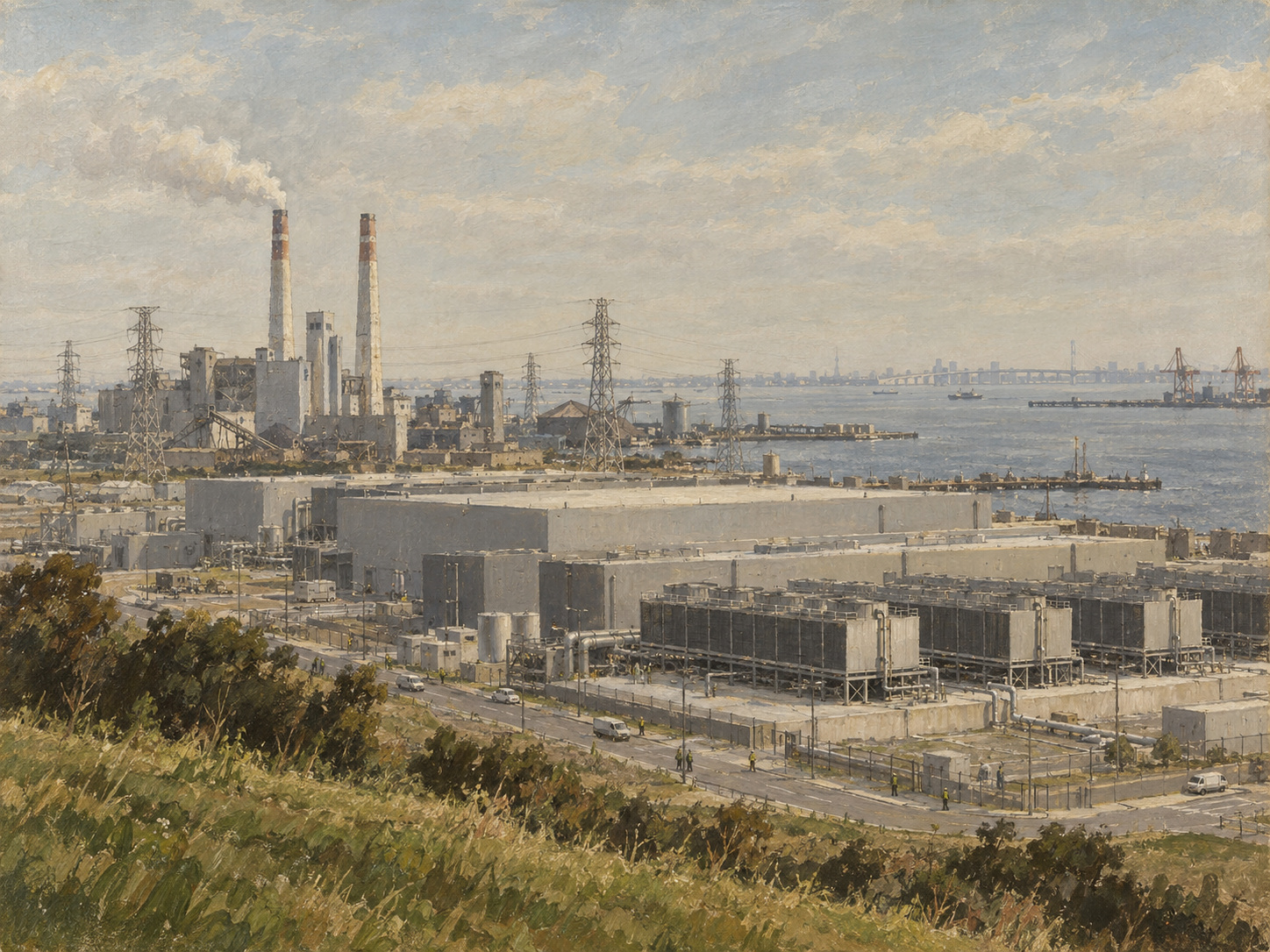
The race to build artificial intelligence capacity is often described as a contest over chips. In practice, chips are only one layer. Large AI clusters require buildings, transformers, cooling systems, high-speed networks and, above all, immense quantities of electricity that must be available reliably and on schedule.
On October 1, Japan’s JERA, Dell Technologies and London-based RHAELM Holdings signed a memorandum of understanding to develop a standardized framework for AI infrastructure at national scale in Japan. The first project is planned at JERA’s Chiba Thermal Power Station in Chiba City, where JERA and RHAELM have also agreed heads of terms for a development of up to 400 megawatts of AI infrastructure using Dell’s standardized rack-scale systems.[1]
JERA says total capital deployment across land, power infrastructure, facility construction and AI computing capacity is expected to exceed US$15 billion—about ¥2.3 trillion in the company’s announcement. At Japan.co.jp’s October 2 reference rate of ¥158.09 per dollar, US$15 billion converts to roughly ¥2.37 trillion. JERA targets operation around 2028; Reuters, citing a JERA official, reports phased operations beginning in 2028 and full 400 MW capacity in 2029.[1][2]
First, separate a giant announcement from a final investment decision
The headline number is large enough to create an easy misconception: that a fully financed $15 billion data center has already been approved for construction.
That is not what the primary documents say. The three companies have signed an MoU. JERA and RHAELM have agreed heads of terms for the first Chiba project. Apollo Global Management intends to participate as RHAELM’s strategic investment and financing partner. Important details—including final financing, all permits, customer commitments, exact accelerator configurations and the complete construction timetable—have not been publicly settled.
The US$15 billion-plus figure also should not be read as a Dell equipment order. JERA explicitly says it covers the full capital stack: land, power infrastructure, facility construction and AI compute.[1]
Why put an AI data center beside a power station?
Conventional data-center development typically begins with land, then a grid-connection request, then a wait for enough transmission capacity to become available. For high-density AI facilities, that wait can become one of the hardest constraints on development.
The Chiba model tries to change that sequence. JERA already owns a large power station and industrial site. RHAELM brings development, construction, operations and financing. Dell brings standardized rack-scale AI infrastructure. The companies say they want power generation, electrical infrastructure, cooling and compute designed as one repeatable package instead of re-engineered separately for every project.[1]
JERA’s release says the project will receive on-site power from existing generation, aiming to make AI capacity available years earlier than a conventional grid-connected project. Reuters reports that JERA plans to provide up to 400 MW under a 15- to 25-year agreement and make land next to the Chiba station available for the development.[2]
Chiba Thermal Power Station is a 4.38 GW machine
JERA’s Chiba Thermal Power Station sits in Soga, Chuo Ward, Chiba City. The company lists the site at roughly 760,000 square meters with maximum output of 4.38 GW. It is an LNG-fired combined-cycle station.[3][4]
A 400 MW data-center load is, by simple comparison, a little over 9% of the station’s maximum output. That does not mean 9% of the plant will continuously feed the data center—actual dispatch depends on maintenance, markets, grid conditions and contracts—but the comparison illustrates how large a single AI campus has become in power-system terms.
Tokyo Bay was already an energy landscape before it became a data-center landscape
Chiba’s industrial coast has long helped power metropolitan Tokyo. JERA operates or participates in major generating assets across Chiba Prefecture, including Chiba, Anegasaki, Sodegaura, Futtsu and Goi. JERA says it generates about 227 billion kWh annually in Japan, roughly 30% of national electricity generation.[5]
The company itself grew from a comprehensive alliance between Tokyo Electric Power and Chubu Electric. Established in 2015, JERA gradually absorbed fuel transportation and trading, fuel procurement, overseas power operations and then, in 2019, the two parent groups’ existing thermal generation businesses.[6]
That history matters because the AI project extends the same logic of vertical integration one step further. JERA’s strength has been linking LNG procurement, shipping, import, storage and generation. Now the company wants to connect that chain directly to computing demand.
Dell’s role is larger than “selling servers”
Dell Technologies is positioning itself around what it calls the Dell AI Factory: a stack of compute, networking, storage, rack integration, cooling and management software intended to reduce deployment complexity.
In 2026 Dell expanded its PowerRack portfolio and emphasized factory-integrated rack-scale systems. In June it described next-generation configurations supporting more than 300 kW per rack with direct liquid cooling.[7][8]
That power density helps explain why AI projects increasingly need to be engineered from the utility side inward. Transformers, switchgear, pumps, chillers, liquid loops, floor loading and networking cannot simply be added after the building is finished.
Who is RHAELM?
RHAELM Holdings Ltd. is based in London. JERA’s Japanese announcement provides the reading “RHAELM(レルム).” The company describes itself as a sovereign AI infrastructure developer that combines power availability with secure compute, networking and storage infrastructure.[1][9]
For Chiba, RHAELM is expected to handle development, construction, operations and financing. Apollo’s planned participation adds another layer: the project brings together a generator, a hardware vendor, an infrastructure developer and a major asset manager.
Chiba is meant to be a prototype, not an endpoint
The most consequential part of the agreement may be what comes after Chiba.
JERA and RHAELM say they will examine deployment of the standardized model at other JERA thermal sites and aim to support several million kilowatts of AI computing capacity across Japan in the 2030s. The Chiba site is explicitly described as the first real-world project for refining that model.[1]
If the design works, the value is not only the 400 MW campus. It is a template: power contract, site layout, cooling, rack architecture, procurement and financing that can be repeated without starting from scratch each time.
AI growth runs straight into the gas-power question
The project also exposes a tension at the center of Japan’s AI policy.
JERA’s announcement states that rapidly scaling AI infrastructure will depend on reliable gas-fired generation and a resilient LNG value chain. Yet JERA has also committed to net-zero CO₂ emissions from its operations by 2050 and aims to reduce domestic CO₂ emissions by at least 60% from FY2013 levels by FY2035, relying on renewables and lower-carbon thermal generation using technologies such as hydrogen and ammonia.[1][10]
The Chiba announcement does not yet disclose the AI campus’s expected annual electricity consumption, emissions intensity, renewable-energy share, waste-heat strategy or a project-specific pathway from conventional LNG generation toward lower-carbon supply.
Those figures will matter. A data center can be locally quiet and still carry a large carbon footprint through the electricity it consumes.
“Behind the meter” could reshape Japan’s data-center map
Data-center location has traditionally been shaped by fiber connectivity, land cost, seismic risk and proximity to users. AI adds another filter: access to very large blocks of power without years of interconnection delay.
That can make existing power stations newly valuable as digital infrastructure sites. They already have grid connections, electrical equipment, industrial zoning, skilled maintenance workforces and large parcels of land.
If JERA can replicate the model, AI investment could spread beyond the usual data-center districts into communities that already host major power infrastructure. The tradeoff is that those communities may also absorb new water, noise, construction, traffic and land-use burdens.
For Chiba, this could be more than a data-center deal
Chiba already combines Narita Airport, Tokyo Bay logistics, petrochemicals, steel, energy and manufacturing. A successful 400 MW AI site would add another industrial layer: large-scale digital compute.
Data centers are not factories employing tens of thousands of production workers, but they create substantial construction, electrical, mechanical, cooling, network, security and operations demand. A campus of this scale may also attract cloud, software, AI-development and specialized infrastructure businesses around it.
But those local benefits remain to be demonstrated. The announcement does not disclose expected permanent employment, local procurement, tax revenues or wider economic multipliers.
$15 billion is not the price of one building
The capital figure is easy to misunderstand because AI data centers combine real estate with unusually expensive technology.
JERA says the total covers land, power infrastructure, facilities and computing capacity. Much of the value therefore sits inside GPUs, servers, networking, storage, cooling and electrical systems—not simply concrete and steel.
For investors, that matters because the spending flows across utilities, construction, hardware, cooling, finance and operations. AI infrastructure is becoming an industrial supply chain in its own right.
The fastest-moving risk is technological obsolescence
A project aiming for 2028 operations must design around hardware that may look very different by the time racks arrive.
Buildings and substations last decades. Accelerators may turn over in a few years. Rack power density, cooling technology and network architecture continue to change rapidly.
That is one reason standardization matters. The physical plant must accommodate successive generations of compute without requiring the entire data center to be rebuilt.
The opposite risk also exists: AI demand may not grow exactly as today’s forecasts assume, model efficiency could improve, and capital-intensive facilities may compete for the same limited pool of customers.
Does the power company become part of the compute business?
The Chiba model nudges JERA closer to a different role.
A traditional generator sells electricity. A generator that colocates a massive AI campus turns site access, LNG procurement, power reliability and electrical engineering into inputs for computing capacity.
That does not make JERA a cloud provider. But it moves the company deeper into the value chain where electricity becomes digital output.
Five numbers to watch next
The project will become easier to evaluate when five things are public: a final investment decision and financing package; detailed construction phasing; anchor customers or tenants; project-specific electricity and carbon metrics; and expected local employment, tax and infrastructure impacts.
Until then, the right description is ambitious but conditional.
A new kind of industrial landscape
Postwar Chiba Bay was built around power, steel, petrochemicals, ports and logistics. AI now adds an industry that appears immaterial on a screen but is profoundly physical on the ground.
A 400 MW data center does not produce smoke from its servers. It still requires generators, transformers, cooling systems, pipes, backup systems and fuel supply behind the scenes.
If the Chiba project proceeds as planned, the power station will no longer be only a place that produces electricity. It will become part of a system designed to turn electricity directly into computing power.
That may be one of the defining industrial shifts of the AI era: the data center as a factory, and the power station as part of the digital supply chain.
Sources
- JERA, “JERA, Dell Technologies and RHAELM Sign MoU to Accelerate National-Scale AI Infrastructure Development in Japan”
- Reuters, “JERA teams up with Dell, RHAELM on AI infrastructure development in Japan”
- JERA, Chiba Thermal Power Station
- JERA, Types and Mechanism of Thermal Power Generation
- JERA FAQ — generation scale
- JERA, Corporate History
- Dell Technologies, Dell AI Factory / PowerRack
- Dell Technologies, next-generation rack-scale AI infrastructure
- RHAELM, JERA / Dell / RHAELM MoU announcement
- JERA, Vision and Environmental Targets for 2035