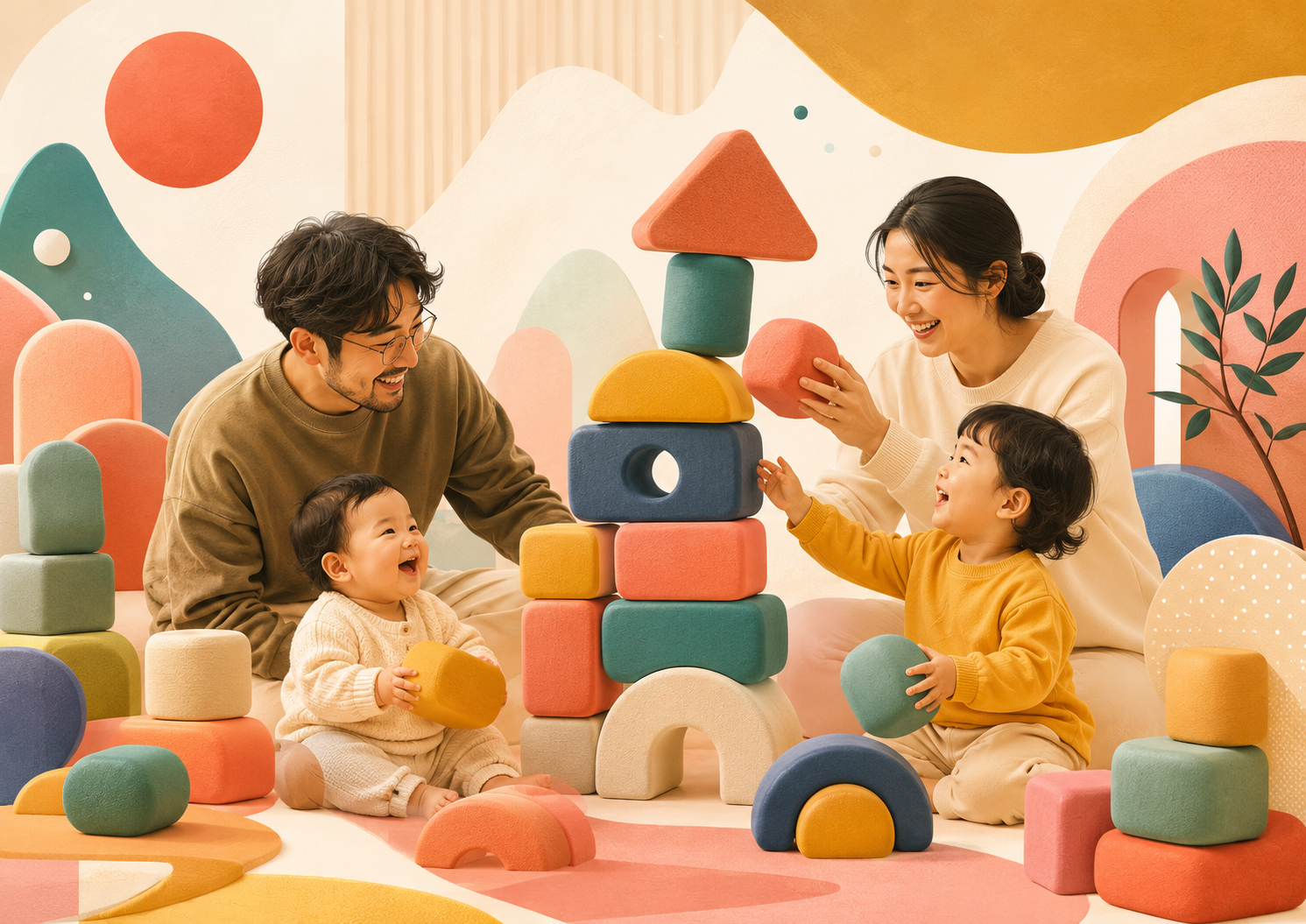
The small pain every parent knows
Building blocks often announce themselves most loudly after play ends: under a bare foot in a dark room, scattered ahead of the vacuum, thrown by a sibling or dropped onto a hard floor.
Jelly Blox attempts to solve that old household problem through material design. Distributed in Japan by Dream Blossom, the blocks are soft enough to squeeze, twist and compress. Some transparent pieces contain sand, beads or other materials that move and make different sounds.
The important idea is not merely “a soft block.” It is an attempt to preserve construction play while reducing stepping pain, impact, floor noise and the grip difficulty experienced by very young children.
Blocks were educational toys centuries ago
Building blocks long predate modern plastic toys. Sixteenth- and seventeenth-century writers described lettered cubes as a way to teach the alphabet through play.
By the late eighteenth century, blocks were treated as “rational toys” for learning gravity, structure and spatial relationships. Stacking, collapsing and rebuilding became embodied experiments.
A block does not give the child a finished object. It provides parts from which the child can make, fail and reconstruct a world.
Froebel connected blocks with kindergarten
In the 1840s, Friedrich Froebel developed early kindergarten education and a sequence of play materials known as Gifts. Spheres, cubes, cylinders and wooden blocks allowed children to discover shape, number, symmetry and relations between parts and wholes.
For Froebel, play was not a break from education. It was the central way young children understood the world.
His materials later influenced modern design and architecture; several major architects described geometric block play as formative.
Montessori emphasized touch and independence
Maria Montessori’s early twentieth-century method emphasized learning through the hand and senses. Children compared size, weight, form and texture through repeated independent activity.
Jelly Blox is not a traditional Montessori material, but it belongs to the broader history of sensory learning. Children see, hear, press and grip.
Softness itself becomes information: pressure changes the shape, resistance can be felt and the object returns when released.
From wood to plastic to softness
Twentieth-century construction toys moved from gravity-held wooden forms to interlocking plastic systems. Kiddicraft and LEGO made connection strength central.
Japan developed its own precision systems through products such as Kawada’s Dia Block and later Nanoblock.
Rigid plastic offers accuracy, durability and complex structures. For toddlers, it can also mean hard corners, difficult connections, painful stepping and loud impact. Soft blocks move the history of construction toys toward the body rather than toward ever greater precision.
How softness changes safety
Soft blocks can reduce bruising, sharp impact and the pain of stepping on a toy. They may also absorb more force if a child falls onto them.
Softness matters in sibling play because young children throw objects. It can also reduce impact on furniture and floors.
But soft does not mean automatically safe. Tears, internal particles, chemical composition, mold, choking risk and age grading still matter. Adults should inspect damaged pieces and follow safety instructions.
The enormous value of ‘ouch-free’
A toy’s household cost includes cleaning, storage, noise and injury risk—not only price and educational value.
Stepping on a hard construction brick has become a universal parenting joke because the problem is so common. Jelly Blox’s “ouch-free” message is commercially simple but practically meaningful.
When adults feel safer allowing toys across the floor, children may receive more space and time for open play.
Noise matters in urban housing
In Japanese apartments, toy noise can travel beyond the household. Hard pieces dropped onto flooring may disturb neighbors below.
Soft material can reduce high-frequency impact and echo, making play easier during early mornings, evenings or remote work.
Pieces containing beads or sand intentionally produce sound when shaken, so these are not silent toys. They replace accidental impact noise with controlled sensory sound.
Visible interiors create sensory play
A distinctive feature is the visible material inside selected blocks. Sand, beads and particles shift and sound different.
Children can build, squeeze, shake, hold pieces to light and track movement. Vision, touch and hearing operate together.
Sensory play also teaches cause and effect: pressure changes shape, tilting moves particles and speed changes sound.
Gripping, pinching and pressing
Young hands are learning independent finger movement and force control. Squeezing, pulling and pressing soft blocks engage different motions from simply placing a wooden cube.
Building combines visual positioning, movement and controlled force—hand-eye coordination, fine motor control and spatial reasoning.
Claims that one toy dramatically increases intelligence or strength should remain modest. Development depends on sleep, nutrition, conversation and varied play.
Spatial thinking through block play
Research and educational practice associate block play with spatial reasoning, motor coordination, mathematical language, creativity and cooperation.
Words such as above, beside, taller, equal and half arise naturally. Falling towers demonstrate balance; bridges introduce span and support.
Soft pieces create different design problems because structures bend and connections deform. The emphasis may shift from precision towers toward tactile forms and movable constructions.
The constraints created by softness
Softness is not universally better. Deformation can make tall, exact construction difficult. Weak connections may separate when a model is lifted.
Rigid blocks hold lines, angles and dimensions and support complex machines and architecture. Soft blocks are stronger as an early-childhood, sensory and safety-oriented system.
Jelly Blox therefore does not replace LEGO or wooden unit blocks. It creates an earlier doorway into construction play.
Washability and hygiene
Toddler toys travel between floors, mouths, food and bathrooms. Soft materials may be easy to rinse, but water trapped inside seams can be difficult to dry.
Families should follow the manufacturer’s cleaning directions rather than assume dishwasher or boiling safety. Pieces containing internal particles should be checked for leaks and damage.
Hygiene depends on cleaning, complete drying and discarding damaged toys—not only antibacterial claims.
Materials and environmental questions
Soft construction toys often use elastomeric or silicone-like materials. They offer flexibility and durability but differ environmentally from long-lived single-material wooden blocks.
Mixed materials, internal sand or beads and sealed construction can make municipal recycling difficult. Material disclosure, take-back options and durability therefore matter.
Safety should not justify short product life. Designs that can pass between siblings, nurseries and secondhand users reduce environmental impact.
Why the concept fits Japan
Japanese toy choices are shaped by storage, apartment noise, cleanliness and limited floor space.
The educational-toy market is also strong, with parents seeking developmental value. Jelly Blox combines safety, sensory play, building, color and sound.
Transparent pieces and visible deformation also communicate well through social video. ASMR-like sound and squishability make the product easy to demonstrate online.
Age grading is a safety rule
Age labels on toddler toys indicate safety as well as difficulty. Children who mouth toys are especially vulnerable to detached pieces, tears and leaking internal material.
Even large soft parts should be checked for bite damage. In mixed-age households, every individual component matters.
Caregivers should verify the official age range, warnings, importer and applicable toy-safety standards.
Parent-child play expands the value
Open-ended toys have no required finished model. Simple questions—what did you build, which feels softer, which sounds different—turn play into language and observation.
Families can sort by color, match sounds, hold pieces to light, compare softness or test tower height.
Adults should avoid deciding every correct answer. Since Froebel, the educational value of blocks has rested on children discovering relationships for themselves.
Soft construction play by the numbers
What to check before buying
- Age range: Match the product to mouthing and developmental stage.
- Damage: Inspect regularly for tears, leaks and detachable parts.
- Cleaning: Follow official washing and drying directions.
- Connection force: Ensure the child can join and separate pieces independently.
- Storage: Confirm that the complete set fits the household.
- Longevity: Consider durability, expansion and reuse.
Japan.co.jp view: toy innovation reduces family friction
The best toy innovation does not simply add features for children. It reduces how often adults must say no, be quiet, clean up or do not throw that.
Jelly Blox does not radically change the educational logic of blocks. Children still stack, collapse, experiment and rebuild. What changes is the impact on household life.
Less painful underfoot. Quieter when dropped. Easier for small hands to squeeze. Filled with visible movement and sound. Each improvement is small, but toddler play repeats small interactions dozens of times a day.
For centuries, blocks have helped children construct a world. Soft blocks propose a gentler way for that imagined world to coexist with the real home around it.
Sources and further reading
- Dream Blossom: Japanese-market Jelly Blox features, soft material, internal sensory contents and sound.
- Jelly Blox: Product overview focused on construction and sensory play.
- Froebel Trust: Froebel’s Gifts and early-childhood education in the 1840s.
- Learning Materials Workshop: History and developmental value of block play.
- Penn State Extension: Physical, mathematical, imaginative and social benefits of block play.
- Parenting Science: Research overview on spatial, language, motor and creative development.