- Two champions, two podiums, and a contest still wide open
- What a street skateboarding score actually measures
- Horigome built his career across the Pacific
- Yoshizawa's progress was years in the making
- How Japan became a center of competitive skateboarding
- A new urban sports park offers a local development experiment
- The LA28 qualification rules: why a medal is not a berth
- The next two years will test more than individual tricks
Two champions, two podiums, and a contest still wide open
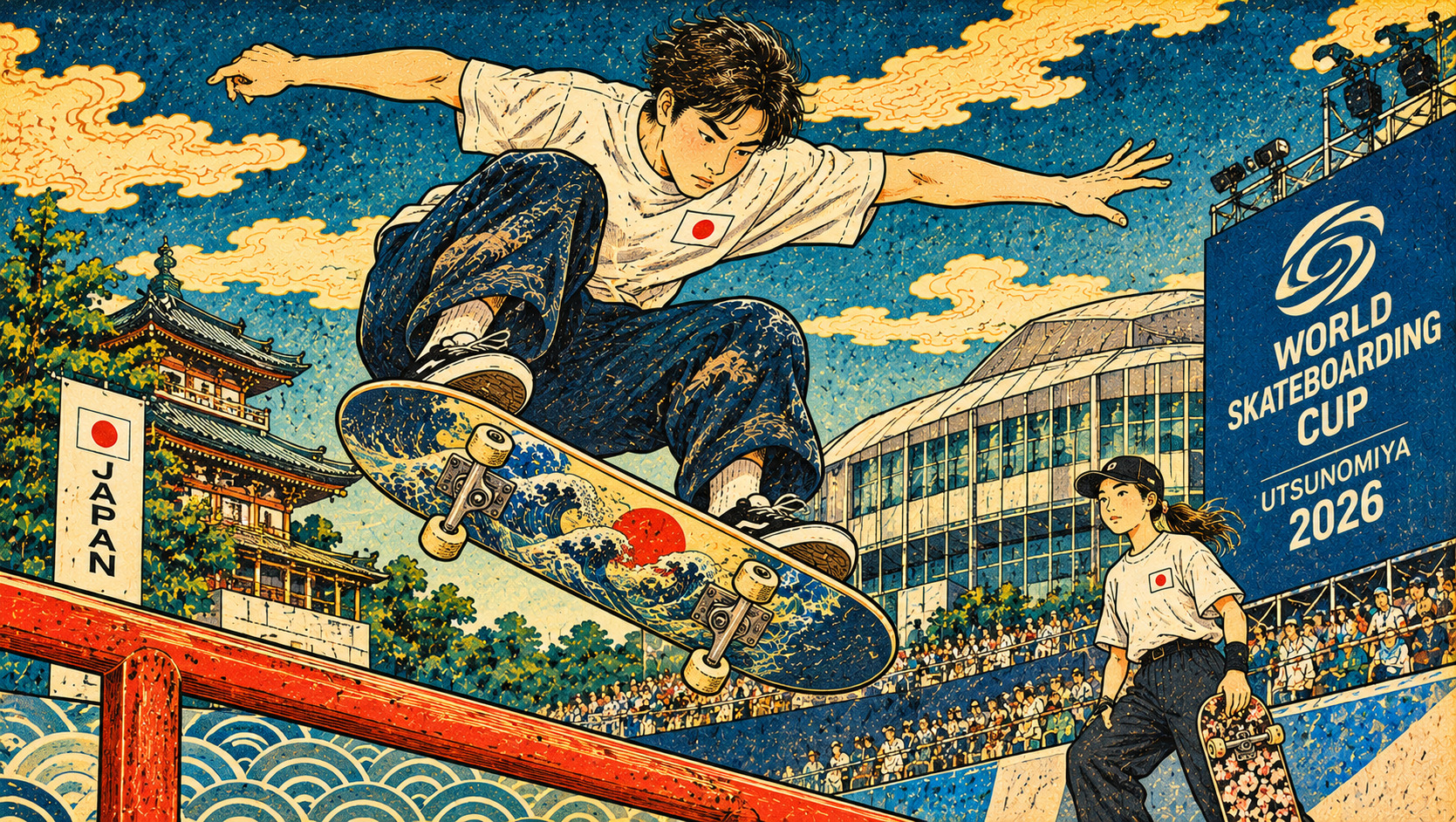
The road to Los Angeles passed through a newly opened sports park in Utsunomiya on November 23. Yuto Horigome, the only man to have won both Olympic street skateboarding titles contested so far, finished second. Coco Yoshizawa, the reigning women's Olympic street champion, placed third. Neither result was a victory, yet both mattered in a competition that counts toward qualification for 2028.
South Korea's Juni Kang took the men's title and Brazil's Rayssa Leal won the women's. Specialist results reporting put Horigome at 178.25, just ahead of American Jagger Eaton on 178.18. Leal scored 176.03, Australia's Chloe Covell 175.13 and Yoshizawa 175.11. Less than a point covered all three women on the podium.
The Japanese Olympic Committee's published report also recorded fifth place for Kairi Netsuke, sixth for Sora Shirai and eighth for Ginwoo Onodera in the men's event, with Funa Nakayama eighth among the women. Six Japanese finalists illustrate the depth of the country's competitive scene, but the winners from Korea and Brazil are a reminder that the international field is evolving just as quickly.
What a street skateboarding score actually measures
A street course brings features of the urban environment into a competition arena: stairs, ledges and rails become opportunities for different combinations of movement. Unlike a timed race, the result depends on judges assessing the quality and difficulty of the skating. Athletes have to decide which obstacles and tricks best demonstrate their abilities under pressure.
At Utsunomiya, finalists had three 45-second runs and three individual trick attempts. Their highest run and highest trick scores were added together. The semifinal used two runs and three trick attempts. This is a competition-specific format; the Paris Olympic scoring arrangement was different, so totals from the two events cannot be compared directly.
A run rewards the ability to link multiple movements into a coherent performance. An individual trick gives a skater the chance to concentrate on an especially demanding maneuver. A failed landing can leave an athlete with little opportunity to recover. Horigome advanced from the last qualifying position in the quarterfinal to first in the semifinal, showing how a ranking can change from one round to the next. Yoshizawa reached the final in second place and, according to specialist coverage, landed the bigflip front board that had featured in her Paris victory.
Horigome built his career across the Pacific
Horigome was born in Tokyo on January 7, 1999. He began skating at six under his father's influence, focused more seriously on street during his school years and moved into American competition after high school. That international experience matters to understanding his career: the Olympic champion emerged from an existing global skateboarding culture rather than from the Olympics alone.
He finished second at the 2019 world championships and won the world title in 2021. That year also brought the postponed Tokyo 2020 Games, where skateboarding made its Olympic debut. His gold medal gave a Japanese athlete the first men's street title in Olympic history.
His second Olympic triumph was hardly inevitable. Horigome secured his Paris opportunity late in the qualifying process and then came from behind with his final trick at the Games. Those experiences illustrate a central feature of the sport: reputation cannot substitute for successful execution on the day. At 27, he enters another qualification cycle with an extraordinary record but no automatic ticket to Los Angeles.
Yoshizawa's progress was years in the making
For international viewers, Yoshizawa appeared to arrive almost overnight when she won Olympic gold at fourteen. Her development record tells a different story. Born in Kanagawa Prefecture on September 22, 2009, she began skateboarding at seven and entered competition to test her abilities against other skaters.
She placed fifth at Japan's national championships in 2021, began competing overseas in 2022 and finished fifth at the 2023 world championships. In 2024 she placed third in the Shanghai Olympic qualifier and won in Budapest before taking the Paris title. Her rise involved repeated encounters with unfamiliar courses, international opponents and the pressure of formal competition.
Now seventeen, she faces a different developmental challenge: sustaining progress after achieving the sport's most visible prize. Training, recovery, schooling and the freedom to enjoy skating all matter to the long-term careers of young competitors. Her close contest with Leal and Covell in Utsunomiya offers a more meaningful snapshot of current competitiveness than any assumption that a previous gold medal will guarantee future success.
How Japan became a center of competitive skateboarding
Skateboarding grew out of a wider board-riding culture associated with the United States and developed through local scenes, shops, filmed performances and competitions. Street skating in particular treats the built environment as a setting for invention rather than merely a standardized sports surface. Olympic recognition at Tokyo brought this culture into a new relationship with public sports institutions.
Japan's success is not readily explained by a single national academy or training formula. Horigome's family and overseas experience contrast with Yoshizawa's progression from local participation into domestic and international contests. Independent shops, peers, coaches, sponsors and access to places to practice can each play a part. The two careers demonstrate the importance of allowing different routes into elite sport.
Video also connects skaters across borders: a difficult trick performed in one city can inspire practice elsewhere. But watching a maneuver is not the same as mastering it. Reliable practice space, time for repetition and an environment where failure is part of learning are important. The challenge for Japan is to support these conditions without stripping skateboarding of the creativity that made it distinctive in the first place.
A new urban sports park offers a local development experiment
Arctown Utsunomiya opened on March 28, 2026. The city describes an urban sports destination with an all-weather skatepark, a multipurpose plaza accommodating three-on-three basketball, green spaces, children's facilities and commercial amenities. It is connected to the Hiraishi stop on the city's light rail system.
That combination gives the November World Cup a significance beyond the competition standings. A child attending an international event can encounter the sport in a public setting, while an everyday visitor may discover a facility through its other attractions. The municipality encouraged spectators to arrive by light rail, linking an urban sports venue with a broader transportation strategy.
Whether this becomes a durable development model depends on what happens between major events. Participation, affordability, accessibility, maintenance expenditure and the experience of nearby businesses are all relevant measures. No economic-impact estimate is established by the event announcement. A successful public park must serve regular users as well as international visitors.
The LA28 qualification rules: why a medal is not a berth
The July 10, 2026 version of the IOC and World Skate qualification system provides for 22 competitors in each of four events: men's and women's street and park. Twenty places per event are distributed through the world ranking process, including continental representation provisions; the system also includes a host-country place and a universality place.
The qualifying period extends from June 11, 2026 through June 11, 2028. Its first phase ends March 31, 2028. Access to the second phase is restricted to athletes selected on the basis of first-phase achievements, with 44 competitors per gender and discipline and a maximum of six from each national Olympic committee. The final Olympic limit is three per national committee in each event.
The ranking on June 11, 2028 is the decisive reference under the published rules. World Cups, world championships and Olympic qualifying events contribute to the ranking system. Utsunomiya is therefore a meaningful step, not a selection decision. For Japanese skaters, international rankings and competition against compatriots both matter. An athlete could be among the world's strongest and still face the national quota.
The next two years will test more than individual tricks
Japan leaves Utsunomiya with two podium finishes and several other finalists, but neither defending Olympic champion won. The narrow women's result and Kang's men's victory offer an unusually clear reminder that the sport is not standing still. The next two years will bring new tricks, new competitors and different course designs.
For readers in Los Angeles, Horigome's career offers a particularly relevant link between Japanese athlete development and American skateboarding culture. Yoshizawa represents a generation that grew up as skateboarding was becoming an Olympic sport. Their respective journeys suggest that competitive achievement and the informal culture of skating need not be opposing forces.
The most useful indicators to follow now are qualification standings, performances across different venues and the ability of athletes to remain healthy through the long cycle. At home, the legacy of a venue such as Arctown will depend on sustained local participation. The next chapter of Japanese skateboarding will be written not only on Olympic podiums but also in the places where future competitors first learn to ride.