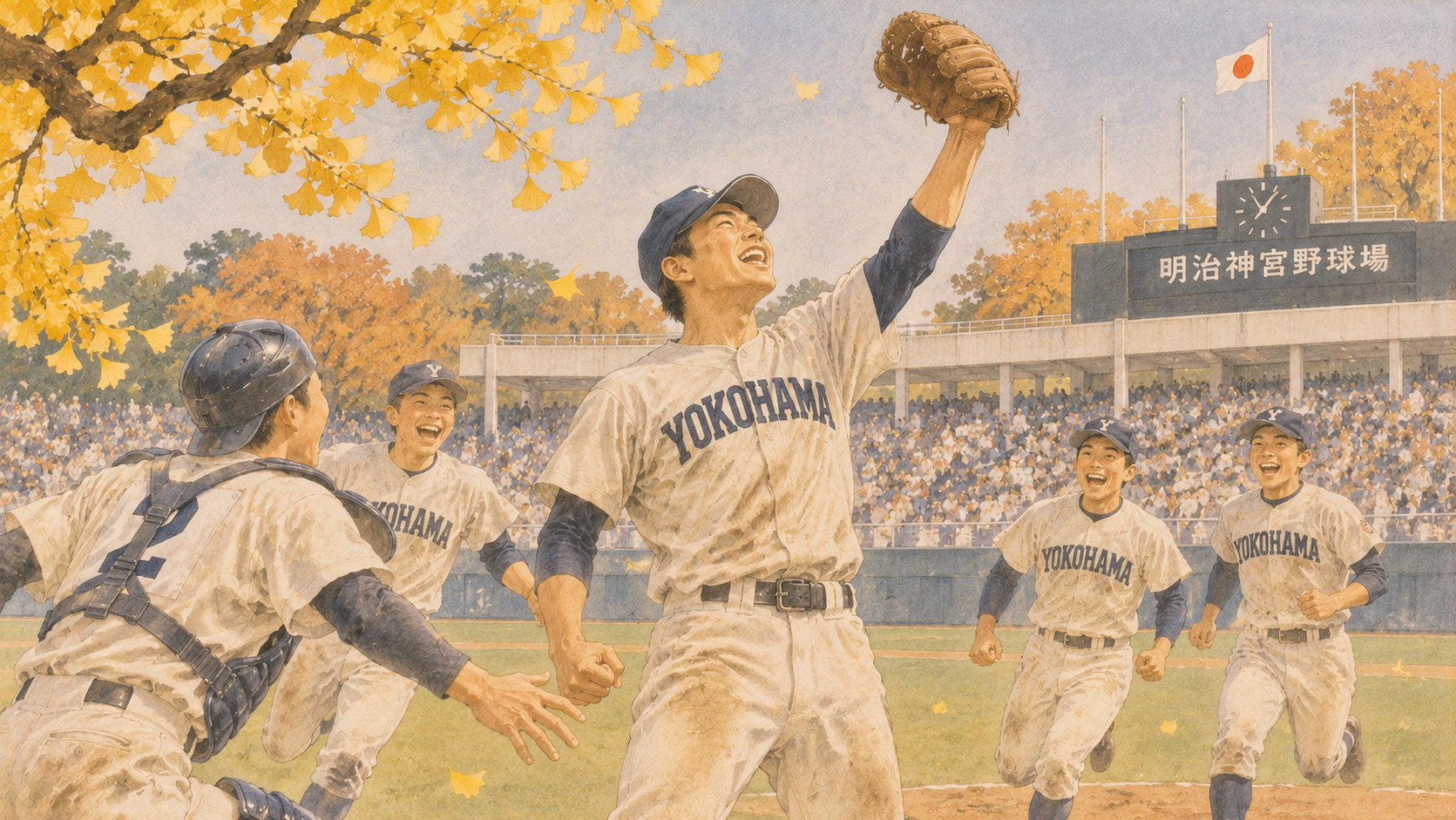
- A championship decided by four runs, and a record built over three games
- What eleven RBIs actually tell us
- Why the autumn tournament matters
- A victory that changes the spring selection landscape
- The Yokohama tradition: from Matsuzaka to a new generation
- A national institution with a shrinking membership
- The professional pipeline is only one path
- The next test is growth, not simply another trophy
A championship decided by four runs, and a record built over three games
Yokohama High School won the high-school division of the 57th Meiji Jingu Baseball Tournament on November 25, defeating Tokoha University-affiliated Kikugawa High School of Shizuoka 4–1 in Tokyo. The official scorebook confirms Yokohama’s third title and its first since 2024. It also records a new tournament high of 11 runs batted in by second-year catcher Kaito Wakiyama.
The final was a different test from Yokohama’s explosive semifinal. The Kanagawa school scored twice in the first inning and added insurance runs in the fourth and seventh. Starting pitcher Tetsusaburo Kobayashi finished the game himself; TBS reported five hits allowed and ten strikeouts. Kikugawa scored its only run in the ninth. The performance demonstrated a team capable of protecting a modest lead, not merely overwhelming opponents with offense.
What eleven RBIs actually tell us
Wakiyama drove in one run against Sendai Ikuei, eight against Nishogakusha University High School and two in the final, according to contemporary coverage. His semifinal output matched the reported single-game tournament record. Yokohama’s three victories produced 32 runs in total. The record therefore reflects both individual hitting and an unusually productive lineup.
An RBI measures a run credited to the batter under scoring rules. It is not a pure measure of individual skill: the number of available baserunners and the situations in which a hitter comes to the plate matter enormously. A catcher also has responsibilities beyond batting, including receiving pitches, coordinating with the pitcher and reacting to runners. Wakiyama’s achievement is impressive without treating three games as a reliable forecast of professional performance.
| Opponent | Score | Wakiyama RBIs |
|---|---|---|
| Sendai Ikuei | 8–7 | 1 |
| Nishogakusha | 20–7 | 8 |
| Tokoha Kikugawa | 4–1 | 2 |
Why the autumn tournament matters
For international fans accustomed to a single postseason championship, Japanese school baseball has a distinctive calendar. The Meiji Jingu tournament brings regional champions together in autumn, after the summer competition and the transition toward a new team built around younger students. Its university and high-school divisions are separate competitions.
The format offers a national comparison before the long winter training period. Yokohama came to Tokyo as the Kanto champion. Facing opponents from other regions exposes a developing squad to different pitching and defensive approaches. Autumn success is valuable evidence of competitive strength, but several months of physical development and preparation separate Jingu from the next spring tournament.
A victory that changes the spring selection landscape
Yokohama’s win also carries a regional consequence. The Jingu championship earns an additional place in the following spring’s invitational tournament for the winning school’s region. Kanto therefore gains an extra opportunity in the 2027 selection process. This does not mean a specific additional school has already been chosen.
The Japan High School Baseball Federation schedules the 99th Senbatsu tournament to begin at Hanshin Koshien Stadium on March 19, 2027, with the selection committee meeting on January 29 and the draw on March 5. The spring event is an invitational competition informed by autumn results, rather than a simple nationwide qualifying bracket. The summer championship, by contrast, is built around regional qualifying tournaments. Understanding this distinction explains why the November final matters to schools that were not playing in it.
The Yokohama tradition: from Matsuzaka to a new generation
Yokohama won Jingu in 1997 before its celebrated 1998 spring and summer championships. Daisuke Matsuzaka’s no-hitter in the summer final remains a landmark in the federation’s official tournament history. Former coach Motonori Watanabe recalled the team’s 44 consecutive official-game victories in material published by Kanagawa Prefecture. Matsuzaka later became familiar to international audiences through professional baseball in Japan and North America.
A different generation captured Jingu again in 2024 and won the spring tournament in 2025, defeating Chiben Wakayama 11–4 for Yokohama’s fourth spring championship. The 2026 autumn title matters because school teams must rebuild as students graduate. The institution’s ability to remain competitive is more revealing than superficial comparisons between today’s teenagers and famous alumni. No young athlete should be expected to reproduce a predecessor’s career.
A national institution with a shrinking membership
The roots of the summer national championship date to 1915, when ten representative schools competed at Toyonaka. The spring invitational began in Nagoya in 1924 and moved to Koshien the following year. Over the ensuing century, these school competitions became a highly visible part of Japan’s sporting calendar, bringing together local identities and national attention.
The system now faces a demographic challenge. In its June 2026 membership survey, the federation counted 124,116 members of hardball clubs at 3,746 affiliated schools. Membership fell for a twelfth consecutive year. The count includes managers and other club members, not exclusively active players. Smaller school populations can make it more difficult to field teams and maintain facilities. Keeping baseball accessible beyond famous programs will be essential to sustaining the sport’s regional foundations.
The professional pipeline is only one path
The official 2026 Nippon Professional Baseball draft list provides a concrete example of Yokohama’s role in player development: the Yomiuri Giants selected pitcher Shoki Oda in the first round and infielder Ikeda in the third. Draft selection establishes negotiating rights rather than a completed professional contract. Other graduates may continue in university or corporate baseball, or pursue careers outside sport.
The challenge is to build skills without sacrificing long-term health. The federation made its weekly 500-pitch competition limit permanent in 2025 following a trial introduced in 2020. A numerical ceiling is not a guarantee against injury, and training workloads and recovery remain important. A school’s success should therefore be assessed not only by championship trophies or draft selections, but by whether students can develop safely and retain meaningful educational choices.
The next test is growth, not simply another trophy
The November result offers a clear snapshot: a productive lineup, a record-setting catcher and a pitcher who completed a closely controlled final. It does not establish how the team will perform in March. Opponents will have time to study autumn results, and young athletes themselves can change substantially over the winter.
For readers following Japanese baseball from overseas, that is the enduring fascination of Jingu. It reveals an emerging generation before the more internationally recognized Koshien stage. For the students, however, the value is more immediate: opportunities to compete, learn and improve alongside teammates. Wakiyama’s record is already secure in the official scorebook; the next chapter is still unwritten.
Sources and further reading
- Japan Student Baseball Association — official final scorebook
- TBS — final and autumn results, November 25
- Asahi — semifinal and Wakiyama’s name reading
- Japan Student Baseball Association — past champions
- Japan High School Baseball Federation — summer championship history
- Japan High School Baseball Federation — spring tournament history
- Japan High School Baseball Federation — 2027 Senbatsu schedule
- Japan High School Baseball Federation — 2026 membership survey
- Japan High School Baseball Federation — historical membership statistics
- NPB — 2026 Giants draft selections
- Japan High School Baseball Federation — professional baseball declarations
- High School Baseball.com — 2025 spring championship
- Kanagawa Prefecture — former coach Motonori Watanabe’s account
- Japan High School Baseball Federation — 2024 project report, pitching limits