- A retrospective that has not finished looking forward
- An education in the possibilities of postwar painting
- What America offered: a different surface
- When a color becomes a space
- Changing medium without abandoning the question
- International attention catches up with a Japanese career
- Seeing the paintings beside the sea
A retrospective that has not finished looking forward
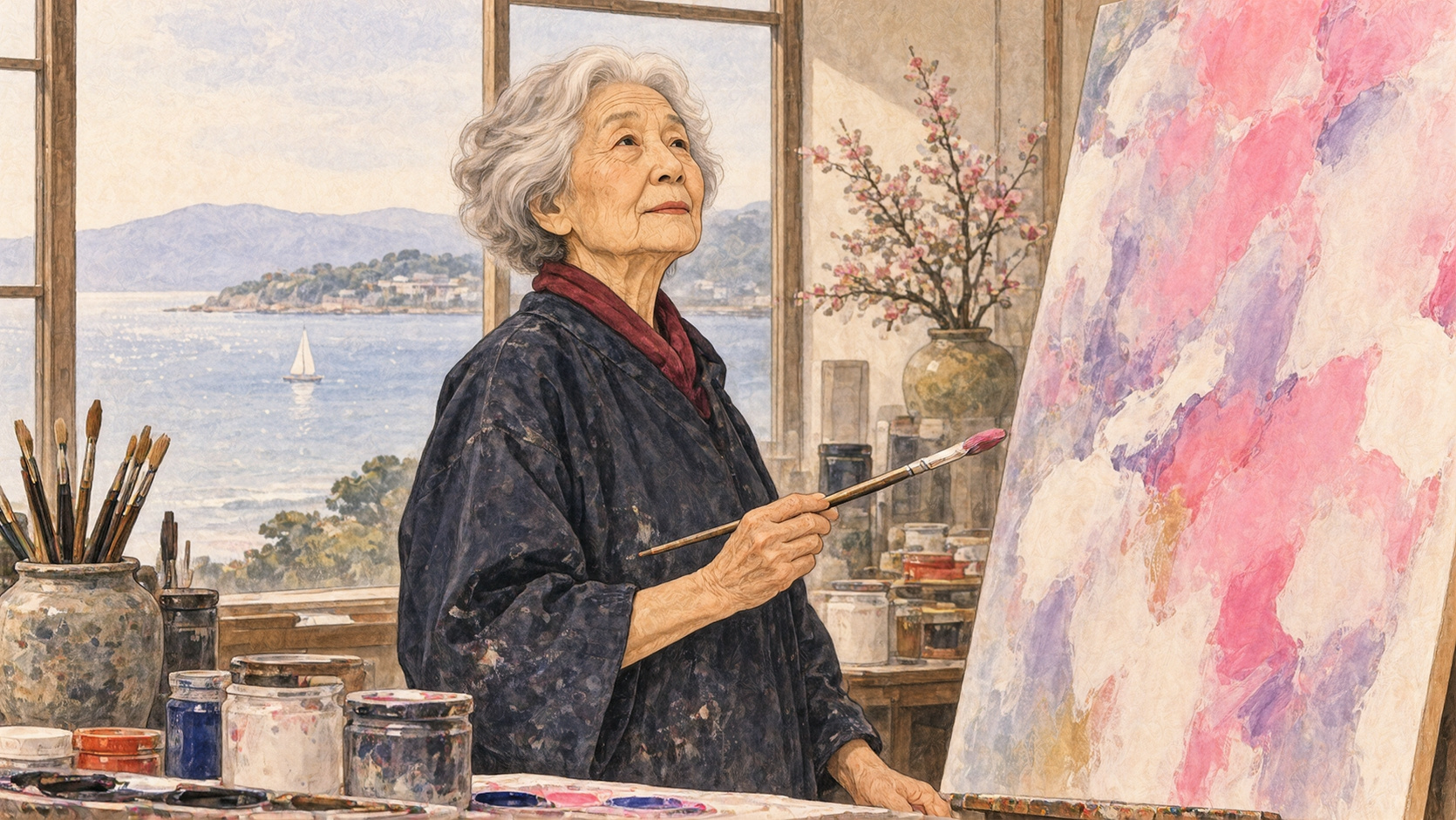
Most retrospectives invite viewers to consider an artist’s completed achievement. Yoko Matsumoto’s exhibition in Hayama poses a different question: what happens when the artist is still changing the terms of her work? At 90, the Tokyo-born painter is making new pictures, and those pictures belong alongside the early paintings in her first touring retrospective.
The Museum of Modern Art, Hayama, is scheduled to open the final leg of The Day I Saw the Evening Star on November 28. Following presentations in Fuchu and Iwaki, the coastal museum plans a selection spanning her student years and 2026, with more than forty works and associated materials. The additions include sketchbooks and large paintings, one of them her largest canvas format, size 300 in the Japanese sizing system.
This is an opportunity to understand a career through its changes rather than through one recognizable signature. The pink paintings that established her reputation are only one stage in an investigation of what color can do on a flat surface.
An education in the possibilities of postwar painting
Born in 1936, Matsumoto was a young student during a period when international exhibitions were widening the vocabulary available to Japanese artists. She completed her oil-painting studies at Tokyo University of the Arts in 1960 and won the grand prize at the tenth Modern Art Association exhibition that year.
Her representing gallery traces her development to study with Ryohei Koiso and encounters with Art Informel in the 1950s. The movement offered an alternative to painting as the orderly representation of an identifiable subject. For a young painter interested in abstraction, improvisation could become a method of discovering forms rather than merely executing a predetermined design.
A 1964 oil painting titled Work, catalogued by the National Museum of Modern Art, Kyoto, provides a useful historical anchor. It predates her American journey. The encounter with new materials later in the decade therefore did not originate her interest in abstraction; it gave an existing investigation a different physical foundation.
What America offered: a different surface
During 1967 and 1968 Matsumoto spent time in Cleveland and New York. The materials she encountered there mattered as much as the paintings. Acrylic paint, polymer medium and raw cotton canvas made possible interactions between pigment and fabric quite different from those she had explored in oil.
Acrylic paint is a water-based dispersion that generally dries more quickly than oil. On unprimed cotton, diluted color can penetrate the weave instead of remaining entirely on a prepared surface. The painter must negotiate absorption, the movement of liquid and the timing of successive applications. These properties make the substrate an active part of the picture.
White Cube places her practice in conversation with American color-field painting and East Asian ink painting. That relationship is especially interesting because a new industrial paint could enable qualities associated with older practices of staining and washing. Her achievement was not simply to import a fashionable American style but to develop an individual language through sustained experimentation after returning to Japan.
When a color becomes a space
A large abstract canvas can change with the distance from which it is seen. From across a room, a field of pink may seem almost atmospheric. At close range the fabric, marks and overlapping pigment become more apparent. Neither view alone exhausts the painting.
Matsumoto became particularly associated with pink acrylic compositions during the 1980s and 1990s. The National Museum of Modern Art, Tokyo, catalogues a 1993 painting titled The Light is Shining in the Wilderness at 250 by 200 centimeters. Its dimensions give a sense of the physical encounter her work can demand. The Hayama exhibition page lists a similarly titled work with a II suffix; this report does not assume that the two catalogue titles refer to the same object.
Hayama’s planned display of exceptionally large canvases is therefore more than a numerical attraction. It allows the visitor to experience the shifting relationship between a painted surface and the space occupied by the viewer. Photographic reproductions can document compositions, but they cannot convey that relationship at full scale.
Changing medium without abandoning the question
The shift back toward oils in the late 1990s complicates any simple account of Matsumoto as a painter of pink. By the mid-2000s green paintings had become an important part of her practice. More recent work has explored darker and blue tonalities.
Oil and acrylic differ in drying behavior and in how artists can blend or layer their marks. Changing medium thus changes the practical decisions available during painting. It need not mean changing the artistic problem. Matsumoto’s continued concern with luminosity suggests a productive continuity between otherwise very different surfaces.
The National Museum of Art, Osaka, records her 2011 oil painting Approaches in Wilderness at 194.2 by 259.5 centimeters. The Iwaki retrospective also introduced a 2026 work titled 植物に視つめられる私, made with oil, charcoal and pastel. Its title can be understood as an inversion of the usual relationship between a person and the natural world: what if nature is looking at us? That is an editorial reading of the title, not a quotation from the artist.
International attention catches up with a Japanese career
International rediscovery can sometimes obscure the institutions that sustained an artist’s earlier career. Matsumoto had already been the subject of important Japanese exhibitions, including a 2005 two-person presentation in Kamakura and the 2009 exhibition Light at the National Art Center, Tokyo, with photographer Rika Noguchi. Their different media offered complementary ways of approaching the experience of light.
In 2024 White Cube presented her work in London and New York, followed by an announcement of representation alongside Hino Gallery in January 2025. These commercial developments provide additional routes to international audiences; they are not substitutes for independent museum scholarship.
The institutional context is widening, too. Mudam Luxembourg’s Kaihō: Japanese Women Artists after 1945 brings together work by thirty-nine artists to reconsider the international history of postwar art. The Hayama museum identifies Matsumoto as a participant. Her career makes a persuasive case for viewing Japanese abstraction not as a belated imitation of Western developments, but as part of a complex international exchange.
Seeing the paintings beside the sea
Hayama’s museum opened in 2003 and incorporates natural light in its exhibition spaces. That setting makes it particularly appropriate for an artist whose work repeatedly asks how luminosity can be produced by pigment rather than by an image of a light source.
On November 28 the museum plans a conversation between Matsumoto and sculptor Atsuhiko Misawa. Later screenings of an extended artist interview are scheduled for December 19 and February 20. Visitors interested in the process behind the paintings can use these events to supplement their own observations.
The strongest reason to visit is not the artist’s age in isolation. It is the chance to compare experiments made decades apart and see how one painter has continued to reconsider her medium. Rather than closing a chapter, this exhibition presents a career whose latest chapter is still being written.
Visitor information
| Venue | Museum of Modern Art, Hayama, galleries 1–3 |
|---|---|
| Dates | November 28, 2026 – February 28, 2027 |
| Hours | 9:30–17:00; last entry 16:30 |
| Closed | Mondays except January 11; December 28–January 4 |
| Admission | Adults ¥1,200; under 20/students ¥1,050; 65+ ¥600; high school ¥100; younger children free |
| Address | 2208-1 Isshiki, Hayama, Kanagawa |
Official exhibition information and concessions
Sources and further reading
- Museum of Modern Art, Kanagawa — exhibition
- Iwaki City Art Museum — retrospective
- Fuchu Art Museum — retrospective
- National Art Center, Tokyo — 2009 exhibition
- White Cube — artist biography
- National art museums — 1993 painting record
- National art museums — 2011 painting record
- White Cube — 2025 announcement
- Mudam Luxembourg — international exhibition
- Hayama — opening-day artist talk
- Hayama museum information
- National art museums — 1964 painting record