Japan Won Asian Games Gold. Why Were So Many Seats Empty?
Japan won a third straight Asian Games title, but only 6,243 spectators attended the final. At the same time, WE League attendance is at a record high. The gap between sporting success and commercial scale is the story.
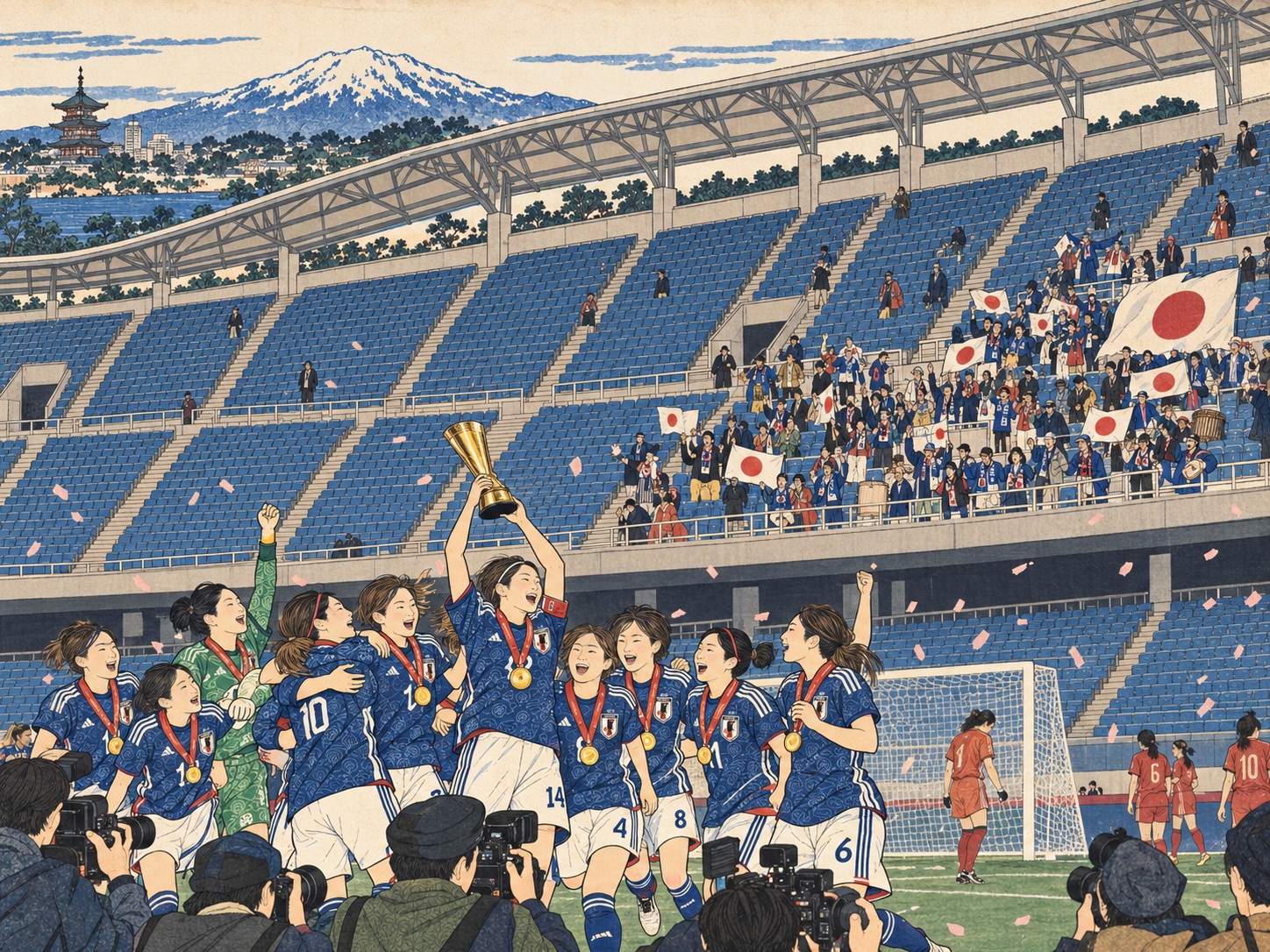
SHIZUOKA. When the decisive penalty went in, Japan’s players sprinted toward one another and the noise inside Shizuoka Stadium Ecopa rose sharply. On October 2, Nadeshiko Japan had just beaten North Korea 5-3 in a shootout after a 2-2 draw and extra time, winning a third consecutive Asian Games women’s football gold medal.
It was a final. It was a home Asian Games. It was Japan’s third straight title.
The official attendance was 6,243.
In a stadium built for crowds many times larger, empty seats remained visually dominant. Yuzuho Shiokoshi, who converted Japan’s fifth penalty, used the moment to point beyond the medal. Reuters reported that she wanted more people in Japan to watch women’s football, attend WE League matches and value the domestic women’s game more highly.
The contrast is important precisely because Japan’s women’s game is not standing still. Crowds in the professional WE League are rising. The national team remains internationally competitive. Domestic players just won a major tournament without relying on a full squad of Europe-based stars. Yet the pipeline from elite success to habitual spectatorship, broadcast visibility and commercial scale is still incomplete.
Winning is no longer enough by itself
Japan has already proved that success at the highest level can transform the public profile of women’s football. The 2011 FIFA Women’s World Cup victory made Nadeshiko Japan a national story. The team won Olympic silver in London in 2012 and returned to the World Cup final in 2015.
But a national-team boom and a domestic sports market are not the same thing.
After 2011, Homare Sawa and her teammates became household names and the team received Japan’s People’s Honour Award. Interest in women’s football soared. Yet that surge did not automatically create a permanently large weekly audience for domestic club competition.
That is one reason Japanese football moved toward full professionalization. The country’s first national women’s league began in 1989. It later evolved into the Nadeshiko League, and in September 2021 the WE League launched as Japan’s first fully professional women’s football league, initially with 11 clubs.
The professional project was never only about paying players. It was about creating clubs, sponsorship, broadcasting, local identity, youth pathways and a commercial structure capable of existing every week rather than only during a World Cup.
WE League crowds are actually growing
The easy description—“nobody watches women’s football”—is contradicted by the league’s own recent data.
Across league and cup matches, the 2025/26 WE League season drew a record 380,179 spectators, up 13% from the previous season. League matches alone attracted 315,747 across 132 fixtures, an average of 2,392. Including the cup, 173 official matches averaged 2,198.
In the inaugural 2021/22 season, official WE League competition drew 171,601 spectators at an average of 1,560. Total annual attendance has therefore more than doubled in four seasons.
| WE League official matches | Total attendance | Average |
|---|---|---|
| 2021/22 | 171,601 | 1,560 |
| 2022/23 | 180,284 | 1,326 |
| 2023/24 | 271,878 | 1,668 |
| 2024/25 | 337,290 | 2,044 |
| 2025/26 | 380,179 | 2,198 |
The upward trend is visible in individual events as well. The first two rounds of the 2025/26 league drew 34,044 spectators, 18% above the comparable opening period a year earlier. The WE League Cup final on April 29 attracted 12,006.
So the question raised by the Asian Games final is not whether an audience exists. It is why a home gold-medal match still attracted only 6,243—and how Japan can turn episodic interest into a larger, repeat audience.
Shiokoshi’s point was also about the league’s quality
Shiokoshi plays for Tokyo Verdy Beleza in the WE League. The Asian Games squad was composed largely of players based in Japan rather than a full collection of overseas-based senior internationals.
That team still beat South Korea 2-0 in the semifinal and survived a demanding final against North Korea. Nishio equalized in the 86th minute, Ohba made the decisive shootout save and Japan converted all five penalties.
That makes the gold medal a marketing asset for the domestic league. The tournament demonstrated that Japan can field a deep pool of high-level players at home.
Reuters reported that Shiokoshi hoped the Asian Games run would encourage people to attend WE League games and raise perceptions of the competition. The commercial opportunity is obvious: a spectator who discovers a player in national colors can become a customer of her club the following weekend.
Stars are difficult to build when audiences rarely see them
Attendance is partly a media problem.
Men’s football players appear repeatedly across J.League coverage, European club football, national-team matches, highlight shows, sports news and social media. Women’s football receives fewer of those repeated exposures.
Shiokoshi told Reuters that women’s football needed greater television visibility. The issue is broader than whether a final appears on terrestrial television. It is about frequency: daily news mentions, highlights, player profiles, club stories, short-form video and recurring debate.
People rarely buy tickets to see athletes they do not know. Familiarity is built through repetition. A name becomes a personality, a personality becomes a reason to care about a club, and that relationship eventually becomes a ticket purchase.
From 1981 to the 2011 breakthrough
Japan’s women’s national-team history began well before its global breakthrough. JFA traces the modern national side to the 1981 Asian Women’s Championship. Japan’s first nationwide women’s league was established in 1989, creating a stronger domestic base ahead of the inaugural FIFA Women’s World Cup in 1991.
That first World Cup was harsh. Japan lost all three matches and failed to score, including an 8-0 defeat to Sweden.
Twenty years later, the same national program reached the top of the world. Japan beat the United States on penalties in the 2011 World Cup final after a 2-2 draw. Sawa won both the Golden Boot and player-of-the-tournament award. The victory, only months after the Great East Japan Earthquake, became one of the most emotionally resonant moments in modern Japanese sport.
London 2012 brought an Olympic silver medal; the 2015 World Cup brought another final. JFA’s broader women’s development system also produced world titles at U-17 level in 2014 and U-20 level in 2018.
The long-term challenge is that a World Cup happens every four years. A commercial sports culture must create value on the hundreds of days in between.
Professionalization changed the question
The WE League’s formal name is the Women Empowerment League. Its stated mission is to use women’s football and sport to help create a society in which people with diverse dreams and ways of living can thrive.
That mission is expressed through “WE ACTION” programs in which clubs, players and commercial partners work on gender, diversity, education, health and community projects.
For sponsors, that social mission can add value beyond advertising inventory. For clubs, it can make the organization relevant even on days without a match.
But social purpose cannot substitute for sports economics. A sustainable professional league still needs ticket demand, sponsorship, media rights, merchandise, hospitality and other recurring revenue. The strongest model is not “mission or commerce.” It is mission plus commerce.
Venue scale can magnify both success and emptiness
Large international tournaments favor large, fully equipped venues. Big stadiums simplify security, broadcasting, accreditation and competition standards.
They also change perception. Six thousand people in a compact venue can feel intense. The same crowd inside a stadium with roughly 50,000 seats can look sparse on television and in photographs.
That matters because sports consumption is social. Viewers respond not only to the action but to the sense that an event matters to other people. A visibly full venue communicates scarcity and importance. Empty seating can communicate the opposite even when the absolute crowd is respectable.
The Asian Games is a multi-sport event, so stadium selection is constrained by logistics beyond women’s football alone. It would therefore be too simplistic to treat the 6,243 attendance figure as a verdict on the organizers. But the visual lesson for women’s sports remains relevant.
Attendance is only one metric—but it is a powerful one
Women’s football can grow through streaming audiences, social media, sponsors, youth participation, overseas transfers and national-team value even before stadium crowds become large.
Paid attendance still has special meaning. A supporter who buys a ticket, travels to a venue and gives up several hours has made one of the strongest possible commitments to a club.
The WE League’s record total attendance is therefore genuinely encouraging. Its average crowd just above 2,000 also shows the scale of the remaining opportunity.
The real test comes the week after the medal
The hardest part of a successful tournament begins after the podium ceremony.
Will people who discovered Shiokoshi, Ohba or Nishio on October 2 seek out their next club match? Will broadcasters and digital platforms treat women’s football as a year-round product rather than a tournament product? Will sponsors invest because the clubs can offer both social purpose and an expanding fan market?
If those connections strengthen, 6,243 will not be remembered only as a disappointing number. It will be evidence of how much room remained to grow.
Nadeshiko Japan has once again demonstrated that it can win. The next challenge is to turn winning into a durable audience.
Sources
- Japan Football Association, “Nadeshiko Japan win third consecutive Asian Games gold medal”, Oct. 3, 2026
- JFA, Aichi-Nagoya 2026 women’s football results
- Reuters, “Japan's penalty hero wants more home fans to embrace women's game”, Oct. 3, 2026
- WE League, record 2025/26 annual attendance announcement, May 16, 2026
- WE League Season Review 2025/26
- WE League Cup final attendance release, Apr. 29, 2026
- JFA, History of FIFA Women’s World Cup and Nadeshiko Japan
- Japan Football Association, Origins and History
- WE League, About WE