- A championship turned by one save
- Why the opponent mattered
- The two names behind the winning sequence
- A handball game shaped by wheelchair skills
- Why there are different versions of the sport
- From a 2003 national event to a 24th edition
- Inside Osaka’s adapted-sports program
- A world silver medal changes the context
- The opportunity—and limits—of greater visibility
- What 28–27 will be remembered for
A championship turned by one save
The decisive moment in Fujisawa did not begin with a shot at the other end of the court. It began with a stop. On November 15, the Osaka University of Health and Sport Sciences adapted-sports club APES and three-time defending champion Knockü SC Shinjuku A finished regulation tied 27–27 in the final of Japan’s 24th National Wheelchair Handball Tournament. Under the event’s golden-goal extra-time rule, the next score would decide the championship.
Shinjuku started with possession and created a chance. Osaka goalkeeper Toshiya Ishikawa saved the attempt; the ball moved upcourt, and Norito Nakanishi finished the winning play. The final score was 28–27. With a sequence lasting only one possession after the save, APES denied Shinjuku a fourth straight title and captured its own third championship, the first in four years.
Why the opponent mattered
Shinjuku was no ordinary finalist. Japan’s handball federation identified members of the club—including Yukio Moriya and Shinnosuke Morooka—as players from the national side that won silver at the September 2026 wheelchair handball world championship. That experience made the final more than a contest between university students and a metropolitan club.
Official tournament reporting describes Osaka taking the lead behind repeated interventions from Ishikawa, only for Shinjuku to catch up late. The equalizer sent the match into golden goal rather than a conventional fixed-length overtime. Osaka’s players were required to defend the next possession before they could make one final attack.
The two names behind the winning sequence
Osaka University identifies Ishikawa as a fourth-year education student and Nakanishi, whose given name is read Norito, as another fourth-year education student. The institution credits Ishikawa with the decisive save and Nakanishi with the winner. Ishikawa also received the tournament’s men’s most valuable player and top goalkeeper awards, while Osaka’s Ayaka Morimoto was named the women’s most valuable player.
The names and roles are documented, but the available public summaries do not provide a complete play-by-play, a verified shot chart, or an independently calculated save percentage. It would be tempting to turn a single highlight into a detailed tactical reconstruction. The evidence supports something narrower and powerful enough: a save under immediate pressure made a championship-winning counterattack possible.
A handball game shaped by wheelchair skills
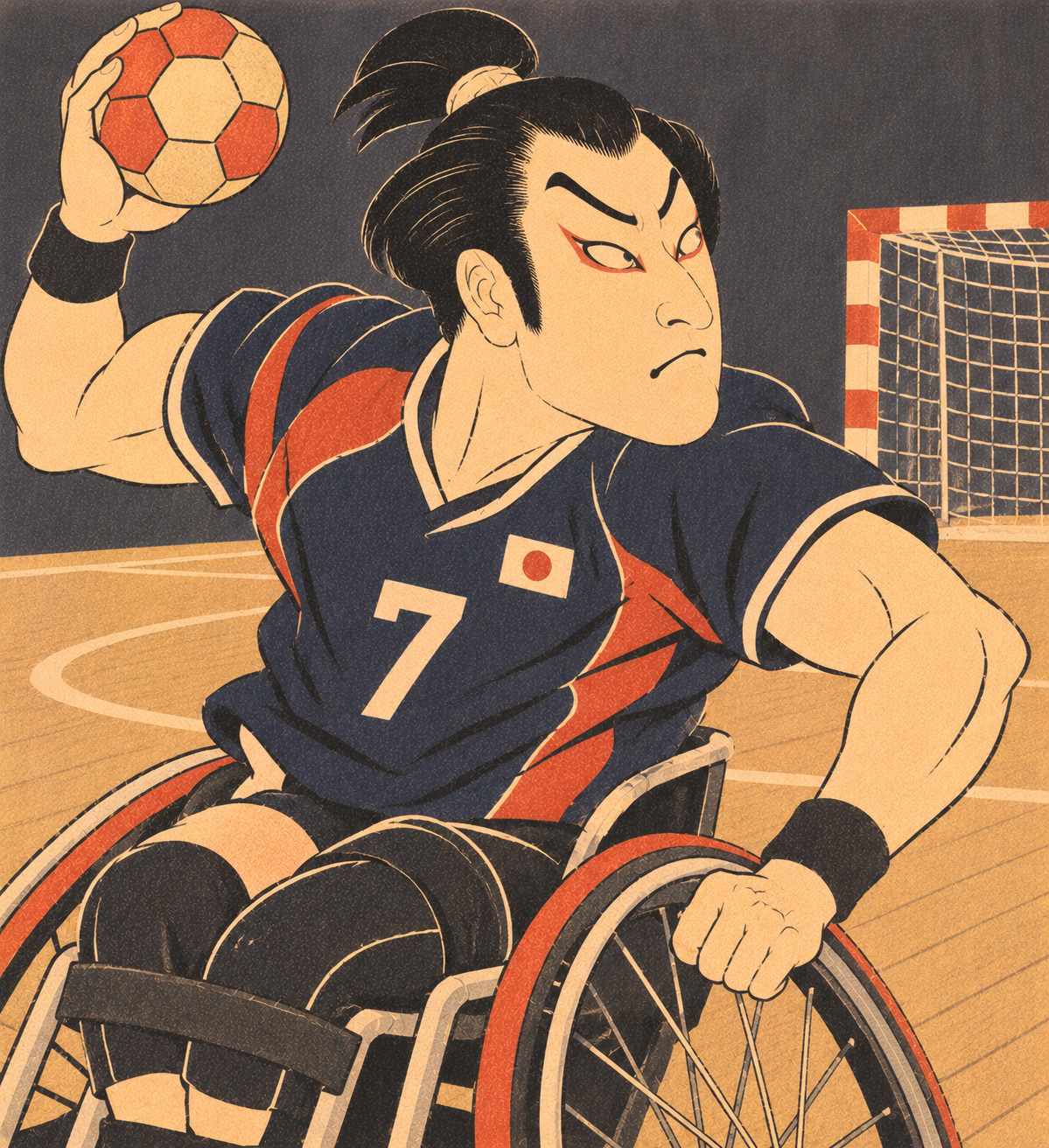
Wheelchair handball preserves handball’s demand for passing, decision-making, shooting and defensive positioning, while placing maneuvering, braking and turning in a sports wheelchair at the center of play. Japan’s wheelchair handball federation describes the sport as a fast contest in which a player must quickly decide whether to dribble, pass or shoot, with a three-second holding rule.
The Japanese national final was played as a six-a-side event. According to Osaka University, its domestic participation rules require at least one on-court player from specified categories: a woman, a player aged 65 or over, or a man with a disability. That domestic arrangement is not interchangeable with the classification requirements of international four-a-side wheelchair handball. Nor can an individual athlete’s disability status be inferred from photographs or uniforms.
Why there are different versions of the sport
Wheelchair handball has not always followed a single global format. The International Handball Federation developed frameworks for both six-a-side and four-a-side competition, then prioritized four-a-side for recent world championships. Japan has maintained a longstanding six-a-side domestic tradition. These choices reflect different goals and sporting environments.
International four-a-side play uses functional classification and on-court class-point limits to structure competition. The domestic six-a-side competition reported here uses different participation rules. A world-championship score therefore cannot be read as a direct equivalent of a Japanese domestic six-a-side score; the formats require different tactics, substitutions and participation arrangements. That distinction is essential to understanding the next stage of Japanese development.
From a 2003 national event to a 24th edition
The Japan Handball Association’s published history records the first national wheelchair handball tournament in July 2003. By November 2026, the competition had reached its 24th edition. Longevity matters here: the annual championship has provided a place for clubs, organizers, referees and athletes to sustain a sport that rarely commands mainstream coverage.
Thirteen teams entered the competitive division in Fujisawa on November 14–15. A separate family division ended with JWHF+KHA defeating Knockü SC Chiba. The coexistence of a title race and broader participatory play gives the event a wider purpose than deciding a champion, although national participation totals and year-on-year growth are not established by the federation’s results announcement alone.
Inside Osaka’s adapted-sports program
APES is part of a university program whose ambitions extend beyond winning medals. The club became an official university club in 2021 after previously operating as a student group. Osaka University’s own explanation of adapted sport describes a model in which rules or environments are modified to suit participants, instead of defining the activity exclusively by one disability category.
In an institutional feature from 2024, the university linked participation to students pursuing careers in education, welfare, policing and sports instruction. Those are the university’s stated educational aims, not independently measured proof of a particular social outcome. Yet the connection helps explain why the national title belongs in a story about Japan’s sporting institutions as well as a match report.
A world silver medal changes the context
Japan arrived at this national tournament only weeks after a breakthrough on the international stage. At the four-a-side World Championship in Granollers, Spain, in September 2026, Japan reached the final and lost to the host nation two sets to one. The International Handball Federation recorded Japan as the runner-up and Spain as champion.
Shinjuku fielded athletes associated with that silver-medal team, and organizers held a medal-report gathering before the domestic event opened. The two formats should not be confused, but a shared network of athletes and clubs links international results to domestic visibility. Japan’s next challenge is to convert attention into sustainable pathways for players and coaches.
The opportunity—and limits—of greater visibility
A remarkable final may attract attention, but strong participation depends on less visible resources: accessible venues, suitable sports wheelchairs, trained officials, coaching, transport and reliable opportunities to play. The domestic federation explains both forms of the game, while the IHF has been building international rules and classification systems. Each body addresses a different layer of development.
It is fair to describe the championship as a vivid example of competitive depth. It is not yet possible to conclude from these releases that the national player population has expanded by a given percentage, that funding has risen, or that the sport has secured a place on the Paralympic program. Such claims would need separate data and decisions from the responsible authorities.
What 28–27 will be remembered for
Championships are often reduced to a scoreline. Here, the single-point margin conceals a sequence of decisions: Shinjuku’s push back into the match, a first opportunity in golden goal, Ishikawa’s intervention and Nakanishi’s finish. It also marks a reversal after three years of Shinjuku titles and a return to the top for an Osaka university club.
Perhaps the strongest reason to watch the sport is also the simplest. Wheelchair handball is not merely an example of inclusion to admire from afar; it is a demanding, technically complex competition in which a goalkeeper, a pass and a shot can transform an entire season. Fujisawa supplied that drama in full.
Sources and reporting limitations
This independently composed account uses primary reports published by November 18, 2026 JST. No direct interviews, original match filming or on-site observation were conducted; match detail follows the federation and university reports. Participation growth, budgets and all individual playing statistics were not independently established.
- Japan Handball Association: 2026 national championship result
- Osaka University of Health and Sport Sciences: APES wins national title
- Japan Wheelchair Handball Federation: how the sport works
- Osaka University: educational role of adapted sports
- Japan Handball Association: history of the sport in Japan
- IHF: Spain defeats Japan in 2026 world final
- IHF: wheelchair handball formats and classification
- IHF: 2026 championship rankings
- EHF: development of wheelchair handball