- A celebration should begin with a choice
- A tradition that has never stood still
- Eighty years since the ceremony at Warabi
- Designing the garment around a seated wearer
- A second route: keep the family kimono intact
- From weddings to graduation photographs
- Accessibility extends beyond the wardrobe
- The future of craft is also a question of access
A celebration should begin with a choice
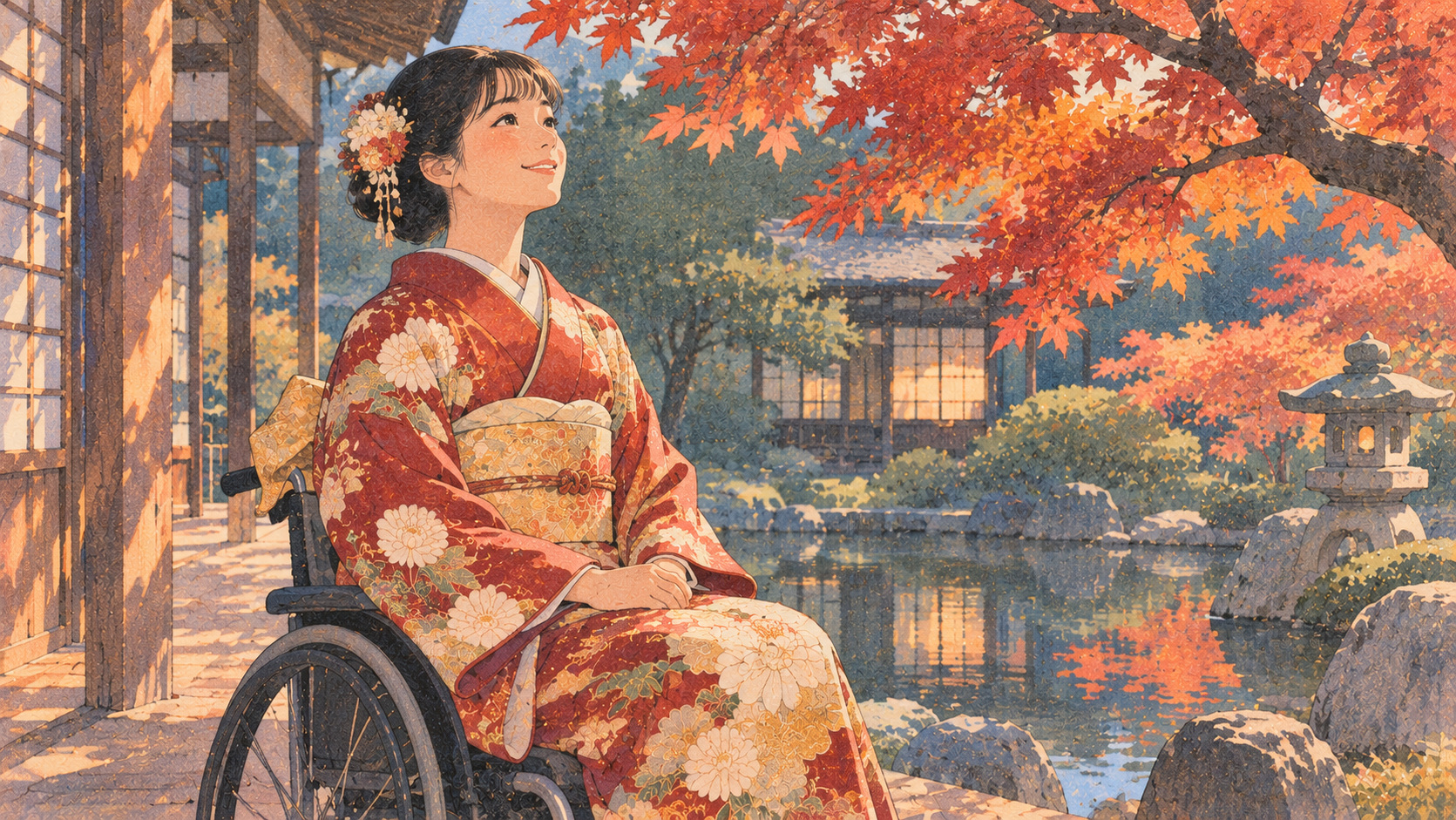
A coming-of-age outfit is often chosen for its colors, patterns and the memories it will carry. For someone who uses a wheelchair, the decision may also involve whether the garment can be put on while seated, whether its sleeves interfere with mobility and whether it will be comfortable throughout a ceremony. Those are design questions, not reasons to exclude someone from a cultural tradition.
Japan's kimono retailer Ichikura announced on October 15 that its Universal Design Furisode had received a 2026 Good Design Award. The company traces the project to a wheelchair user's expressed interest in wearing kimono at a fashion show. A November 23 index of Mainichi English reporting also brought attention to specialist wheelchair dressing. These developments offer a window into a wider set of services that are adapting both garments and the skills used to put them on.
The objective is not to make traditional dress compulsory. It is to make a genuinely desired choice possible. A garment may be an important expression of personal identity, family history or simply a taste for beautiful textiles.
A tradition that has never stood still
The familiar long-sleeved furisode is a formal kimono traditionally associated with unmarried women. Its place in Japanese life is the result of centuries of changing dress conventions. The National Diet Library's historical exhibition describes the practice of sodetome, in which sleeves were altered at the transition to adulthood. Changes in the shape of the obi sash and garment construction also reshaped the distinction between furisode and tomesode.
Wedding clothing evolved in parallel. Wealthy townspeople in the Edo period used colorful outer robes known as iro-uchikake, while black-ground formal kimono became common among ordinary families after the Meiji transition. The textiles often carried auspicious designs, including cranes and pine trees, expressing hopes for a marriage rather than adherence to a single immutable uniform.
The association of elaborate furisode with today's coming-of-age festivities became widespread particularly during the economic growth of the 1960s, according to a library reference study. The modern ceremony and the historic garment therefore have separate histories. Adaptation is not necessarily a departure from tradition; it has long been part of the way tradition survives.
Eighty years since the ceremony at Warabi
On November 22, 1946, young people gathered in Warabi, now a city in Saitama Prefecture, for a celebration organized in the difficult aftermath of World War II. The municipal archive preserves the program of that first youth festival. The event is widely regarded as a precursor of the modern Japanese coming-of-age ceremony. Its eightieth anniversary fell three days before this edition.
Japan established Coming of Age Day as a national holiday in 1948. A change to the Civil Code in April 2022 lowered the legal age of adulthood from 20 to 18, but Warabi continues to celebrate its ceremony at age 20. Eligibility for municipal events should be checked locally rather than inferred from the legal age of majority.
The history matters because these celebrations were conceived as encouragement for young people entering a new stage of life. A ceremony intended to recognize adulthood should accommodate different bodies and different preferences, rather than make a particular style of dress a condition of belonging.
Designing the garment around a seated wearer
Ichikura's approach starts with the construction of the clothing. Its adapted furisode incorporates a rear zipper intended to ease restroom use, adjustable sleeve length and a sash fastening system that avoids some of the complexity of traditional tying. Its product information describes two garment configurations intended to accommodate different support needs.
The company quotes roughly eight minutes for dressing in its award announcement, while its product page gives a ten-minute estimate. Neither is an independently measured average across all wheelchair users. The amount of assistance, range of movement, individual fitting and familiarity with the garment will influence actual dressing time.
This is a good example of design addressing the entire experience rather than the appearance alone. Long sleeves may look magnificent in a photograph, yet their placement matters when wheels are moving. A sash must work with a person's seated posture and support equipment. A fitting that evaluates these conditions can be more informative than a claim about how quickly a garment can be put on.
A second route: keep the family kimono intact
Not every wearer wants a newly manufactured adaptive garment. A family may own a treasured kimono that has already been worn at several generations of celebrations. Altering it permanently could sacrifice part of its value or simply be unnecessary.
The Japan Rapport Welfare Association teaches wheelchair dressing with conventional kimono and obi, without cutting or sewing them. Its basic course covers wheelchair-related support and garments such as yukata and visiting kimono; advanced instruction includes furisode and hakama. The association also offers individual instruction that addresses dressing while lying down.
The distinction between a clothing innovation and a service innovation is important. A trained dresser may expand the range of existing garments available to a customer. An adapted garment may instead make dressing with familiar support people easier. Neither is inherently superior for every individual. Training in dressing does not itself establish medical expertise, and arrangements involving medical equipment or physical assistance must follow the wearer's own support needs.
From weddings to graduation photographs
A growing range of specialist suppliers illustrates the breadth of occasions for which adapted Japanese clothing may be useful. Wasou describes rentals for coming-of-age events, graduation and wedding wear, with individual adjustments available. Hagoromo Style offers nationwide delivery of furisode, hakama and tomesode. Kimono Salon Somu describes a rental service featuring garments made in separate upper and lower pieces.
Separate-piece construction can reduce the need to maneuver a full-length garment around a seated body. It can also make some adjustments more straightforward. But an adaptation useful to one wheelchair user may not suit another, particularly where seating supports, movement limitations or medical equipment differ.
Rental services can extend access beyond major urban centers, although the availability of suitable fittings and local dressing assistance remains important. Families planning an event should ask what the quoted price includes, whether a trial fitting is possible, what adjustments can be made and how delivery and returns are handled. These are examples of existing services, not endorsements or guarantees of suitability.
Accessibility extends beyond the wardrobe
A well-designed garment cannot compensate for an inaccessible venue. A participant may still need step-free transport, adequate space in a dressing room, an accessible restroom and a seating arrangement that permits participation alongside friends rather than apart from them. Photographers and event staff should discuss preferred poses and assistance rather than assume that transferring out of a wheelchair is required.
Japan's amended Act for the Elimination of Discrimination Against Persons with Disabilities took effect in April 2024, making provision of reasonable accommodation mandatory for businesses. The Cabinet Office describes this in the context of removing social barriers and building an inclusive society. It does not mean every shop must stock every form of adaptive garment; appropriate responses depend on the circumstances and the statutory limits.
For public ceremonies and private celebrations alike, communication among the wearer, garment supplier, event organizers and support people can identify obstacles before the event. The wearer should remain the central decision-maker. Independence may mean directing one's own assistance, not necessarily performing every physical task without help.
The future of craft is also a question of access
Adaptive clothing offers a promising direction for Japan's traditional textile economy: skilled tailoring can be combined with rental logistics, professional training and feedback from customers whose needs were previously overlooked. The sources examined for this article establish that such services exist, but do not establish a national market size, uptake rate or profitability.
A meaningful assessment would ask whether wearers can choose from a broad range of designs, whether they remain comfortable during the event, whether costs are transparent and whether people outside major cities can obtain comparable services. Listening to users throughout product development is more informative than judging success solely from a photograph or award.
Japan's formal clothing carries stories of family, craftsmanship and changing social customs. Its future does not depend on requiring every body to fit the same garment. It depends in part on whether the garment and the surrounding service can accommodate the person who chooses to wear it.
Sources and further reading
This report draws on public provider and institutional records. No independent customer interviews or product testing were conducted.
- Ichikura: October 15 award announcement
- Ichikura: adaptive furisode product information
- Japan Rapport Welfare Association: wheelchair dressing courses
- Wasou: adaptive coming-of-age clothing
- Hagoromo Style: nationwide rental service
- Kimono Salon Somu: separate-piece rental service
- National Diet Library: historical coming-of-age customs
- National Diet Library: wedding clothing history
- Warabi City: history of its coming-of-age ceremony
- Library reference research: modern ceremonies and furisode
- Government of Japan: age of majority
- Cabinet Office: amended disability discrimination law
- The Tokyo: index of November 23 Mainichi English report