- A small class with a larger question
- The environment is part of the sport
- What adaptive sports can teach ordinary clubs
- From Meiji classrooms to modern parasport
- A national participation gap, and what the numbers cannot say
- What research tells us about movement and independence
- Inclusion means having a choice of places to play
- The freedom to come back next month
A small class with a larger question
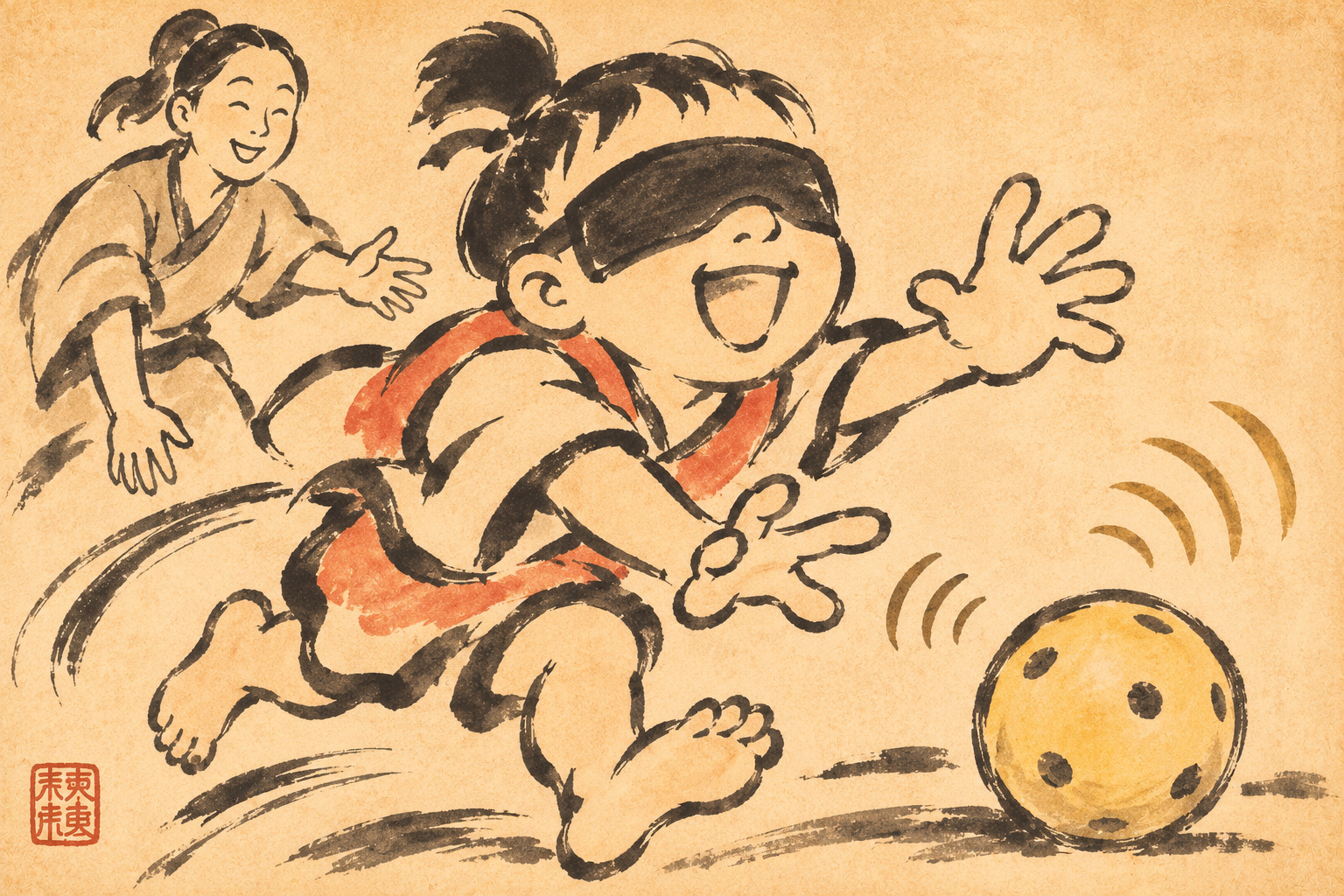
On November 22, four elementary-school children took part in an exercise session at Mag Suminoe, a leisure facility in Osaka's Suminoe Ward. Asahi Shimbun reported the gathering on November 24, describing 45 minutes of activity. A photograph showed participants and coaches passing a ball while standing back to back. A Gakken adaptation of the report identified the children as second- through fifth-graders and described the sessions as free and monthly.
The gathering belongs to the Kansai Low Vision Exercise Class, a project whose own records trace its first session to March 22, 2026. Its stated age range runs from the first year of elementary school through the final year of high school, with an emphasis on children with low vision. Football is central to its program, but the organizer also offers other movement activities. Its published principles emphasize individual pace, opportunities to try unfamiliar activities and a welcoming setting.
The news is modest in scale. Its significance lies in a question that extends well beyond Osaka: what makes ordinary childhood play accessible? A sporting opportunity can be technically open to everyone and still be practically inaccessible if its instructions, equipment or surroundings assume that every participant can see in the same way.
The environment is part of the sport
Vision impairment is not a single experience. A child may have difficulty identifying a moving object, seeing detail, noticing an obstacle outside a narrow field of vision, or coping with glare. Another may rely primarily on sound and touch. The same gym can be easy to navigate for one participant and challenging for another.
In accessible physical education, the task is therefore not simply to simplify a game. It is to identify which information the game requires and make that information available in a form the participant can use. A verbal description of a movement, an opportunity to handle equipment before play begins, or a familiarization walk through the space may make the difference between watching and taking part. Tokyo's sports accessibility guidance gives examples of converting visual cues into sound and language, while recognizing that words alone may be insufficient.
Good instruction begins with listening to the child. Assistance should be agreed rather than imposed, and activities should accommodate individual medical restrictions and preferences. Safety and independence are not competing goals: a predictable setting can give a participant more freedom to make decisions without constant adult intervention.
What adaptive sports can teach ordinary clubs
Japan already has a substantial body of practical knowledge about nonvisual sport. In blind football, an audible ball and a coordinated system of spoken information allow players to locate the ball, teammates and goal. Goalball uses a different audible ball and tactile court markings, illustrating how a sport can be designed around information available without sight rather than adapted only after its rules are fixed.
These are examples of established competitive sports, not a description of equipment confirmed at the November Osaka session. A regulation goalball, for instance, is not automatically suitable for a young beginner. Teachers must choose materials and activities appropriate to age, experience and individual circumstances. For children who use residual vision, visual contrast and lighting may be as important as sound.
A community club need not introduce an entire new competitive discipline to apply these principles. It can reconsider where instructions are delivered, whether players have time to learn the space, and how competing noise affects the ability to hear relevant cues. An accessible game should also retain its essential pleasures: uncertainty, cooperation, challenge and the satisfaction of mastering a skill.
From Meiji classrooms to modern parasport
Japan's institutional history of education for blind children has roots in Kyoto in 1878. The Kyoto Moain, established through the efforts of educator Tashiro Furukawa and others, created educational opportunities for children with visual and hearing disabilities. The Kyoto Municipal Museum of School History documents teaching materials from that era, including tactile geographical models. Today's Kyoto Prefectural School for the Blind traces its origins to the institution.
Those teaching objects embody an idea still relevant to physical education: the form in which information is delivered can be changed without diminishing what a student is expected to learn. As specialized education developed, physical training and play became important avenues for gaining experience of movement. The history should not be read as a simple progression from exclusion to equality; access remains uneven and educational approaches have changed substantially.
The 1964 Tokyo Paralympics gave organized disability sport a further institutional foundation. In 1965, the association now known as the Japan Para-Sports Association was established. International competition has since expanded public awareness and athletic opportunities. But elite sport and everyday recreation serve different purposes. A child does not need to become a Paralympian to deserve access to a neighborhood sports club.
A national participation gap, and what the numbers cannot say
The Japan Sports Agency's fiscal 2025 survey, published in March 2026, found that 38.3 percent of respondents with disabilities aged seven to 19 participated in sport or exercise at least once a week. Among adults aged 20 and above the figure was 35.0 percent. The agency described the younger group's participation as broadly unchanged from the preceding year.
These figures cover disabilities generally; they are not estimates specifically for blind or low-vision children. Nor do they establish why any particular child does or does not exercise. The distinction matters because a national rate can conceal large differences in local provision, family resources and the types of activities available.
A free monthly session addresses one barrier, but it cannot by itself guarantee access. Travel, scheduling, availability of knowledgeable coaches and confidence that a venue will welcome the child all influence participation. A family outside a major city may have fewer nearby choices. For municipalities, this makes transport and accessible mainstream recreation part of the same policy discussion as specialized sports provision.
What research tells us about movement and independence
A systematic review published in 2020 examined 17 studies of factors associated with physical activity among children and adolescents with visual impairments. It identified consistent associations with measures including the degree of visual impairment and body composition. A separate longitudinal review published in 2026 considered the relationship between childhood vision impairment and later outcomes, including physical activity and social participation.
Neither study establishes that the Osaka initiative produces measurable improvements in health, confidence or independence. Observational relationships are not proof of causation, and the class has not published a controlled evaluation of long-term outcomes that could be verified for this report.
Nevertheless, movement offers occasions to practice decisions that also matter outside sport: judging direction, communicating with another person, exploring unfamiliar spaces and recovering from mistakes. The experience is valuable on its own terms. An exercise program should not have to justify every enjoyable activity as therapy. The aim can be to expand the child's choices, not to turn leisure into another medical or educational obligation.
Inclusion means having a choice of places to play
Article 30 of the UN Convention on the Rights of Persons with Disabilities addresses participation in cultural life, recreation, leisure and sport. Its provisions include equal access for children to play and sporting activities. Japan's 2025 revision of the Basic Act on Sport also explicitly situates access regardless of disability within the country's sporting policy, as described in the Cabinet Office's 2026 white paper.
Specialized programs have a legitimate and useful role. They can concentrate expertise, offer peer relationships and give children the chance to try activities with fewer unfamiliar barriers. Inclusive mainstream clubs offer another possibility: playing alongside siblings, classmates and neighbors. The policy objective should not be to force every child into one type of provision but to make both genuinely available.
Local authorities can support this through accessible registration, instructor development, shared equipment and cooperation with schools and disability organizations. Evaluation should consider not only attendance but also whether children return voluntarily, whether families can manage the journey, and whether participants gain access to other activities they wish to pursue. These are proposed measures of success, not reported outcomes from the Kansai class.
The freedom to come back next month
The Kansai project's activity archive records sessions from its March launch through the autumn. Continuity is significant for a community initiative: a single event can introduce an unfamiliar activity, while repeated opportunities give children time to discover their preferences and develop relationships. Sustaining that continuity requires venues, coaches and communication with families.
Families interested in the class can consult the organizer's official website for eligibility and registration. Individual requirements, including whether a particular session can accommodate a child's needs, should be discussed directly with the program. The organizer's published age range and focus on low vision should not be interpreted as a guarantee of suitability for every participant.
The most important measure of a sporting experience may be one that does not appear on a scoreboard. A child who enjoys a game enough to want another opportunity has found something worth choosing. Osaka's small class offers a reminder that the freedom to play, rather than the obligation to overcome a disability, belongs at the center of inclusive recreation.
Primary sources and references
- Asahi Shimbun, November 24 report
- Gakken Kids Net, November 24, adapted from Asahi reporting
- Kansai Low Vision Exercise Class, official website
- Organizer’s first session report
- Organizer’s activity archive
- Kyoto Municipal Museum of School History, Kyoto Moain
- Kyoto Lighthouse, history of Kyoto Prefectural School for the Blind
- Japan Para-Sports Association, history and current status
- Japan Sports Agency, FY2025 disability sports survey
- Ministry of Foreign Affairs, disability rights convention, Article 30
- Cabinet Office, 2026 disability white paper
- Tokyo Metropolitan Government, visual impairment and sports
- Japan Blind Football Association, rules
- Japan Goalball Association, rules
- Systematic review of physical activity correlates, 2020
- Systematic review of longitudinal outcomes, 2026