This is a substantive follow-up to our earlier factory announcement coverage, examining the October 22 financing analysis against the September 2025 government memorandum. Read the earlier report.
Financing a factory is not the same as owning its economic upside.
The question behind the $21 billion headline
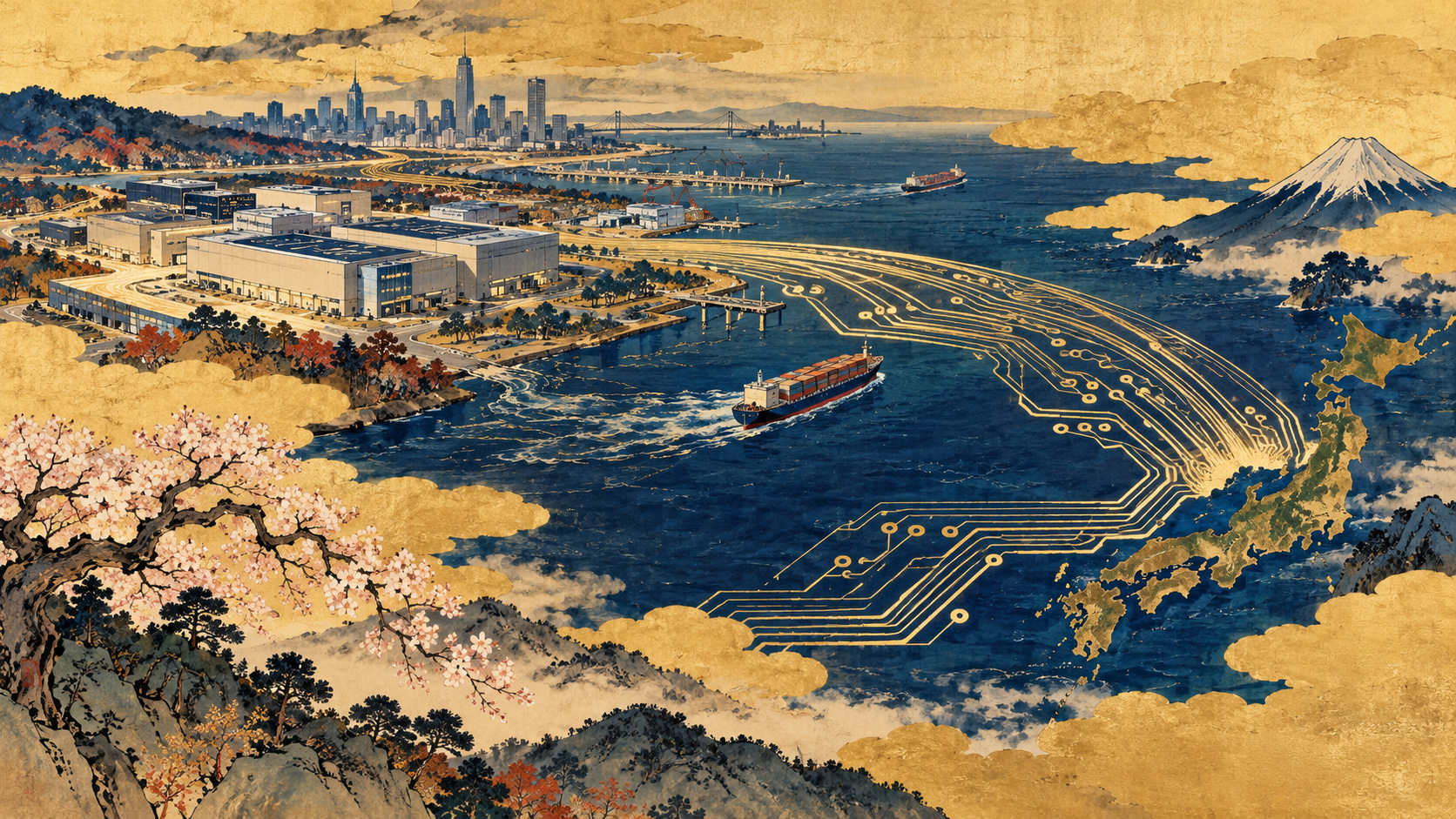
The two planned semiconductor factories in Malta, New York, are a striking illustration of the United States’ new approach to trade negotiations: investment pledges have become an instrument of tariff diplomacy. For Japan, the project puts a sharper question on the table. Who funds the expansion, who earns the fees, who collects the cash and who absorbs a shortfall?
GlobalFoundries announced the plan on October 14. A Reuters Breakingviews analysis published October 22 brought attention to its financial architecture, giving this story a materially new focus compared with Japan.co.jp’s earlier account of the manufacturing announcement.
A trade agreement becomes a factory balance sheet
The roots of this project lie in the 2025 Japan–U.S. trade negotiations. In September that year the two governments signed a strategic-investment memorandum covering as much as $550 billion of contemplated investment in the United States, including semiconductors, energy and other strategically important industries. Japan created supporting financing arrangements involving the Japan Bank for International Cooperation.
The headline total is a framework, not proof that $550 billion in cash has already crossed the Pacific. A commitment, a financing vehicle, a project announcement, a disbursement and a profitable operating plant represent different stages. Collapsing them into one figure makes serious evaluation impossible.
The 50–50 split, followed by 90–10
Paragraph 13 of the September 2025 memorandum sets an order for distributing available cash flows. At first, the United States and Japan each receive 50% until each has received a defined deemed allocation amount. Subsequent distributions are allocated 90% to the United States and 10% to Japan. The meaning of the deemed allocation amount, the treatment of taxes and the costs of financing are essential to understanding what Japan can ultimately recover.
Those percentages are not the same as a guaranteed commercial return. A project that fails to produce distributable cash can disappoint either party even if the distribution formula is settled. Nor does the memorandum by itself disclose every project-level operating fee, credit support or customer commitment.
Two fabs, and a significant execution gap
In a company statement filed with the U.S. Securities and Exchange Commission, GlobalFoundries described an initial investment of approximately $10 billion to accelerate a new 300-millimeter wafer fabrication plant, expected online in 2029. Roughly $10 billion more would support a second fab. The release described up to $21 billion of funding overall; it did not in that passage explain how the difference between the two rounded $10 billion plant estimates and the ceiling would be allocated.
The first plant is projected to add about 900,000 300-millimeter wafers in annual U.S. capacity at full operation, and a second factory would contribute a similar quantity. The company estimated around 27,000 construction and ecosystem jobs, plus more than 1,000 manufacturing positions. These are forecasts, not completed construction or filled jobs.
An operator with a different risk profile
GlobalFoundries says it will supply technology, manufacturing expertise and operational capabilities while Japan supplies the investment. Reuters Breakingviews assessed the arrangement as allowing the chipmaker to receive technology, construction and operating fees, and a share of earnings, without committing its own capital to the first plant. The commentary also reported a company expectation of about $3 billion in cumulative adjusted free cash flow over ten years.
That $3 billion figure concerns the chipmaker’s own reported cash-flow outlook; it is not a Japanese government payout. The exact mix of fees, equity interests, project finance and residual risk deserves further scrutiny. Breakingviews is analytical commentary, and its return hurdles and valuations should not be presented as confirmed government projections.
Japan has been here before — but the industry changed
Japanese manufacturers were formidable in memory chips during the 1980s. Trade disputes, the emergence of South Korean and Taiwanese competitors and the separation of chip design from outsourced manufacturing altered the sector. Japan remains influential through semiconductor materials, precision engineering, manufacturing equipment and industrial customers.
The New York project is not directly comparable to Rapidus’s attempt to commercialize advanced 2-nanometer logic production in Hokkaido. GlobalFoundries specializes in differentiated manufacturing platforms serving automotive, industrial and connected products. The economics of long-lived automotive production differ from those of the highest-end processors used in frontier computing.
The strategic return is real — but must be demonstrated
A new American fabrication site could help Japanese carmakers and electronics producers spread sourcing risk beyond East Asia. Japanese equipment and materials suppliers may win orders. Exposure to disruptions in the Taiwan Strait adds a legitimate security rationale to geographic diversification.
But merely locating a fab in an allied country does not establish guaranteed access for Japanese customers during a shortage. Contractual capacity rights, export restrictions, pricing, product specifications and government policy will determine how much resilience is actually delivered. Security value should be examined, not simply invoked.
What Tokyo should publish next
Officials should disclose the financing vehicle’s exact obligation, any sovereign or agency guarantees, debt service, interest assumptions, construction contingencies and the waterfall of distributions. They should explain which customers have contracted capacity and how the second facility would be authorized. The release’s up-to amount must be separated from funds actually committed and spent.
Japan’s industry minister Akazawa Ryosei argued in a February press conference that investments would be vetted under principles of financial balance, while acknowledging that unforeseen events can still produce losses. Neither that assurance nor criticism of the deal substitutes for project-level financial evidence.
A test of policy, not just semiconductor demand
This investment may ultimately reinforce an alliance, diversify supply chains and generate work for Japanese firms. Or its economics may look weak after financing costs and distributions are counted. Both outcomes are plausible before construction and customer contracts are complete.
The question is not simply whether two more factories will be built in America. It is whether Japan’s public-backed capital buys measurable industrial security and an acceptable financial result—and whether the public can see enough of the accounts to decide.
Sources and documents
Primary documents and attributed reporting available before publication. Plans, contracts and disbursements are not interchangeable.
- GlobalFoundries SEC-filed announcement, Oct. 14
- 2025 Japan–U.S. investment memorandum (original)
- Japanese Cabinet Secretariat: investment agreement sources
- Japan Ministry of Finance: JBIC strategic investment facility
- METI: Strategic Investment Initiative, Feb. 2026
- METI: Akazawa press conference on repayment and risks
- Reuters Breakingviews: analysis, Oct. 22
- Japan.co.jp: earlier Oct. 22 chip-industrial strategy analysis