The title is decided by a university, not a star
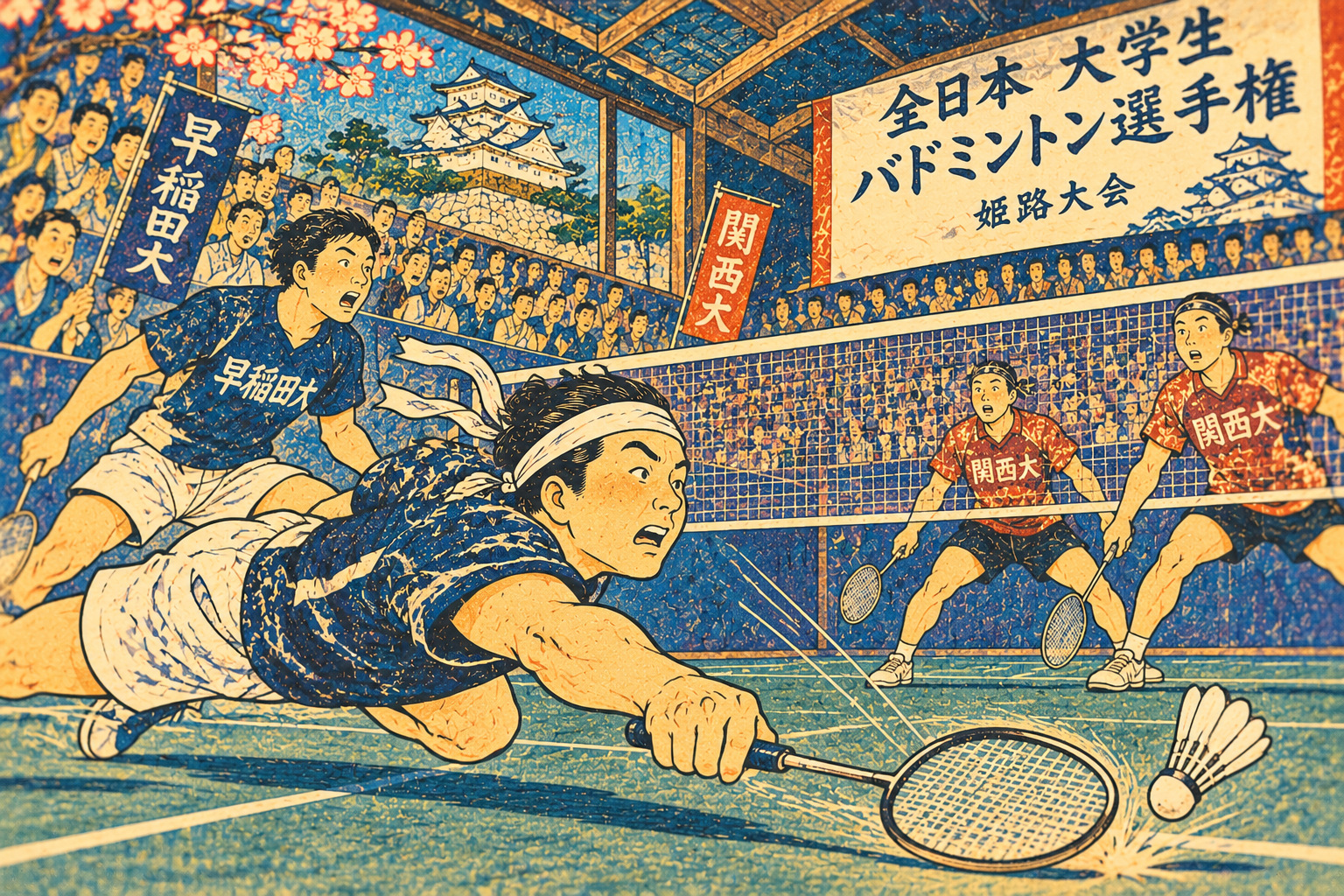
The University Team Championships begin their competitive rounds in Himeji on Friday, November 6, with 32 men's teams and 32 women's teams in the published draw. The 77th edition of the All-Japan Intercollegiate Badminton University Team Championship is the rare setting in which an individual champion can win a match and still watch their university lose. A school must assemble singles and doubles players capable of combining to defeat another complete lineup. The tournament's opening ceremony and representatives' meeting are scheduled for November 5; first and second rounds follow November 6, the next two rounds November 7, and the finals November 8. These are scheduled events, not results already achieved. A November 6 edition should introduce the competition and be updated with confirmed scores once play actually starts.
The champions everyone will measure themselves against
In Kanazawa last November, Nippon Sport Science University beat Nihon University 3–1 to claim the men's title, its 17th overall and first in 13 years, according to the Japan Badminton Association's official report. Ryukoku University won the women's championship for a second successive year, edging the University of Tsukuba 3–2. Those final scores convey two different kinds of pressure. The men's champions found three points before the fifth match was required; the women's final ran to the final match. They are proven achievements from 2025, not predictions for Himeji. Whether either university can repeat will depend on the 2026 squad, not the prestige of the trophy won by graduates or previous-season players.
Where the 2025 bronze medals went
The previous tournament's shared third-place finishers also speak to the breadth of the national field. Hosei University and Keiwa College reached the men's semifinals; Hokushō University and Kwansei Gakuin University did so on the women's side. Keiwa's own badminton club confirmed its bronze finish in a November 9, 2025 account, an important reminder that a smaller institution can enter the last four alongside larger established sports programs. A semifinal appearance does not necessarily prove financial parity or equivalent recruitment resources. It demonstrates what happened on court in one tournament. The more revealing follow-up question is how those institutions attract and retain players capable of reproducing that result.
The October individual championships supply the names
The October 16–22 individual intercollegiate championships in Kanazawa produced a shortlist of players to watch. Meiji University's Mutsuki Fujiwara won men's singles; Ryukoku University's Yuka Kobayashi won women's singles. Hosei University's Kosuke Sakurai and Kazuya Minamoto took men's doubles; the University of Tsukuba's Aya Tamaki and Yuma Nagasako won women's doubles; Minamoto and Hosei's Rin Ueno won mixed doubles. The association published these winners on October 24. They are verified individual results, not 2026 team-match victories or a guarantee that each player will be available or selected on a particular Himeji court. Still, they offer something more substantial than loosely calling every athlete a 'rising star': recent national-level performances that readers can investigate.
A championship team needs more than its top singles player
A strong badminton school may possess a player who can dominate one singles rubber. That produces only one match point. Teammates still have to win the remaining rubbers, which calls for depth, adaptable pairings and recovery between contests. University team competition is especially unforgiving when the day's program contains more than one round: players and coaches must allocate energy without assuming a favorable draw. A doubles partnership needs its own rhythm of serve, receive, rotation and trust; outstanding singles form cannot simply be converted into a doubles point by moving two talented names into the same column. That is why the university champion is often more revealing of a program than a ranking of its most famous player.
The lineup sheet is a tactical document
Federation materials describe a five-rubber match format and identify singles and doubles orders for the university contest. Yet public explanations of earlier editions and the 2026 finalized material are not perfectly consistent about the women's precise singles-to-doubles distribution. Rather than silently resolve that inconsistency, this report treats the official match-day lineup and results sheet as authoritative for the actual sequence. Regardless of format detail, the core question is which university collects three match wins. Coaches must consider which players can handle a second appearance, which partnerships are battle-tested, and when to expose a strong pairing to an opponent. Without a verified Himeji match sheet, claims that a particular coach employed a clever tactical switch would be invention.
Himeji, a national stage beyond its castle
The venue is Yamato Kogyo Arena Himeji, in Hyogo Prefecture, with November 5–8 dates listed by both the Japan Badminton Association and the intercollegiate federation. Its setting matters more than a picturesque label. The national team event moves among host prefectures: Kanazawa staged the 2025 edition, and Himeji receives the 2026 event under the auspices of the Kansai Student Badminton Federation. Hosting brings players, staff, families and tournament officials from geographically scattered campuses to the same courts. The historic castle city thus becomes, for three days of actual matches, a working test of Japan's collegiate sports network rather than merely a tourism backdrop.
National qualification is a geography of opportunity
The intercollegiate federation's season is not built around a single November weekend. Eastern and Western Japan student championships, regional student leagues and other qualifying or recommendation pathways precede the national team draw. In the 2026 calendar, the Eastern competition was scheduled in Sapporo and the Western competition in Tottori before the national final in Himeji. Such a structure gives schools outside the largest urban sports centers a route into national competition. It also makes opportunity uneven: travel costs, training facilities and the depth of local opposition differ markedly by campus. Precise eligibility allocations are detailed in the federation's criteria and should not be guessed from the number of entrants alone.
The meaning of seventy-seven editions
A 77th edition gives this event a long institutional history, but an edition count is not a substitute for a carefully sourced founding narrative. What can be documented now is a continuous modern competition system with individual and university team tournaments, regional championships, national governing bodies and published rankings. The university system plays a distinctive role in Japan's badminton landscape because student athletes can move from school competition to corporate teams, national championships or international events. Their trajectories are not identical: some pursue elite playing careers, while others graduate into professions outside sport. Treating all university players as future Olympians would miss the educational and social life of the event.
Women’s competition is not an appendix
The 2025 women's final was among the closest available examples of a championship decided across the entire team contest: Ryukoku defeated Tsukuba 3–2 for a second successive title. The 2026 individual results add fresh context, with Ryukoku's Kobayashi winning women's singles and Tsukuba's Tamaki–Nagasako pair winning women's doubles in October. These results show how different universities produced excellence in different disciplines. They do not establish how those athletes will perform or pair up in the November team bracket. This distinction is useful editorially because it prevents women's competition from becoming an afterthought to a men's title defense; it has its own rivalries, competitive histories and developing players.
The difficult transition from campus to international court
Japan's international badminton reputation is built on a broader development structure than a single university meet. Students gain match experience, training discipline and familiarity with pressure through collegiate competition; professional and corporate pathways can then offer different levels of support. But this progression is not automatic. The speed and physical intensity of the BWF circuit, financing for travel, equipment and coaching, and selection opportunities all influence careers. An athlete's October individual championship should therefore be read as evidence of a strong national student performance, not a promise of a future world ranking. A compelling follow-up would track where Himeji finalists go over the following two years, using actual enrollment, graduation and player records.
What a fair opening-day report should measure
When results become available, a useful match account should list the winner and team score, the individual rubbers, opponents and the scoreline of any deciding game. It should establish whether a top player competed or sat out, and whether a doubles partnership was stable or newly assembled. A final 3–2 result does not, by itself, prove a comeback, a coaching gamble or an injury scare. For teams that fall early, the story may be how close a smaller university came to the favorite. For schools advancing, the test becomes how much energy the victory required ahead of subsequent rounds. The underlying records and coaches' on-the-record comments matter far more than dramatic phrases detached from verified play.
The questions Himeji is about to answer
Can Nippon Sport Science University's men defend their title after a 13-year wait for the previous one? Can Ryukoku's women extend their run? Will individual champions from Meiji, Hosei, Tsukuba and Ryukoku contribute to successful complete teams, or will deeper lineups upset the expected order? And can a university outside the usual title conversation reach a semifinal as Keiwa did last year? Those are genuine questions at the November 3–4 reporting cutoff, not outcomes. The first day of competition is November 6, with the final scheduled for November 8. Readers deserve a tournament story that knows the difference between an intriguing possibility and a completed match.
Sources and reporting method
Based on official student federation and national badminton association records, including the 2025 team finals and October 2026 individual championship. Match times are Japan local time. Changes should be checked with the organizer.
- Japan Intercollegiate Badminton Federation: 77th University Team Championship (official schedule, timetable, draws and program)
- Japan Badminton Association: November 2026 official tournament calendar
- Japan Badminton Association: official report on 2025 team championship, published November 10, 2025
- Japan Badminton Association: 2026 individual intercollegiate championship results, October 24
- Japan Intercollegiate Badminton Federation: institutional competition calendar, East and West qualifying events
- Kansai Student Badminton Federation: 2026 tournament listings and host federation
- Japan Intercollegiate Badminton Federation: competition regulations and selection criteria
- Keiwa College: 2025 bronze-medal team account