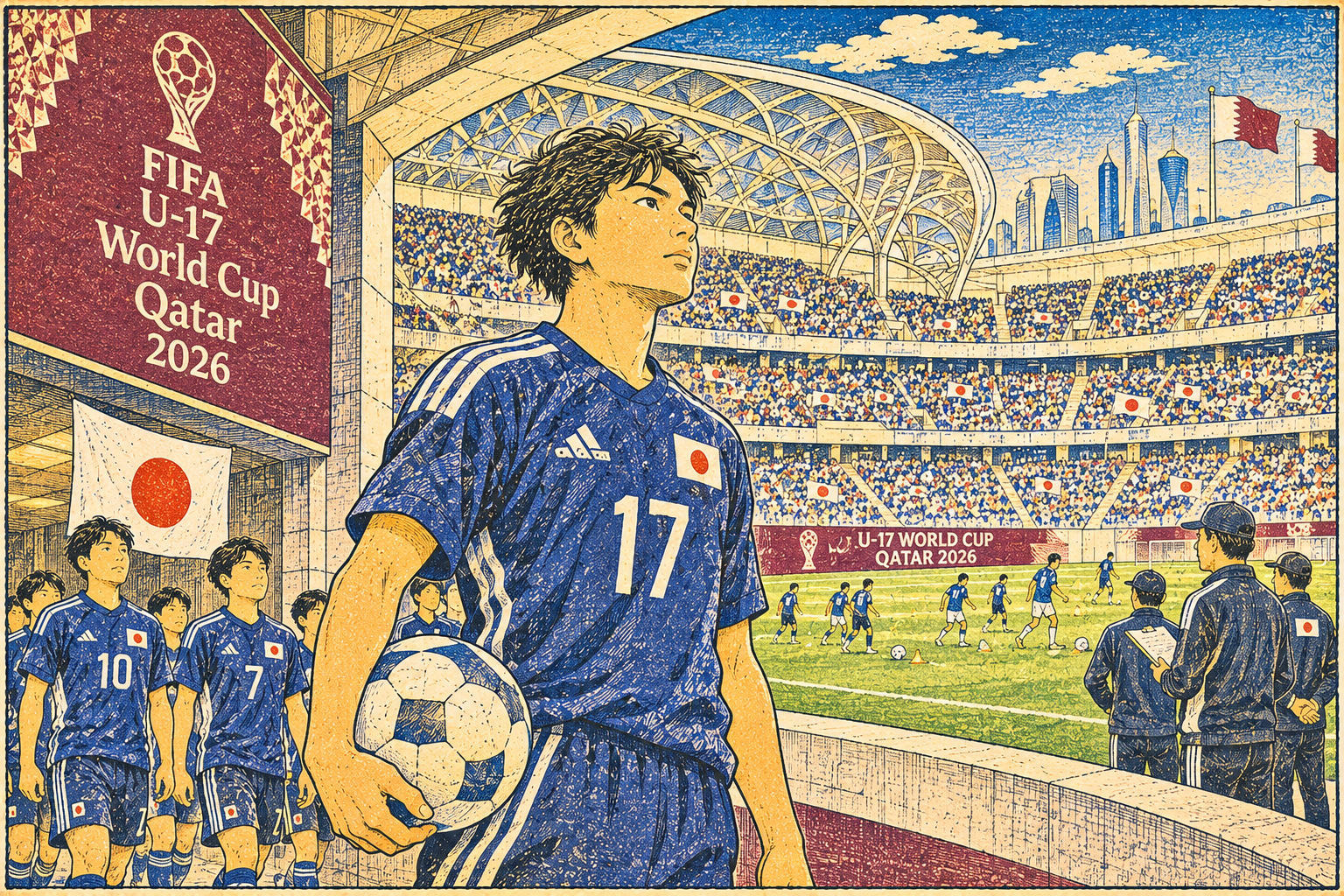
- A continental champion faces a wider world
- The roster: 21 players, several routes into elite football
- What the Asian title proves—and what it does not
- Colombia, Serbia and Honduras: the Group L examination
- A World Cup that has changed shape
- The quarterfinal barrier in Japanese youth football history
- How Japan makes players: the club, the school and the academy
- Names to follow, without writing teenagers’ futures for them
- The tactical demands behind the headline results
- Travel, welfare and what a youth tournament asks of families
- The real measure of a generation
A continental champion faces a wider world
Japan’s newest football story begins with a scoreline that looks comfortable until the second half is considered. In the AFC U17 Asian Cup final on May 22, Japan led China 3–0 at halftime in Jeddah. China scored twice after the interval, and Japan survived 3–2. The goals belonged to Tafuku Satomi, Kakeru Saito and Maki Kitahara. The trophy was earned, but so was a lesson in the difficulty of finishing a major match.
On November 2, the Japan Football Association named the 21 players who will carry that experience into the FIFA U-17 World Cup in Qatar. Coach Shingi Ono has selected an unusually instructive mix of J.League first-team players, club academy products and school footballers. The squad gathers for training on November 11; the World Cup itself begins on November 19 and runs through December 13.
Japan begins Group L against Colombia, then plays Serbia and Honduras. The first opponent arrives as South America’s U-17 champion. This is not a prearranged path to a title. It is the next test of whether Japan’s youth system can turn continental success into the adaptability and precision demanded by the world game.
The roster: 21 players, several routes into elite football
The JFA announcement lists three goalkeepers, six defenders, ten midfielders and two forwards. The goalkeepers are Koki Takahashi (Taisei High School), Kosei Oshita (Kashima Antlers Youth) and Rento Kida (Teikyo Nagaoka High School). The defenders are Anthony Udemba Motosuna (Kashima Antlers), Chimezie Kai Ezemuokwe (Cerezo Osaka), Koki Kurahashi (Kashima Antlers Youth), Riku Hashimoto (FC Tokyo U-18), Yuzo Takeuchi and Atsuki Sameshima (both Nagoya Grampus U-18).
In midfield are Sosuke Hoshi (Shoshi High School), Yoshiki Fujimoto and Arata Okamoto (Gamba Osaka Youth), Tafuku Satomi (Vissel Kobe U-18), Sora Iwatsuchi (Kashima Antlers Youth), Takeshi Wada (Urawa Reds), Maki Kitahara (Fujieda MYFC), Riku Nakashima (FC Tokyo U-18), Kazato Kimura (Kawasaki Frontale U-18) and Ryo Igarashi (Kashiwa Reysol U-18). The two forwards are Kakeru Saito (Yokohama FC) and Eito Takaki (Kashima Antlers Youth). All club and school descriptions are the affiliations published in the November 2 roster.
Numbers alone do not establish a preferred starting eleven. Ono must decide how to balance players with professional minutes against those developing within youth leagues and high-school competitions. The roster shows the breadth of Japan’s production system, but it says nothing by itself about which combinations will handle an opponent’s pressing, set pieces or changes of tempo.
What the Asian title proves—and what it does not
Japan’s May championship was its fifth men’s U17 Asian crown, according to JFA president Tsuneyasu Miyamoto. Reaching the final required more than one successful night. A striking detail is that Japan also met China in the group stage, winning 2–1 through goals from Anthony Udemba Motosuna and Maki Kitahara. By the final, both teams had information about the other’s movement and preferences.
The title match illustrated both strengths and vulnerabilities. Satomi struck in the 31st minute, Saito in the 42nd and Kitahara during first-half stoppage time. China replied in the 48th and 79th minutes. Japan won, but the final was a reminder that managing a lead is its own skill—especially when fatigue, substitutions and an opponent’s adjustments change the second half.
An Asian championship is evidence of performance against that tournament’s opposition. It is not proof of superiority over Colombia, Serbia or Honduras. The world tournament introduces different player profiles, tactical cultures and demands. A successful scouting report must account for what those teams are doing now rather than presume that a regional ranking will predict the result.
Colombia, Serbia and Honduras: the Group L examination
FIFA’s May draw placed Japan in Group L with Colombia, Serbia and Honduras. The official JFA schedule lists Japan–Colombia on November 21 at 3:30 p.m. at Aspire Zone Pitch 9, Japan–Serbia on November 24 at 4 p.m. at Pitch 1, and Japan–Honduras on November 27 at 4 p.m. at Pitch 4. Those kickoff times are local Qatar time; Japan is six hours ahead in November.
Colombia’s status as reigning South American U-17 champion makes the opener an immediate test. Japan will need to control distances between the lines and recognize when to press versus when to protect space. Serbia and Honduras offer different national football contexts, but the roster announcement does not prove they will employ any single formation or style. Those details require confirmed recent match evidence.
Three group matches in seven days reward tactical flexibility and careful recovery. There is little time to correct a poor start. But the most misleading preview would be one that pretends to know the tournament’s results or any opponent’s final selection before the matches are played.
A World Cup that has changed shape
The men’s U-17 championship began in 1985 as a competition for players under 16, before the age ceiling changed. Its format has changed repeatedly, but one recent reform is especially important. FIFA moved to an annual 48-team tournament from 2025, with Qatar hosting successive editions. The 2026 tournament runs from November 19 to December 13 rather than beginning with Japan’s pre-event training camp.
Under the expanded format, the group stage is a global festival of youth football and the knockout bracket opens with a round of 32. More teams gain exposure to world competition, yet the extra knockout hurdle means that an impressive group campaign is only part of the road forward. Scheduling, injury management and the emotional recovery of teenagers all become central to tournament performance.
The JFA lists the final for December 13; FIFA identifies Khalifa International Stadium as the final venue, while a JFA schedule page gives a different final venue. Because the published venues are inconsistent, this report does not use a definitive final-stadium claim. Japan must first qualify from Group L before the knockout question becomes its own.
The quarterfinal barrier in Japanese youth football history
For Japan, the U-17 World Cup carries memories reaching back to the home tournament of 1993. That side reached the quarterfinals, as did the 2011 team in Mexico. The 2011 squad included future senior international Takumi Minamino, whose presence illustrates both the promise of youth competition and the limits of predicting adult careers from one age-group event.
The 2025 edition brought another quarterfinal appearance. Japan advanced past Korea DPR in the round of 16 on penalties but lost 1–0 to Austria on November 21. Many young footballers from that generation were already being assessed on the global stage. The present group includes some players with earlier international youth experience, although youth squads are not identical across years.
Reaching the last eight is an achievement; making it a ceiling would be a failure of ambition. Yet every new group has to earn its own result. Historical quarterfinal finishes provide a useful benchmark, not an entitlement, and a new tournament’s 48-team structure complicates comparison with older smaller formats.
How Japan makes players: the club, the school and the academy
The roster offers a cross-section of a distinctive national development ecosystem. Kashima, FC Tokyo, Gamba Osaka, Nagoya Grampus, Vissel Kobe, Kawasaki Frontale and Kashiwa Reysol appear through their youth programs. Meanwhile, high schools including Shoshi, Taisei and Teikyo Nagaoka remain part of the route into the national side. The J.League pathway and the school pathway coexist rather than forming mutually exclusive worlds.
This diversity can be an advantage. Club academies may provide long-term tactical familiarity and carefully structured training; schools offer different competitive rhythms, traditions and pathways. Several players already listed with first-team clubs illustrate the possibility of stepping into professional environments before leaving their teens. The essential question is whether the national camp can build a common language quickly enough.
Japan’s longer-term policy has emphasized technical fundamentals, offense-and-defense responsibility, education and player welfare. JFA Academy Fukushima describes age-appropriate development, holistic support and the goal of players contributing at both ends of the field. None of this proves that a particular U-17 World Cup player passed through that academy. It is context for the country’s broader football-development philosophy.
Names to follow, without writing teenagers’ futures for them
Maki Kitahara, who is listed with Fujieda MYFC, scored in both the group meeting with China and the Asian Cup final. Tafuku Satomi and Kakeru Saito scored the other final goals. Those are observed contributions in matches under pressure, not evidence that one player alone carried the team. They make the trio reasonable subjects to watch without declaring future superstardom.
Anthony Udemba Motosuna and Chimezie Kai Ezemuokwe are among the defenders whose names reflect the breadth of contemporary Japanese football. The JFA gives the official Japanese readings for both players; their identities should not be shortened or transliterated casually. The published list also includes Wada and other players whose first-team club affiliations show that professional and youth experience can sit side by side.
No journalist should promise that a 16-year-old will become the next senior national-team star. Growth at this age is uneven. Minutes at the World Cup, physical maturity, schooling, injuries and club opportunities all influence what follows. A useful report observes the decisions players make on the pitch instead of reducing them to hype.
The tactical demands behind the headline results
An elite youth side needs more than creative attackers. Japan’s Asian final illustrated the value of an explosive first half but also the cost of allowing an opponent back into the contest. Against new opponents, Ono’s staff must determine which midfielders can receive under pressure, when the full-backs can push forward, and how the team covers transitions when possession is lost.
Set pieces can be decisive in closely matched tournament football. So can discipline: a badly timed foul or a careless pass near one’s penalty area can overturn an otherwise convincing performance. There is also a specific challenge in managing a compact 21-player squad when games come quickly. Coaches need alternatives and must make decisions informed by fitness rather than reputation.
It is important to label these as scouting questions and editorial analysis. JFA’s November 2 roster is not a statement of the precise formation Japan will use in Qatar. Predictions about starting lineups or tactical instructions cannot be represented as quotes from Ono without a directly sourced interview or press conference.
Travel, welfare and what a youth tournament asks of families
For the players, a World Cup means international travel and a series of pressure-filled games at a stage of life when education and development still matter. The JFA has scheduled training from November 11, giving the side preparation time before its first November 21 group game. Managing sleep, heat, recovery and the emotional swing of results is part of the work, even if official public releases do not describe every internal support arrangement.
Parents, school staff and club coaches have invested years in these athletes long before their names appeared on a national roster. The opportunity may accelerate a career, but a single tournament should not become a final judgment on a young person’s value or professional future. In a system with multiple pathways, continuing development after Qatar matters at least as much as the fortnight before kick-off.
The scheduled tournament is a celebration of young talent, yet it also highlights the responsibilities of the adults around it: safeguarding, appropriate expectations, academic continuity and a careful balance between competition and longer-term health. Claims about specific players’ private circumstances require their own reporting and are not inferred from the JFA roster.
The real measure of a generation
When Japan walks onto the pitch against Colombia, the Asian trophy will not count as a goal. The young players will have to build possession, defend space and solve problems in real time against opponents who have prepared for them. The opening whistle removes the comfort of May’s result and makes the next decision the important one.
What would progress look like? Not merely a place in the knockout round, although that matters. The ability to respond after conceding, protect a lead, adapt to a different opponent and give teammates better options are signs of a team learning together. These are tangible aspects of performance that a viewer can assess without turning the tournament into a referendum on each teenager’s future.
Japan’s youth development story is therefore neither a simple triumphalist account nor a warning that failure waits abroad. It is a continuing experiment in how schools, professional clubs and national coaching turn potential into capability. Qatar will provide a serious, public test—and the first answers will arrive on November 21.
Sources and reporting method
The JFA roster, Asian Cup match records, FIFA tournament notices and player-development materials were checked. Tactical questions are editorial analysis rather than attributed coaching statements.
- JFA: November 2, 2026 squad announcement and full schedule
- JFA: official 2026 World Cup team page
- JFA: 2026 AFC U17 Asian Cup final official score
- JFA president: June 2026 retrospective on Asian title
- JFA: official 2026 U-17 results
- FIFA: May 21 2026 draw, Group L
- FIFA: tournament format and start date
- JFA: Japan’s 2025 quarterfinal loss to Austria
- JFA: historical U-17 World Cup squads
- JFA: development pathway and academy philosophy
- JFA: 2026 Asian Cup Japan–China group match