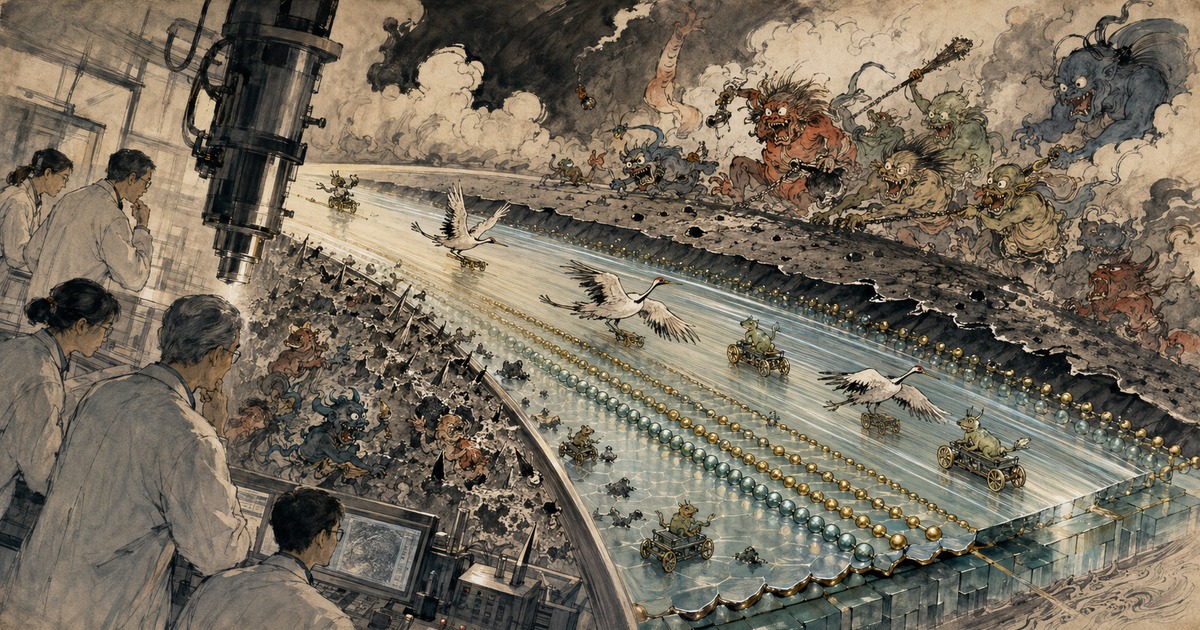
Imagine a field of molecular grass growing from a steel or glass surface. Each blade is a polymer chain, chemically anchored at one end and crowded so closely by its neighbors that it must stretch outward. Immerse that field in a compatible liquid and the chains swell. Press another surface against it, and the brush resists being crushed while a thin, mobile layer at the interface allows the two sides to slide past one another.
The result can be astonishingly low friction. Concentrated polymer brushes, or CPBs, can enter the “super-low-friction” regime, conventionally described here as a coefficient of friction no greater than 0.01. In a test, that means the tangential force resisting motion is no more than about one hundredth of the normal force pressing the surfaces together. It does not mean friction has vanished, and the number cannot be transferred unchanged from a laboratory contact to an aircraft actuator or an artificial hip. But it is low enough to make engineers imagine machines that waste less energy and surfaces that move more gently.
There has always been a catch. The brush that slides beautifully does not necessarily survive. Polymer chains can be damaged or removed, the lubricating layer can thin, and the frictional performance can deteriorate. Until now, researchers could measure pieces of that failure—force in one experiment, thickness in another, molecular structure in a third—but the interface changed while they looked away.
A team led by Associate Professor Hikaru Okubo at Yokohama National University has now brought those views together. Its paper, published July 27 in ACS Applied Materials & Interfaces, reports a multimodal operando system that measures mechanical, spatial and molecular information simultaneously while a concentrated polymer brush is actually under load and shear. The team’s conclusion is both precise and counterintuitive: wear originates when the brush undergoes a stress-induced glass transition and stretching strain builds in the polymer chains.
The Difference Between Friction and Wear
Friction is resistance to relative motion. Wear is the loss or damaging transformation of material caused by contact. They often reinforce each other, but they are not synonyms. A high-friction contact can sometimes form a stable, protective layer. A low-friction coating can shear easily yet slowly lose the molecules that make it slippery. Measuring only the friction coefficient is like judging a tire entirely by rolling resistance without asking how much tread remains.
That distinction is the heart of the new result. Concentrated polymer brushes were already known for low friction, and previous studies had shown layered structure and declining thickness during sliding. What remained obscure was the molecular event that connected load to irreversible loss. Why would a surface designed to prevent harsh solid-on-solid contact still wear?
The difficulty is that friction happens at a buried, moving interface. The region of interest may be microscopic, squeezed between solids and liquid, changing with every pass. Stop the machine and remove the sample for spectroscopy, and relaxation may erase the state that caused the damage. Perform force and optical measurements in separate experiments, and tiny differences in load, speed, alignment or surface history can make the signals describe different moments.
Three Instruments, One Moving Interface
Okubo and colleagues—Daiki Kagiwata, Toru Takeuchi, Ken Nakano and Yoshinobu Tsujii—built their advance around simultaneity. Their multimodal operando system integrates surface-force microscopy, optical interference spectroscopy and vibrational spectroscopy. “Multimodal” means the apparatus sees the same event in different ways. “Operando” means it observes the material while the material is performing its function, not only before or after.
| Measurement | What it reveals at the interface | Why it matters |
|---|---|---|
| Surface-force microscopy | Normal and shear response, stiffness and other mechanical behavior. | Shows how the brush carries load and resists sliding. |
| Optical interference spectroscopy | Gap and layer-thickness changes with spatial and time information. | Shows which parts of the brush compress or disappear. |
| Vibrational spectroscopy | Molecular conformation and order. | Shows when chains reorganize into a different physical state. |
| Simultaneous correlation | Force, geometry and molecular state under the same conditions. | Connects a transition to wear instead of merely observing both separately. |
Each instrument answers a question the others cannot. Force data can identify a change in stiffness without saying which molecules moved. Optical interference can show that a layer became thinner without distinguishing elastic compression from material loss. Vibrational spectra can reveal molecular ordering without showing the exact mechanical consequence. Aligned in time, the three signals form a causal sequence.
The instrument may prove as important as the immediate material finding. Batteries, catalysts, hydrogels, coatings and biological interfaces all change during use. Materials science increasingly depends on watching function and failure together rather than comparing pristine and damaged snapshots. A synchronized method reduces the risk of assembling a false story from separate specimens.
The Brush Is a Landscape, Not a Carpet
A simple illustration makes every polymer chain look equal and every height identical. The measurement revealed a gradient. Moving outward from the solid anchor, the researchers distinguished concentrated, intermediate, semidilute and dilute regions. The names describe how crowded the polymer segments are, not four separately manufactured films.
Near the grafting surface, chains are densely packed and strongly constrained. Farther out, their concentration falls and their motion becomes less restricted. The outer region can retain fluid character and accommodate shear; the inner structure carries load and keeps the opposing solids apart. Super-low friction is not produced by a single magic molecule. It emerges from this hierarchy.
That hierarchy also means wear is not simply a top layer being sanded away in even sheets. The team’s earlier work had indicated that a dilute surface region could be continuously re-formed as sliding reduced denser layers below it. The new simultaneous molecular view goes further: it connects the changing layer structure to a phase transition and strain inside the chains.
“Glass” Without a Shattered Window
The phrase “glass transition” can sound as if the coating crystallizes or breaks like a window. That is not what it means. Many polymers can move between a soft, rubber-like state in which chain segments rearrange readily and a rigid, glass-like state in which molecular motion becomes slow and constrained. Temperature is the familiar control, but pressure, confinement, solvent conditions and mechanical stress can also change the effective state.
Under combined compression and shear, the concentrated polymer brush in the experiment underwent this kind of transition. As the chains became more ordered and dynamically arrested, stretching strain accumulated. The brush could still present a low-shear interface, but internally it was no longer relaxing the imposed deformation in the same way. Wear increased across the transition.
This resolves a paradox. Dense grafting and chain extension help create the brush’s excellent lubrication: neighboring chains cannot collapse casually, solvent remains in the structure, and the surfaces stay separated. Yet if load and shear push those already constrained chains into a glass-like regime, their limited freedom can turn extension from a functional architecture into stored damage.
The transition itself is described as reversible; wear is not. A chain arrangement may soften again when conditions change, but material already removed does not return. The design challenge is therefore not only to produce the low-friction state. It is to keep the operating envelope away from the molecular condition that converts recoverable deformation into accumulated loss.
From Leonardo’s Red Chalk to the Buried Interface
Humans used water, animal fat and oils to move heavy objects long before friction had equations. Around 1493, Leonardo da Vinci recorded two empirical relationships: frictional resistance increased with load and, within the cases he studied, did not depend on the apparent area of contact. His notes remained unpublished and did not shape the next centuries of mechanics.
Guillaume Amontons presented similar laws in 1699. Charles-Augustin de Coulomb expanded the experimental framework in the eighteenth century, including distinctions involving the onset and continuation of sliding. These “laws” remain useful approximations, but modern surface science has shown why they are not universal. Apparently flat solids touch through microscopic high points, or asperities; chemistry, adhesion, deformation, speed, humidity and temperature change the real contact.
Industrial machines pushed lubrication science from observation to design. In the late nineteenth century, Osborne Reynolds explained how moving surfaces can draw fluid into a pressure-bearing film. The Stribeck curve later organized the transition among boundary, mixed and full-film lubrication as speed, viscosity and load change. In the twentieth century, Frank Philip Bowden and David Tabor linked friction to real contact area and adhesive junctions, while John Archard’s 1953 model related wear volume to load, sliding distance, hardness and a system-dependent wear coefficient.
Only in 1966 did the field receive the name “tribology,” from the Greek root for rubbing. The British government’s Jost Report argued that friction, wear and lubrication were not scattered maintenance problems but a connected economic discipline. The name was new; the loss was everywhere—in bearings, gears, seals, brakes, cutting tools and joints.
Why a Molecular Brush Was a Radical Idea
Traditional lubrication usually puts a liquid film or low-shear additive between surfaces. A polymer brush takes a different approach: it permanently tethers one end of many long molecules to the surface. In a good solvent, crowding and the chains’ preference for the liquid drive them outward. The brush can support normal pressure through osmotic and entropic forces while maintaining a fluid-rich shear plane.
In 1994, Jacob Klein and colleagues reported in Nature that solvent-swollen polymer brushes reduced effective friction below their detection limit—less than 0.001 under the specific contact pressures, speeds and chemistry tested. The result suggested that molecular architecture could replace a conventional bulk oil film at an interface.
The next challenge was density and control. Surface-initiated living radical polymerization enabled researchers, including Tsujii and colleagues in Japan, to grow chains from a surface with unusually high grafting density and controlled length. These “concentrated” brushes were denser and often thicker than conventional semidilute brushes. Microscopic tests produced friction coefficients around 10−4 in favorable systems; macroscopic contacts remained more demanding.
Over the past decade, the group and collaborators tested thermal treatment to shorten swelling time, microgrooved and laser-textured substrates to improve durability, thick brushes on rough steel, and reciprocating-seal geometries. The research trajectory moved from “Can it be extraordinarily slippery?” to “Can it seal, carry load and survive?” The 2026 paper is a molecular answer to that engineering turn.
The Energy Prize—and the Danger of a Giant Number
A widely cited 2017 analysis by Kenneth Holmberg and Ali Erdemir estimated that about 23% of global energy use originated in tribological contacts: roughly 20% in overcoming friction and 3% in remanufacturing or replacing equipment lost to wear and wear-related failures. The calculation spanned transportation, manufacturing, power generation and residential systems.
That figure explains the scale of interest, but it must not be converted into a claim that this polymer brush will save 23% of energy. No single coating could. Much friction is useful—tires need road grip, brakes must dissipate motion, shoes need traction—and every contact has different temperature, contamination, load, speed and safety requirements. CPBs require a compatible solvent and a stable grafted interface, conditions that may not exist in many machines.
The realistic opportunity is selective. Seals, guides, precision positioning systems, fluid-handling components and other sliding interfaces can lose energy through friction while also failing through wear. A coating that reduces both could allow smaller actuators, lower heat generation, longer maintenance intervals and less replacement material. The new study supplies a design criterion: avoid or control the transition that concentrates damaging chain strain.
Artificial Joints Are Inspiration, Not Yet Validation
The biological analogy is powerful because articular cartilage uses soft, brush-like molecular structures and trapped water to sustain remarkably low friction under repeated load. CPBs imitate part of that strategy. The Yokohama National University release identifies precision machinery, aerospace equipment and medical devices such as artificial joints as potential future applications.
Those are directions, not product announcements. An artificial joint coating must withstand millions of cycles, complex body fluids, impact, sterilization, aging and imperfect alignment. It must adhere to implant materials, remain biocompatible and avoid harmful wear debris. An aerospace sliding component must survive wide temperature ranges, vibration, radiation or vacuum conditions and strict qualification. The July 2026 paper does not demonstrate those lifetimes.
The distinction matters because laboratory superlubricity often fails at scale. A smooth model contact has controlled chemistry and a small area; an industrial component has roughness, edges, particles, misalignment and variable load. The friction coefficient is a property of the complete tribological system—not a permanent number stamped on a material.
A New Design Map
Once the failure sequence is known, engineers can begin asking more useful questions. Can grafting density or chain length be tuned so the outer layer remains fluid while the inner layer carries load without entering the glass-like regime? Can chemistry or solvent choice move the transition beyond the intended pressure and temperature range? Can surface textures distribute load, store lubricant or provide a tougher substructure? Can sacrificial chains be replenished, or can damage trigger self-repair?
Those are design inferences, not results already proved by this paper. Each introduces trade-offs. Lower density may reduce strain but allow opposing asperities to touch. Cross-linking can raise strength while restricting relaxation. A softer brush may preserve lubricity but squeeze out under heavy load. A texture that helps in one sliding direction may concentrate stress in another. The value of the new measurement is that these compromises can be observed as molecular and mechanical events rather than guessed from final wear scars.
| Observed sequence | Possible design question |
|---|---|
| Compression and shear act together | Can contact geometry or texture spread peak stress? |
| Brush crosses toward a glass-like state | Can chain chemistry, solvent or operating temperature shift the transition? |
| Stretching strain accumulates | Can graft density and chain length preserve relaxation without losing load capacity? |
| Dense layers wear while the outer dilute layer reforms | Can the hierarchy be reinforced or made self-renewing? |
| Thickness loss becomes irreversible | Can operando signals provide an early-warning threshold before failure? |
What the Study Establishes—and What It Does Not
The study establishes an integrated method, resolves four layers at a solid–liquid concentrated-polymer-brush interface, and correlates a stress-induced glass transition and chain-extension strain with wear. It advances a line of prior work that had identified layered structure and measured thickness loss, adding molecular information under the same operating conditions.
It does not establish a universal wear mechanism for every “superlubric” material. Structural superlubricity between misaligned crystalline lattices, diamond-like carbon, molybdenum disulfide, hydrogels, ionic liquids and hydrated biological interfaces rely on different physics and chemistry. Nor does it prove zero wear. The university says the result suggests design routes toward durable ultra-low-friction materials; “suggests” is the scientifically important word.
It also does not replace endurance testing. A molecular mechanism can tell engineers where to look and which variable to change. Only long-duration, application-specific experiments can show whether the modification survives contamination, manufacturing variation and real duty cycles.
- Operating window: Does low friction persist across real loads, speeds, temperatures and start-stop cycles?
- Durability: When does thickness loss begin, and how does it accelerate?
- Environment: Does the required solvent remain stable, safe and contained?
- Scale: Can the brush be grafted uniformly to rough, complex and large components?
- Failure safety: What happens to the machine, patient or vehicle when the coating is damaged?
The Most Revealing Moment Is When a Material Changes Its Mind
Materials are often described by nouns: solid, liquid, coating, lubricant, polymer. Machines force them to behave like verbs. They compress, shear, order, relax, heat, fracture and heal. The interface that began a test as a soft molecular brush can become locally glass-like under stress, and that change can decide its lifetime.
This is why the Yokohama team’s result matters beyond one coating. Failure frequently begins not with a visibly broken part but with a hidden transition: a lubricant film collapses, a battery interface changes phase, a polymer stops relaxing, a protective layer becomes brittle. Measuring the average force after the fact can miss the instant when the system crossed from resilient to damaging.
Tribology has spent five centuries moving closer to that instant. Leonardo weighed blocks and recorded resistance. Amontons and Coulomb turned observation into empirical laws. Reynolds described the fluid film. Bowden, Tabor and Archard connected apparent surfaces to microscopic contact and material loss. Polymer scientists built interfaces molecule by molecule. Now three synchronized measurements can watch a buried brush change its mechanical state while it is still sliding.
The achievement is not frictionlessness. Friction is necessary to walk, grip and stop, and even the best lubricated machine must manage contact rather than abolish it. The achievement is legibility: seeing why a surface that slides so easily can still wear away.
Once failure becomes visible, “make it tougher” is no longer the only instruction. The sharper goal is to preserve the molecular freedom that makes the brush slippery while preventing the strain that consumes it. That is a more difficult design problem—and, after this work, a more answerable one.
Reporting notes and sources
This article distinguishes the paper’s demonstrated result from proposed applications and design inferences. The threshold μ≤0.01, four-layer description, combined measurement methods and glass-transition-induced strain mechanism come from Yokohama National University and JST’s July 27 release. The global energy figure is a system-wide 2017 estimate, not a forecast for this material. Friction coefficients depend on the entire test system and should not be compared without load, speed, chemistry, scale and environment.
- Yokohama National University: research summary, methods, mechanism and applications
- Japan Science and Technology Agency: joint announcement and funding record
- ACS Applied Materials & Interfaces: “Multimodal Operando Characterization of Layering and Wear at Concentrated Polymer Brush Interfaces”
- Langmuir: the team’s 2023 study of layered structure and CPB wear
- Nature, 1994: landmark measurement of friction between polymer-brush-bearing surfaces
- University of Cambridge: Leonardo da Vinci’s systematic friction studies
- Holmberg and Erdemir: global energy, cost and emissions estimate for friction and wear
- Institution of Mechanical Engineers: the 1966 Jost Report and the definition of tribology