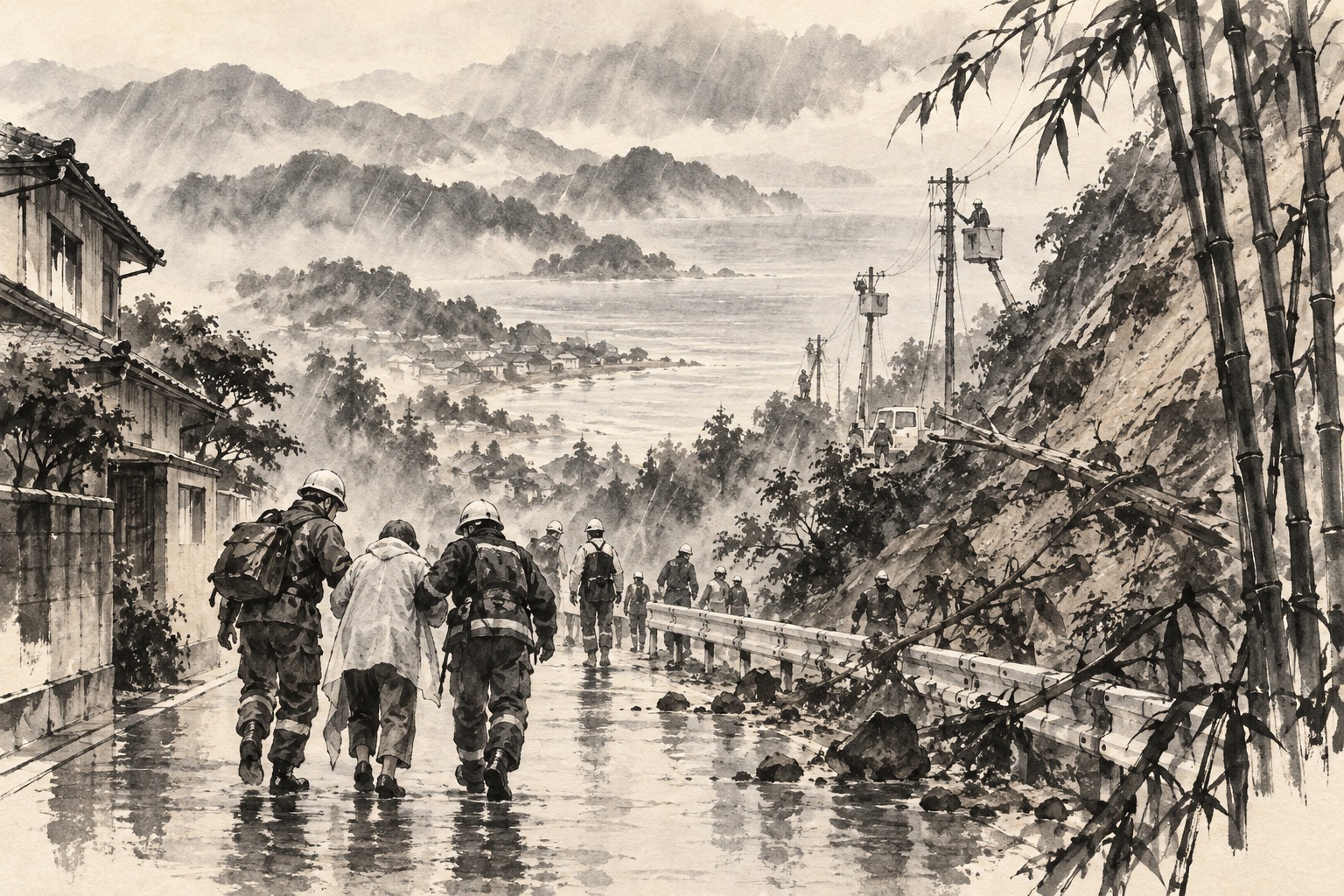
Communities in Kanagawa and Chiba face rescue and access challenges following Typhoon Dujuan’s heavy rain. Reuters, citing NHK, reported four deaths and six missing people in an article published September 22 at 12:14 JST.[1] Those figures are a reported snapshot, not a final toll.
Information date
This September 24 edition uses information checked through September 22. Shelter availability, road restrictions and power conditions can change. Follow the official links below for current local information.
Miura prioritizes rescue and access
Miura City says its disaster response headquarters is prioritizing rescue, assessment of conditions and support for evacuees. It describes coordination with the Yokosuka fire service, police and local volunteer firefighters, including work to check transport access.[2]
The city’s road notice timestamped September 22 at 17:00 JST listed closures or impassable locations on municipal roads 14 and 32, among others.[2] That notice should not be read as a forecast of conditions on publication day.
For households, road access connects recovery to everyday needs: reaching services, receiving supplies and moving between home and temporary accommodation. A route reopening in one place does not establish that a complete journey is possible.
Chiba requests additional rescue support
Chiba Prefecture says it requested a Self-Defense Forces disaster deployment because rescue required a prompt response. Its typhoon-response page provides disaster headquarters materials, including those for a fourth meeting held September 22 at 17:30 JST.[3]
These official records are useful for tracking the response, but casualty reports, infrastructure updates and local service notices may cover different reporting periods. They should not be combined into an apparently simultaneous picture without checking their timestamps.
Restoration needs to be checked service by service
TEPCO Power Grid’s outage information is the official starting point for electricity conditions.[5] This report has not verified a region-wide restoration completion time.
For a shop, employer or delivery company, restored electricity alone does not establish that premises and access routes are ready to use. Japan.co.jp’s assessment is that reopening decisions need location-specific information about both utility service and municipal restrictions. No individual business’s reopening is confirmed here.
Where residents can check assistance information
The Kanagawa disaster information portal provides evacuation and shelter information. A notice dated September 22 at 13:04 JST said shelters were open in some municipalities.[4] Check the relevant municipality’s current notice before travelling; this article does not confirm that a particular shelter remains open.
- Miura City: disaster response, road notices and a link to shelter availability.
- Yokosuka City: disaster information through its official homepage.
- Chiba Prefecture: Typhoon No. 25 response and headquarters documents.
- Sakura City: emergency information and municipal contacts.
Residents seeking help with housing damage or recovery should use their municipality’s official information to identify the responsible office. No disaster-specific payment amount, application deadline or volunteer recruitment arrangement has been verified for this report. These links are verified information channels, not confirmation of eligibility for a particular benefit.
Sources
- Reuters: casualties attributed to NHK (September 22, 12:14 JST)
- Miura City: disaster response and road information (checked September 22)
- Chiba Prefecture: response to Typhoon No. 25 of 2026
- Kanagawa Prefecture disaster information portal
- TEPCO Power Grid: outage information
- Yokosuka City official website
- Sakura City official website
