- The river has a life beyond its main channel
- A mosaic of water within a few dozen meters
- Why biodiversity is not a fixed inventory
- A wooden technology designed to negotiate with current
- The Kizu River's long relationship with seigyu
- When a river is allowed to remake itself
- The scientific boundary that matters
- Conservation design meets public safety
- The value of places that will not stay the same
The river has a life beyond its main channel
To most travelers, a river is the water moving between its banks. On a sandbar beside Japan’s Kizu River, however, small inlets and isolated pools tell a different story. Some connect to the current; others are cut off. Their temperatures shift, their shapes change, and the animals living on their beds change with the seasons. A landscape that seems marginal can be an essential part of the river’s ecological fabric.
Research announced by Kyoto University on November 12, 2026, followed a cluster of these small waters around traditional wooden river-training structures known as seigyu. A team spanning Nara Women’s University, Kyoto University, Osaka Metropolitan University and Setsunan University surveyed the habitats on five occasions, identifying differences between pools, backwaters and the neighboring main channel.
The discovery is not that an ancient device has been proved to increase biodiversity. The researchers did not conduct a controlled comparison of sites with and without seigyu. Instead, they observed how habitats that exist around the structures vary over short distances and through time—an important distinction for anyone considering historical engineering as a modern conservation tool.
A mosaic of water within a few dozen meters
Backwaters retain some connection to the river’s main flow, while riverine ponds can become comparatively isolated. Their appearance may be similar, but their daily experience is not. Differences in water exchange, depth, sunlight, sediment and temperature can favor very different species. During a flood, what was a quiet pool may reconnect with a faster current.
The researchers examined one sandbar in the regulated Kizu River system, rather than multiple Japanese rivers. The study focused on environmental conditions and benthic macroinvertebrates—animals such as aquatic insect larvae and other organisms living on or near the riverbed. It did not attempt a census of every fish, plant, amphibian or bird in the catchment.
One of the strongest gradients was water temperature. Even along the limited length of a sandbar, temperatures and other conditions varied spatially and seasonally. Lumping all quiet waters into a single habitat category would have obscured the fine-grained variety that emerged from the field observations.
Why biodiversity is not a fixed inventory
The communities observed in the small waters differed from those of the adjacent main channel, and many taxa were associated with the in-channel ponds or backwaters. Composition also varied across sampling periods. The same location was not simply occupied by a permanently fixed set of organisms.
This finding complicates a familiar conservation instinct: find a valuable place and preserve it exactly as it looks today. Rivers are constructed by disturbance as much as by stability. Water levels rise and fall, sediment is carried away or deposited, and pools can appear, merge or disappear. Those transitions may create ecological opportunities as well as risks.
In the Kizu River, the evidence points to an interaction between spatial variety and changing seasonal conditions. It does not show that every flood is beneficial or that allowing unconstrained erosion is safe. Nor can results from a single sandbar be presumed to represent every regulated waterway. The practical insight is more precise: a shifting network of microhabitats may contribute to the overall diversity of a river.
A wooden technology designed to negotiate with current
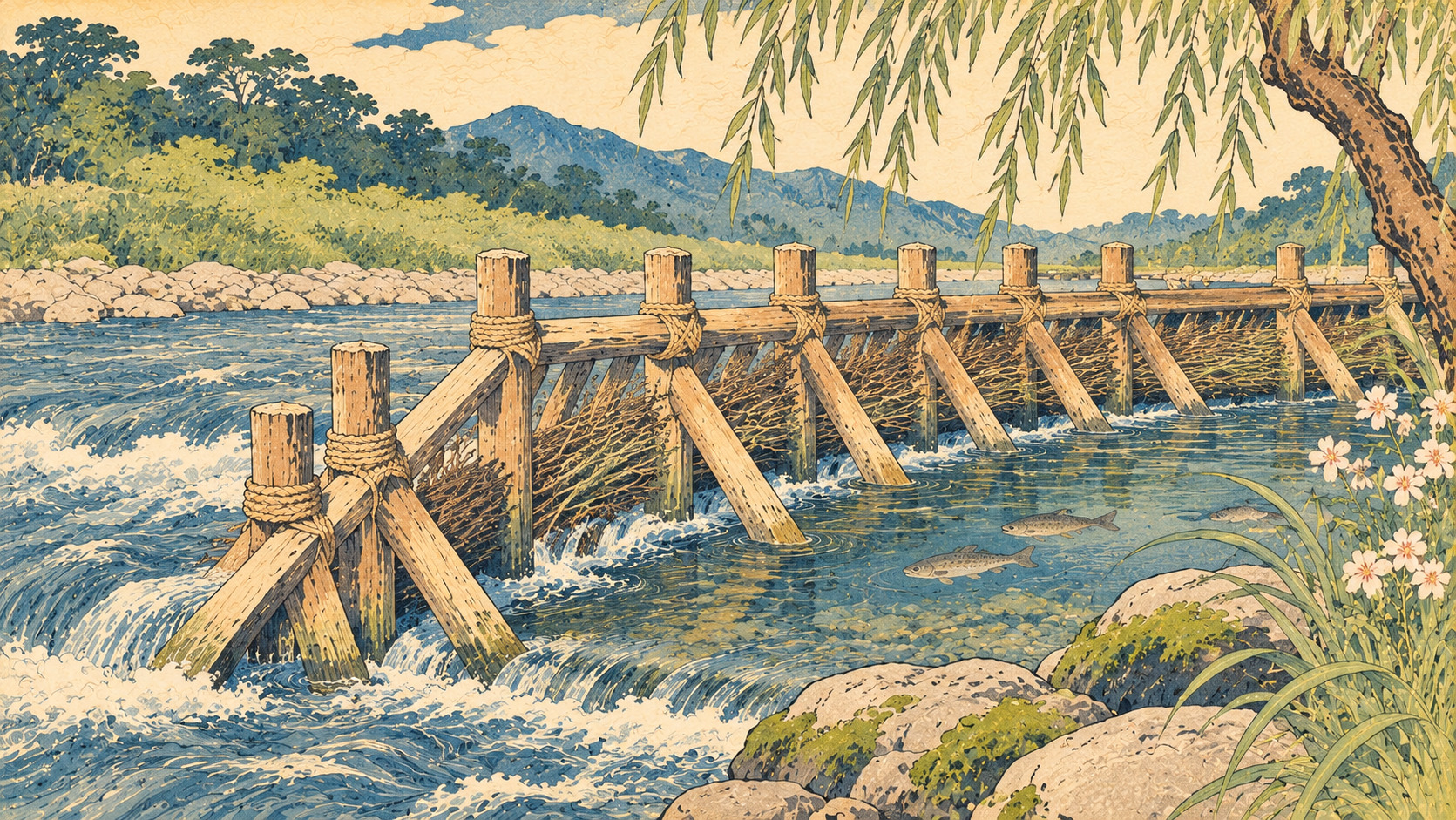
Seigyu are triangular, timber-based river-training structures, traditionally secured with materials such as stones and bundles of brushwood. As groynes or flow-control devices, they can redirect local currents and encourage erosion in one place and deposition in another. Their purpose was historically practical: protect embankments and manage the river without building an uninterrupted wall across its entire course.
Japan’s Ministry of Land, Infrastructure, Transport and Tourism identifies the Fuji River basin as the birthplace of the technique within the Koshu school of river management. Tradition associates it with the era of the sixteenth-century warlord Takeda Shingen, but historical attribution should not be confused with a documented invention by Shingen personally. The method subsequently appeared in numerous fast-flowing rivers.
Although a seigyu looks deceptively simple, placing one well requires an understanding of flow direction, flood force, sediment supply and the bank being protected. Its rediscovery is not a license to romanticize wooden structures as universally superior to modern hydraulic engineering.
The Kizu River's long relationship with seigyu
The Kizu River has its own record of the technique. Following destructive flooding in southern Kyoto Prefecture in 1953, seigyu were used to help protect road and railway infrastructure. Decades later, river managers and local groups revived the idea as part of a broader attempt to restore varied riverbed conditions.
In December 2017, community partners and the regional river administration helped build and install medium-size seigyu near the 15.2-kilometer point of the Kizu River. Government materials describe the installation as a trial involving sediment movement and the preservation or creation of small river habitats. It was not simply a display of historical craftsmanship.
A separate 2019 report from Kyoto University’s Disaster Prevention Research Institute monitored three structures and described erosion and sediment deposition around them following floods in 2018, with temporary ponds forming nearby. The earlier geomorphological observation supplies context for the 2026 ecology research, but the two studies must not be combined into a single claimed experiment or causal proof.
When a river is allowed to remake itself
Rivers move sediment continuously: bed material is scoured from one place, carried downstream and deposited where energy falls. Floods are damaging to human settlements, but they also reshape habitats. An engineering approach that tries to freeze every channel margin in place can erase part of this dynamism, particularly the alternation of shallow ponds, inlets and new sandbars.
Japanese river-management documents for the Kizu have articulated a different ambition: help the river build and renew its own forms while maintaining flood protection. The relevant public policy is not simply “leave nature alone.” It means choosing interventions that satisfy hydraulic safety requirements while preserving some of the geomorphic processes that create habitat.
Such an approach demands better measurements. A waterbody that looks unremarkable in one season may become a distinct ecological patch in another. The Kizu team’s repeated sampling helps reveal those differences, illustrating why restoration plans should be informed by time-series data rather than a single inspection.
The scientific boundary that matters
There is an important gap between two claims: “small waters around seigyu support diverse benthic communities” and “seigyu cause higher biodiversity than alternative engineering methods.” The first is supported by the November 2026 observations. The second would require a comparative design that controlled for other differences in channel shape, hydrology and habitat availability.
The new study examined one sandbar over five survey periods; it did not establish national-level effectiveness, long-term structural safety or a universal prescription for river restoration. It did not measure every ecosystem service either. A benthic community can be ecologically valuable while a structure still needs rigorous assessment for flood behavior, debris accumulation and effects on infrastructure.
These boundaries are strengths of transparent reporting, not defects in the research. The paper documents habitat mosaics; it does not pretend that a single field campaign answers every conservation and engineering question.
Conservation design meets public safety
For river managers, the potential lesson is to treat backwaters and ponds as part of the river rather than as expendable fragments outside the main channel. Habitat surveys could include seasonally disconnected water, temperature gradients and shifts in invertebrate communities. Restoration projects could then be evaluated on their ability to maintain varied conditions through time.
Yet interventions remain site-specific. A timber training structure is subject to flood loading, abrasion, decay and debris. It may alter erosion near a bank, bridge or other asset. Engineers must consider where sediment will accumulate and who will maintain the structure. Ecological objectives do not remove these obligations.
The Kizu River trial also suggests a governance lesson. Researchers, local river groups and public authorities worked in connected but distinct roles, from making structures to monitoring their effects. The next step for any broader application would be comparative projects with repeated biological and hydraulic measurements.
The value of places that will not stay the same
A small river pond is easy to dismiss. It may not be visible on a tourist map and might disappear after a dry spell. But the Kizu River research suggests that its very transience can be part of a river’s ecological wealth. The network of still and flowing waters changes—and so does the community of animals that uses it.
Seigyu originally belonged to the practical craft of flood management. Their presence beside this sandbar now offers a window into the interaction of human engineering and river dynamics. There is no proof that the historic structures alone created the observed biodiversity. There is, however, evidence that the changing waters around them are more biologically varied than a view focused solely on the main channel would suggest.
To conserve a river may sometimes mean allowing it room to change, while measuring carefully enough to know when change supports life and when it threatens people. That balance, rather than nostalgia for an ancient technique, is the enduring significance of this Japanese study.
Primary sources, historical records and reporting limits
Based on official university disclosures, the peer-reviewed study’s published abstract and bibliographic record, and government historical records, reviewed through November 14, 2026. No original interviews or field visits. The study did not conduct a seigyu-versus-no-seigyu causal comparison.