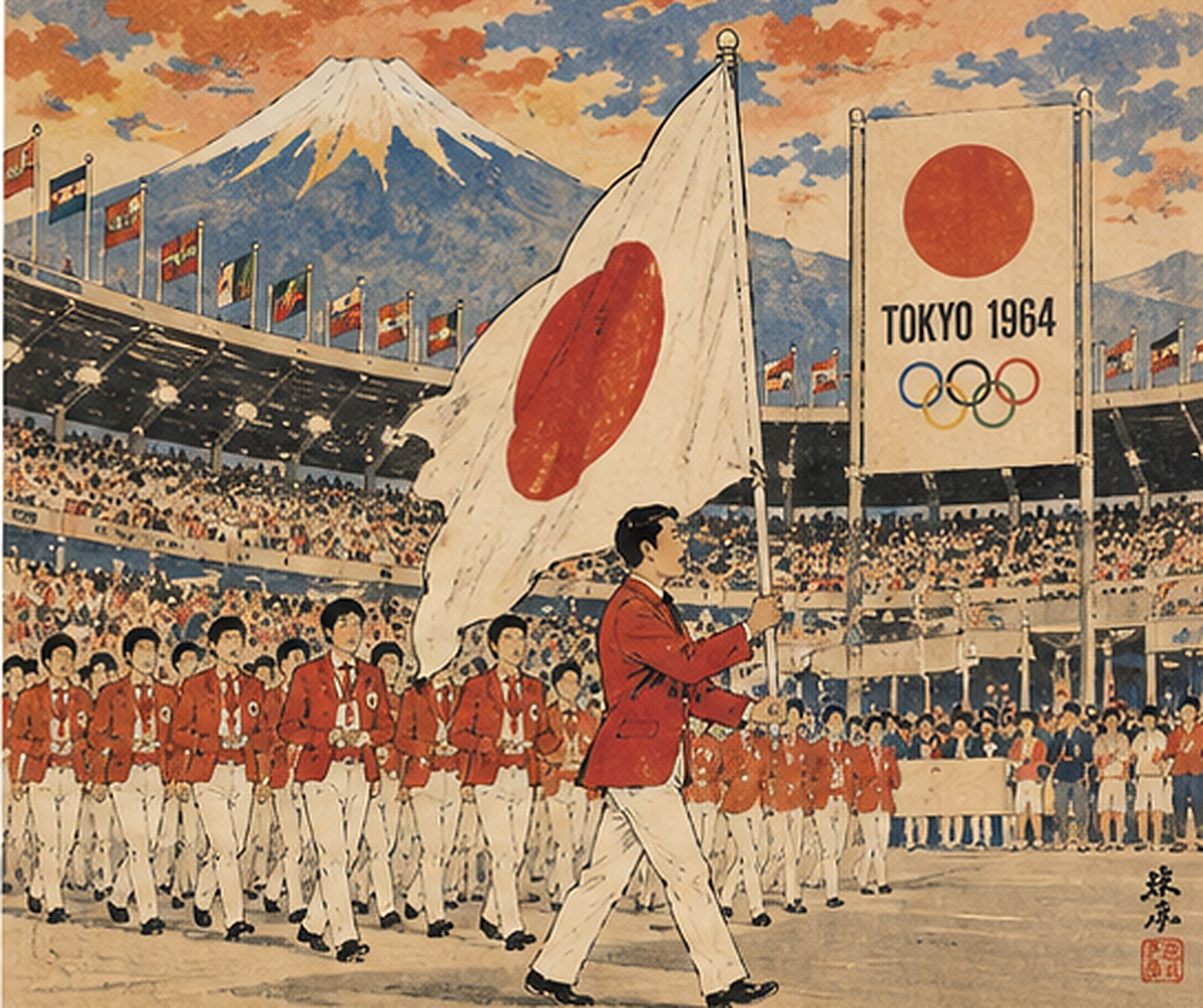
The day Tokyo showed itself to the world
Rain had fallen before the opening ceremony. On October 10, 1964, the skies cleared over Tokyo, and delegations from around the world marched into the National Stadium. Japan entered last, as host. The ceremony announced Asia’s first Olympic Games, but it also offered a carefully staged account of a country emerging from war, reconstruction and rapid economic growth.
On October 10, 2026, that opening is 62 years in the past. Japan’s modern Sports Day holiday falls two days later, on Monday, October 12. The separation between the date of the original ceremony and the present public holiday makes an apt starting point for a broader question: what, precisely, is Japan commemorating?
The most durable legacy is neither a single medal nor one photograph of a flame. It is a mixture of transport and public-space investments, new sporting ambitions, architectural landmarks and urban costs that continue to shape Tokyo.
An Olympic debut for Asia—with complications
The Japanese Olympic Committee records 5,152 athletes from 93 countries and territories at the XVIII Olympiad, held October 10–24, 1964. Competitors contested 163 events across 20 sports. Japan won 16 gold, five silver and eight bronze medals; its delegation comprised 355 athletes and 82 officials. These are figures for the Games as a whole.
Even that apparently straightforward statistical record requires care. A JOC historical account separately describes opening-parade expectations and withdrawals involving Indonesia and North Korea, reporting a 94-delegation parade after the changes. This is not a reason to silently replace the committee’s overall participation figure of 93; the accounts concern different counting points and contexts.
The Games used 30 competition venues across Tokyo and four neighboring prefectures. The organizing footprint encompassed new arenas, upgraded older grounds and temporary sites. Hosting the Olympics was therefore also an exercise in regional logistics and long-term land use.
The flame, the oath and the construction of memory
Yoshinori Sakai carried the final stage of the torch relay. According to the JOC, he entered the stadium at 3:03 p.m., ascended 163 steps and lit the cauldron. Gymnast Takashi Ono then delivered the athletes’ oath. Doves and jet aircraft tracing the Olympic rings overhead added images of peace and modernity that proved exceptionally enduring.
Those images were powerful, but they were not a complete portrait of 1964. International eligibility disputes and the Cold War intruded upon the Games. The peace expressed in the ceremony was an aspiration presented by its organizers—not a claim that postwar tensions had vanished.
Director Kon Ichikawa’s documentary film Tokyo Olympiad subsequently helped shape how the event was remembered. Its importance lies not merely in recording results but in showing athletes as human beings—resting, competing, waiting and straining—as well as components of a national spectacle.
A bullet train, a monorail and the deadline effect
The Tokaido Shinkansen opened on October 1, 1964, just nine days before the ceremony. Its presence powerfully reinforced Japan’s technological image. Yet it is too simplistic to say the Olympics single-handedly caused the high-speed rail project: the route answered wider industrial, intercity and transport ambitions that preceded the final preparation for the Games.
The Tokyo Monorail and portions of the metropolitan expressway network were also part of the transformation visible to visitors. Olympic deadlines accelerated infrastructure delivery and concentrated political attention, while the resulting assets served commuters and businesses for decades afterward.
The analytical distinction matters. A public investment may have been planned before an Olympic bid, built faster because of the Games and used long afterward. Its entire cost should not automatically be counted as an Olympic expense, just as all later growth should not automatically be credited to the sporting event.
The other side of the modernization story
Elevated roads and new facilities reshaped Tokyo, but they also changed historic neighborhoods, waterways and the urban landscape. Urban-planning scholarship has specifically identified the damage done to the setting of Nihonbashi by expressway construction as a negative legacy of the 1964 development drive.
Every story of improved mobility therefore invites a second set of questions: who lost a home, a working environment, or access to public space, and who bore the long-run cost of maintaining the new infrastructure? National triumphal narratives are poor substitutes for street-level records, compensation documents and testimony. This article does not invent a single consolidated displacement total.
Success and harm need not cancel each other out. The reason to document both is to avoid an overly simple equation in which spectacular construction automatically means universal public benefit.
Architecture outlives the competition—sometimes
Kenzo Tange’s Yoyogi National Gymnasium demonstrated how an Olympic arena could also become a landmark of Japanese architectural innovation. The former athletes’ village area and other sites entered a changing network of parks and public facilities. Sport, design and city planning were entwined.
The National Stadium that hosted the 1964 opening ceremony, however, was later demolished, and its site redeveloped for Tokyo 2020. Buildings do not have to remain physically unchanged to influence collective memory, yet replacement also tests what a city considers worth preserving.
That debate is especially relevant to an aging society. A handsome venue does not automatically provide affordable exercise for residents, accessible facilities for disabled participants or sufficient maintenance funding. The public value of an Olympic building must survive beyond its ceremonial moment.
How October 10 became Sports Day
Japan established Taiiku no Hi, or Health and Sports Day, following a 1966 legal revision, originally fixing it on October 10 in commemoration of the 1964 opening. From 2000 the holiday moved to the second Monday in October. In 2020 its Japanese name changed to Supōtsu no Hi—Sports Day—and its official purpose was broadened to emphasize enjoyment of sport, respect for others, and a healthy, active society.
For 2026 the national holiday is Monday, October 12, not Saturday the 10th. Getting that detail right matters in an anniversary feature: the exact date of a historic event and the government’s current holiday calendar are different facts.
The legacy of 1964 is ultimately a question of allocation. Japan demonstrated that it could build, organize and welcome the world. Sixty-two years later, the more demanding measure is how those capacities benefit ordinary people: the person who needs a safe gym, a reliable train, or a city square in which to move. Remembering the Games means asking who gets to share in what was built.