A universe small enough to hold
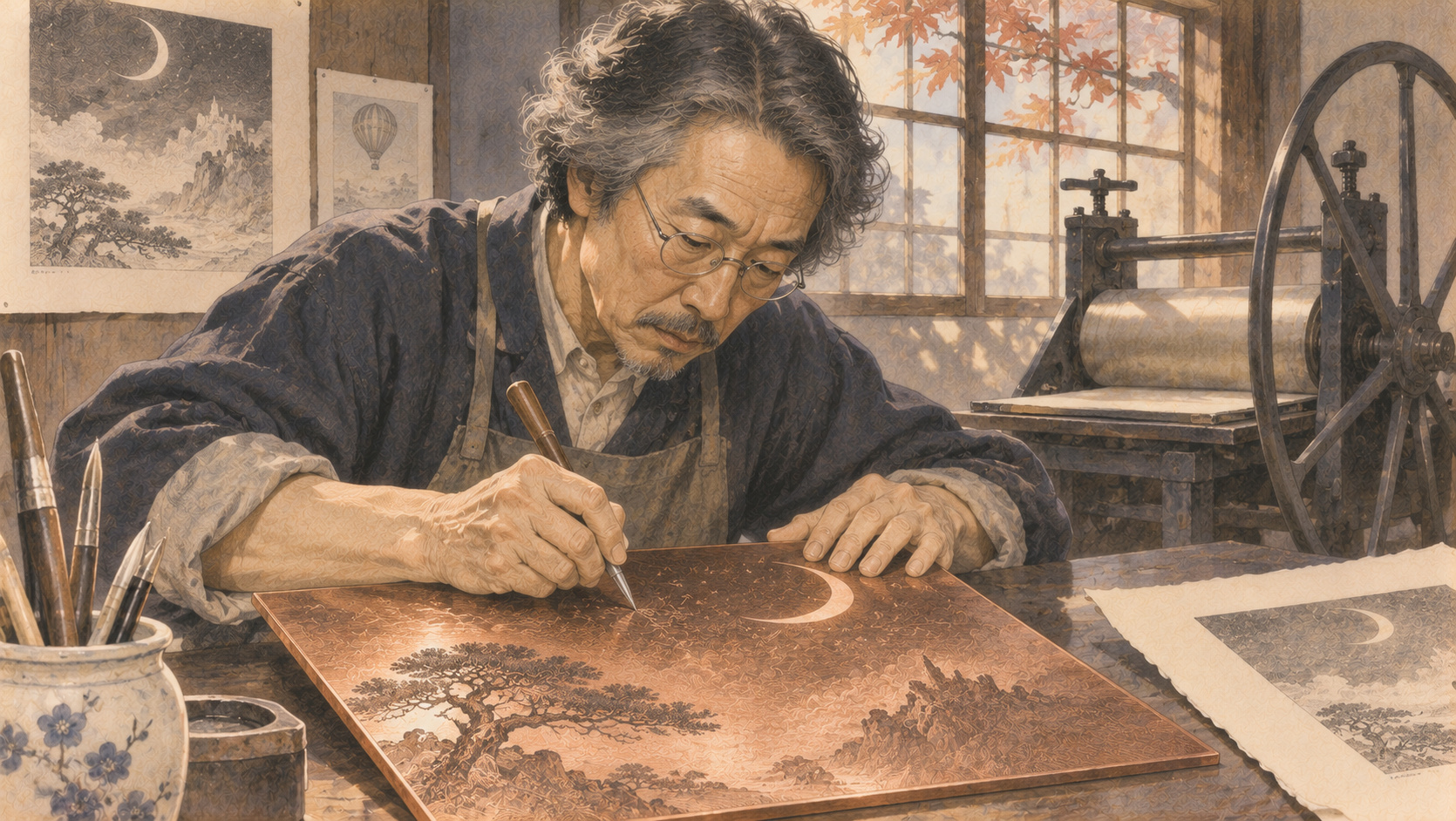
A print need not be large to suggest an immense space. In Tetsuro Komai’s work, a few suspended shapes can evoke the depth of a night sky, while a finely worked patch of darkness can seem to contain its own atmosphere. The scale of the sheet invites an unusually intimate encounter with art.
Setagaya Art Museum is scheduled to mark the fiftieth anniversary of his death with a retrospective opening November 28. The exhibition follows a presentation at the Museum of Modern Art, Hayama. Its focus is a collection donated by Yoshiharu Fukuhara, formerly honorary chairman of Shiseido. The roughly 300 items include archival material as well as art, allowing visitors to approach the maker as well as the finished print.
An alternative history of Japanese prints
International audiences often encounter Japanese printmaking through the colored woodblocks of the Edo period. Komai belongs to a different chapter: the development of modern artist-led printmaking in which the physical properties of the printing matrix became a means of personal expression.
Born in Tokyo’s Nihonbashi district in 1920, he encountered copperplate printing as a teenager and graduated from Tokyo School of Fine Arts in 1942. After the war he joined Ichimokukai, a print study group associated with woodcut artist Koshiro Onchi. This was an environment in which artists could exchange ideas across techniques rather than follow one inherited formula.
Recognition followed at the Shunyokai exhibition in 1950, the inaugural São Paulo Biennial in 1951 and an international print exhibition in Lugano in 1952. The recognition of Kiyoshi Saito and Shiko Munakata at international exhibitions around the same time illustrates the breadth of postwar Japanese printmaking.
Making darkness tangible
Unlike a relief woodcut, where the raised surface generally carries the ink, an intaglio print draws ink from recessed marks in a plate. Etching makes those marks through controlled corrosion; aquatint is particularly suited to tonal areas. Engraving with a burin cuts directly into metal, while drypoint can produce a distinctive soft-edged line. These methods offer quite different visual possibilities.
The Museum of Modern Art, Ibaraki records Komai’s 1951 Momentary Illusions as an etching involving sandpaper. Its floating forms suggest a space that cannot be mapped through conventional perspective alone. Texture becomes as important as contour. The title, the museum explains, comes from a piano cycle by Sergei Prokofiev.
The exhibition’s inclusion of printing plates and tools makes this material language unusually accessible. A plate is not simply a duplicate of the printed picture: its recessed marks, the ink and the pressure of printing interact to produce the image. Examining both matrix and impression can reveal decisions that a digital image of the print tends to conceal.
A printmaker listening to music and poetry
In 1952 Komai joined Jikken Kobo, the Experimental Workshop, a group that brought together artists and musicians in postwar Japan. Yokohama Museum of Art’s 2018 retrospective documented his collaboration with composer Joji Yuasa on an automated slide presentation. Such projects explored relationships between visual images, sound and duration.
His time in France in 1954–55, including contact with printmaker Kiyoshi Hasegawa, placed him in direct conversation with European printmaking traditions. His interests ranged from Charles Meryon and Odilon Redon to modern artists including Paul Klee and Joan Miró. The Setagaya exhibition also presents works from his own collection, offering a way to examine those interests without reducing his art to European influence.
Books were another meeting place. Working with poets including Makoto Ooka and Tsuguo Ando, he explored what happens when an image accompanies words without merely illustrating their literal meaning. A reader may return to an image after reading a poem and discover that its apparent significance has changed.
The pictures behind a childhood book
A special feature of the Setagaya presentation is its first public display of original illustrations for Yume o Ou Ko, the 1972 Japanese edition of a children’s story by W. H. Hudson, translated by Minoru Nishida and published by Fukuinkan Shoten. The museum’s claim concerns the original artworks, not the first appearance of the published illustrations.
Book illustration places an artist within a sequence: pictures must work in relation to words, page turns and the reader’s imagination. The original drawings offer an opportunity to examine visual decisions independently of the printed book. They also make it possible to consider Komai’s work for children alongside his better-known prints for adult collectors.
His publishing activities were not confined to monochrome images. The museum includes cover artwork made for the literary magazine Shincho in 1972, in which oil paint and pastel powder appear. Color was an additional expressive resource, rather than an abandonment of his interest in black.
Why this career matters fifty years later
Komai became a professor at Tokyo University of the Arts in 1972. His role as an educator and writer extended the significance of his studio practice. His editorial and explanatory work on Redon appeared in 1974, and his book on the material qualities of copperplate printing appeared in 1976, the year he died at 56.
The exhibition’s donated collection raises a broader question about cultural stewardship. Individual prints can circulate widely, but the tools, studies and collections that explain their making are more vulnerable to dispersal. Preserving them together can help a later generation understand artistic work as a process.
There is a fruitful contrast with the Maruyama Okyo exhibition opening in Tokyo on the same scheduled date. Okyo’s observations created a convincing sense of physical space; Komai often created an imagined space through texture and tonal uncertainty. Neither approach needs to be treated as the definitive expression of Japanese art. Together they demonstrate the range of its visual traditions.
Planning a visit
Setagaya Art Museum is situated in Kinuta Park. The exhibition takes place in its first-floor gallery, and some works will rotate between two display periods. Visitors interested in particular objects should consult the museum’s latest information before traveling.
Allow time for the smaller works and for the original plates and documents. Their relationship is one of the exhibition’s most useful opportunities: the finished sheet can be seen not only as an image, but also as the outcome of sustained physical and intellectual experimentation. The following information reflects the schedule available on November 26 JST, before the planned opening.
| Dates | Nov. 28, 2026 – Jan. 31, 2027 |
|---|---|
| Hours | 10 a.m.–6 p.m.; last entry 5:30 p.m. |
| Closed | Mondays and Dec. 28–Jan. 4; open Jan. 11, closed Jan. 12 |
| Display periods | Nov. 28–Dec. 27; Jan. 5–31 |
| Admission | Adults ¥1,400; 65+ ¥1,200; high school/university ¥800; elementary/junior high ¥500; preschool free |
Official exhibition information
Sources and further reading
- Setagaya Art Museum — exhibition information
- Yokohama Museum of Art — 2018 retrospective and chronology
- Museum of Modern Art, Ibaraki — Momentary Illusions
- Shiseido Gallery — 2010 Komai exhibition
- Museum of Modern Art, Kanagawa — touring exhibition
- Cultural Heritage Online — 13
- Setagaya Art Museum — press materials