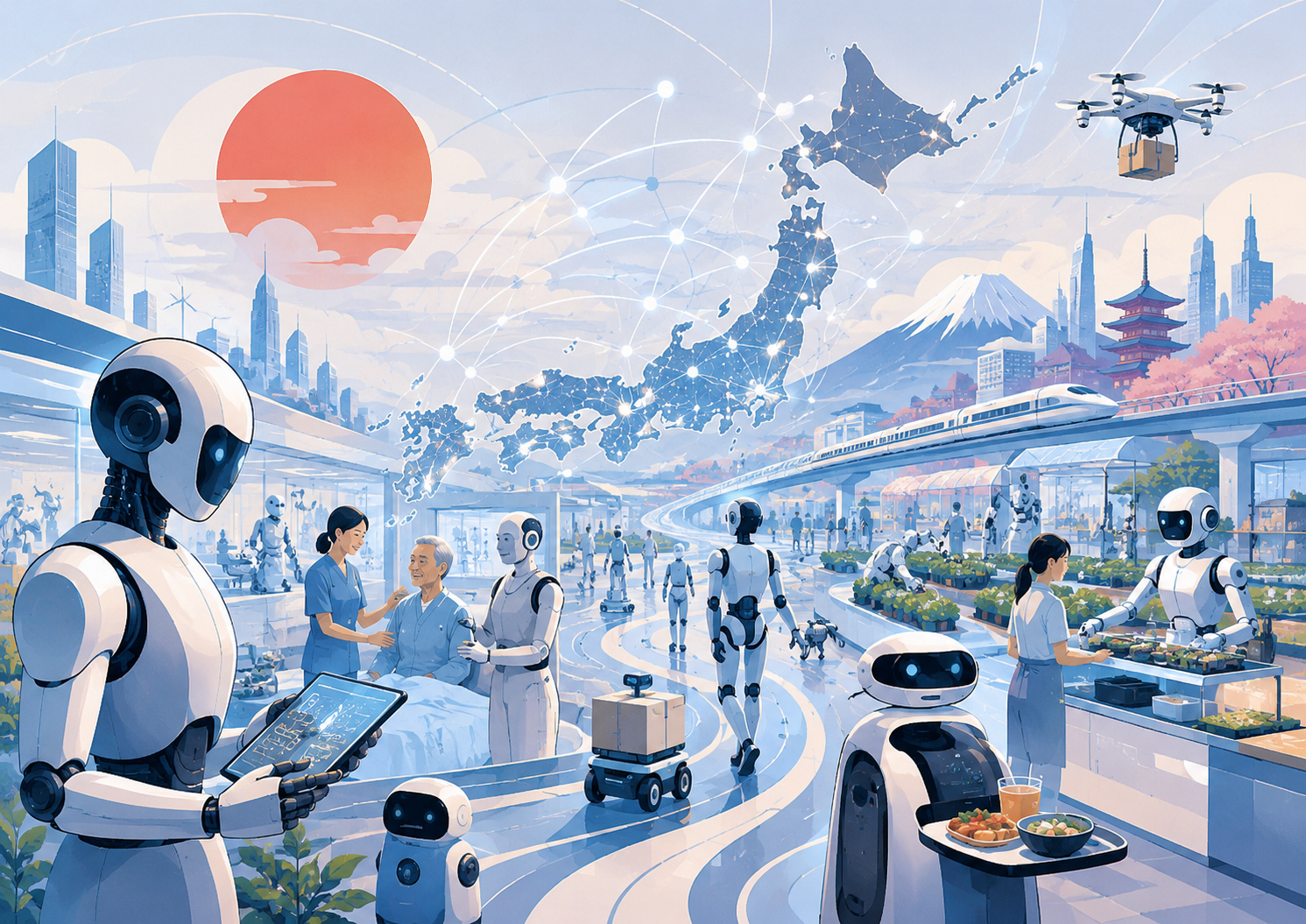
What ten million really means
Japan’s target of deploying approximately ten million robots by 2040 immediately evokes a futuristic robot nation. The actual policy is more practical and more urgent. It is an attempt to sustain eldercare, food production, logistics, healthcare, disaster response and infrastructure as the population and workforce shrink.
METI’s revised AI Robotics Strategy expands social deployment to 18 fields, adding food service, food and beverage manufacturing and healthcare. It also calls for a physical-AI foundation combining data, research, workforce training and corporate adoption.
The scale is enormous. Japan had about 450,500 industrial robots operating in factories in 2024. Reaching ten million requires movement far beyond automotive and electronics plants into hospitals, care homes, kitchens, farms, warehouses, shops, construction sites and local government.
What is Noetra?
Noetra is being organized as a national platform for sovereign AI and physical AI. Reports identify SoftBank, NEC, Sony Group and Honda among the central participants, linking domestic strengths in models, communications, sensors, mobility and robotics.
The aim is not simply to import U.S. or Chinese foundation models. Japan wants AI adapted to Japanese language, domestic industrial processes, safety requirements and robot control. Government support could reach as much as ¥1 trillion over five years, subject to performance.
Noetra is not supposed to build one robot. Its potential value lies in common models, training data, simulation, cloud infrastructure, communications and evaluation tools that many manufacturers and users can share.
Japan is already a robot power
Japan’s robotics strength began with factory automation during the high-growth era. From the 1960s through the 1980s, automotive and electronics plants adopted robots for welding, painting, handling and assembly. FANUC, Yaskawa, Kawasaki Heavy Industries, Mitsubishi Electric and Nachi became global suppliers.
The classic Japanese robot was not humanoid. It was a fast, accurate arm working behind a safety fence. Quality manufacturing, long production runs and supplier coordination made Japan the “robot kingdom.”
Japan remains one of the world’s largest robot markets and producers. It installed 44,500 industrial robots in 2024, bringing operational stock to about 450,500. Yet China now dominates annual installations, and Korea exceeds Japan in robot density. Leadership is no longer automatic.
Success in factories, frustration elsewhere
Japan has repeatedly imagined robots outside factories. Honda’s ASIMO, Sony’s AIBO, Toyota’s partner robots and SoftBank’s Pepper became global icons.
Homes and service environments proved far more difficult. They contain stairs, clutter, wet food, children, pets, narrow corridors and unpredictable human movement. A factory can be redesigned around a robot; a hospital or home requires the robot to adapt.
ASIMO demonstrated remarkable engineering but did not become a mass product. Pepper showed the appeal of robotic customer interaction but struggled to prove consistent operational value. AIBO and LOVOT created a different category based on emotional attachment rather than labor substitution.
The 2040 strategy must move from exhibition technology to machines with clear return on investment.
Physical AI changes the equation
Traditional industrial robots repeat programmed motions. Physical AI combines vision, force sensing, language models and action models so that a machine can understand instructions, perceive surroundings and adapt.
Instead of coding every movement, developers can train a robot to pick a red box, avoid fragile objects and stop when a worker approaches. Robotics foundation models seek the same type of broad transfer that language models achieved with text.
Data is the bottleneck. Robot data is expensive and scarce. Real machines must run for thousands of hours while recording images, force, failure, contact and successful outcomes. Noetra will be judged by whether it can create a trusted system for collecting and sharing that data.
In care, support matters more than replacement
Eldercare is the strategy’s most urgent field. Japan’s care population is growing while recruitment remains extremely difficult. Reuters reported in 2025 that the sector had more than four vacancies for every applicant in parts of the labor market.
Potential tasks include lifting, bathing, monitoring, toileting, meal delivery, recordkeeping, laundry and mobility support. These are technically and ethically difficult because people are soft, unpredictable and vulnerable.
The first successful systems will probably not be fully humanoid nurses. They will be specialized devices for transfer, walking support, monitoring, internal transport, voice documentation and cleaning.
The realistic objective is to preserve human conversation, dignity and judgment while shifting back-breaking and repetitive tasks to machines.
Food becomes a new frontier
The addition of restaurants and food manufacturing is significant. These sectors face severe labor shortages but have resisted automation.
Car parts are uniform. Vegetables, fish, meat and bread vary in size, texture, moisture and shape. Food equipment must also meet strict sanitation requirements.
Better vision, soft grippers, tactile sensors and cheaper collaborative robots could automate bento assembly, dish collection, frying, beverage replenishment, inspection, packing and cleaning.
Small restaurants cannot purchase multimillion-yen engineering projects. Leasing, Robot-as-a-Service, standardized kitchen layouts and simple maintenance will be essential.
Healthcare needs a clear liability line
Medical applications include surgical assistance, pharmacy delivery, specimen transport, rehabilitation, imaging support and cleaning. Internal transport is relatively straightforward; direct physical contact with patients requires much stricter validation.
If a robot injures a patient, responsibility could involve the manufacturer, hospital, AI developer or operator. Regulators must decide how to certify a machine after its learning model changes. Hospitals also need protection against cyberattacks and rules governing medical data.
Mass adoption depends on certification, insurance, incident reporting, cybersecurity and privacy as much as on mechanical performance.
Disaster response and Fukushima
Japanese robot policy is deeply connected to disaster. The 1995 Kobe earthquake and the 2011 earthquake, tsunami and Fukushima Daiichi accident demonstrated the need for machines that can work where humans cannot.
At Fukushima, robots faced radiation, debris, water, narrow passages and failed communications. Many machines broke or became unrecoverable. Those failures advanced remote operation, radiation resistance, mobility and sensing.
The Fukushima Robot Test Field now provides land, sea and air environments for field-robot validation. Disaster response, infrastructure inspection, drones and unmanned vehicles could become major Japanese export strengths.
Ten million cannot mean ten million prototypes
Deployment at this scale requires manufacturing economics. A robot that costs ¥50 million, needs a specialist engineer and stops after a room layout changes cannot spread through regional clinics and restaurants.
Japan needs modular hardware, standard components, common software, simulation, remote maintenance and service contracts. Customers should purchase an outcome—clean floors, transported trays, picked boxes—not a complicated machine.
Robot-as-a-Service can spread capital costs and make suppliers responsible for uptime. It also creates concentration risk if a cloud failure or cyberattack disables thousands of machines at once.
How much labor is ten million robots?
One robot is not one worker. A cleaning robot may replace several hours of floor work but cannot handle customers or emergencies. A hospital transporter may reduce nurses’ walking time but does not make medical decisions.
The useful measures are hours saved, injuries prevented, productivity, wages, turnover and continuity of service. Ten million underused machines would be failure. One million highly productive systems preserving rural healthcare and food supply could be transformational.
Robots will not solve the workforce crisis alone
Japan’s working-age population will continue to decline, and shortages are already severe in care, construction, logistics, agriculture, hotels and restaurants.
Robots are not a substitute for immigration policy, support for women’s employment, older-worker participation, higher wages or better working conditions. A poorly managed low-wage workplace does not become sustainable merely by buying an expensive machine.
Companies must redesign work, digitize records and change buildings and kitchens so machines can operate. Automation is organizational redesign, not equipment procurement.
Safety, surveillance and dignity
Ten million robots equipped with cameras, microphones, location systems and health data would create an enormous sensor network. In homes and care facilities, the boundary between monitoring and surveillance will be difficult.
Users need to know what is recorded, who can see it, where it is stored and whether it trains future models. Consent is especially difficult when patients cannot decide for themselves.
Emergency stops, human supervision, data minimization and continuous safety evaluation will be essential. Japan has promoted international service-robot safety standards, but learning machines require ongoing assessment because their behavior can change after software updates.
The international race has begun
China is investing aggressively in humanoids and factory automation, combining low-cost hardware with manufacturing scale. The United States leads in foundation models, chips, software and venture capital. Korea has extraordinary robot density and an advanced manufacturing base. Europe is strong in industrial machinery, safety standards and collaborative robots.
Japan’s strengths include precision equipment, motors, reducers, sensors, automotive engineering, factory operations and quality control. Weaknesses include software platforms, cloud infrastructure, data sharing, startup scale and slow decision making.
Noetra must be more than a club of large companies. Startups, universities, regional firms and international partners need access to data and development tools.
What success should look like in 2040
- Real use: Publish uptime and continuing adoption, not only units delivered.
- Productivity: Reduce work hours, injuries, absence and turnover.
- Wages: Share automation gains with frontline workers.
- SME access: Make systems affordable for regional hospitals, food plants and farms.
- Exports: Sell solutions refined through aging, disasters and labor scarcity.
- Trust: Establish clear rules for accidents, data and responsibility.
Japan.co.jp view: robotics is social design
Japan’s ten-million-robot plan is not simply a technology fantasy. It is an answer to whether a country with fewer workers and more care needs can preserve living standards.
Japan succeeded with factory robots but repeatedly allowed expectations to outrun service-robot reality. The difference now is the maturity of generative AI, vision models, sensors, communications and semiconductors.
Still, ten million is a target, not an outcome. Value comes from machines that give caregivers more time with patients, move supplies through rural hospitals, remove dangerous work from food factories and protect responders in disasters.
Japan should be judged not by how many robots appear in public, but by whether machines push humans out—or return people to the work only humans can do.
Sources and further reading
- METI Minister Akazawa press conference, June 30, 2026: Ten million robots and deployment across 18 fields.
- METI: Physical AI, robotics data and Japan’s 2040 industrial structure.
- International Federation of Robotics: Japan’s 2024 industrial robot installations and operational stock.
- International Federation of Robotics: Japan’s manufacturing robot density.
- Reuters, February 28, 2025: Care-worker shortages and the AIREC healthcare robot.
- METI Robot Industry Policy: Service robots, safety standards and delivery robots.
- Agency for Natural Resources and Energy: Fukushima Robot Test Field and decommissioning technology.
- The Japan Times, July 1, 2026: Noetra, sovereign AI and the support framework.