- A toy that refused to stay in the 1990s
- The innovation was a relationship, not a screen
- The dangerous economics of a phenomenon
- A second life through connection
- Nostalgia is a platform, not a product plan
- Why pixels can matter emotionally
- From a pocket toy to an international experience
- What the next generation of companion products can learn
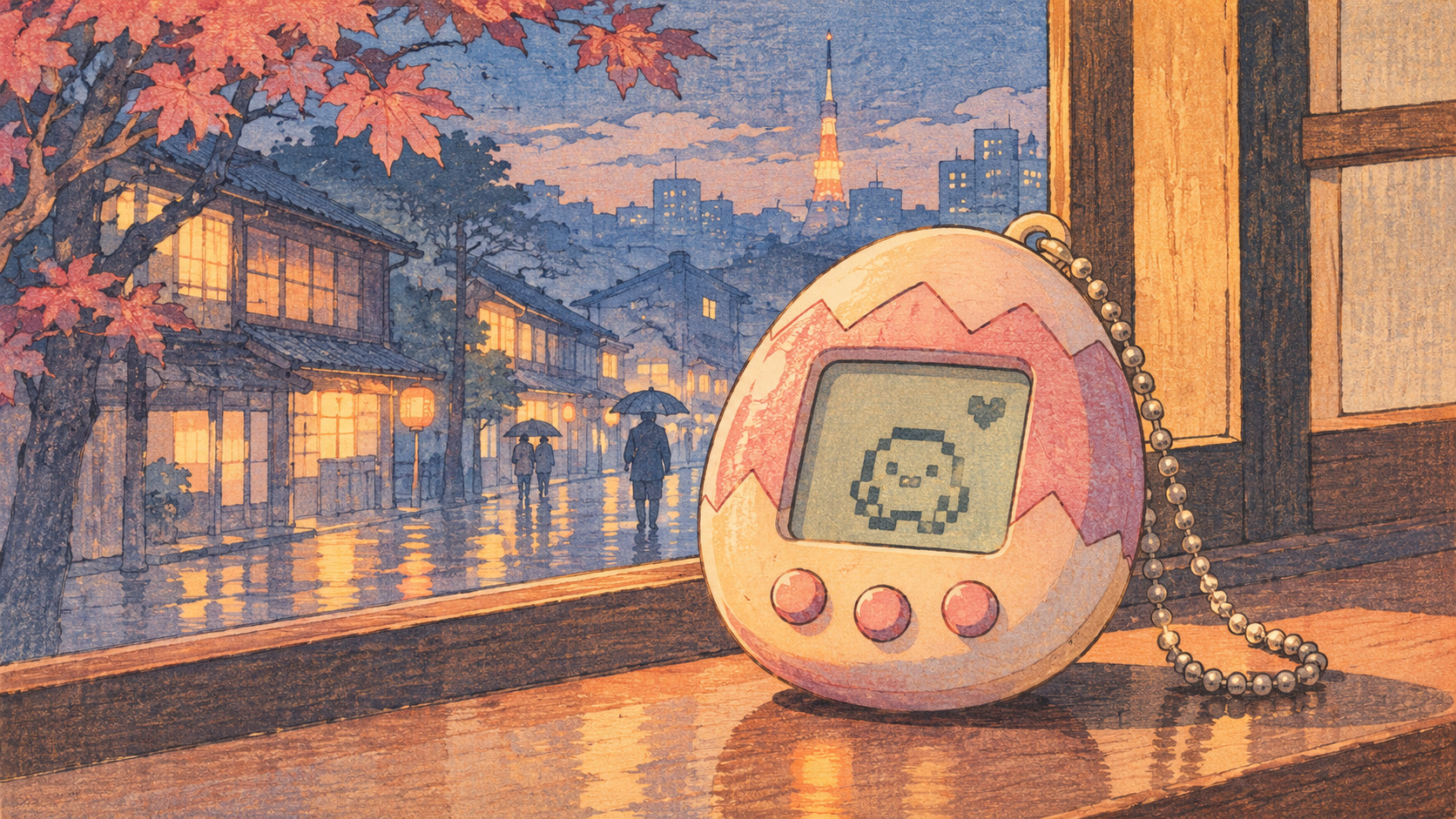
A toy that refused to stay in the 1990s
On November 23, 1996, Bandai introduced a pocket-sized creature that could not survive indefinitely without attention. Thirty years later, its anniversary program spans Tokyo and New York. Bandai advertised a Times Square celebration for November 22 local time, corresponding to November 23 in Japan, while a festival in Harajuku and Shibuya is scheduled through December 6. The anniversary is a useful moment to examine a business that has repeatedly returned from apparent obsolescence.
Bandai’s report on its 2026 children’s journalism program puts cumulative worldwide shipments above 103 million at the end of March. That is a count of devices distributed, not a count of individual owners, active players or revenue. The distinction matters when evaluating a franchise that encourages collecting and repeat purchases.
The innovation was a relationship, not a screen
The early design was conceived as a wearable watch; the eventual ball-chain format made the toy a portable companion. Its name combined the Japanese word for egg with watch. The original audience included Japanese high-school girls, whose bags became a conspicuous place to carry the device.
Unlike an arcade game, the toy made demands outside a conventional play session. The player could feed, clean and entertain a creature whose development depended on care. A failure to attend to it could end its virtual life. A modest screen and simple controls were sufficient because the crucial feedback was personal: something changed because the owner had acted.
The dangerous economics of a phenomenon
An English-language version entered the US market in May 1997. The speed of international demand created a familiar manufacturing dilemma: produce enough to meet the immediate rush, yet avoid committing too much inventory to a trend whose duration is unknowable. Bandai’s corporate retrospective records an extraordinary loss of approximately ¥6 billion for the fiscal year ended March 1999.
The initial collapse matters as much as the spectacular launch. A toy can be culturally omnipresent and still leave a manufacturer with inventory that customers no longer want. The recovery required identifying an enduring form of play beneath a temporary fashion, rather than assuming that the original sales trajectory would return.
A second life through connection
In 2004 Bandai revived the product with infrared communication. Two devices could interact, giving children a reason to bring their pets together. The innovation changed the social context of ownership while preserving the underlying nurturing activity.
Later generations adopted color displays in 2008, touch interfaces in 2021 and Wi-Fi in 2023. Each introduced different possibilities, but the essential feedback loop remained recognizable. The lesson for product designers is not to add connectivity indiscriminately; it is to ask whether a new capability enriches the reason people originally cared.
Nostalgia is a platform, not a product plan
The Original Tamagotchi range introduced in 2018 made older forms of play available in varied designs. A familiar shell can appeal to adults who remember the first wave, while the same simplified interface can be a novelty for children accustomed to multipurpose screens. The two audiences do not necessarily want the same thing.
Tamagotchi Paradise, released in July 2025, takes a different route. Its zoom dial lets players move between scales, from the creature’s internal world to its habitat and beyond. This expands the scope of nurturing without requiring the company to abandon the classic device. Maintaining both approaches gives the franchise ways to serve collectors and players seeking unfamiliar experiences.
Why pixels can matter emotionally
A virtual pet does not need to be sentient for its owner to experience genuine concern. Repeated care, visible consequences and a sense of responsibility can encourage people to attribute individuality to a digital object. This is an interpretation of the design, not proof that every player develops an emotional attachment.
In their 1999 essay Disposable Love, Linda-Renée Bloch and Dafna Lemish examined the toy through the lens of nurturing and disposable consumer culture. Mark D. Jones’s small focus-group study found that older participants tended to emphasize peer relationships, while younger participants were more directly interested in their virtual pets. The limited sample prevents broad generalization, but the work helps explain why the same device can serve both private and social purposes. Neither study establishes a clinical benefit or demonstrates that software experiences emotion.
From a pocket toy to an international experience
The anniversary program combines physical retail, public events and online platforms. The Tokyo festival uses an imaginative archaeological theme; the New York program advertised demonstrations and a synchronized screen presentation. A November collaboration in Roblox extends the campaign to people who may never have owned an original device.
These are distinct channels for discovery, not evidence of equivalent sales or engagement. Bandai has not supplied audited attendance or incremental revenue in the announcements reviewed for this report. The business question is whether these encounters can become lasting relationships rather than a burst of anniversary publicity.
What the next generation of companion products can learn
Modern digital companions can sustain far more elaborate interactions than a 1990s toy. Yet Tamagotchi offers a reminder that sophisticated computation is not the only path to meaningful engagement. Clear feedback, comprehensible rules and the ability to build a personal history with an object can be powerful design choices.
There is also a boundary worth protecting: a product that demands attention can become a source of pressure. Good companion design should respect a user’s ability to disengage. For Bandai, the challenge of the next thirty years is to keep nurturing enjoyable while changing the surrounding technology. The achievement of the first thirty is not that the original boom never ended, but that the idea survived its ending.
Primary sources and further reading
- Bandai: 100 million shipments, August 2025
- Bandai: anniversary and development history
- Bandai: March 2026 shipment total
- Official product chronology
- Official Tokyo festival
- Official New York anniversary program
- Official Paradise gameplay
- Bloch and Lemish (1999): Disposable Love
- Mark D. Jones: Virtual Pet Ate My Homework
- Mezamashi Media: original developer retrospective, November 23