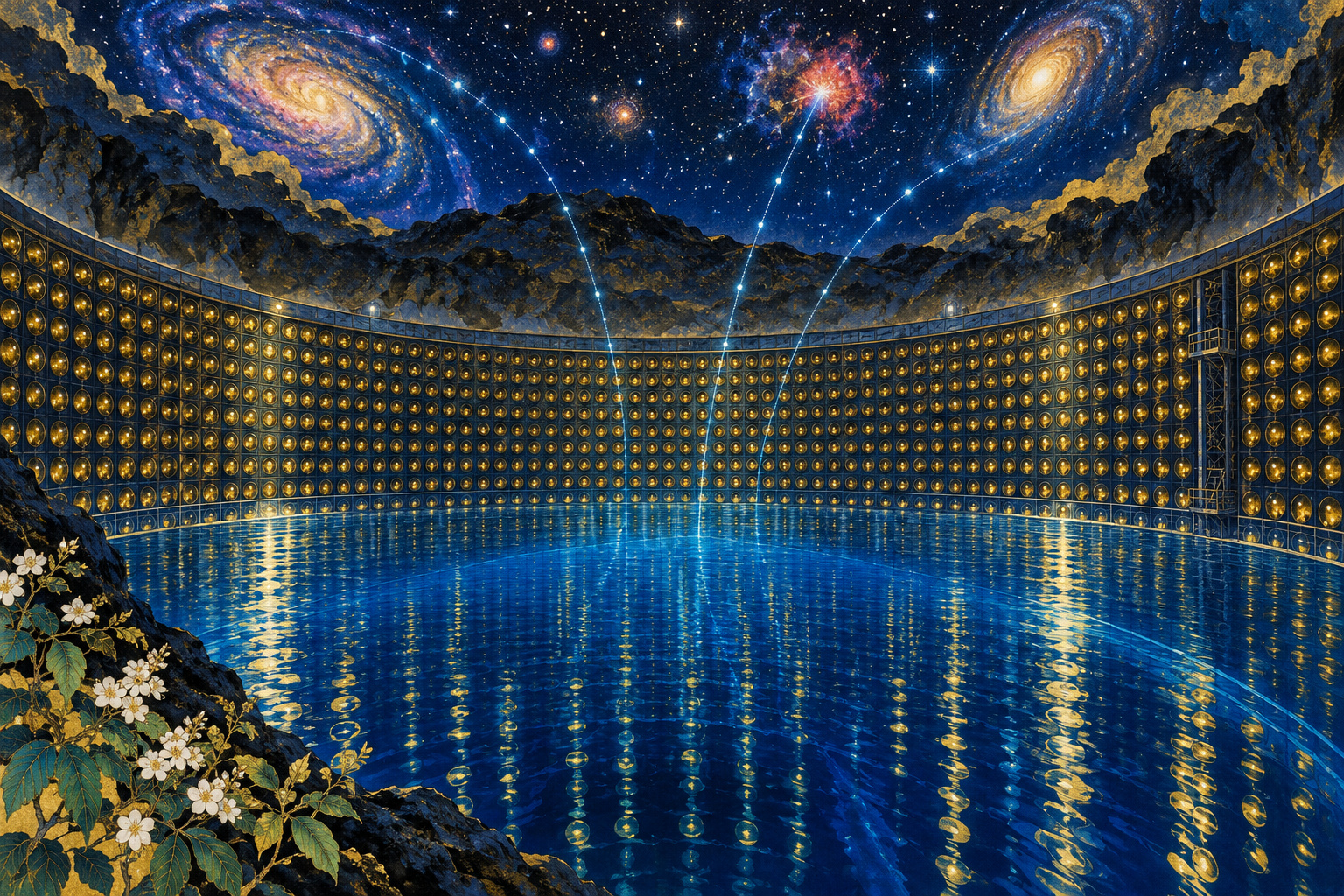
Super-Kamiokande’s tentative signal from past stellar explosions offers a possible new way to study cosmic history—but it remains short of a discovery. Okayama University highlighted the work in a September 22 release. The underlying result was presented at Neutrino 2026 on June 25, rather than newly established this month.[1]
A population of stellar deaths
The diffuse supernova neutrino background, or DSNB, is the combined neutrino flux from core-collapse supernovae across cosmic history. It is different from a burst associated with one nearby explosion. A confirmed measurement could help researchers examine the history of star formation.[2]
The collaboration combined 3,349 days of pure-water observations with 1,653 days after gadolinium was introduced, reporting a 2.6-sigma indication.[2] Its announcement explicitly distinguishes that result from the five-sigma benchmark for discovery.[3]
Why adding gadolinium helps
An electron antineutrino interacting with a proton in water produces a positron and a neutron. Gadolinium helps capture the neutron, producing a delayed light signal that can be paired with the initial signal. The additional information helps distinguish candidate events from background.[4]
The engineering includes a purification system that keeps the water clear while retaining gadolinium, together with materials prepared to limit radioactive contamination.[4] For readers interested in scientific instrumentation, that is a concrete reminder that sensitivity depends on managing the detector environment as well as collecting light.
What 2.6 sigma does—and does not—mean
Statistical significance measures how incompatible the data are with a specified hypothesis, such as an expectation of background events alone. ATLAS at CERN explains sigma in those terms.[5] It does not directly assign a probability that an astrophysical interpretation is true.
The collaboration’s quoted 99.5% confidence level therefore should not become “a 99.5% chance this is DSNB.” Statistical fluctuations and uncertainty in the background assessment remain relevant. The collaboration calls for further data and improved analysis before a definitive detection.[3]
The next test is stronger evidence
Japan.co.jp’s analysis is that future reports should be assessed on more than the size of the dataset. Readers should also ask how backgrounds are estimated, how uncertainties in the detector and analysis are handled, and whether the interpretation remains consistent as the evidence grows.
The importance of the result lies in the observational possibility it opens. Keeping the distinction between an indication and a discovery clear allows that possibility to be taken seriously without presenting an unsettled signal as a settled account of the universe.
