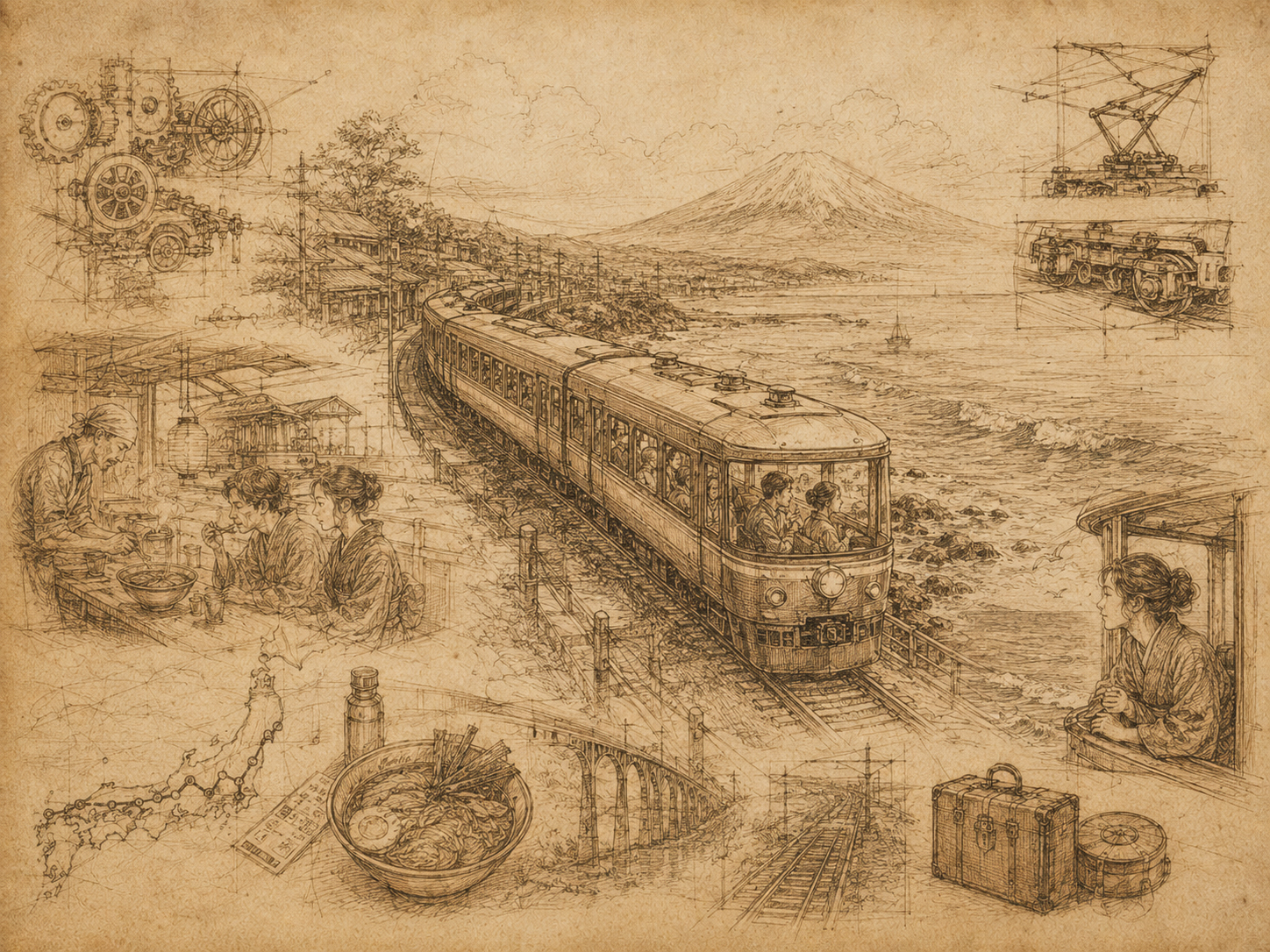
Boarding a train at Kyoto Station after dark still feels like the beginning of an old Japanese story. The city lights thin out after Shin-Osaka and Osaka. By Wakayama, the journey has changed temperature. The train is no longer simply moving passengers. It is carrying them through the night, toward the Pacific, toward Kumano, toward a slower version of Japan.
For summer 2026, JR West’s WEST EXPRESS GINGA is back on the Kinan route. According to JR West, the service runs from July 3 to September 30, linking Kyoto and Shingu. The southbound service is an overnight limited express from Kyoto and Osaka to Shingu; the northbound return is a daytime limited express from Shingu back to Osaka and Kyoto. The planned frequency is about two round trips per week.
The timetable is part of the romance. The overnight train leaves Kyoto at 9:13 p.m., stops at Shin-Osaka, Osaka and Wakayama, reaches Kushimoto at 6:50 a.m., Kii-Katsuura at 9:05 a.m., and Shingu at 9:35 a.m. The daytime return leaves Shingu at 1:05 p.m. and reaches Kyoto at 8:53 p.m. This is not the fastest way to move through Japan. That is the point.
JAPAN.co.jp is treating this as more than a travel item. Japan’s overnight trains have almost vanished. The age of the Blue Trains is over. Yet sightseeing trains, cruise trains and regional rail experiences are becoming more important. GINGA’s summer run shows how Japanese rail culture has learned to sell time, scenery and regional identity after the age of pure speed.
The 2026 Kinan Route
WEST EXPRESS GINGA is not an ordinary train. JR West frames western Japan as a universe, with each region as a star, and GINGA as the train that connects them. The Kinan route links the metropolitan gravity of Kyoto and Osaka with the southern Wakayama coast: Kushimoto, Koza, Taiji, Kii-Katsuura and Shingu. For travelers, the drama is simple and powerful: leave the city at night, arrive at the gateway to Kumano in the morning.
The route’s design matters. Southbound, it is an overnight journey. Northbound, it is a daylight scenic ride. The same railway becomes two different trips. One is about sleep, anticipation and darkness. The other is about the Pacific, fishing towns, mountains, stations and the long slow return to Kansai.
SoraNews24 described the 2026 run as one of Japan’s most distinctive summer sightseeing trains, highlighting the overnight schedule, the daytime return, the Kii Peninsula scenery, ramen stops and ocean views. Those details are not decorations. They are the product. The modern sightseeing train sells the in-between moments that faster transport erases.
Why Japan’s Night Trains Disappeared
To understand why GINGA feels special, it helps to remember what Japan once had. For decades, overnight expresses and sleeper limited expresses connected the country. Tokyo to Kyushu. Kansai to Tohoku. Honshu to Hokkaido. Blue Trains such as Sakura, Hayabusa, Fuji, Asakaze, Hokutosei and Twilight Express were not just transport. They were moving hotels, restaurants, lounges and dreams.
During the high-growth decades and into the 1970s and 1980s, sleeper trains were practical and emotional. Business travelers, students, families and honeymooners all shared the same nocturnal railway world. The platform at departure time had a ceremonial atmosphere: luggage, destination signs, berth numbers, boxed meals, goodbyes, steam or electric hum, and the sense that morning would bring another region.
Then the system changed. Shinkansen speeds rose. Domestic flights grew. Highway buses took night demand. Hotels became more plentiful. Rolling stock aged. Sleeper trains were expensive to maintain and difficult to fit into busy daytime networks. One by one, the great overnight services disappeared.
Today, the Sunrise Seto and Sunrise Izumo are widely described as Japan’s only remaining regularly scheduled sleeper trains. They still run daily between Tokyo and western Japan, splitting at Okayama for Takamatsu and Izumo. But they are the exception that proves the rule: the old night-train map has been reduced to a precious remnant.
GINGA Is Not a Blue Train. It Is a Regional Stage.
WEST EXPRESS GINGA is not a simple revival of the classic sleeper express. It is a long-distance sightseeing train rebuilt from 117 series electric stock, designed around regional experience, shared spaces, onboard atmosphere and local hospitality. It is not only about sleeping. It is about turning the hours onboard into the opening act of the destination.
This is the essence of the modern Japanese sightseeing train. The railway company is no longer merely selling transport from Point A to Point B. It is editing the route. It chooses longer stops, scenic timing, local food, onboard interpretation and regional partnerships. Passengers are carried not just across distance, but through a narrative.
The Kinan route is especially strong because the destination is strong. Southern Wakayama has Kumano Kodo pilgrimage routes, Nachi-Katsuura, Taiji, Kushimoto, Koza River, Shingu, Kumano Sanzan, hot springs, fishing ports, mountains and sea. It is far from the main Shinkansen spine. That distance is not a weakness for this kind of trip. It is the reason the journey matters.
The Small Happiness of a Ramen Stop
One reason the summer service attracted attention is the idea of ramen stops. The combination is irresistible: an overnight train, a long station stop, a bowl of hot noodles, and the feeling that travel has slowed enough for appetite to matter. It recalls an older railway culture of ekiben, platform noodles, station kiosks, night halts and meals that belonged to a specific place.
On a Shinkansen trip, stops are short. On a flight, meals are controlled by the airport or cabin. On a sightseeing train, the stop itself can become part of the attraction. The train waits. Passengers step onto the platform. The station has light. Steam rises from bowls. The meal is brief, but it lodges in memory.
Rail travel is built from these margins. Looking out the window. Reading an unfamiliar station name. Stepping onto a platform to breathe different air. Eating something local before the destination officially begins. A ramen stop is not efficient. It is better than efficient: it is memorable.
Ocean Windows on the Kii Peninsula
The other star of the Kinan route is the Pacific. The Kisei Main Line, known along this stretch as the Kinokuni Line, threads between mountains and sea. Around Kushimoto, Koza, Taiji, Kii-Katsuura and Shingu, the railway passes fishing towns, coves, rocky coastline, wooded slopes and sudden windows of ocean.
Trains and coastlines belong together. In a car, someone must drive. In a plane, the coast is a blur. On a train, the view becomes a shared room. Passengers can watch the sea without having to manage the journey. When the ocean appears, the carriage changes mood: cameras rise, conversations pause, and everyone briefly looks the same way.
Japan National Tourism Organization promotes scenic railways as routes into the natural beauty and essence of the regions. The Kinan route fits that language perfectly. A coastal train does not merely show scenery. It connects geography, food, ports, pilgrimage, fishing culture, hot springs and local memory into one continuous line.
A Railway Pilgrimage to Kumano
There is also a deeper historical resonance in traveling from Kyoto to Shingu. Kumano was one of Japan’s great sacred destinations. For centuries, emperors, retired emperors, aristocrats, warriors and commoners made pilgrimages toward Kumano. They walked, crossed mountains, endured weather, and entered a religious landscape of shrines, forests, waterfalls and sea.
Today’s travelers enter by rail rather than on foot. Yet the structure of the journey still echoes the old pilgrimage: leave the capital region, move through darkness and distance, and arrive at the threshold of Kumano. The train is not a religious act, but travel forms can awaken old meanings.
Shingu is the town of Kumano Hayatama Taisha. Kii-Katsuura is the gateway to Nachi Falls and Kumano Nachi Taisha. Taiji carries a complicated maritime history. Kushimoto holds the ocean edge of Honshu and a story of international contact. GINGA’s route turns those separate dots into a line. Rail, at its best, draws story across a map.
What Rail Can Do in the Age of Overtourism
Japan in 2026 faces a tourism paradox. Visitor demand is strong, but pressure is concentrated. Kyoto buses are crowded. Fuji has new controls. Accommodation prices have climbed. Residents in famous places are frustrated. Yet many regions still want more visitors, more overnight stays and more attention.
Rail can help rebalance that map. It can move travelers away from the most crowded nodes and into regional corridors. It can turn the route itself into the attraction. It can package lodging, food and local stops into a manageable rhythm. It can encourage visitors to experience places that are not always easy to reach by Shinkansen.
A train like WEST EXPRESS GINGA does not solve overtourism by itself. It is too limited and too curated for that. But it points toward a healthier model: fewer people moving more slowly, staying longer, and understanding the places between the famous names.
Slow Travel Has Become a Luxury
There was a time when taking the train was simply practical. Now, in a country of bullet trains, domestic flights and night buses, a slow overnight sightseeing train is a choice. It is not necessary. That is why it has value.
Modern travel is optimized. Apps find the shortest path. Tickets are stored on phones. Hotels are compared instantly. The temptation is to compress everything: more cities, more photos, less time. A train like GINGA resists that logic. It asks the traveler to spend time rather than save it.
That may be the deepest reason night trains still move people emotionally. Sleeping while moving, passing unknown stations in the dark, waking up to a different landscape — these are experiences that cannot be reduced to arrival time. They belong to the old romance of travel, but they may also be part of its future.
Reader’s Guide
| Item | Details |
|---|---|
| Train | WEST EXPRESS GINGA, Kinan route |
| Operating period | July 3 to September 30, 2026 |
| Route | Kyoto to Shingu |
| Southbound | Overnight limited express from Kyoto, Shin-Osaka and Osaka toward Shingu |
| Northbound | Daytime limited express from Shingu toward Osaka and Kyoto |
| Main stops | Kyoto, Shin-Osaka, Osaka, Wakayama, Kushimoto, Koza, Taiji, Kii-Katsuura, Shingu |
| Why it matters | Night-train nostalgia, coastal views, Kumano access, regional food, and slow travel |
JAPAN.co.jp View
The Kinan route of WEST EXPRESS GINGA shows what Japanese rail has lost and what it has gained. What it lost is the nationwide web of ordinary night trains. What it gained is the ability to turn movement into a carefully edited regional experience.
The old night-train era may not return. But leaving the city at night and arriving by the sea in the morning still has power. Ramen stops, ocean windows, Kumano mountains, summer darkness, long station pauses — these are forms of Japan that speed alone cannot reveal.
Japan’s next tourism challenge is not only to move people faster. It is to move them more deeply. GINGA’s summer run sketches one answer on the rails between Kyoto and Shingu.
Sources and references
This article draws on JR West’s official WEST EXPRESS GINGA information, Kinan-route operating data, SoraNews24’s July 2026 feature, Japan National Tourism Organization scenic-rail resources, and public background on Japan’s surviving sleeper-train culture.
- JR West: WEST EXPRESS GINGA Kinan route operating information.
- JR West: WEST EXPRESS GINGA official page.
- SoraNews24: Japanese overnight sightseeing train returns for summer with ramen stops and ocean views.
- JNTO: Scenic Railway Journeys.
- Inside Kyoto: Sunrise Seto and Sunrise Izumo guide.