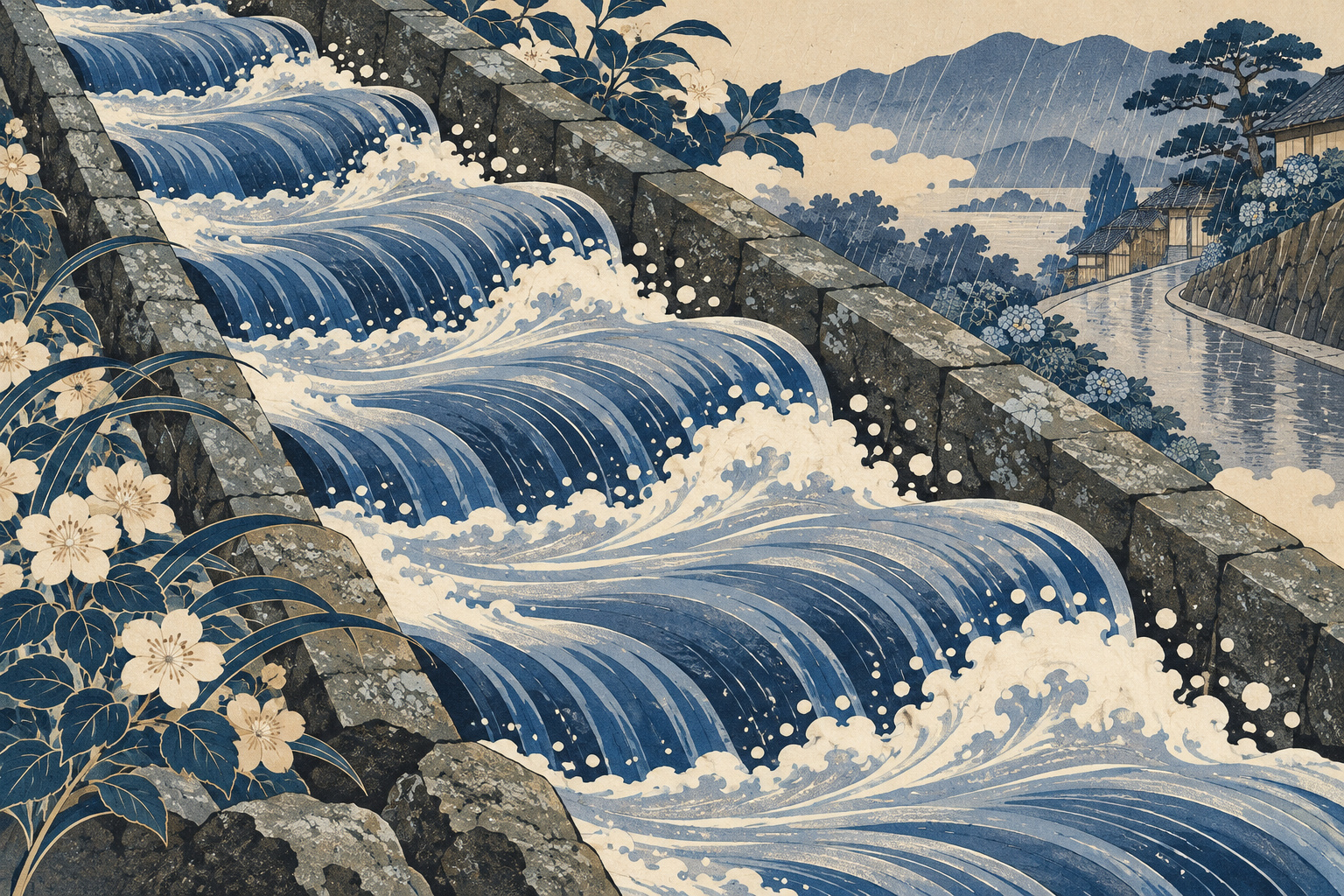
A smooth water surface can be a misleading picture of a steep channel. Under certain conditions, the flow develops a procession of surges: raised fronts followed by shallower water, travelling downhill in a repeating pattern. Kyoto University researchers have returned to the mathematics of these “roll waves” to ask a consequential engineering question: when a uniform flow exists as a solution on paper, can it actually persist?[1]
The study is by Koichi Unami, an associate professor in Kyoto University’s Graduate School of Agriculture, master’s student Yuka Matsutoku and Professor Dia Zeidan of German Jordanian University. Their paper appeared in Physics of Fluids on September 15, followed by Kyoto’s announcement on September 16. Unami’s research programme connects mathematical analysis with hydraulic and rural water problems.[1][3][4]
The distinction between an answer and a lasting flow
According to the university’s detailed account, the team established that uniform flow can be unstable under the conditions examined, despite being a solution of the one-dimensional shallow-water equations. It also established travelling roll-wave solutions containing discontinuities and used numerical experiments to examine their development.[2]
The distinction is easy to overlook. A balance can be mathematically exact without being resistant to disturbance. In practical terms, finding an ideal depth and velocity is a different task from asking what happens when conditions depart slightly from that ideal.
Consider the information in two descriptions of a channel: one gives the average water depth; the other records the water level as successive surges pass. The average may be useful, but it cannot by itself tell a reader how high each passing front rises. This is the editorial significance of the study: a satisfactory reference calculation is the beginning of the question about variability, rather than its conclusion.
| Term | What it describes |
|---|---|
| Uniform flow | Depth and mean velocity do not vary along the channel. |
| Steady flow | The flow at a fixed location does not change with time. |
| Stability | How a reference flow responds to disturbances. |
A travelling pattern can retain its shape while producing a changing water level at a stationary observation point. Following the wave and standing beside the channel give different views of the same motion.
What the equations keep—and simplify
Shallow-water models track depth and depth-averaged motion through conservation of mass and momentum. Their basic approximation is especially useful when the horizontal wavelength is long compared with water depth. They simplify vertical structure instead of calculating every detail of three-dimensional movement.[5]
That simplification makes a question manageable, but also defines its scope. Before taking a mathematical conclusion to a particular structure, an engineer must ask whether the omitted processes are important there. A proof within a model and evidence that the model fits a site are complementary forms of knowledge.
Gravity drives water downslope while bed resistance opposes its movement. Their balance can define a uniform reference flow without guaranteeing that disturbances decay. Roll-wave research examines how those disturbances grow; the onset depends on the treatment of resistance and the bed, as well as the flow. Slope alone is not a universal test.[6]
Allowing a sharp front without abandoning physics
The new analysis uses weak entropy solutions. Kyoto explains this as a way to accommodate discontinuities through an integral formulation, with an additional rule selecting physically admissible changes. A sharp front need not end the mathematical description merely because the ordinary smooth description fails there.[2]
“Weak” is a technical description of how the equations are satisfied, not a judgement that the evidence is weak. Conservation across a moving front still imposes constraints. Entropy conditions distinguish allowable shocks from mathematical connections that would describe the wrong physical evolution.[5]
This matters for interpreting simulations. A pleasing animation is not its own validation: a pattern must be consistent with the equations and the physical restrictions imposed on their solutions. Conversely, smoothing away every abrupt feature risks removing something the calculation ought to represent. The useful relationship is a two-way check between theory and computation.
A long history behind a new paper
Roll waves were not discovered in 2026. A 2004 investigation by N. J. Balmforth and S. Mandre traces detailed observations to Cornish in 1910, instability analysis to Jeffreys in 1925, and the construction of discontinuous wave profiles to Dressler in 1949. Balmforth and Mandre also examined how bed topography changes instability and how waves overtake and merge, altering the spacing of a wave train.[6]
The historical lesson is that observation, mathematical existence and the evolution of a disturbed flow are separate research questions. A century of work on the phenomenon does not make every formulation interchangeable. It does mean that the latest contribution should be described as a further examination of the governing mathematics, rather than the first explanation that water can become wavy.
What the challenge to engineering standards means
Kyoto’s announcement argues that design approaches assuming stable, steady conditions can overlook important unsteady behaviour. That is the research group’s criticism of design assumptions. It is not a published inspection finding that every Japanese spillway is defective, or that a particular dam is unsafe.[1]
In Japan.co.jp’s assessment, the productive engineering question is more specific: for the channel being considered, what disturbances can develop, and how would the resulting flow differ from the reference calculation? Answering it requires connecting the model to the structure’s geometry and operating conditions, then checking the response with suitable calculations, observations or hydraulic experiments.
There is no universal replacement design dimension in the university’s announcement. Nor does mathematical instability alone quantify an eventual wave height at a real site. The route from a theoretical warning to a design decision requires those additional steps. Keeping them visible makes the research more useful, not less significant.
Fishways pose a different test
The researchers propose future work on fishways, which help fish pass barriers. Their idea concerns a balance between the resistance fish encounter when swimming upstream and the current stimulus associated with rheotaxis, their response to flow. This is a proposed research direction, not a demonstrated improvement in fish passage.[2]
Japan’s fishway work already has a history of connecting hydraulics with ecology. The river bureau of the Ministry of Land, Infrastructure, Transport and Tourism published its fish-passage handbook in March 2005, drawing on a model programme begun in fiscal 1991. Its introduction places fishways within the wider task of restoring connected, suitable river habitat.[7]
The design chapter considers the swimming ability and endurance of target species. It recognises that an excessively weak current may fail to encourage upstream movement, while warning that waves, eddies and excessive aeration in pool-type fishways can make passage difficult. It also favours a choice of flow conditions where species have different abilities.[8]
That creates a demanding test for the proposed roll-wave application. The relevant outcome would be successful passage by the intended fish under relevant conditions, rather than the mere production of a visually regular wave. A fish responding to a current and a fish reaching the upstream end are different observations.
The experiment continues after construction
The handbook’s adaptive-management chapter explicitly recognises that a built fishway may not reproduce its intended velocity or achieve its expected passage performance. It calls for monitoring, identifying causes and revising the structure or design when necessary. Riverbed changes after construction are another reason a facility may cease to function as intended.[9]
This existing framework provides a sensible setting for evaluating a new idea. Mathematical analysis would establish the proposed flow behaviour; controlled testing would check whether it can be produced; biological observation would determine whether it helps the fish. Success at one stage should not be treated as a substitute for the next.
The modest waves on a steep surface therefore lead to a substantial question about how knowledge reaches infrastructure. A solution must be more than available in an equation. Its response to disturbance, its relevance to the site and its actual consequences all need examination. Kyoto’s work brings attention to the first of those tests, while pointing toward others that remain to be done.
Sources and methodology
The new findings are reported from Kyoto University’s detailed Japanese release. Earlier research and official Japanese fishway guidance provide context. Mathematical results, attributed design criticism and proposed applications are distinguished.
- Kyoto University: Japanese research announcement, September 16, 2026; researchers, findings and attributed design implications
- Kyoto University: detailed three-page release, including mathematical approach, weak entropy solutions and proposed fishway research
- Unami, Zeidan and Matsutoku, Ill-posedness of uniform flows and formation of roll waves in the one-dimensional shallow water equations, Physics of Fluids 38, 094116 (2026). Bibliographic details cross-checked against Kyoto’s release
- Kyoto University researcher database: Koichi Unami, Japanese name and reading, affiliation, position and research interests
- Clawpack, Riemann Problems and Jupyter Solutions: shallow-water equations, shock conditions and physical admissibility
- Balmforth and Mandre, Dynamics of roll waves, Journal of Fluid Mechanics 514, 1–33 (2004), author-hosted paper; history, bed effects and wave coarsening
- MLIT River Bureau: fish-passage handbook, March 2005, cover and introduction; programme history and habitat context
- MLIT fish-passage handbook, section III-4, Design, especially printed page 54 on flow conditions and swimming ability
- MLIT fish-passage handbook, section III-9, Adaptive Management, printed pages 86–87