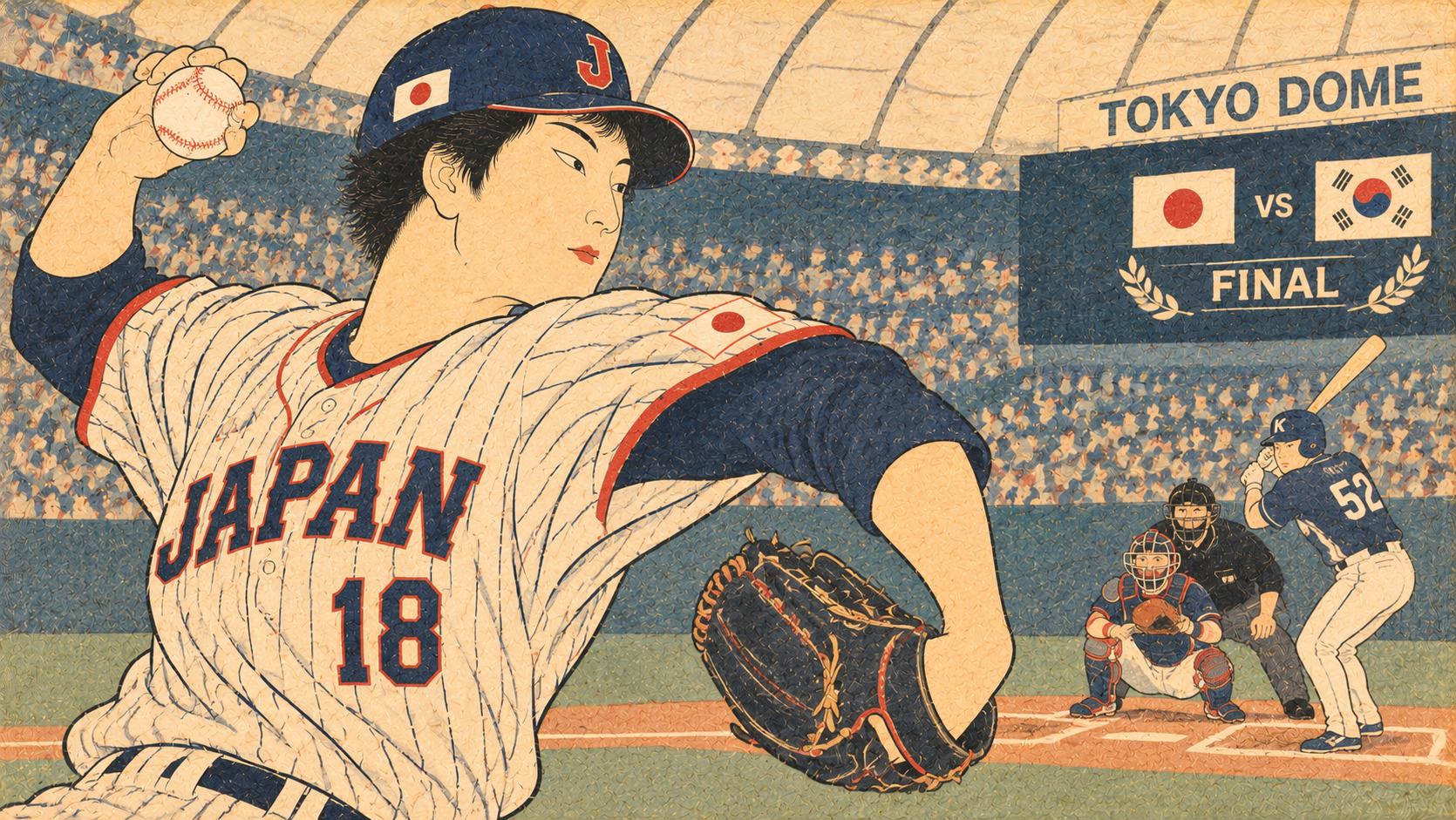
- The same opponents, a different championship
- Why the earlier 9–5 game was closer than it looks
- A confirmed duel: Hiroto Takahashi versus Kim Geon-woo
- South Korea's route makes this more than an undefeated team's coronation
- How a new tournament became a recurring Japan–Korea final
- What the tournament actually means by emerging talent
- Tokyo Dome and four different baseball systems
- What to watch beyond the first inning
- The result belongs to November 15; its meaning may last much longer
The same opponents, a different championship
Japan and South Korea are scheduled to meet at Tokyo Dome at 7 p.m. Japan time on November 15 for the 2026 Asia Professional Baseball Championship final. They know each other unusually well for teams drawn together in a four-day international tournament: Japan won their November 13 encounter 9–5, and the nations contested the championship games in both 2017 and 2023. But the final is not a replay. It offers a new pitching matchup, a different set of decisions and a trophy that cannot be awarded on the strength of preliminary results.
Japan entered the title game with three victories: 5–0 against Chinese Taipei, 9–5 against South Korea and 16–1 against Australia. South Korea took a more difficult route, losing 8–7 to Australia and 9–5 to Japan before recovering to beat Chinese Taipei 6–4. Those contrasting paths have generated a compelling rematch between undefeated momentum and a team that has already endured setbacks.
This account is anchored in official results available through November 14 and the announced starting pitchers. The game itself was still in the future when this version was prepared. No championship score, winner or postgame reaction has been reported here as fact. A November 17 publication must incorporate the official final result. That's not a small addendum: it will determine the article's news opening and conclusion.
Why the earlier 9–5 game was closer than it looks
A score of 9–5 can sound decisive, yet the last meeting between these teams contained a remarkable late reversal. Japan led through seven innings, but South Korea scored four runs in the top of the eighth to draw level at 5–5. Japan immediately answered with four of its own in the bottom half and held on. That sequence tells far more about the challenge facing both bullpens than the four-run final margin alone.
The NPB box score recorded ten Japanese hits and eight Korean hits before 38,385 spectators. Japan committed no error; South Korea made one. Rui Muneyama's two home runs became the story of the evening, giving the Japanese lineup an explosive middle-order threat. But the Korean rally was just as instructive: it exposed how quickly a lead can disappear when hitters reach base in succession.
The teams now return to the same field, but facing newly selected starters and a higher-stakes occasion. Managers will have evidence of how individual hitters handled previous pitchers, yet changing tactics from one appearance to another is part of the attraction of elite baseball. One night's offensive rhythm is not a reliable prediction of the next.
A confirmed duel: Hiroto Takahashi versus Kim Geon-woo
Japan's federation named Chunichi Dragons right-hander Hiroto Takahashi, wearing number 19, as its scheduled starter for the final. South Korea is due to counter with SSG Landers pitcher Kim Geon-woo, number 39. These are official announcements, not reports that the two have already pitched. Starting assignments can change, and the definitive pitching lines must come from the game box score.
A championship game places the starting pitcher within a broader sequence of decisions. How long should he remain when runners reach base? Which relievers are available following three consecutive days of tournament play? Can a lineup adjust after a dominant opening inning, or does a manager need to alter its approach? The late surge in the November 13 encounter underlined how vital timing can be.
The tournament permits a pitch clock and lists no formal individual pitch limit. That does not erase the physical demands of pitching, nor does it disclose how either team will manage its staff. Tactical analysis should be grounded in observable game events rather than imagined private plans from either dugout.
South Korea's route makes this more than an undefeated team's coronation
South Korea did not arrive as the event's most consistent side. Australia beat it 8–7 on the opening afternoon; Japan then won 9–5. Still, Korea remained alive long enough to defeat Chinese Taipei 6–4 on November 14 and secure the second place in the round robin. In this format, a rocky opening two games did not eliminate the possibility of playing for the title.
That matters because a final can reward improvement as much as early dominance. A team that has struggled with run prevention must learn what to change quickly, under the pressure of a short schedule. South Korea's return to the title game confirms resilience in the limited sense that it recovered sufficiently to qualify. It does not tell us how the final will unfold.
The other two participants were not mere spectators to the Japan–Korea rivalry. Australia defeated South Korea, and Chinese Taipei earned a victory over Australia. Every result influenced the path toward the final. A responsible account of Asian baseball acknowledges all four professional baseball communities rather than treating the tournament as a two-nation exhibition.
How a new tournament became a recurring Japan–Korea final
The Asia Professional Baseball Championship began in 2017 with Japan, South Korea and Chinese Taipei. At Tokyo Dome, Japan beat South Korea 8–7 in preliminary play and then 7–0 in the inaugural final. It was conceived as a competition for younger professionals, a stage on which emerging players could experience international baseball before the more established senior championships.
In 2023, Australia joined to create a four-team field. Japan beat Korea 2–1 in the round robin, then won an extraordinary 4–3 final. Japan's Makoto Kadowaki was named the tournament's most valuable player, while the all-tournament team included players from several of the participating countries and regions. The point was wider than the name on the trophy: the event produced a record of young professionals moving into the international spotlight.
The 2026 matchup will be a third straight Japan–South Korea final if the scheduled game proceeds as announced. Yet each edition features different rosters, different coaching choices and new circumstances. History can give the rematch emotional resonance without deciding its outcome in advance.
What the tournament actually means by emerging talent
Calling this an under-24 competition oversimplifies the eligibility rules. For 2026, the tournament allows rosters of 28 players, generally selecting those aged 24 or younger or within their first three professional seasons. Up to three over-age players aged 29 or younger can be included, and the regulations provide a conditional exception for certain roster difficulties with consent from participating organizations.
These provisions are part of the championship's design. They balance prospects still establishing themselves in domestic leagues with a limited number of more experienced contributors. The event can test adaptability: unfamiliar pitchers, cross-league scouting, game management over four consecutive days and the psychological demands of playing for a national team.
An individual performance here is significant but not definitive. A player who thrives in four games has demonstrated ability under a particular set of conditions; it does not automatically follow that he will become a senior national-team star. The more interesting question is how international opportunities accelerate or reshape professional development over subsequent years.
Tokyo Dome and four different baseball systems
Japan's domestic professional game, South Korea's KBO, Chinese Taipei's CPBL and Australian baseball have developed through different histories and institutional structures. Their players arrive at the same ballpark carrying different styles, training practices and league experiences. Japan and Korea attract significant interest, but the diversity of the field gives the championship much of its developmental value.
The four national or regional baseball organizations co-host the 2026 event. Tokyo Dome, familiar from Japanese professional baseball and previous international tournaments, provides a highly visible setting. The atmosphere is important, but so are technical details: teams must work with standardized international baseballs, adjust to game regulations and prepare for opponents that may be less familiar than domestic league rivals.
The competition also demonstrates why one dramatic score cannot stand in for a region's sporting hierarchy. Japan's 16–1 victory over Australia came a day after Australia had beaten South Korea 8–7 earlier in the tournament. Baseball generates swings large enough to upset simplistic rankings, especially in a short series with developing rosters.
What to watch beyond the first inning
Because the preliminary game turned in the eighth, the final may be best understood through its middle and late innings rather than its opening pitch. Early baserunners and pitch counts can set the tone, but substitutions, bullpen choices and defensive execution may reshape the contest. What matters is not a speculative key matchup but the decisions that are actually made when the game is played.
The championship is scheduled for November 15 at 7 p.m. JST. Official tournament information lists a TBS network broadcast for Japan's final and Prime Video streaming, subject to the broadcasters' specific distribution conditions. Readers should consult those providers for availability in their country or region.
For subsequent reporting, the official NPB scorecard should take precedence over preliminary social posts when recording pitching changes, hits, errors and extra-inning rules. Any dramatic player quotations should be traceable to a named and dated interview, not reconstructed from what a participant might plausibly have felt.
The result belongs to November 15; its meaning may last much longer
As of the reporting cutoff, three things are established: Japan is unbeaten in its group, South Korea has qualified despite two early defeats, and the two teams are scheduled to meet again in the final. The next facts must come from the game. Whether the decisive contribution is a starting pitcher's control, a late pinch-hit, a defensive play or a ninth-inning rally, journalists must observe or verify it rather than supply a dramatic ending in advance.
Across 2017 and 2023, the championship has shown how emerging players can gain recognition beyond their clubs. Its enduring significance lies in that longer career arc. For the Japanese and Korean athletes involved in the 2026 final, the competition is both a chance to win and an opportunity to carry new lessons back to professional seasons ahead.
A responsible November 17 story should open with the outcome once the official result is available, then explain what that outcome reveals about these two teams. Until then, the tension is legitimate without a manufactured conclusion: a team that dominated preliminary play faces an opponent that fought its way back, with a new generation's international experience at stake.
Primary records, historical sources and reporting limits
Official NPB and Samurai Japan sources, checked through November 14. The final game, postgame comments and tournament awards are not included. No original interviews or on-site reporting were conducted.