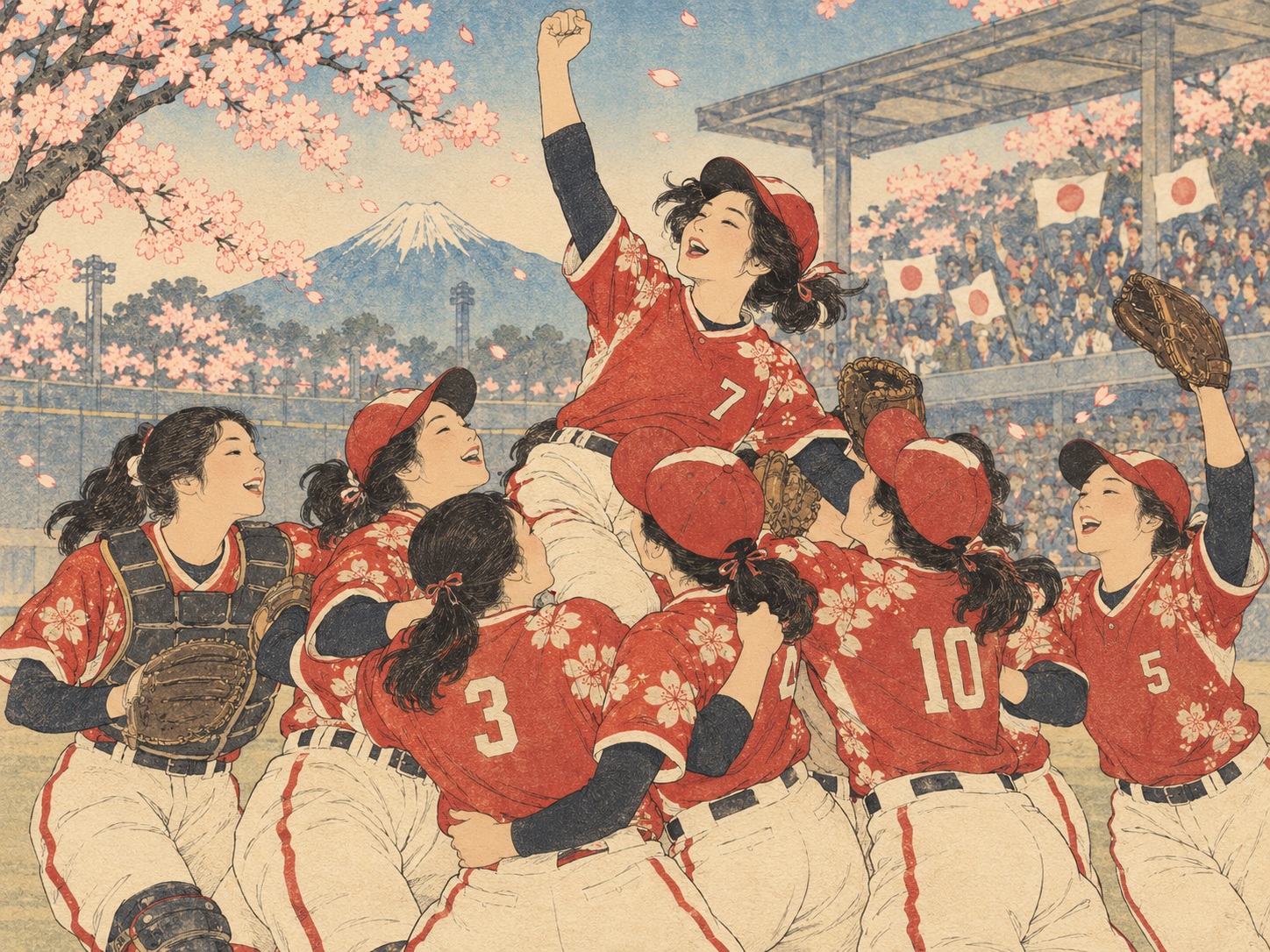
Japan entered the Asian Games final carrying the pressure that comes with being expected to win—and answered it with its clearest performance of the tournament.
On October 3 at Anjo Sports Park in Aichi Prefecture, Japan defeated China 7–0 in five innings to win a seventh consecutive Asian Games women’s softball gold medal. The streak dates to Busan 2002. Japan went 7–0 in the round robin and then won the championship game to finish the tournament 8–0.
The game did not end at 5–0
The scoreboard near the top of the Japan Softball Association’s game page shows Japan at five runs through four innings, which can create confusion if read in isolation.
The play-by-play continues into the bottom of the fifth. Japan loaded the bases, and after two outs Fujimoto delivered a two-run single. That made the score 7–0 and triggered the tournament’s mercy rule for a seven-run margin from the fifth inning onward.
Japan had taken the lead in the second after Yamauchi was hit by a pitch, Risa Kawamura singled, and a baserunner was awarded home on an obstruction call. Ayane Nakagawa then added a sacrifice fly.
In the fourth, Kanna Kudo drove in a run and captain Kyoko Ishikawa hit a two-run triple. Fujimoto finished the game an inning later.
Miu Goto was trusted with the final
Japan gave the start to left-hander Miu Goto.
She opened with a three-up, three-down first inning and kept China scoreless while Japan gradually built its lead.
The Japan Softball Association has described Goto as one of Japan’s leading left-handed aces. The setting added another layer: Goto is from Aichi Prefecture, making the Asian Games not only a home-country event but a home-region event.
One day earlier, China pushed Japan to 6–5
The 7–0 final makes the tournament look more comfortable than it actually was.
Japan and China met on October 2 in the final round-robin game with both teams unbeaten. Japan scored early through Saori Yamauchi, Kyoko Ishikawa and Ayane Nakagawa, but China hit its way back into the contest.
Japan won only 6–5.
Twenty-four hours later, China did not score at all. The contrast between those two games says as much about Japan’s tournament as the gold medal itself: the team adjusted quickly against its strongest opponent.
A streak that began in 2002
Japan’s run of Asian Games gold medals began at Busan in 2002.
At the Hangzhou Games, Japan beat China 4–0 to secure a sixth consecutive title. The Aichi-Nagoya victory extends that streak to seven.
A run lasting more than two decades cannot be explained by one generation of athletes. Rosters change. Coaches change. The sport changes. Yet Japan has continued to replace elite players without giving up the top position in Asia.
The Japan Softball Association has described the seventh straight gold as an unprecedented achievement for the sport.

Japan’s dominance extends beyond Asia
Japan’s women are not simply the strongest team in their region.
They won Olympic gold at Beijing 2008 and again when softball returned to the Olympic program at Tokyo 2020. In 2024, Japan won the WBSC Women’s Softball World Cup Finals, its fourth world championship and first since 2014.
Japan also went unbeaten to win the 2025 Asia Cup. The federation has framed the next cycle around defending its global standing, reaching the 2027 World Cup Finals and pursuing another Olympic gold at Los Angeles 2028.
China was not Japan’s only test
Eight teams competed in Aichi: Japan, Chinese Taipei, China, the Philippines, Singapore, South Korea, Hong Kong China and Thailand.
Japan went through the round robin unbeaten, but the margins varied. Chinese Taipei pushed Japan in a 4–2 game. China came within one run in the 6–5 round-robin meeting.
That matters because a dynasty can look inevitable only after the result is known. During the tournament, Japan still had to solve different pitchers, different defenses and different game situations.
Japan did not win on power alone
The final illustrated a style that has long been associated with Japanese international softball: precision before spectacle.
Japan used sacrifice bunts, a sacrifice fly, aggressive baserunning and contact hitting to create runs, then punished mistakes with extra-base hits when opportunities opened.
In elite softball, where pitching dominates and games can turn on one run, that ability to convert a runner on first into a scoring chance matters enormously.
Japan’s seven-title streak is built not only on velocity in the circle or power at the plate, but on repeatable execution.
Depth behind Goto matters
Japan’s pitching staff in Aichi included not only Goto but Yukiko Ueno, Sakura Miwa and Mio Sakamoto.
Ueno has been the defining figure of Japanese women’s softball for years, central to Japan’s Olympic and world-level success. But the national team has increasingly had to build around a broader group of pitchers as it transitions generations.
Against Chinese Taipei, Miwa started and Ueno worked five innings. Against China in the round robin, Miwa and Sakamoto shared the pitching. Goto then started the final.
That depth is critical in compressed international tournaments where no single pitcher can reasonably carry every inning.
Winning at home carries a different pressure
The softball tournament was held in Anjo, Aichi Prefecture.
Home events reduce travel and time-zone burdens, but they also create a harder expectation: for a program this successful, anything short of gold is often treated as failure.
Japan answered that pressure by going 8–0 and producing its most decisive result in the championship game.
The next target is LA28
Softball will be on the program at the Los Angeles 2028 Olympic Games.
Japan won gold in Beijing in 2008 and Tokyo in 2021. If it wins in Los Angeles, it would have gold medals in three consecutive Olympic softball tournaments in which it participated.
The challenge will be far greater than at the Asian Games. The United States remains Japan’s principal global rival, and other countries continue to improve.
The Japan Softball Association has already positioned its 2026 Japan-U.S. series as part of the road toward the next World Cup and LA28.
Seven straight titles are a result—and evidence of a system
A seven-title streak can look like the accomplishment of one national team.
In reality, a run spanning more than 20 years depends on much more: junior development, schools, company teams, domestic leagues, coaching, pitching development and a national-team structure capable of replacing champions with new champions.
The same athletes did not win all seven titles. New players arrived, inherited expectations and learned how Japan expects to win close international games.
Every streak resets to 0–0
The cruel part of a dynasty is that yesterday’s gold medal does not start tomorrow’s final with a lead.
Japan entered the championship game with six straight Asian Games titles. The scoreboard still began at 0–0.
Japan had to win again.
That is what gives the seventh title its meaning. It confirms the history, but it is also evidence that a new group can carry the standard forward.
When Los Angeles 2028 arrives, none of these seven Asian Games gold medals will score a run. Japan will have to start from 0–0 once more.
Sources and references
- 公益財団法人日本ソフトボール協会 — 第20回アジア競技大会 優勝決定戦 日本 vs 中華人民共和国 公式試合レポート。
- 日本ソフトボール協会 — 予選ラウンド第7戦 日本 vs 中華人民共和国、2026年10月2日。
- 日本ソフトボール協会 — 第20回アジア競技大会 大会概要・出場選手。
- 日本オリンピック委員会 — 「日本、60年ぶり金の最多更新 ソフトボール7連覇、アジア大会」2026年10月3日。
- 日本オリンピック委員会 — 杭州アジア大会「ソフトボール日本が6連覇」2023年10月2日。
- 日本ソフトボール協会 — 女子TOP日本代表の世界大会・アジアカップ実績と2027年W杯への道。
- 日本ソフトボール協会 — 「日米対抗ソフトボール2026」開催決定、LA28への強化方針。
Reporting cutoff: October 6, 2026, 6:40 a.m. JST. The 7–0 final, five-inning mercy rule, Miu Goto start, Rei Fujimoto’s game-ending two-run single and Japan’s 8–0 tournament record are verified in the Japan Softball Association’s official final report. The seven-title streak and wider international history are verified through JSA/JOC materials.
Why it matters
Japan beat China 7–0 in five innings and went 8–0 to extend its Asian Games title streak to seven.
How it happened
Miu Goto kept China scoreless, Kyoko Ishikawa broke the game open and Rei Fujimoto ended it with a two-run single.
What to watch
The 2027 World Cup Finals and LA28, where Japan will again face a deeper global field.