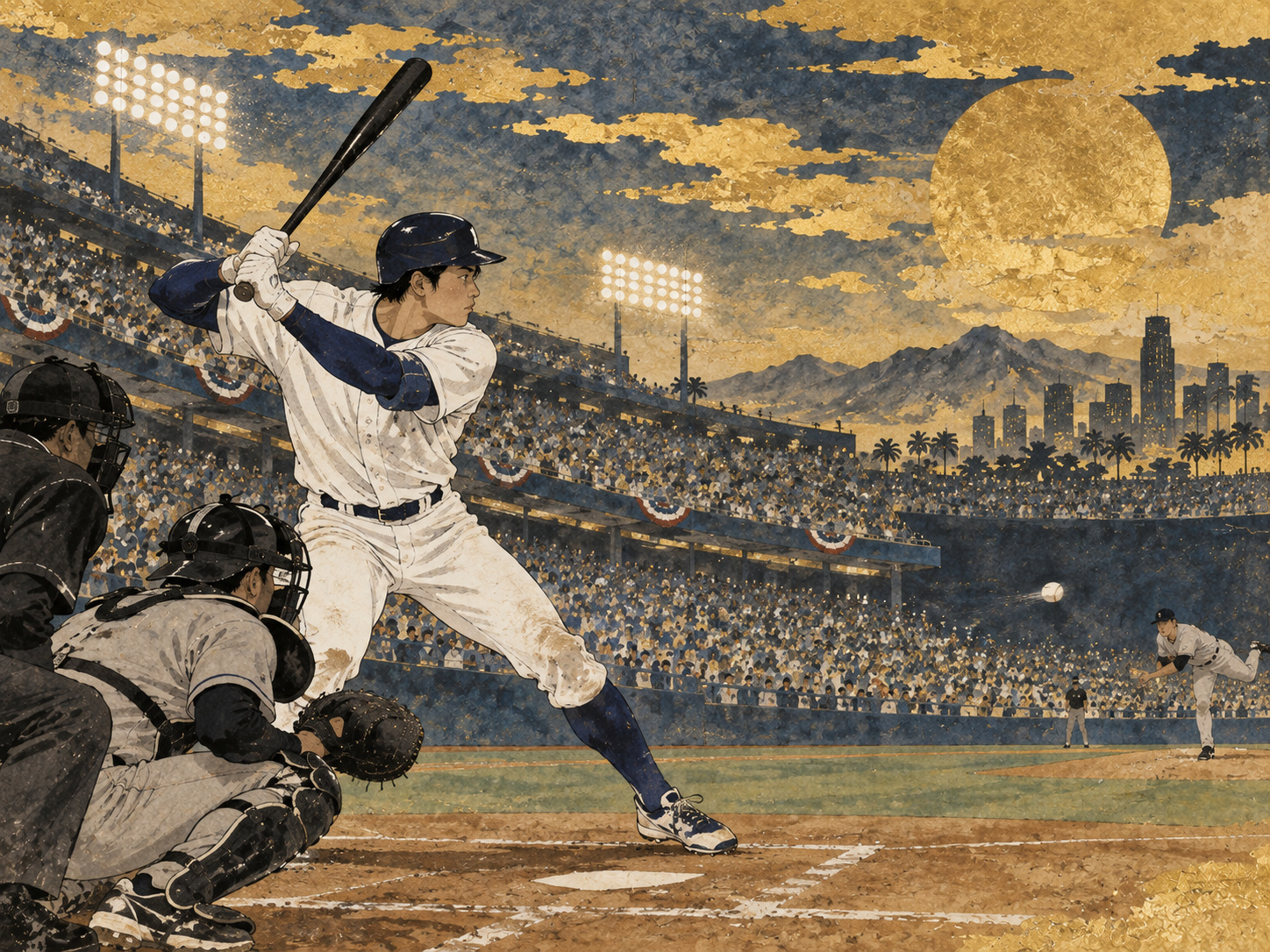
Shohei Ohtani will not enter October 2026 as a two-way player.
The Los Angeles Dodgers enter the postseason as the National League's No. 2 seed, making the playoffs for a 14th consecutive season. They are also the back-to-back World Series champions of 2024 and 2025, now chasing the first MLB three-peat since the New York Yankees won three straight from 1998 through 2000.
Ohtani is back from the injured list and will be part of the lineup. But lingering trouble in his left knee and right biceps has effectively ended his pitching comeback for this season. For the first time in three Dodgers postseasons, the central Ohtani question is not what he can do simultaneously. It is how much of his best hitting the Dodgers can preserve.
2026 was supposed to normalize the impossible
Ohtani underwent right-elbow surgery in September 2023 and spent the entire 2024 season as a hitter. He returned to the mound in 2025 and, for the first time as a Dodger, carried his full two-way role through the regular season and into October.
The expectation for 2026 was that this remarkable workload might begin to look almost routine.
Instead, left-knee inflammation surfaced in June. Imaging showed no structural damage, and Ohtani returned quickly to the lineup, but the knee interrupted his pitching schedule. A separate right-biceps issue then complicated the throwing progression.
His last pitching appearance came on July 3. He has not returned to a Major League mound since.
The injuries eventually reached the swing
For much of the summer, the Dodgers tried to keep Ohtani's bat in the lineup while managing his pitching comeback.
By late August and early September, the arrangement was no longer working cleanly. MLB.com reported that in the 24 games before his IL stint, Ohtani hit .198, going 19-for-96 with 34 strikeouts. In early September he visibly shook out his right arm and showed discomfort after swings.
Roberts explained that physical pain can alter a hitter's approach: a player who does not feel strong or quick may start earlier, “cheat” toward velocity and lose the ability to see the ball normally. Andrew Friedman, the Dodgers' president of baseball operations, acknowledged that the physical issues had affected Ohtani's offense.
The problem was therefore more complicated than “he cannot pitch, but he can still hit.” The attempt to preserve the two-way workload was beginning to erode the part of his game the Dodgers needed most.
Eventually the Dodgers took the bat away too
Ohtani received several days off in early September, briefly returned and still did not stabilize. On September 11 the Dodgers placed him on the 15-day injured list.
It was his first IL stint in three seasons with Los Angeles.
The logic was straightforward: stop trying to extract regular-season plate appearances and maximize the chance that he could be a functional October hitter.
Friedman also described the human-management problem. Whenever the club has approached Ohtani about rest, his response has been some version of doing whatever helps the team win. Friedman added that Ohtani is not always the best reporter of his own physical condition.
The hardest part of managing a two-way superstar may not be deciding what he can do. It may be deciding what the team must refuse to let him do.
He singled in his first plate appearance back
After the 15-day reset, Ohtani returned September 23 against San Diego, batting second as the designated hitter. He singled to right in his first plate appearance and later walked.
Roberts was encouraged not simply by the hit but by the swing quality, movement and strike-zone judgment. The rushed approach that had appeared when Ohtani was hurting was less visible.
Across his final five games he went 5-for-21 with eight strikeouts and one walk. That is not peak Ohtani production. But the Dodgers' objective was different: give him Major League velocity again, restore timing and see whether repeated games caused the knee or biceps to regress.
The first-round bye matters
Los Angeles secured the National League's No. 2 seed and therefore does not need to play in the Wild Card Series.
That gives Ohtani additional days between a five-game return sample and the Division Series.
The rest can help healing. The tradeoff is timing. Hitters returning from injury generally want live pitching, and too long without games can make the transition back to postseason velocity harder.
The Dodgers can use live batting practice and simulated at-bats during the bye, but they must balance baseball rhythm against the entire reason he went on the IL in the first place.
In 2024, Ohtani entered his first October as a hitter only
Ohtani never reached the postseason during six seasons with the Los Angeles Angels.
He signed his 10-year, $700 million contract with the Dodgers in December 2023 in part because Los Angeles offered something he had never experienced in MLB: an organizational expectation of playing deep into October every year.
The promise came true immediately.
Recovering from elbow surgery, Ohtani could not pitch in 2024. He responded by becoming the first 50-home-run, 50-stolen-base player in Major League history and reached the postseason for the first time exclusively as a designated hitter.
The Dodgers defeated the Yankees in five World Series games. Ohtani's first postseason ended with three home runs and 10 RBIs across 16 games, and he played through a left-shoulder injury sustained on a stolen-base attempt in World Series Game 2.
In 2025, October discovered the full two-way version
One year later, Ohtani returned to the mound. The Dodgers entered October with him available both as an elite hitter and as part of the starting rotation.
Then came October 17, 2025.
In NLCS Game 4 against Milwaukee, Ohtani pitched six scoreless innings and hit three home runs. He struck out the first three Brewers he faced, then led off the bottom of the first inning with a homer. His second traveled 469 feet and left Dodger Stadium. He hit a third in the seventh.
Los Angeles won 5-1 and completed a four-game sweep. Ohtani was named NLCS MVP.
Roberts called it probably the greatest postseason performance of all time.
Then the Dodgers repeated
The 2025 World Series against Toronto went seven games.
The Dodgers trailed three games to two after Game 5. They won Game 6, 3-1, then survived an 11-inning Game 7 to win 5-4.
That made Los Angeles the first back-to-back World Series champion since the Yankees completed their three-peat in 2000.
The historical implication for 2026 is therefore real. A third straight title would not simply add another trophy to a loaded roster. It would end a 26-year gap without an MLB three-peat.
2018–2023: Six Angels seasons, no postseason appearances.
December 2023: Signs a 10-year, $700 million contract with the Dodgers.
2024: Hitter-only first postseason; Dodgers defeat Yankees to win the World Series.
2025: Two-way postseason; Ohtani hits three homers and throws six scoreless innings in the NLCS clincher.
November 2025: Dodgers beat Toronto in Game 7 to repeat as champions.
July 3, 2026: Ohtani makes his final pitching appearance of the season.
September 2026: Goes on IL with knee and biceps issues; returns as a hitter Sept. 23.
October 2026: Dodgers begin their three-peat attempt as the NL's No. 2 seed.
Expecting the 2025 version is the wrong test
Ohtani's three-homer, six-scoreless-inning NLCS clincher was almost a perfect visual definition of two-way baseball. Using that game as the standard for 2026 guarantees disappointment.
The Dodgers do not need him to recreate it.
They need him to reach base, drive the baseball, extend innings for Mookie Betts, Freddie Freeman and the rest of the lineup, and stay healthy enough to take the next day's plate appearances.
Not pitching is a competitive loss. Losing the hitter would be worse.
Even the batting-order experiment reflects the new priority
Ohtani returned from the IL batting second instead of in his usual leadoff position. Roberts explained a flexible arrangement: Betts can lead off against left-handers with Ohtani second, while Ohtani can return to leadoff against right-handers.
This is not simply a demotion from the top spot. It is a postseason lineup design intended to make the Betts-Ohtani-Freeman-Smith sequence harder to navigate from either side.
It also acknowledges that October is not about maximizing a player's 162-game counting statistics. It is about extracting the highest run expectancy from a short series while managing health.
Nobody has a mature workload model for this
Friedman said there is “no playbook” for managing Ohtani's situation. There really is not.
Starting pitchers have rest cycles. Designated hitters can play almost every day. Ohtani asks one body to do both jobs.
Should he hit the day after pitching? Rest before a start? Run less aggressively on the bases? Reduce batting-practice volume after a bullpen? How should fatigue data from pitching be combined with fatigue data from hitting?
Traditional pitcher conditioning plus traditional hitter conditioning does not automatically produce a safe two-way workload.
The 2026 injuries do not prove that two-way baseball is unsustainable. They show that keeping a two-way player effective for 162 games plus October remains a workload-science problem that baseball is still learning in real time.
What to watch with Ohtani this October
- Whether the left knee and right biceps stay quiet through repeated game intensity.
- His timing against elite postseason fastballs after the IL layoff.
- Strikeout and chase patterns that worsened while he was physically compromised.
- How Roberts uses the Betts/Ohtani leadoff-second-slot rotation by pitcher handedness.
- Whether the Dodgers reduce aggressive baserunning to limit lower-body load.
- Whether the NLDS bye helps recovery more than it disrupts timing.
- Whether the club truly keeps pitching completely off the table despite creative postseason roster usage.
The Dodgers can protect Ohtani because the rotation is a strength
The Dodgers' postseason roster problem is unusual: their rotation has enough depth that MLB.com's team preview expects the club to carry extra starters and use some creatively in relief.
That reduces the temptation to rush Ohtani back to the mound.
Los Angeles can find innings elsewhere. It cannot replace Ohtani's offensive gravity as easily.
That asymmetry is the strongest argument for the conservative approach.
Japan's October relationship with Ohtani has changed too
In 2024, the story for Japanese fans was whether Ohtani could finally perform in the postseason at all.
In 2025, it became whether his two-way game could survive and even dominate October.
In 2026, the question is different again: what does October look like when Ohtani being there is normal?
This is his third straight postseason with the Dodgers. The club has won the World Series in each of his first two seasons.
For a player who spent six Major League years without reaching October, postseason baseball is becoming not a long-awaited exception but the expected final stage of his season.
A three-peat takes more than talent
The postseason is a short tournament. The best 162-game team does not automatically win. One pitching matchup, defensive mistake, baserunning decision or week-long slump can turn a series.
Repeat champions also arrive with accumulated workload. Opponents have more data. Core players are older. October from the previous year shortened the offseason.
That is why three straight titles have disappeared from modern baseball despite the existence of extremely wealthy and talented teams.
He does not need to recreate the miracle
Ohtani has already answered the question of whether he can matter in October.
In 2024 he won a World Series in his first postseason while limited to hitting. In 2025 he created one of the sport's most extraordinary playoff games by dominating both sides of the ball.
2026 asks for something less cinematic and perhaps more difficult: accept a reduced role, protect the body, and maximize the value that remains.
The right way to judge this October is not to count pitching as something missing from Ohtani. It is to see whether the Dodgers successfully preserved enough of the hitter to make the absence of the pitcher manageable.
For a three-peat, Los Angeles does not need Ohtani to reproduce a legend every night.
It needs Shohei Ohtani healthy enough to take the next at-bat.
Sources & Reporting Notes
- MLB.com Dodgers 2026 postseason FAQ, Sept. 27 — Official postseason status: No. 2 NL seed, 14th straight postseason, back-to-back champions chasing the first MLB three-peat since the 1998–2000 Yankees, and Ohtani's status.
- MLB.com, Sept. 24, 2026: Ohtani returns from IL — Primary current account of Ohtani's return after right-biceps and left-knee issues and comments from Dave Roberts and Andrew Friedman.
- MLB.com, Sept. 11, 2026: Ohtani placed on IL — Official report on the IL decision and the Dodgers' attempt to restore Ohtani for October.
- MLB.com, Sept. 8, 2026: Ohtani unlikely to pitch again — Ohtani says he will focus on hitting and is most likely done pitching in 2026.
- MLB.com, July 29, 2026 — Background on the left-knee and right-biceps issues that interrupted his pitching comeback.
- MLB.com: Dodgers win 2025 NLCS — Official account of Ohtani's three-homer, six-scoreless-inning NLCS clincher and NLCS MVP award.
- MLB.com: 2025 postseason history — Official record of the Dodgers defeating Toronto in seven games for their second consecutive World Series championship.
- MLB.com: Dodgers' 2025 season recap — Official recap of the first successful World Series title defense since the 2000 Yankees.
- MLB.com: 2024 postseason history — Official record of the Dodgers defeating the Yankees in five games in Ohtani's first MLB postseason.
- MLB.com, Oct. 25, 2024 — Confirms Ohtani was exclusively a hitter during the 2024 title run while recovering from right-elbow surgery.
- MLB.com, Oct. 21, 2024 — Background on Ohtani reaching the postseason and World Series for the first time after six Angels seasons without October baseball.
This article is based on public material available through September 30, 2026. It does not independently diagnose Ohtani's left-knee or right-biceps conditions beyond information disclosed by the Dodgers and MLB.com. Ohtani said on September 8 that he was 'most likely' done pitching in 2026, and the club has prioritized his return as a hitter; postseason usage can still change at the team's discretion. The NLDS opponent was treated as unresolved at the time this article was prepared.
Image rights: © 2026 Japan.co.jp. AI-assisted editorial illustration. Permission is required for reuse. Contact.